2025 Under the Lens: Disinformation, Deepfakes, and Deceit
The year 2025 demonstrated how misinformation has evolved—weaponising AI, viral videos, and online scams. This year-end curation highlights the most impactful fact-checks, showing how lies spread and how truth pushed back.
2025 saw the weaponisation of social media platforms to propagate hate and disinformation, which, like in 2024, crossed the boundaries of politics and disproportionately targeted the minorities of the country with false communal claims. India, with a population of over 1.4 billion and a diverse society, is extremely vulnerable to misinformation. We also observed an increase in content where those behind it utilised Artificial Intelligence to create altered images of notable leaders and aimed to entrap ordinary people in online scams and fraudulent schemes. In 2025, there was a significant rise in the use of AI to spread fabricated images of incidents, including AI-generated graphics purportedly depicting a bridge collapse in Bihar or accidents related to a zipline in Wayanad, Kerala.
In recognition of these escalating challenges, the Ministry of Information & Broadcasting issued a press release on December 3, 2025. The statement indicated that the Union Minister for Information and Broadcasting cautioned the Lok Sabha about the pressing issues caused by social media, misinformation, and AI-generated deepfakes.
Pahalgam Attack: Artificial Intelligisation of a Tragedy.
On April 22, 2025, a devastating massacre targeted sightseers at the popular tourist destination of Pahalgam, located in the Anantnag district of Jammu & Kashmir. Factual visuals of the aftermath soon went viral on social media, but so did AI-generated ones. A newlywed bride mourning beside her husband’s body became the face of the attack. An AI-generated version of this image circulated on social media like wildfire. Similar AI-generated images, created using Meta AI,depicting the deadly aftermath of the attack, also went viral online. A fact-check report dated April 25, by Newschecker and Alt News, debunked these visuals.
In the aftermath of the Pahalgam attack, several AI-generated images circulated widely on social media, portraying the victims in idealised and aesthetically “beautified” forms. These visuals, often softened, dramatized, or emotionally amplified, transformed a brutal tragedy into stylised imagery, blurring the line between documentation and fabrication. The use of AI to aestheticise suffering sparked widespread debate, with critics arguing that such representations trivialise violence, distort public memory, and risk exploiting grief for virality rather than truth.
Operation Sindhoor and the disaster of Media Misreporting
As a response to the attack in Pahalgam, India unleashed Operation Sindhoor, an offensive Op, which reportedly focused on destroying terror hotspots in Pakistan.
Boomlive, a well-sought-after fact-checking organisation headquartered in Mumbai, shed light on several cases of media misreporting involving some mainstream news outlets. Boomlive found that Zee News, Aaj Tak, Lokmat Hindi, and News Nation propagated the claim that the Indian Navy had destroyed the Karachi port. Similarly, news reports published by Mathrubhumi, DNA, OneIndia, and Great Andhra falsely claimed that Pakistan’s Chief of Army Staff, Asim Munir, was to be replaced by General Sahir Shamshad Mirza. These media outlets published the reports without citing any credible source. Additionally, Boomlive identified that ABP News, OneIndia, News18, Aaj Tak, and NDTV telecast unrelated visuals by linking them to Operation Sindhoor without verification.
Unrelated videos and false communal claims
The pilgrimage to the Vaishno Devi shrine in Katra, Jammu and Kashmir, that was suspended during the India-Pakistan conflict, resumed on May 14, 2025. On May 23, a video emerged online that showed stone pelting on pilgrims travelling to the shrine. Boomlive, in its report, revealed that the video dates back to May 2024 and depicts a protest in Pakistan-occupied Kashmir (PoK).
On July 25, Alt News published a report about how a video of a gruesome murder from Pakistan was viral on WhatsApp and other social media platforms, such as X (formerly Twitter), with captions suggesting that the video shows a Bajrang Dal murdering a Muslim family in Uttar Pradesh. According to the report, the video was from Pakistan and shows a murder where a labourer in Alipur, Muzaffargarh district, Pakistan, killed his wife and seven children. The individual confessed to his crime and was also arrested.
Following the mass shooting at a Hanuka celebration at Bondi Beach, Sydney, Australia, false communal claims about Muslims celebrating the attack took a flight on social media. The caption of the social media post carrying a video featuring a Muslim cleric making controversial statements indicated that Muslims in Sydney were happy about the shooting. Offbeat Concerns (OBC) investigated the video and found that the footage dates back to a pro-Palestine rally in Lakemba, Sydney, which occurred on October 9, 2023.
Offbeat Concerns also published a deepdive OSINT report about how the extreme right-wing targeted Kerala with a stream of hate speech and false communal claims. The report analysed social media activities from June 2025 to November 2025, to reveal coordinated attempts to spread hate against the secular framework that Kerala upholds.
Meta’s Ad Library and the web of financial scams
On December 15, OBC released a verified report detailing how scammers exploited the names of central government initiatives such as the Pradhan Mantri Rojgar Yojana (PMRY) and Pradhan Mantri Mudra Yojana (PMMY) to entice individuals into an online financial fraud. The report highlights how these scammers utilised AI-generated audio, stating that people could receive ₹5,000 through these programs.
As a follow-up to how Meta’s Ad Library is being exploited by scammers, an OBC OSINT investigation unravelled an active Unified Payment Interface (UPI) scam which lured netizens by claiming that they could receive gifts worth ₹2000 from Prime Minister Narendra Modi on the occasion of New Year’s Eve. The investigation also found that the photo of the Prime Minister is used for such ads and also on fraudulent websites linked to them. These websites contain malicious scripts in the backend, which initiate payments of a certain amount through UPI apps such as PhonePe and Paytm when the victim clicks anywhere on the website. The fraudsters run ads in eight regional languages, including Malayalam, containing links to a rogue website in those languages.
What do the stats from October to December say about fake news targeting Kerala?
Offbeat Concerns actively monitored social media for fake news, which especially targeted Kerala from October 2025 to December 2025. Based on our analysis, we noticed that fake news targeting Kerala falls into two major categories: false communal claims and Political.
From our analysis, it is evident that the false communal claims against Kerala emerge from the right-wing social media accounts and target the Muslim minority in the state.

The graph shows which religion was targeted in Kerala using false communal claims.
Among these false communal claims, a major one targeted the Malabar Gold and Diamonds, a jewellery group headquartered in Kozhikode. The claim propagated online on the backdrop of a boycott due to the organisation’s alleged links to Alishba Khalid, an influencer from Pakistan. Aiming to amplify the boycott of the jewellery group online, several social media accounts circulated the false claim that the jewellery group provides scholarships to Muslim students. In the Verified report dated October 17, OBC debunked it.
December 2025 was a significant month for Kerala from a political standpoint because of the local body elections, which also led to an increase in misleading political claims online.
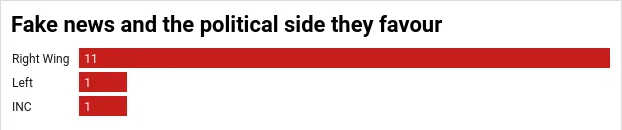
The graph shows which political side the false political claims favoured.
Our analysis revealed that the majority of the false political claims originated from the right-wing accounts on Facebook, X, and Instagram.
One of the key allegations we debunked is the false claim that the government schools in Kerala are forcing Islamic prayers on students. In our Verified report dated November 15, we analysed the claim and found that the video the social media accounts used to propagate the claim was old and shows students from a private school in Palakkad, Kerala, singing “Hasbi Rabbi Jallallah”, a popular Islamic lullaby. Although the school refused to comment on the video, it was clear from the school’s official website that they encouraged the students to celebrate festivals of different religions.
As 2025 comes to an end, we noticed that the year was no different from 2024, and false communal assertions flooded social media. We also noticed a rise in the implementation of AI techniques to create real-like visuals to enhance the quality of fake news. From a political standpoint, the false, misleading claims and hate speech originating from the right-wing political and meme accounts dominated the social media as a whole.

Sujith A
Open Source Intelligence Researcher and Mis/Disinformation tracker. Passionate about investigations and a big fan of Sherlock Holmes.
View all posts by Sujith A