Jabalpur Boat Capsize: How AI Images Are Reshaping Memory, Grief, and Reality
When a boat capsized in Jabalpur, AI-generated images of a mother clutching her child in death flooded social media before the facts did. Political leaders shared them. News outlets published them. The conversation swiftly moved away from safety failures and unheeded warnings- toward romanticised grief. This article examines how beautified fakes go beyond distorting the present-how they reshape memory, fictionalising reality.
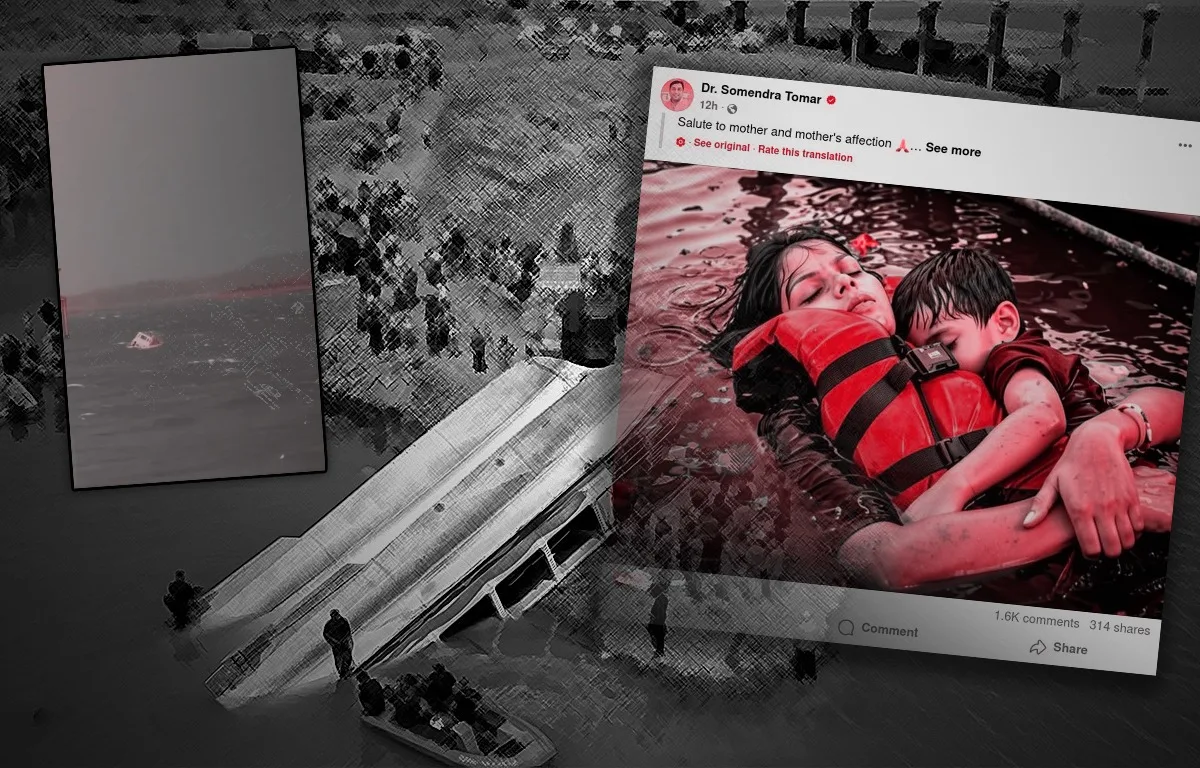
A cruise boat capsized in the Bargi Dam area of Jabalpur, Madhya Pradesh, on April 30, leaving at least six dead and several others missing after a sudden storm overturned the vessel in the Narmada River. As photos of the incident’s aftermath went viral on social media, an image claiming to show the bodies of a mother and child also circulated.
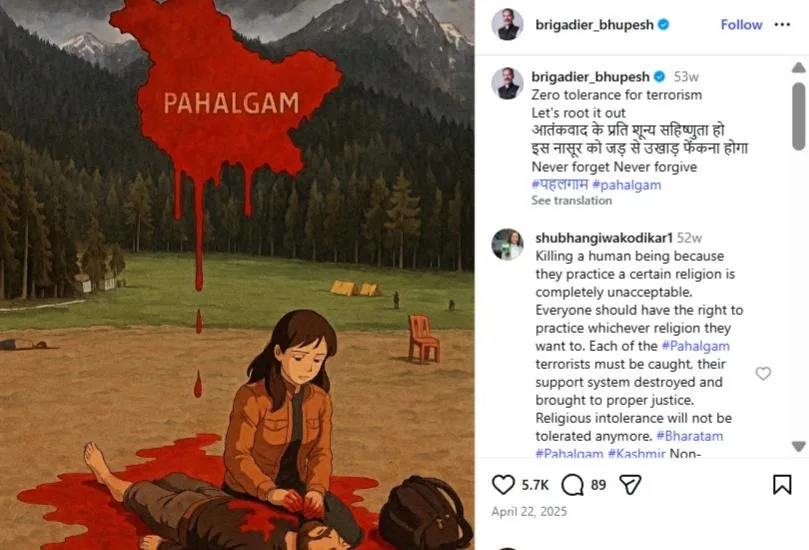
Similar instances were observed after the Pahalgam attack, where AI-generated images were widely shared as real visuals from the incident. We found that the image circulating online is AI-generated and unrelated to the Jabalpur boat tragedy.
This report looks into how AI-generated visuals masquerade as the aftermath of tragic incidents and aid in the beautification of tragedy, while building false narratives and distorting public perception..
The Viral Image and Its Spread
On May 1, Somendra Tomar, a Bharatiya Janata Party (BJP) politician serving as the Minister of State for Energy and Additional Sources of Energy, shared an image on Facebook showing a woman and a child floating in water, with the caption “Salute to mother and mother’s affection.” The post implies that the image shows the bodies of a mother and child from the Jabalpur boat capsize.
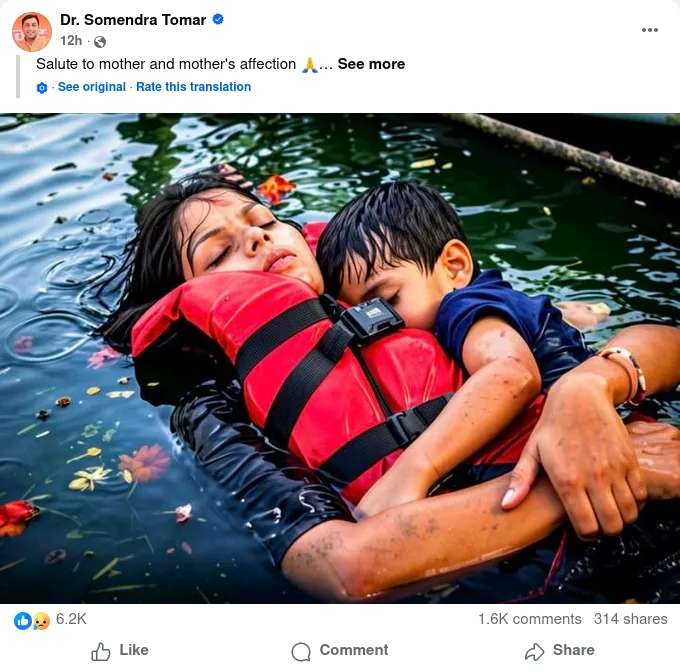
As of May 2, the post has garnered over 6,200 reactions, 1,600 comments, and more than 324 shares.
Responding to the post, a user remarked, ”Really heart touching. I salute the mother who didn’t leave the child despite knowing they were in deep distress. A mother is a mother. I pray for her great soul to attain Mukti. Loss is irreparable. RIP.”
Several social media users shared this image expressing sympathy for the victims of the tragedy. On May 1, a Facebook user, M S Radhakrishnan, shared the same image in a Malayalam post, linking it to the Narmada boat tragedy in Jabalpur. The post suggests that the visuals show a mother and child who died in the incident.
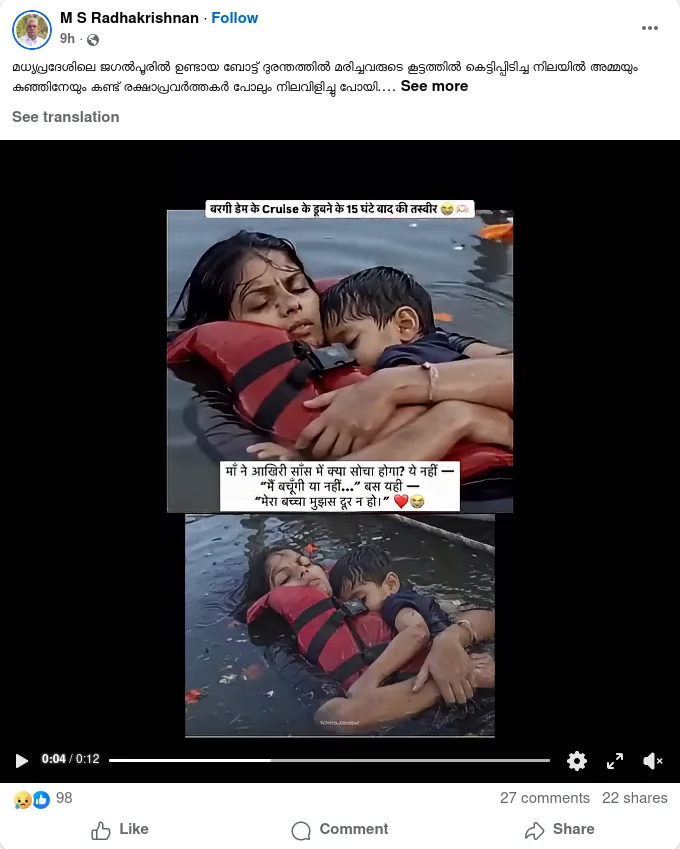
As of May 2, the post has received around 98 reactions, 27 comments, and 22 shares.
We also found that the same image was used by Dainik Jagran in their Madhya Pradesh and Chhattisgarh editions in a news report published on May 1 covering the Jabalpur boat tragedy.
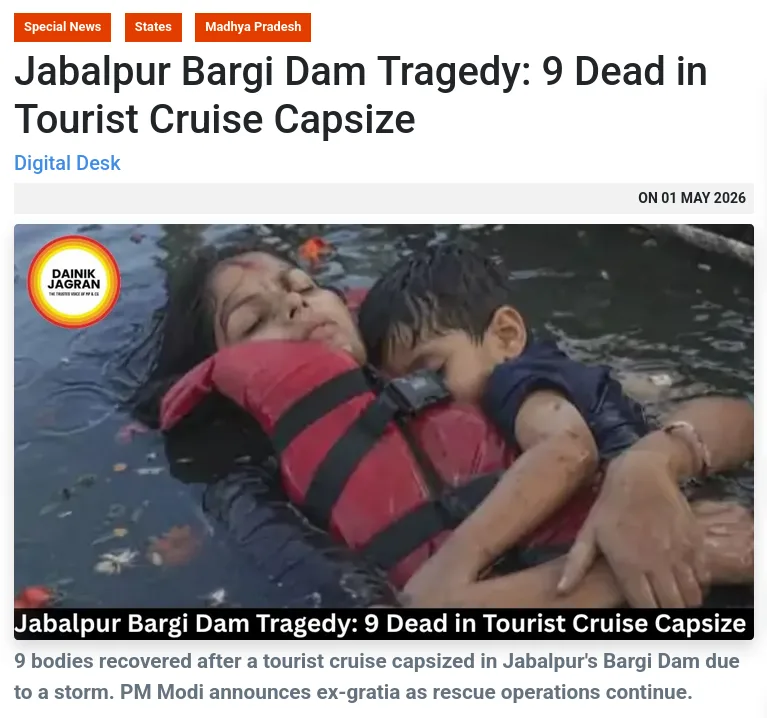
Verification and Findings
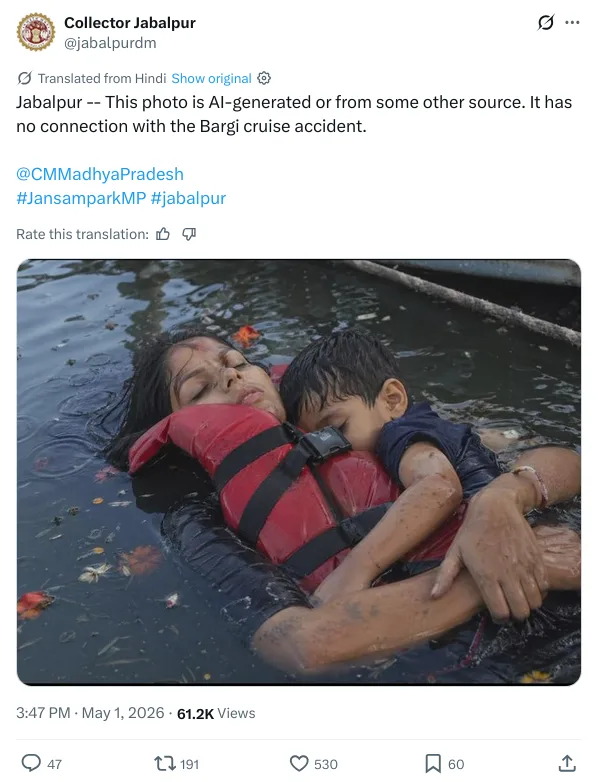
We performed a reverse image search of the viral photo, which led us to a post shared by the Jabalpur District Collector on X on May 1. In the post dated May 1, the district administration clarified that the image is AI-generated or taken from an unrelated source which has no connection to the Bargi cruise boat accident.
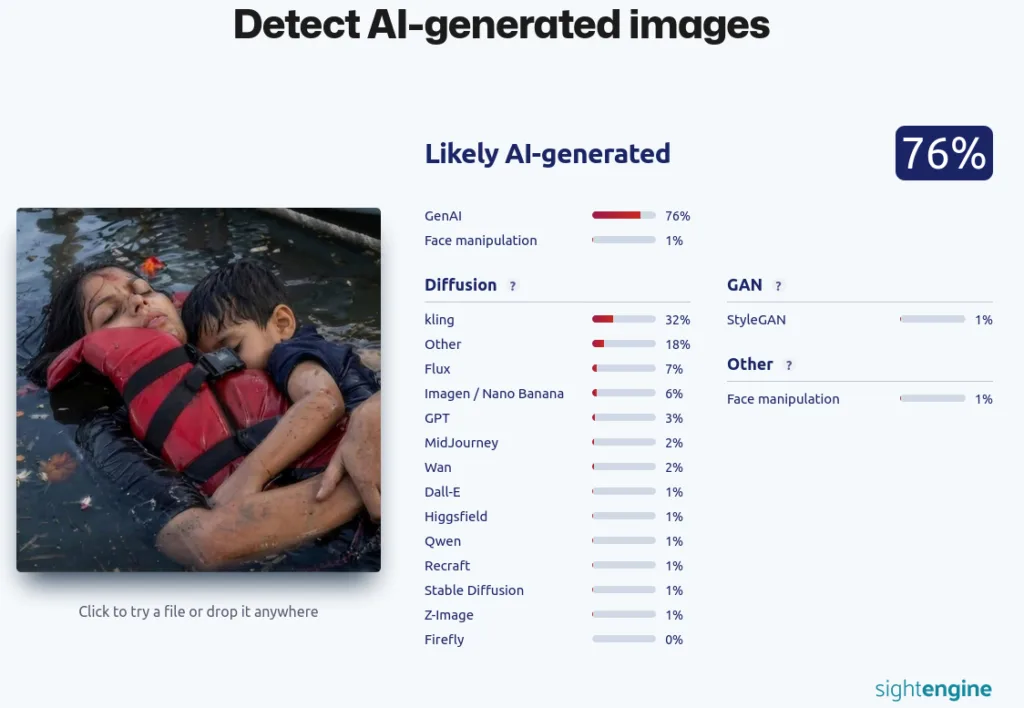
Additionally, we examined the image using the AI-Detection platform. The result indicated that the photo is 76% AI-generated.
Systemic Failure and Rising Safety Concerns
The cruise boat, carrying over 40 passengers, capsized after sudden weather changes brought strong winds and rough waters. However, survivor accounts suggest that warnings about worsening weather were not acted upon, and the boat continued into deeper waters before overturning. Survivors also stated that life jackets were not readily available and were distributed only after the vessel began sinking. Authorities have ordered an inquiry to examine whether safety protocols were followed.
The beautified AI images of a ‘mother hugging her child even in death’ shifted the discourse away from institutional failures and kept it focused on individual grief.
The ‘beautification of tragedy’ and how it distorts reality
Despite being proven AI-generated, the image has been widely shared, even by political leaders and legislators with large online followings. In Kerala, Congress leader T. Siddique, who is also the MLA of Kalpetta constituency in Wayanad, shared the above image. The caption says, ‘Mother💔, a love shielded in a life jacket’, and then describes the incident.
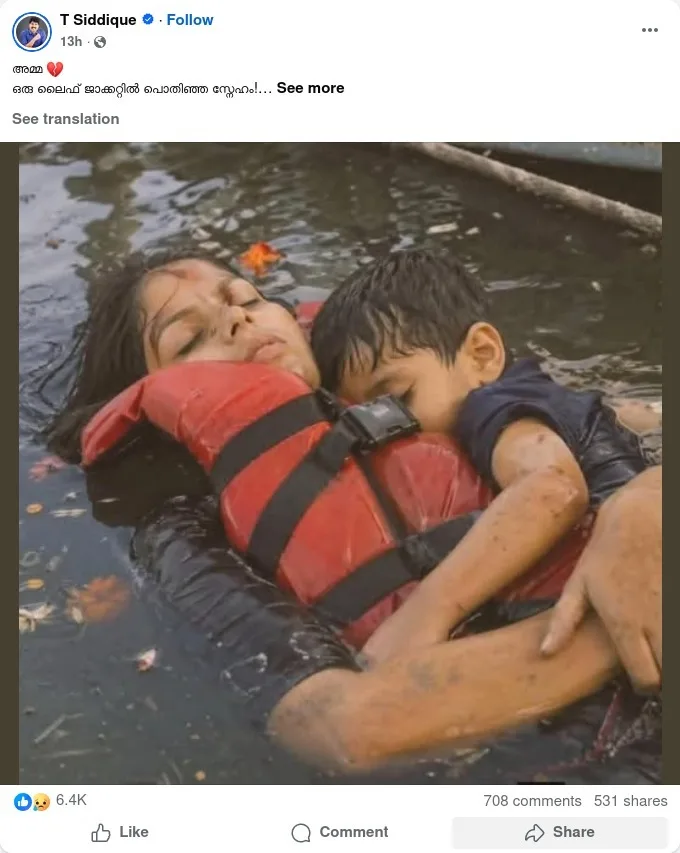
Yet the focus remains not on the gravity of the incident or the lapses in safety protocols. Rather, the narrative leans heavily toward the emotional weight of individual suffering, or ‘maternal love. It largely downplays the gravity of the actual event, and the structural lapses that led to it.
This is not a new phenomenon. A year ago, when deadly terror attacks killed 26 civilians in Pahalgam, AI-generated images flooded the internet. One particular viral image of an Indian Navy lieutenant, Vinay Narwal, lying wounded on the ground with his wife Himanshi, a schoolteacher, sitting beside him in shock, became the subject of numerous AI manipulations across social media. The then-popular Ghibli-style filter was applied to many images, along with numerous other dramatic effects to spread emotionally charged narratives about the attack. Another similar “ghiblified” photo showed the man lying on the ground, drenched in blood. Another widely shared AI generated image of the same incident depicts a grieving woman with a fairer skin tone and smoother hair,features that do not match those of the woman in the original photograph.
Another such instance occurred when an AI-generated image of ‘All Eyes on Rafah’ went viral on social media as Israel advanced its attack on Rafah, a now-destroyed and displaced city in the southern Gaza Strip. Critics contended that the AI image sanitises the horrors. Many reports have pointed out that, particularly in the current post-truth era, the weaponisation of images to deliberately spread misinformation has made AI-generated visuals especially contentious.
HonestReporting says that generative AI has erased the line between documentation and fabrication, enabling the mass production of hyper-realistic but entirely fake ‘atrocity footage’. Several studies have found that AI-edited images distort participants’ memories of the original images, leading them to report false memories and higher levels of confidence in those ‘synthetic memories’.This phenomenon could have consequences in various contexts, from giving false testimony in legal proceedings to the formation of a distorted public memory. Another important finding from the study was that the ‘AI-generated’ label may not help in preventing us from forming false memories. According to the study, when individuals encounter plausible altered content, they may integrate it into their existing memory frameworks regardless of accompanying labels.
Another study published in Nature finds that reliance on AI for emotional simulation may lead to a gradual erosion of individuals’ ability to engage in authentic interpersonal relationships. The researchers describe this as the ‘tragedy of apathy’, a sociotechnical condition wherein humans outsource emotional engagement to machines and thereby forget how to feel.
The spread of misinformation, the lack of institutional accountability in the face of such a serious lapse in safety, and the romanticising of tragedies point to a much graver problem. Misinformation not only creates momentary confusion; it can distort collective perception and public memory. When the focus shifts to romanticised narratives of individual suffering and ‘philosophical life lessons’, what is ignored are the structural failures that can lead to grave casualties. Addressing this would require not only identifying misinformation, but also making efforts to fix structural gaps.