Kerala mocked it, others amplified it : How Kerala Story 2 is shaping narratives across India
From the viral porotta-and-beef satire to primetime television debates and Islamophobic comments online, Kerala Story 2 has received mixed reactions across India. Political leaders, activists, and citizens in Kerala have called it propaganda, while the trailer has gained attention in other states as an “awareness” narrative. As the film approaches its release, OBC explores these reactions—from satire to serious political support—and looks at how propaganda films can influence public perception well beyond Kerala.
Salim. Faizaan. Rasheed.
“Demonic” Muslim men posing as progressive suitors, luring “innocent” Hindu girls with promises of big dreams. Young women, shown as defying their parents’ wishes, only to be physically assaulted, raped and tortured by the very men they trusted. India, the film’s trailer suggests, is on the brink of becoming an “Islamic state”, with Muslim men targeting 85 million unmarried Hindu girls across the country.
Such is the sweeping vilification of an entire community in the second instalment of the propaganda film, Kerala Story 2, directed by Kamakhya Narayan Singh.
Unlike the first part — widely criticised and trolled, yet still a recipient of national awards — for its caricatured portrayal of Kerala women and its awkward Malayalam, the sequel makes little attempt to root itself in Kerala at all. Instead, nearly all its energy is devoted to portraying the Muslim community in the most sinister and dehumanising light possible.
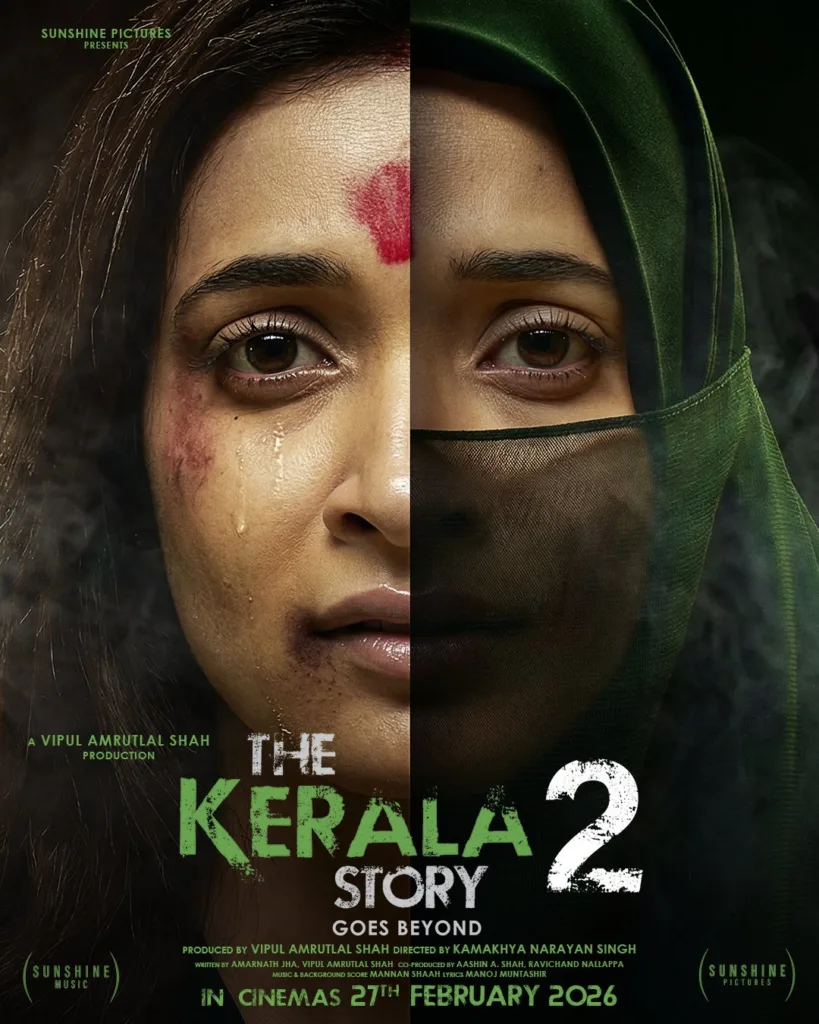
Yet, a small portion of the trailer — in which a girl is shown being force-fed beef by a group of men — became the subject of widespread trolling, particularly in Kerala. At the same time, the film’s repeated attempts to misrepresent the state sparked serious debate. Responding to the controversy, Kerala Chief Minister Pinarayi Vijayan said, “Kerala rejects stories of hate.”
Outside Kerala, however, the spaces of debate appeared different. TV news channels and right-wing accounts rushed to defend the film’s claim of portraying the “true stories” of women allegedly trapped by “love jihad.”
OBC attempts to present a comprehensive account of these reactions — from the trolls to the more serious debates — and to examine the far-reaching impact that propaganda films like this can have on the public imagination, particularly among audiences outside Kerala.
Kerala’s collective rage: How dare you force-feed beef?
Beef, banned in several parts of the country and often weaponised in communal politics by right-wing groups, occupies a very different cultural space in the state. In Kerala, “porotta and beef” is often jokingly described as the unofficial national dish.
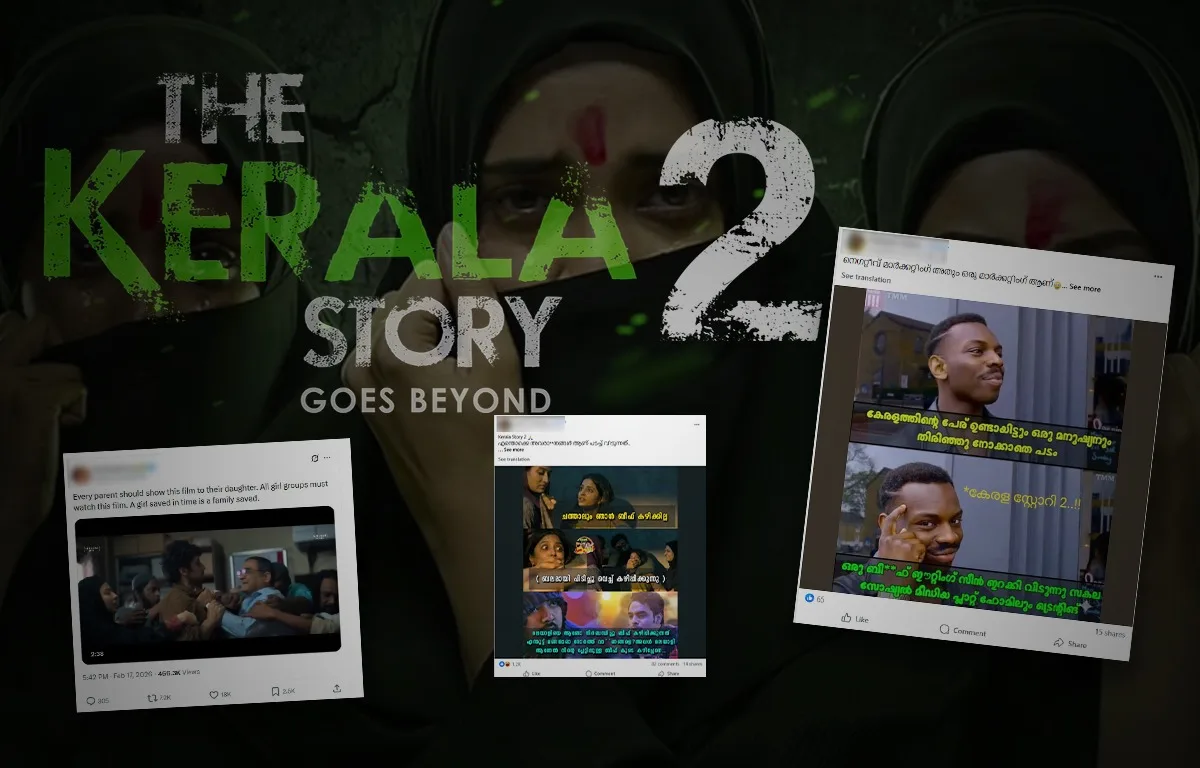
“Which Kerala is this where someone has to be force-fed beef? If she doesn’t want it, give it to me,” one user commented under the trailer. Released on February 17, the movie’s trailer features a twelve-second sequence in which a woman is forcibly restrained by a group. She declares, “I’d rather starve to death than eat beef,” before being forcefully fed it.
A barrage of similar posts mocking the sequence flooded social media after the trailer’s release.
An Instagram user, @strellinmalayalam, who describes himself as an automotive journalist, created an AI-edited version of the sequence titled “If this movie had an extended edition.” In the video, as the woman resists being fed beef, a man heroically bursts in on a motorcycle, breaking through the doors. He grabs the man feeding her by the collar and demands, “How dare you give beef without porotta?” before handing the woman a packet of porottas.
The video has garnered over two million views on Instagram and has been widely shared among Malayali audiences, many of whom viewed it as a satirical response to the film’s framing.
Keralites also expressed their protest against the narrative through edited montage videos featuring sequences of beef being prepared and eaten from various Malayalam films. These edits were shared with captions such as, “How they portray Kerala vs the real Kerala story,” and “This is Kerala. And we will eat whatever we like.” The comment sections also featured remarks such as, “Waiting for Gujarat Story,” and “Epstein Story.”
Notably, even sections of youth who usually maintain a “safe distance” from politics rushed to mock the beef sequence. Social media influencers across the state—including those known primarily for funny and light-hearted content—created reels and posts satirising the trailer, while also defending Kerala’s secular cultural fabric.
Outside Kerala, the narrative found support
On February 17, an X user named Dr Poornima shared the trailer of Kerala Story 2. In the caption, she wrote, “Every parent should show this film to their daughter. All girl groups must watch this film. A girl saved in time is a family saved.” As of February 25, the post had garnered more than 4.5 lakh views, 18,000 likes, and 7,200 reposts.
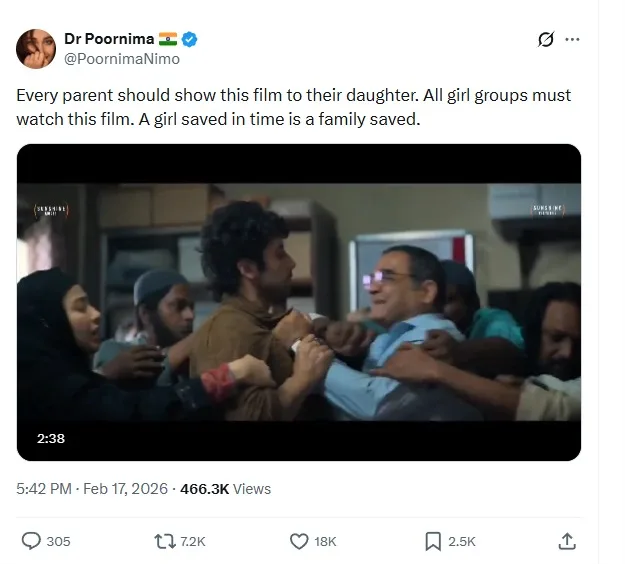
The comment section features a stream of Islamophobic remarks. Numerous news reports in which Muslims are the accused were shared there. “Hindu girls are too crazy to smash patriarchy (Hinduism) and won’t listen to them. They call it empowerment,” one comment read. Others argued that a Hindu rashtra is the only solution and that “every Hindu must see this movie.”
Critics had argued even at the time of the first film’s release that it was not made for Malayali audiences, but for North Indians accustomed to believing exaggerated rhetoric about Kerala. This time as well, the trailer—with its blatant Islamophobic content—appears to have found its target audience outside the state. Particularly on X (formerly Twitter), posts and comments overtly supporting the film and advocating it as an “awareness” tool for Hindu parents have been widely shared.
Primetime platforms and propaganda
Times Now, one of the leading television news channels in the country, aired its popular show India Upfront with Pranesh Roy on February 18. Rather than presenting balanced perspectives or scrutinising the film’s claims, the entire show was structured in a way that defended it. On screen, the channel displayed a column-like format titled “What teaser showed” and “What they say,” making claims that overtly supported the film’s narrative.
The anchor claimed that the Popular Front of India (PFI), an Islamic political organization, possessed a document outlining a plan to make India an Islamic nation by 2047, adding that “these are not some made-up stories.” Outlets like CNN-News18 were also under the radar for taking a stance that largely defended the film, promoting the majoritarian narrative of “love jihad.”
Earlier, in April 2024, the Union government’s decision to telecast The Kerala Story on India’s national broadcaster Doordarshan had invited strong opposition criticism.
How Kerala’s political leadership responded
In a detailed statement, Kerala’s Chief Minister Pinarayi Vijayan said that “Kerala rejects stories of hate.” He added that the film was specifically designed to sow seeds of hatred and insult the state’s secular tradition. He further alleged that Sangh Parivar forces had promoted this “ridiculous fake narrative” and it must be viewed with extreme gravity.
The ruling Communist Party of India (Marxist) and the Opposition Indian National Congress have dubbed it a “propaganda” project aimed at defaming the state. Opposition Leader V. D. Satheesan said that the attempt to divide Kerala along religious lines is “absolutely ridiculous.”
Left organisations, including the Communist Party of India (Marxist)’s youth wing DYFI and student wing SFI, organised beef festivals across the state in response. Senior Congress MP Shashi Tharoor called it a “hate-mongering film.”
However, the BJP’s state president Rajeev Chandrasekhar took a more neutral stance, unlike several of his North Indian counterparts. “I’m not interested in watching the film,” he said. Citing the freedom of speech and expression guaranteed by the Constitution, he added that it was “up to the courts” to decide whether there was anything illegal about the film.
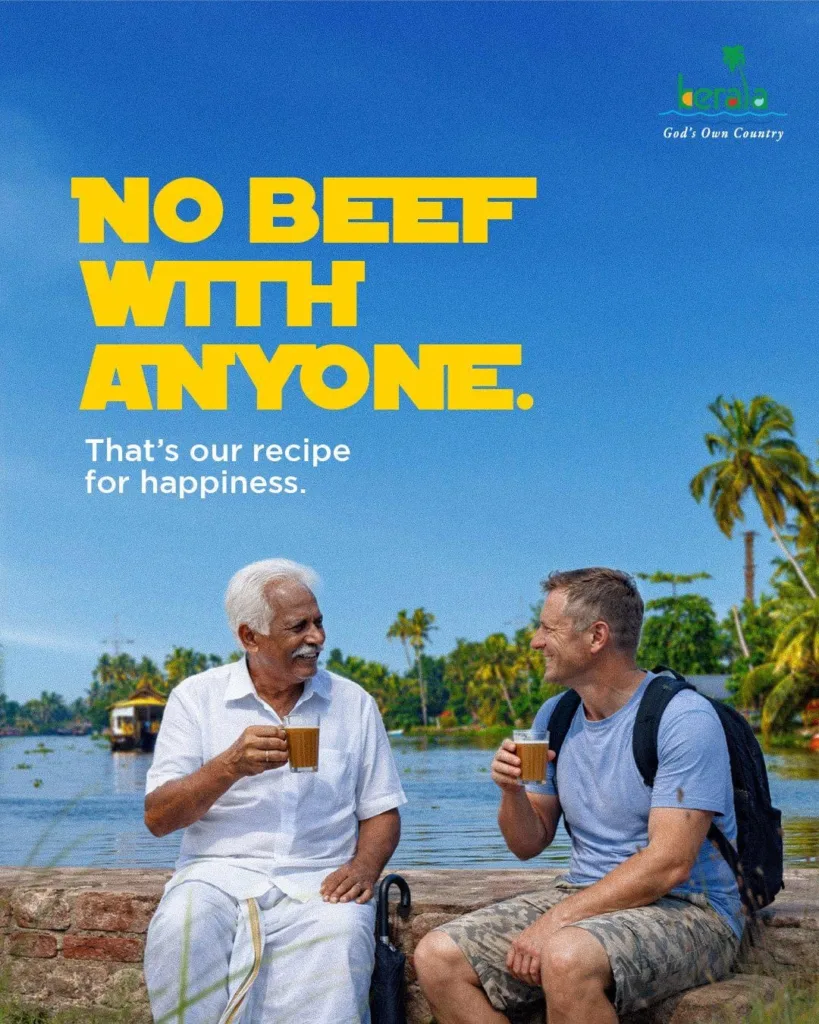
The Union government had earlier, in December 2025, denied permission to screen a Spanish film titled Beef at the International Film Festival of Kerala (IFFK) held in Thiruvananthapuram. Reports said the denial was ostensibly due to its title, even though the film had nothing to do with food or the Indian cultural meaning associated with beef.
When propaganda nears the big screen
During a promotional event for the film held in Delhi, the makers brought 37 women to the stage who claimed to be victims of “love jihad.” However, none of the women was from Kerala. The makers defended this by saying it was a “pan-India” story, but failed to respond when reporters asked why it was then titled Kerala Story.
Though many states in India, including Rajasthan and Uttar Pradesh, have anti-conversion laws in force, no central agencies or government bodies have officially reported cases classified as “love jihad.” As of 2024, under the anti-conversion law in Uttar Pradesh, not a single case had resulted in a guilty verdict. The conviction rate under these laws remains abysmally low.
Yet, right-wingers continue to repeat these claims across political rallies, social media, and even in Parliament, without any statistical or factual backing.
A Kannur resident, Sreedev Namboothiri, filed a petition in the Kerala High Court on February 18, challenging the film’s certification by the Central Board of Film Certification (CBFC). The petition cited concerns over the film’s negative portrayal of Kerala, the potential for communal disharmony, and inadequate safeguards under the Cinematograph Act.
As of February 24, the makers, Sunshine Pictures, have denied rumours of pulling down the teaser following court intervention, and maintained that the matter remains sub judice.
The two instalments of the film mark yet another attempt to spread communal claims—both to tarnish the state and to create false fears around interfaith relationships and marriages. Though Kerala, as a society, has voiced largely unified opposition, the campaign appears to be gaining ground in communally polarised North Indian states. Time and again, social media misinformation has translated into real-world hostility and attacks against minorities. What unfolds after the film’s release remains to be seen.