
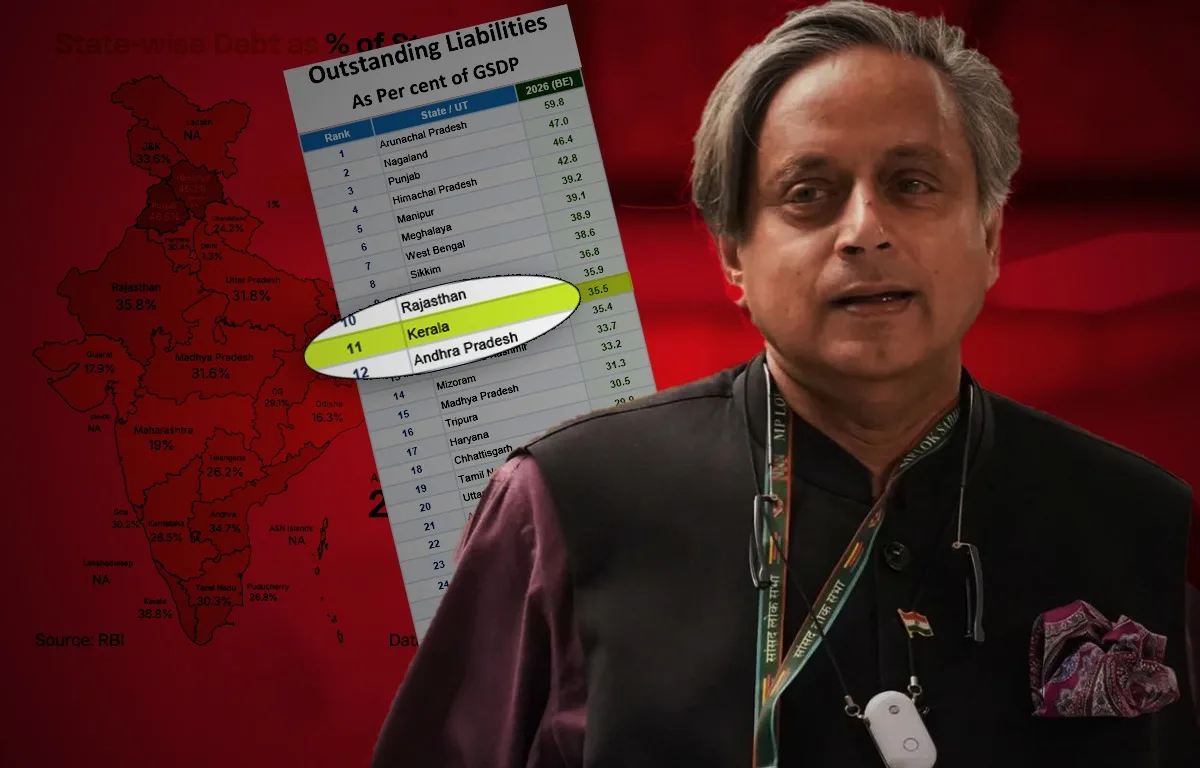
Kerala’s Debt Debate: Do Tharoor’s Claims Hold Up?
Kerala model has turned into a ‘borrowing model’, said Shashi Tharoor. Is it true? Here is a reality check.
The state’s debt has become a key theme in the Kerala assembly election discourse. Shashi Tharoor, MP for Thiruvananthapuram and a senior Congress leader, reignited the debate during the inauguration of Opposition Leader V. D. Satheesan’s election rally in Paravur.
“Everyone wants this government to go. In the past, I used to speak a lot about the Kerala Model of development. But today it has turned into a ‘borrowing model.’ Kerala ranks second in the country in terms of borrowing,” Tharoor said. National media outlets, including The Hindu, The Times of India, and Business Line reported the statement. In an interview with ANI, he also said Kerala is “drowning” in debt.
But are these claims factually accurate?
Tharoor’s remarks can be assessed in two parts. His first claim—that Kerala ranks second in total borrowing—is contradicted by data from the Reserve Bank of India (RBI). According to the RBI’s State Finances report for 2025–26, Tamil Nadu has the highest public debt at ₹10.42 lakh crore, followed by Maharashtra at ₹9.37 lakh crore. Kerala ranks tenth, with ₹5,06,687 crore. This clearly shows that the claim of Kerala being second in total borrowing is incorrect.
However, public debt is not typically assessed using absolute figures alone. As economies grow, borrowing often rises alongside development expenditure. Therefore, a higher total debt does not necessarily indicate a debt trap. A more meaningful metric is the debt-to-GDP ratio, which measures debt as a percentage of a state’s economic output. A higher ratio suggests greater repayment risk.
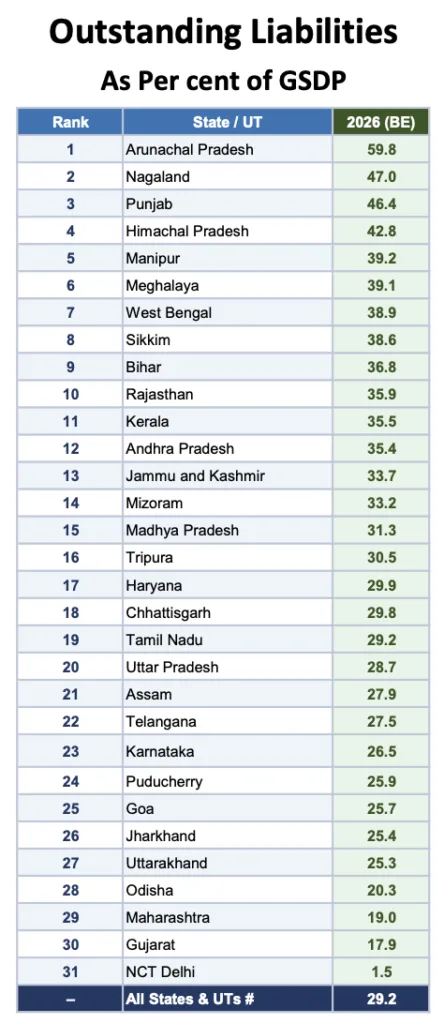
Debt – GDP Rate of different states
Even by this measure, Tharoor’s “second place” claim does not hold. RBI data shows Kerala’s debt-to-GDP ratio at 35.5%, placing it eleventh in the country. The highest ratios are seen in Arunachal Pradesh (59.8%) and Nagaland (47%).
Contrary to circulating claims, Kerala is not among the top states in borrowing. At the same time, a broader look at national finances shows that India’s overall public debt exceeds prescribed limits. Under the Fiscal Responsibility and Budget Management Act (FRBM Act), combined debt of the Centre and states should not exceed 60% of GDP—40% for the Centre and 20% for states. However, the Centre has already utilised a significant share of this limit, and states collectively have also exceeded theirs. As per 2025 estimates, states’ combined debt stands at 27.5% of GDP, while the national debt-to-GDP ratio is 56.1%.
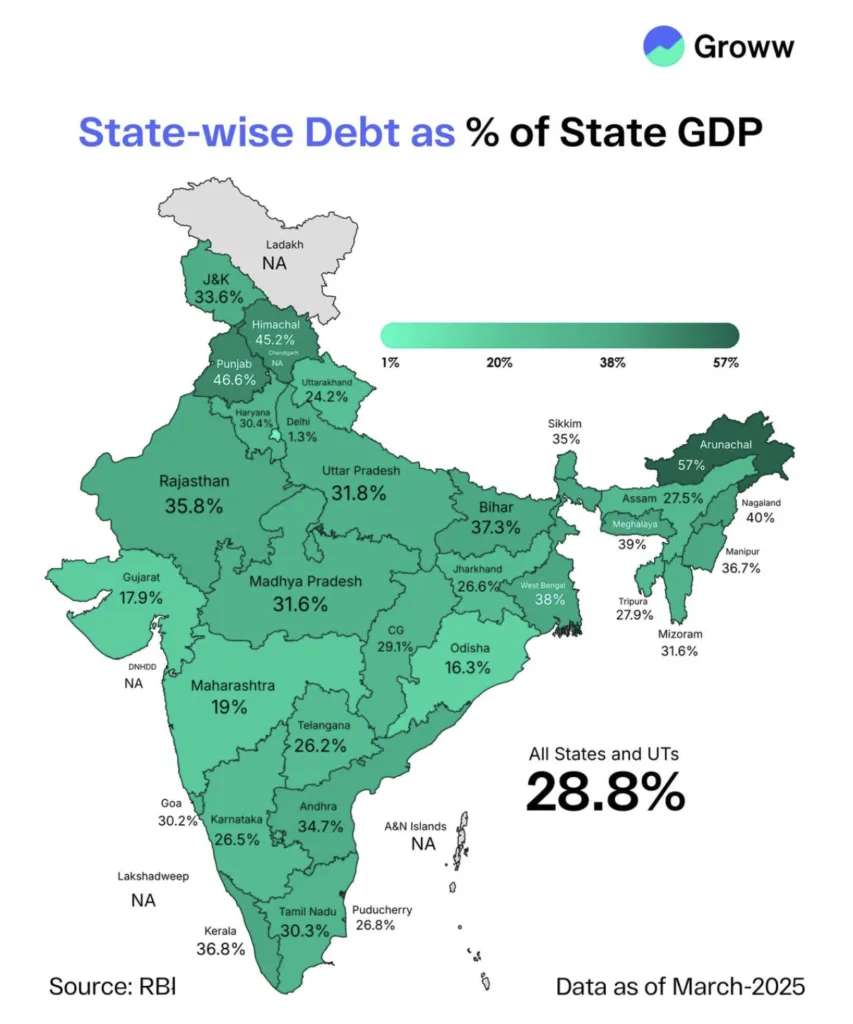
In summary, Tharoor’s claims about Kerala’s borrowing are not supported by RBI data. Kerala does not rank second in either total debt or debt-to-GDP ratio. A data-based assessment shows that its debt burden is lower than that of several major states.
Therefore, the claim is false.
(This is an AI-assisted translation of an article originally written in Malayalam, produced under editorial supervision)