The NCRB’s Invisible Riots: When Methodology Erases Violence
The NCRB’s crime data is considered India’s most authoritative record of violence. But its riot statistics reveal troubling gaps, questionable methodology, and communal violence that often disappears on paper. How does a state with repeated communal flashpoints report zero communal riots? An examination of NCRB data reveals serious flaws in how India records violence.
On November 24, 2024, the Archaeological Survey of India (ASI) conducted a survey at the Shahi Jama Masjid in Sambhal, Uttar Pradesh. The survey followed an order issued by the Sambhal Civil Judge Court on a petition filed five days earlier by advocate Hari Shankar Jain. The petition alleged that the mosque had been built over the remains of a “Harihar Temple” associated with the Hindu deity Kalki. Historical records, however, indicate that the Shahi Jama Masjid was constructed in the sixteenth century during the reign of the Mughal emperor Babur.
Fake News, Real Violence
Despite objections, the first phase of the survey was completed on November 19 itself, the day the court order was issued. During the second phase, rumours spread that the ASI team was demolishing an old well inside the mosque premises. At the same time, people accompanying the ASI officials raised “Jai Shri Ram” slogans outside the mosque.
Violence soon erupted from both sides. Despite police intervention, five people were killed and around thirty others were injured. Although all five deaths were caused by gunfire, none of the bullets recovered from the bodies were police bullets. The sister of seventeen-year-old Mohammed Ayan, who died in the violence, told the media that “a bullet pierced my brother’s chest when he went to see the dispute at the mosque.”
The Sambhal Riot That Vanished from the Records
According to NCRB data, neither Mohammed Ayan’s death nor the violence in Sambhal qualifies as a communal riot. Officially, the incident is counted as just one among nearly thirty thousand riots recorded in India in 2024.
Uttar Pradesh: A State “Without Communal Riots”
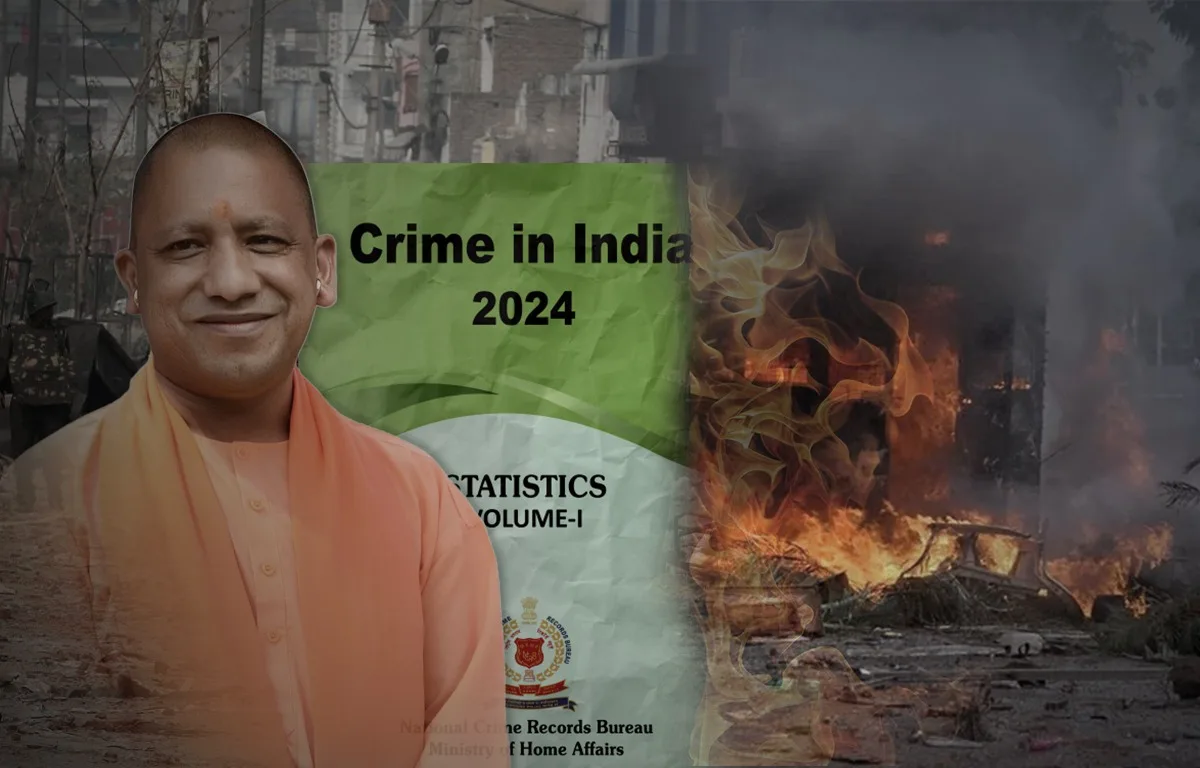
The NCRB’s Crime in India 2024 report states that not a single communal riot took place in Uttar Pradesh. The report records 1,301 riots in the state during the year, yet none of them were classified as communal riots. The Crime in India report remains the country’s primary official source for annual crime and riot statistics.
However, according to data compiled by the Mumbai-based independent research organisation Centre for Study of Society and Secularism (CSSS), Uttar Pradesh witnessed seven communal riots in 2024 alone. None of these incidents appear in NCRB records.
CSSS compiled its findings by analysing the Mumbai editions of newspapers such as The Hindu, Times of India, Indian Express, Shahafat, and The Inquilab. In other words, even an analysis limited to the Maharashtra editions of these newspapers identified seven communal riots in Uttar Pradesh. If relatively less severe incidents were also included, the number would likely be even higher.
Contradictions in the Data
According to the NCRB, India witnessed 349 communal riots in 2024. CSSS, however, recorded only 59 such incidents nationwide. Since the CSSS data relies primarily on media reports, this discrepancy also suggests that the media has increasingly failed to report communal violence comprehensively. At the same time, CSSS identifies seven of these 59 communal riots as having occurred in Uttar Pradesh. Yet NCRB records show zero communal riots in the state that year.
This inconsistency is not limited to 2024. Uttar Pradesh is widely regarded as one of the states most affected by cow-vigilante violence. Yet such incidents are rarely reflected in NCRB data as riots with communal characteristics.
UP Chief Minister’s “Riot-Free” Claim
The NCRB began separately categorising “communal/religious riots” in its Crime in India reports only in 2017. That year, Uttar Pradesh recorded 34 communal riots. But across the eight reports published between 2018 and 2024, the state recorded only one communal riot — in 2021. According to NCRB data, Uttar Pradesh witnessed no communal riots during the remaining seven years.
Since 2018, Chief Minister Yogi Adityanath has repeatedly declared at public events that Uttar Pradesh is “riot-free” (danga mukt). Technically, citing NCRB data to make such a claim is not incorrect. Yogi Adityanath, however, went further — declaring that Uttar Pradesh had seen no riots whatsoever. That broader claim has since been fact-checked by media outlets and found to be inaccurate.
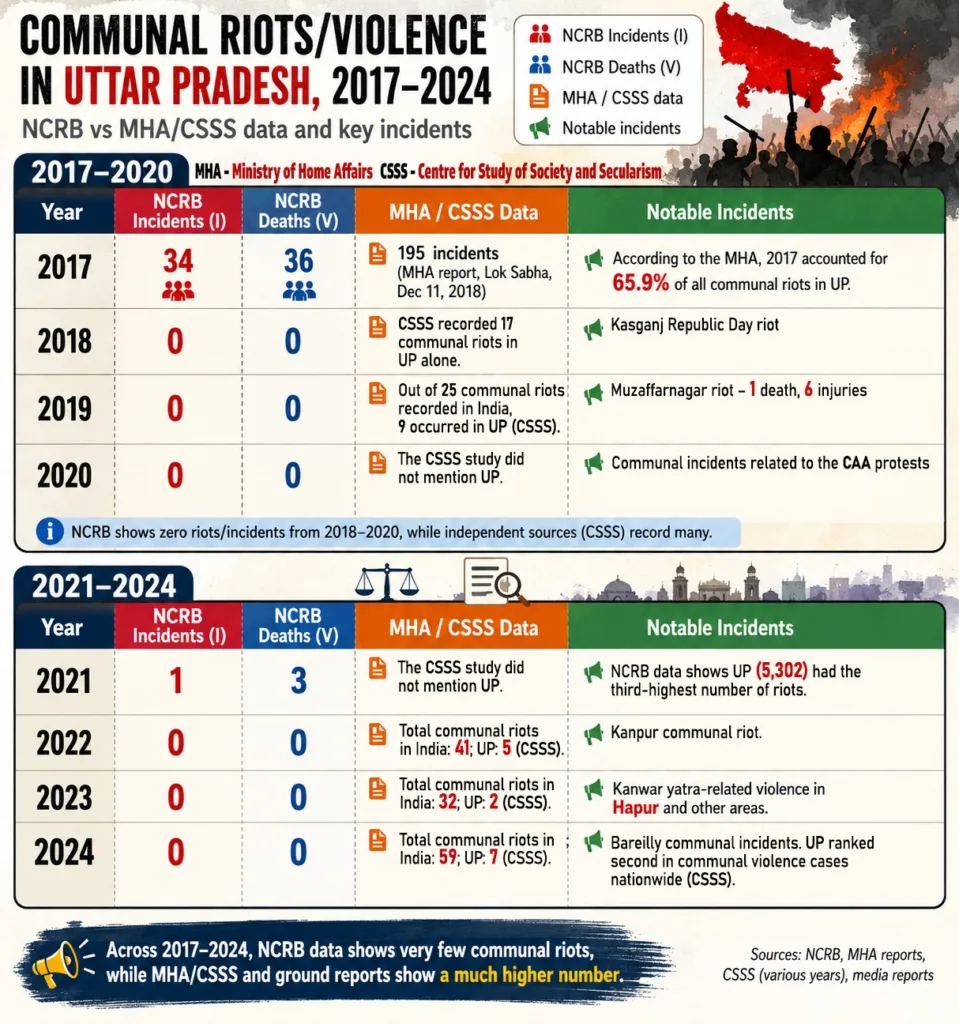
Media reports, however, tell a different story. A year-by-year examination from 2018 to 2024 shows that communal riots did occur in most years, according to CSSS findings. The organisation estimates that nearly forty communal riots took place in Uttar Pradesh during this period. Even this estimate may be incomplete, as the CSSS reports between 2020 and 2022 do not specifically document communal riots in the state.
BJP leader Yogi Adityanath assumed office as Chief Minister of Uttar Pradesh on March 19, 2017. Since then, communal riots have effectively disappeared from the state’s official records.
Riots Declining on Paper
NCRB data suggests that the total number of riots in India has steadily declined over the years. In 2017, the Crime in India report recorded 58,880 riots nationwide, affecting 90,304 people — a victim rate of 4.6 per one lakh population.
By 2024, the total number of riots had reportedly fallen to 30,348 with 40,410 victims. The victim rate declined to 2.2, meaning that 2.2 out of every one lakh citizens were victims of riots that year. In 2023, the figure stood at 2.8.
Communal Riots on the Rise
While the overall number of riots appears to have nearly halved, communal riots have not declined at the same rate. NCRB data records 349 communal riots in 2024 — the highest figure in the last three years. In 2023, the number stood at 272, marking a 28.3 percent increase.
The rise in the number of victims is even sharper. In 2023, communal riots reportedly affected 400 people. In 2024, that number rose to 895 — an increase of 123 percent.
The NCRB claims that the total number of riots has fallen by 49 percent over the past eight years. Yet such a dramatic decline raises a crucial question: how exactly are these statistics compiled?
Flaws in Crime Enumeration
The Crime in India reports rely entirely on crime statistics submitted by state governments. District Crime Records Bureaus (DCRBs) collect data at the district level, which is then consolidated by State Crime Records Bureaus (SCRBs), typically headed by officers of ADGP rank. These compiled figures are subsequently incorporated into the national report.
The NCRB itself has no independent definition of riots. Riot statistics are simply derived from the number of cases registered under riot-related provisions of criminal law.
Until 2023, cases registered under Sections 147 to 151 of the Indian Penal Code (IPC) were counted as riots. After the Bharatiya Nyaya Sanhita (BNS) came into effect in 2024, Sections 189(5), 189(6), 190, 191(1), 191(2), and 191(3) of the BNS were also included. These changes first appeared in the Crime in India 2024 report.
A closer look at the NCRB’s data collection process reveals a deeper problem: the possibility of error exists from the very first stage of recording. Information from police stations reaches the NCRB through the Crime and Criminal Tracking Network & Systems (CCTNS), a nationwide database launched in 2009. Data entry into the system is carried out by officials at individual police stations.
How Communal Riots Are Recorded
The IPC contains no specific provisions dealing exclusively with “communal riots.” Such incidents are recorded under the broader category of “Offences Against Public Tranquillity.” Additional sections are added depending on factors such as the number of participants, the weapons used, and the location of the incident.
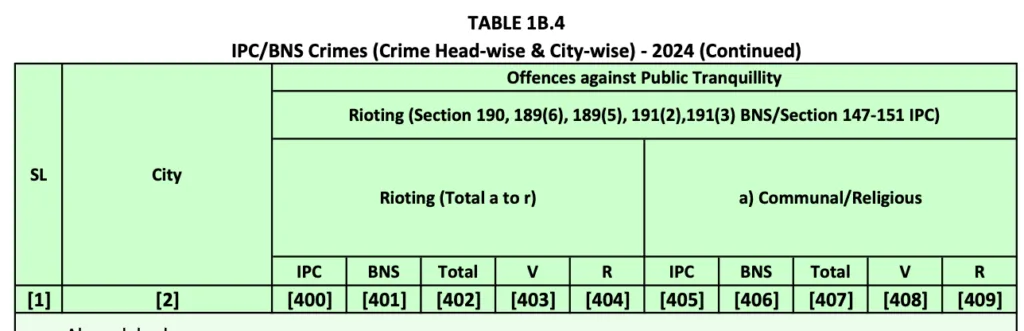
The NCRB classifies communal riots within these same riot-related provisions.
In the Crime in India report, riots and communal riots appear as separate categories. Yet communal riots remain embedded within the broader riot framework.
Under the CCTNS system, the initial FIR details are entered by the station writer or duty officer. These entries determine the broad classification of the case. However, cases are assigned to subcategories only after the “Crime Detail Form” (Crime Detail Form – IIF-2) is completed.
In riot-related cases, once the FIR is entered into the system, the case is added to the total riot count. But for it to be specifically classified as a communal riot, the Crime Detail Form must also be completed.
The CCTNS User Guide clearly states that only the investigating officer has the authority to fill out this form.
Unscientific Consolidation
Since individual officers are responsible for entering information into the system, data can be omitted or misreported — intentionally or otherwise. There is no robust review mechanism to prevent such errors. Because state government personnel control the data-entry process, states themselves can potentially manipulate the statistics.
“Completely depending on police station officials for data collection is a major limitation of the NCRB system. There is always a possibility of inaccuracies arising from individual interpretation,” former Kerala DGP Jacob Punnoose told OBC.
When Punnoose served as DGP in 2012, Kerala was recorded as the state with the highest crime rate in the country. He had then criticised the NCRB’s flawed methodology for producing misleading conclusions.
Evidence from Assam
The failure to complete Crime Detail Forms can directly reduce the number of cases reflected in subcategories such as communal riots. This irregularity was identified in the 2022 Comptroller and Auditor General (CAG) report on Assam, which examined flaws in the Assam Police’s use of the CCTNS system.
The report found that police stations routinely failed to complete Crime Detail Forms or submit them before courts. It also stated that the intended purpose of these forms had not been fulfilled. In addition, discrepancies ranging from 33.33 percent to 100 percent were identified in the forms that had been completed.
The report uncovered another serious lapse as well: police officials had outsourced data entry to private individuals. This raises serious questions about the credibility of the information stored in the system.
The absence of even a single communal riot from Uttar Pradesh’s 2024 records, despite 1,301 riots being officially registered, stems from this very issue. If the Crime Detail Form is not completed, a riot case may never be classified as a communal riot.
Such unscientific methods of data collection — combined with the possibility of suppressing information — fundamentally undermine the credibility of NCRB data.
Although the CAG report focused specifically on Assam, its findings shed light on wider structural flaws in the NCRB’s nationwide data collection system.
No Separate Legal Category for Communal Riots
Indian law does not contain separate provisions specifically dealing with communal riots. As a result, when communal violence occurs, police generally add provisions relating to communal offences to the FIR.
These include IPC 153A / BNS 196 (promoting enmity on religious or racial grounds), IPC 295A / BNS 299 (deliberate acts intended to outrage religious feelings), and IPC 295 / BNS 298 (damaging or insulting places of worship).
If riot cases carrying such communal-offence provisions were separately tabulated, it could provide a far clearer picture of communal violence in the country.
The Unscientific “Principal Offence Rule”
In cases involving multiple offences under the IPC, the NCRB records only the gravest offence. This method is known as the Principal Offence Rule (POR).
For instance, in cases where women are raped and later murdered, the NCRB records the case under murder rather than rape. As a result, the actual number of rape cases becomes obscured. The NCRB itself acknowledged this limitation in its 2017 report.
This practice causes many crimes to disappear statistically.
Following sustained criticism, the Crime in India report began separately listing “Murder with Rape/Gang Rape” cases from 2022 onward. Even so, the Principal Offence Rule itself remains unchanged.
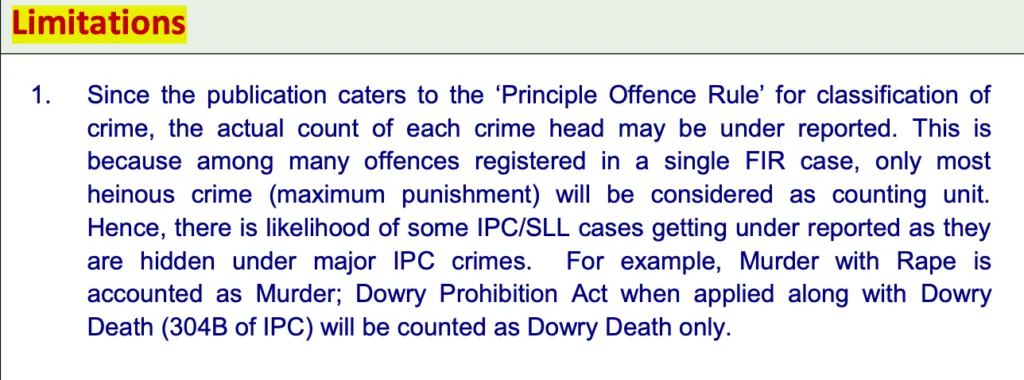
The same rule may also contribute to the undercounting of communal riots. If a death occurs during a riot, the case may ultimately be classified as murder because it carries a harsher punishment. The riot itself may never appear in riot statistics.
Zero Communal Riots in Manipur
Like Uttar Pradesh, Manipur’s statistics also reveal glaring inconsistencies.
The violence that erupted in Manipur in 2023 shocked the country. The clashes began over demands to grant Scheduled Tribe status to the Meitei community. The Kuki community, which already possessed Scheduled Tribe status, opposed the move. Most Meiteis are Hindus, while most Kukis are Christians.
Given the nature of the conflict, the violence in Manipur should logically have been classified in the Crime in India report as either communal riots or sectarian riots.
Between 2023 and 2024, 258 people lost their lives in the violence. Yet the 2023 Crime in India report records zero communal riots in Manipur. It lists only three sectarian riots, with four injuries.
At the same time, the overall number of riots in the state rose dramatically. While Manipur recorded 84 riots in 2022, the number surged to 5,421 in 2023 — an increase of 6,353 percent.
This clearly suggests that the violence was not properly classified into subcategories. Although thousands of riot cases were registered, they appear to have been grouped almost entirely under the broad category of “total riots.”
In 2024, the total number of riots in Manipur reportedly fell to 273. However, following the Manipur violence, the NCRB introduced a new category in its 2024 report titled “Ethnic or Community Group Clash or Agitation,” under which 36 cases were recorded.
Global Models
The United Kingdom’s approach to crime statistics is widely regarded as an international benchmark. Like India’s NCRB, the UK has the National Crime Recording Standard (NCRS). However, to address gaps in police data, the UK also introduced the Crime Survey for England and Wales (CSEW), which conducts independent surveys among the public in addition to relying on police records.
This allows authorities to identify discrepancies and underreporting in official crime data.
The figures from Uttar Pradesh and Manipur suggest that official statistics in India are often far removed from reality. Structural flaws in the CCTNS system, unscientific practices such as the Principal Offence Rule, and the discretionary powers exercised by officials during data collection can all contribute to concealing the true scale of crime.
Taken together, these issues raise serious questions about the transparency, reliability, and credibility of crime data in India.
This is an AI-assisted translation of an article originally written in Malayalam, produced under editorial supervision.