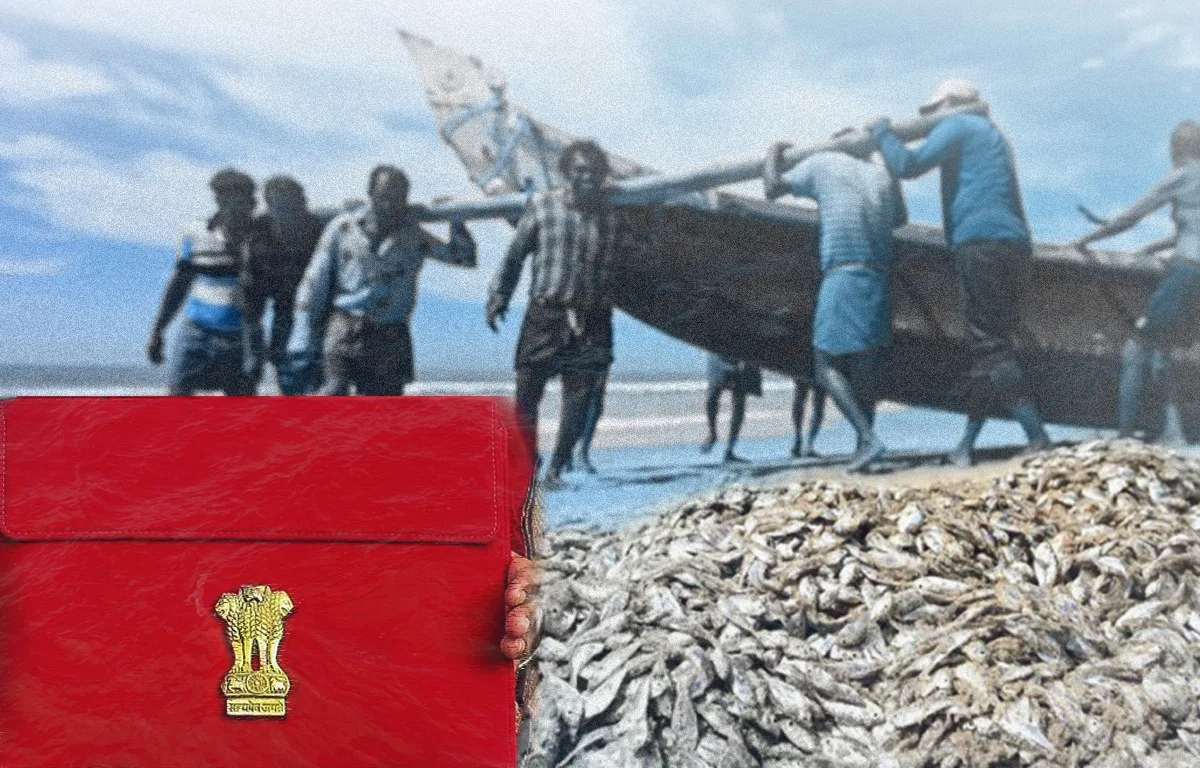
A Budget That Betrays the Sea
The Union Budget’s fisheries reforms favour industrial-scale operations, threatening small-scale fishers, overexploiting marine resources, and prioritizing market gains over ecological and social sustainability.
The Union Budget presented by Finance Minister Nirmala Sitharaman introduces a set of policy measures that have far-reaching and potentially irreversible consequences for India’s fisheries sector. These proposals signal a decisive shift towards corporatisation and capital-intensive industrial fishing, posing a serious threat to the survival of small-scale and traditional fishing communities. The budget reflects a continuation of neoliberal policy orientations aligned with globalisation and the Blue Economy framework, without adequate consideration of social equity, ecological sustainability, or livelihood security.
As per Clause 56(a) of the budget speech, Indian companies have been permitted to operate fishing activities beyond 12 nautical miles. This policy move is justified using the constitutional provision that assigns fishing and management rights in the 12–200 nautical mile zone to the Central Government. The budget further permits trans-shipment of fish products after harvest and allows fishing vessels to dock at foreign ports and transfer their catch. The only regulatory requirement stipulated is the procurement of approval from the Reserve Bank of India. These measures collectively facilitate the transfer of India’s marine resources to global markets, raising serious concerns regarding national resource sovereignty and regulatory oversight.
India already has one of the highest densities of fishing vessels operating within its Exclusive Economic Zone (EEZ). According to Government of India data, there are approximately 314,767 fishing vessels operating in Indian waters, including around 64,000 small trawl boats within the 200-nautical-mile zone. However, scientific assessments indicate that sustainable fishing in India requires only about 93,767 vessels. The current fleet size exceeds sustainable limits by more than threefold, placing immense pressure on marine ecosystems.
Historically, access to India’s marine resources by large vessels was restricted to areas outside the EEZ, even when permitted under earlier policy frameworks—such as joint ventures in 1977 and 1981, the deep-sea fishing policy of 1991, Letters of Permit in 2002, and the Meenakumari Committee recommendations in 2014. The present policy shift marks a significant departure by allowing such operations within the full EEZ. Given the declining fish stocks in deep-sea regions, these vessels are likely to concentrate operations closer to nearshore waters, intensifying competition and directly undermining the livelihoods of small-scale and traditional fishers.
The effective fishing range now extends to areas just beyond 12 nautical miles, placing indigenous fishing vessels and artisanal fishing practices at a severe disadvantage. This is likely to result in widespread livelihood displacement, increased poverty among coastal communities, and further depletion of fish stocks. Such outcomes not only threaten social and economic stability but also compromise the long-term sustainability of marine resources. It is pertinent to note that the Government of India had already issued a Gazette notification on November 4 of the previous year outlining these measures, which the budget speech now reiterates and institutionalises.
Global evidence demonstrates that industrial fishing has contributed significantly to the collapse of marine ecosystems. Organisations such as the International Union for Conservation of Nature (IUCN), operating under the United Nations framework, have documented that industrial fishing practices in Europe have led to the decline of 1,616 major fish species worldwide. Despite these well-documented warnings, Indian fisheries policy appears to disregard international lessons and scientific consensus.
The introduction of capital-intensive industrial models into a labour-intensive sector like fisheries has profound socio-economic implications. The budgetary approach prioritises output and market integration while marginalising producer communities who are central to the sector’s sustainability. This product-centric policy framework fails to acknowledge the social, cultural, and ecological dimensions of fisheries governance.
In this context, the proposed measures warrant serious reconsideration. A fisheries policy that undermines livelihood security, ecological balance, and community rights is neither economically prudent nor socially just. We therefore consider these proposals deeply problematic and call for a nationwide mobilisation to demand a more equitable, sustainable, and community-centred fisheries policy.
(This article is an AI-assisted translation from Malayalam, with editorial oversight.)

Charles George
Charles George is the State President of Kerala Fish Workers’ Coordination Committee (TUCI).
View all posts by Charles George