A Deadly Year for Journalism: Inside the Global Assault on Press Freedom
As attacks on journalists surge worldwide, the RSF roundup lays bare the deadly consequences of speaking truth to power. From India’s declining press freedom to conflict zones where reporters are targeted, the figures expose a profession increasingly under siege.
On September 28, the body of Rajeev Pratap, a journalist who ran the YouTube news channel Delhi Uttarakhand Live, was recovered from a hydroelectric barrage on the Bhagirathi River in northern Uttarakhand. Though police found no injury marks on Pratap’s body and said that preliminary investigations indicated he died in a car accident, Pratap’s wife Muskan said that many people had been calling him, threatening to kill him if he did not remove a video report about alcohol consumption at the Uttarkashi district hospital. The Special Investigation Team concluded that it was a case of a road accident caused by intoxication, police said on October 3, 2025.
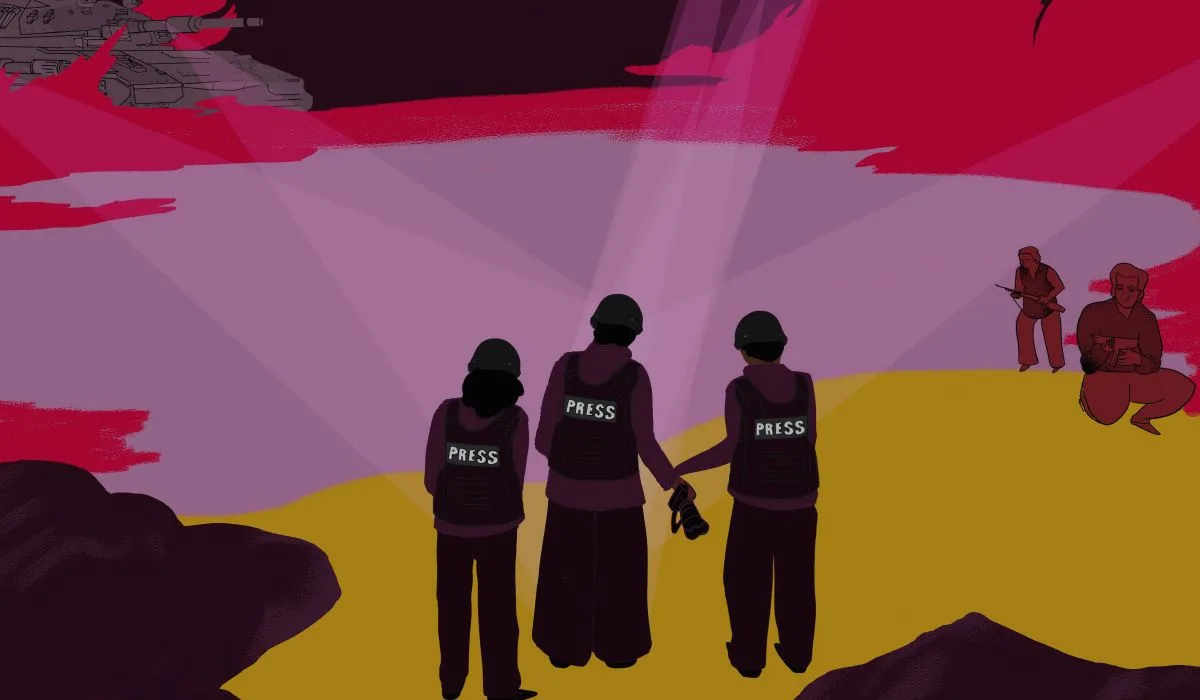
This is not the story of a lone Indian journalist. Across the world, journalists are killed for the work they do, and 2025 has been a particularly “deadly year” for them, says Reporters Without Borders (RSF), an international press freedom advocacy organisation, in their annual roundup report. At least 53 of the 67 media professionals killed over the past year were victims of war or criminal networks, according to RSF.
Deathbeds for Journalists
“No one gives their lives for journalism — it is taken from them; journalists do not just die — they are killed,” Thibaut Bruttin, the Director General of RSF, notes grimly.
RSF says that over the past year, the Israeli army has been responsible for over 43% — nearly half — of crimes committed against journalists worldwide. Since October 2023, the Israeli army has killed nearly 220 journalists. Sixty-five of them were killed either because of their work or while they were working. At least 79% of the journalists killed were victims of armed forces or paramilitary groups (37 journalists) and criminal networks (16 journalists).
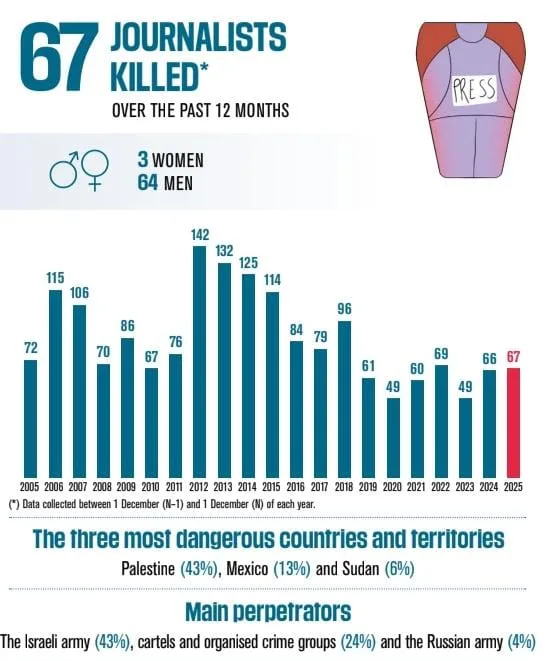
This year, in conflict-torn Sudan, four journalists were killed while working, two of whom died after being abducted by the Rapid Support Forces. Two of the journalists killed were foreign correspondents who died outside their home countries: French photojournalist Antoni Lallican, killed in Ukraine by a Russian drone strike, and Salvadoran journalist Javier Hércules, killed in Honduras, where he had lived for more than a decade. All the others were murdered while reporting in their own country, RSF noted.
Missing, Hostage, Imprisoned: The Toll of Telling the Truth
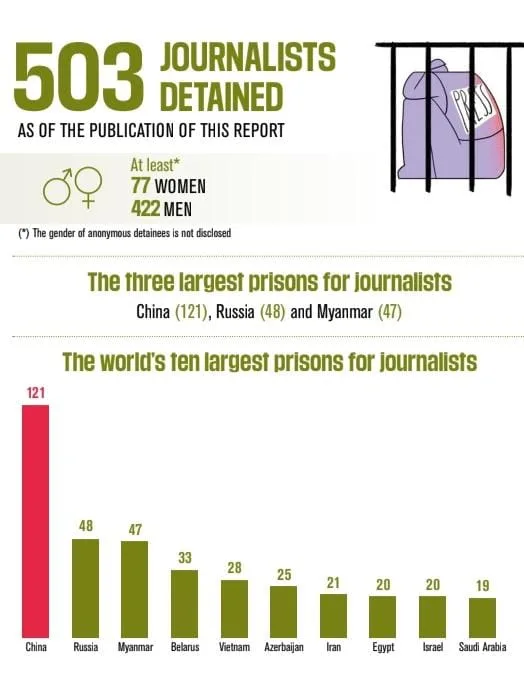
China remains the world’s largest prison for journalists, with 121 currently behind bars. It is followed by Vladimir Putin–led Russia, with 47 detainees, and Myanmar, which also holds 47 journalists. According to the RSF Roundup, Russia and Israel imprison the highest number of foreign journalists. As of December 1, 20 Palestinian journalists are behind Israeli bars, 16 of whom were arrested over the past two years in Gaza and the West Bank. Russia has 48 news professionals behind bars, 26 of whom are Ukrainian.
A total of 503 journalists are currently detained worldwide.
Georgia and Azerbaijan also feature prominently on this list. Georgian journalist Mzia Amaghlobeli was arrested twice in January during peaceful protests in Batumi, in southwestern Georgia, against government policies. Her arrest has raised broader concerns about politically motivated prosecutions, suppression of dissent, and gender-based reprisals against those exercising their right to protest in the country.
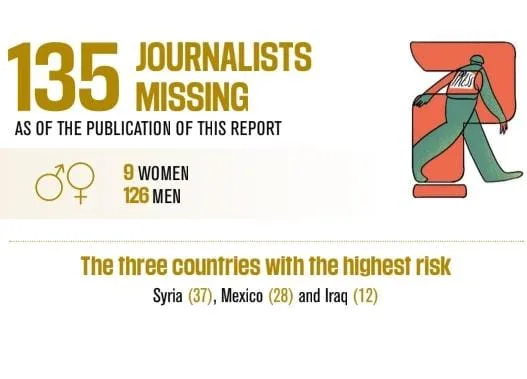
Another alarming figure highlighted by RSF is that 135 journalists are missing across 37 countries. Some have been missing for more than 30 years. The spike is most evident in Mexico, where 28 journalists are missing, followed by Syria, with 37 missing. In Syria, many were held hostage by ISIS, the Islamist extremist group, or imprisoned by the regime of Bashar al-Assad, the former Syrian president. Though both regimes have fallen or weakened considerably, the missing journalists were never recovered, says RSF.
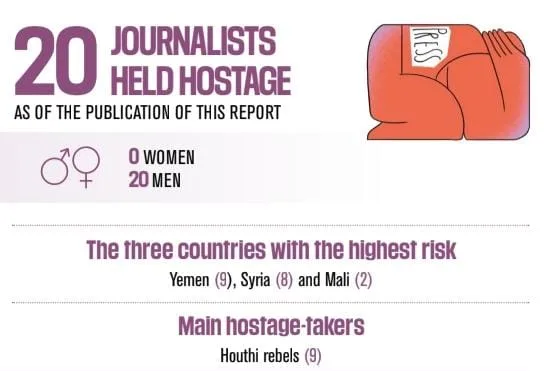
Yemen has become the epicentre for journalists held hostage in the past twelve months, according to RSF. Of the 20 journalists held hostage worldwide, seven are from Yemen and were kidnapped by the Houthi rebels, an armed group that has been engaged in the country’s ongoing civil war and exerts significant control over large parts of northern Yemen.
In a separate incident in Mali, it has now been two years since Saleck Ag Jiddou, journalist and director of Radio Coton d’Ansongo, and Moustapha Koné, a presenter at the same community radio station, were abducted by members of an unidentified armed group.
RSF identifies Russian President Vladimir Putin and Taliban leader Haibatullah Akhundzada of Afghanistan as political press-freedom predators who “stifle the news in their countries.” The Israeli armed forces, Myanmar’s State Security and Peace Commission, and Mexico’s Jalisco New Generation Cartel are labelled security predators of press freedom, “who kill and detain journalists.”
A Crisis at Home and Beyond
As the global political climate shifts further right, journalists and media workers across the world struggle to exist and carry out their work in peace.
Ahead of International Human Rights Day, the Committee to Protect Journalists (CPJ) has written to heads of government across Asia urging them to immediately release reporters jailed for doing their work. CPJ says Asia accounts for over 30% of all imprisoned journalists worldwide. In seven separate letters, the group called on authorities to take urgent steps to let detained journalists return to their families and continue their work without fear. CPJ also urged leaders to uphold their human rights commitments.
RSF’s World Press Freedom Index ranks India at 151 out of 180 countries and notes that, “With an average of two to three journalists killed due to their work every year, India is one of the world’s most dangerous countries for the media.”
It is imperative that we heed the urgency reflected in these numbers and ensure that the rights of those meant to be the eyes and voices of ordinary citizens remain free and independent, both in India and beyond.