A Grim Reminder of Shrinking Dissent: Inside India’s Recent Campus Unrest
A series of confrontations on university campuses — from clashes at Delhi University and JNU to the recent attacks and vandalism at Azim Premji University — has reignited concerns about academic freedom and political interference. Discussions and protest gatherings are increasingly met with counter-mobilisation, police action, or administrative crackdowns. These incidents signal a shrinking tolerance for dissent, and raise urgent questions about the health of democratic life within India’s universities.
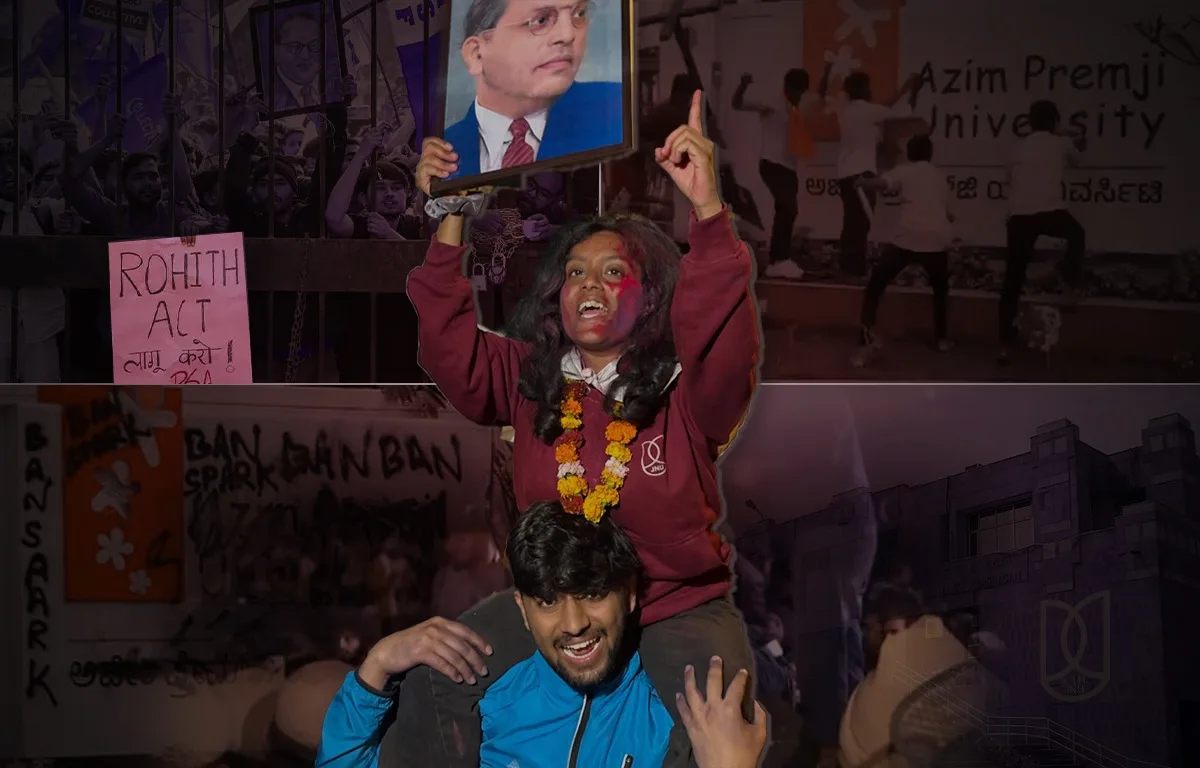
“To the Vice Chancellor sitting in her pink palace, you had us arrested and sent to Tihar Jail, but our spirits remain intact. You cannot break this union. Your corruption, Brahmanical attitude, and casteism will come out. The movement you tried to crush with brute police force will regain strength in the coming days,” said Gopika Babu, vice president of the Jawaharlal Nehru University Students’ Union, in a video statement after her release.
Gopika was among fourteen students arrested on February 27 during clashes that broke out amid a protest march demanding action against Santishree Dhulipudi Pandit, the Vice Chancellor of Jawaharlal Nehru University (JNU). The protest was triggered by alleged casteist and discriminatory remarks made by the VC against the UGC equity regulations introduced in January 2026. In a podcast, she said there was a sense of “permanent victimhood” among the Dalits in India.
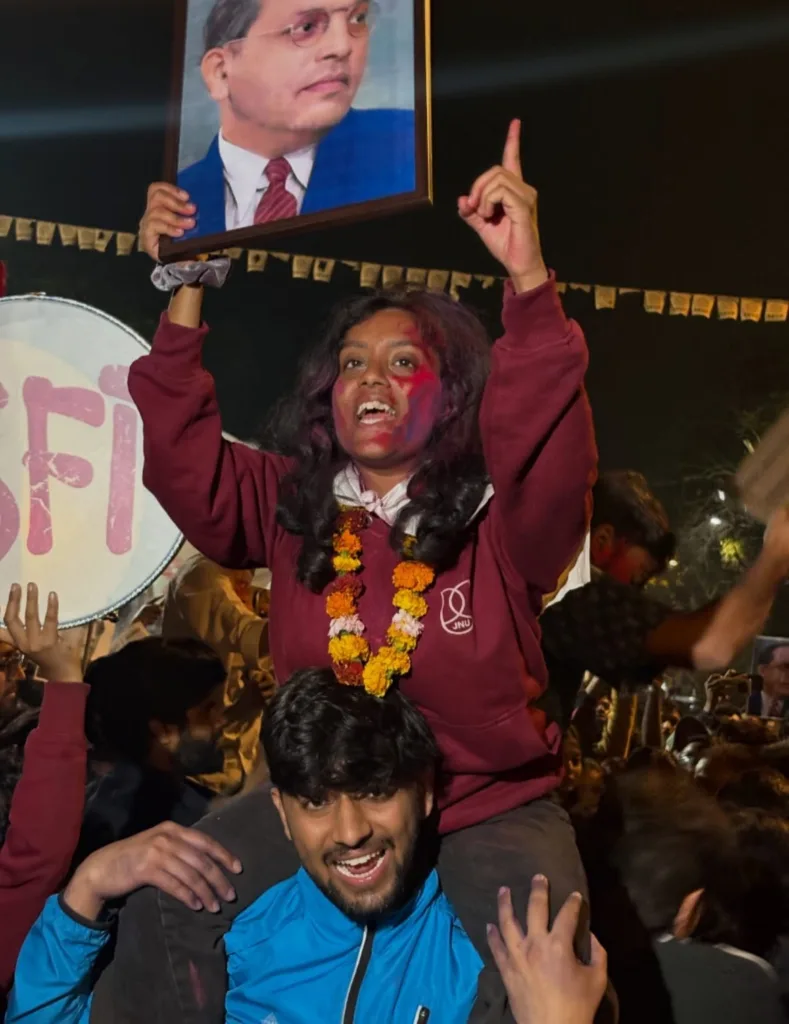
Since the BJP came to power in 2014, universities and centers of higher education across the country have been undergoing dramatic changes. Clashes between student bodies and right-wing-aligned vice chancellors and administrations have increasingly become a routine affair. Institutions like JNU, long known for their tradition of academic freedom, secular politics, and a vibrant culture of debate and dissent, have turned into frequent flashpoints of confrontation.
This year, the situation appears to have taken a sharper turn. The UGC regulations, and even academic and cultural observances on campuses, became flashpoints of conflict.
OBC unpacks the recent wave of student protests, tracing how they turned confrontational and violent, and how these recurring clashes are weakening campuses as spaces of debate and dissent.
When the UGC regulations emerged as a flashpoint
On January 13, the UGC announced the enforcement of the Equity Regulations 2026, stating that the objective was to address discrimination and ensure dignity and equal opportunity for students and faculty belonging to the Scheduled Castes, Scheduled Tribes, and Other Backward Classes.
A massive backlash followed from sections of the ‘general category’. They alleged that the regulations would rob them of opportunities and reinforce caste divisions in higher education institutions. Although the Supreme Court stayed the regulations on January 29 following the protests, the bill remains a flashpoint, continuing to trigger protests and conflicts.
On February 26, students of JNU planned a march to the Ministry of Education. Their demands included the resignation of the VC, restoration of the earlier UGC equity rules, implementation of the proposed Rohith Act to protect Dalit and Adivasi students, the release of detained students, withdrawal of FIRs and proctorial action, and action against police personnel whom they alleged had damaged a portrait of B. R. Ambedkar during the protests.
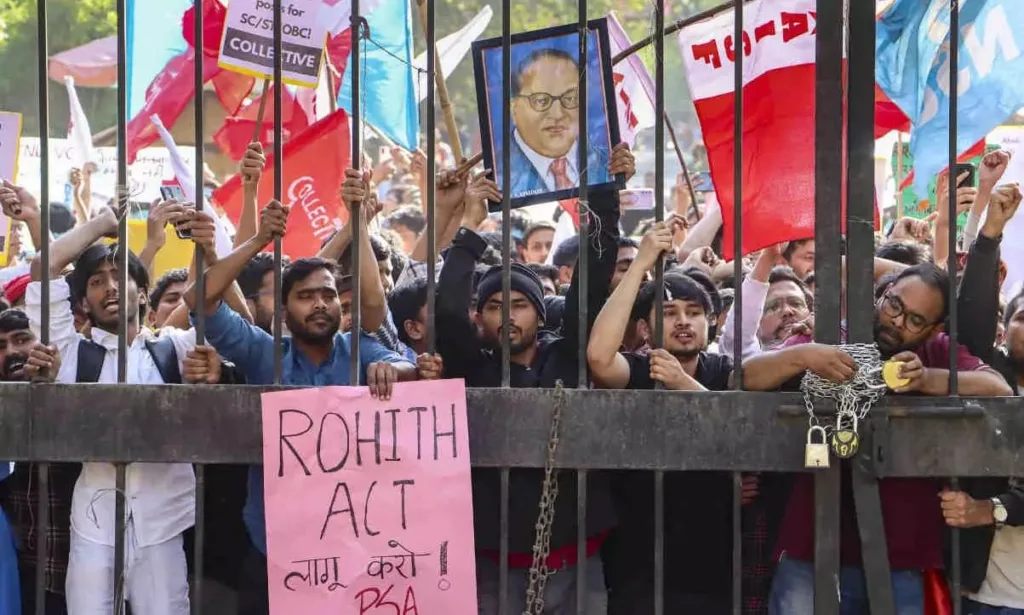
According to reports, the police said the students attempted to move out of the campus without permission to hold a protest outside university grounds and that barricades were broken. They also alleged that sticks and other objects were thrown and that some officers were bitten during the confrontation.
However, the students alleged excessive use of police force during the confrontation. Fourteen students, including union office-bearers, were arrested and an FIR was registered under multiple sections, including Section 221 (obstructing a public servant while discharging duty), Section 132 (assault or criminal force to deter a public servant from duty), and Section 121 (voluntarily causing hurt or grievous hurt to deter a public servant from duty). More than fifty students were detained.
A Delhi magistrate court on Sunday directed the immediate release of all 14 students on bail, according to PTI.
This is not the first time the UGC regulations have pushed campuses into conflict. Just ten days earlier, the Delhi University (DU) proctor, Manoj Kumar Singh, had announced a complete ban on protests, public meetings, processions, and demonstrations of any kind for a period of one month. It focused solely on the protests turning violent, without engaging with the core issue — the Equity Guidelines.
On February 13, a demonstration in support of the UGC Regulations at DU turned chaotic. The protest was organised by the All India Forum for Equity and backed by the left-wing All India Students’ Association (AISA). It led to clashes between the left-wing organisers and the student wing of the RSS, the Akhil Bharatiya Vidyarthi Parishad (ABVP).
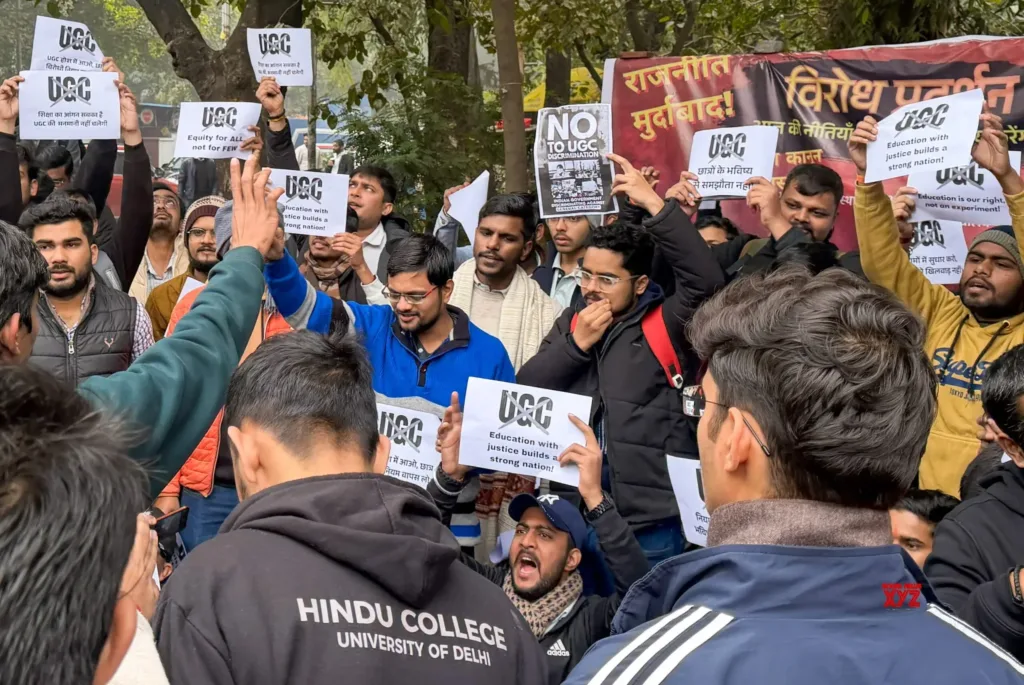
OBC had earlier analysed how tensions unfolded between protesters from both sides and how the confrontation shaped narratives online.
Condemnation had poured in after veteran historian S. Irfan Habib was seen on February 12 in a video being doused with a bucket of water during a programme held at the Arts Faculty of DU. AISA had alleged that students affiliated with the ABVP were behind the act.
The incident occurred while Habib was delivering a speech at an event organised under the ‘People’s Literature Festival’. According to a poster shared by AISA, the programme also raised demands for the reinstatement of the UGC regulations and the enactment of the Rohith Act.
‘Propaganda’, vandalism and a remembrance event: What unfolded at Azim Premji University
Around the same time, in the southern part of the country, another set of events unfolded. The pattern, however, appeared similar — left-wing student organisations organising an event or protest, followed by confrontation from right-wing-affiliated students. In this instance, the actions attributed to the ABVP went a step further, according to those involved.
On February 24, members of the ABVP allegedly barged into the campus of Azim Premji University (APU) in Bengaluru and vandalised property. The trigger was an event organised by a student club. The Spark APU Reading Circle had planned a discussion on the alleged mass rape of Kashmiri women in Kunan Poshpora by Indian armed forces on February 23, 1991 — a day observed as Kashmiri Women’s Resistance Day.
While the Indian Army has denied that any such incident took place, a 2013 petition before the Supreme Court of India led to a reinvestigation of the case.
According to videos shared online, ABVP members protested in a central area of the university where cultural events are usually held. They vandalised the university campus and wrote graffiti on the walls demanding that the Spark Reading Circle be banned.

A statement issued by the university later that night, however, said that those who had forced their way into the campus were protesting against an event they claimed was going to be held there. APU stated that it had not authorised any event of that nature.
On the same day, the university registrar filed a First Information Report (FIR) against the Instagram page “Spark Reading Circle, APU,” run by students, alleging misuse of the university’s name and accusing it of instigating unrest on campus and repeatedly defaming the institution.
A statement from the APU Student Council, released on February 26 read, “To respond to critical thinking with an FIR undermines intellectual freedom”. Around 200 students of the university boycotted classes and staged a protest that day, demanding the immediate withdrawal of the FIR against the Spark Reading Circle.
A broader ‘saffronisation’ drive in universities
Academicians and experts argue that a broader “saffronisation” agenda in India’s premier higher education institutions is not being pushed only through such confrontations and violence.
In states such as Keralam, conflicts between student organisations and the Governor — who also serves as the Chancellor of universities — as well as Vice Chancellors, have often made headlines.
In an earlier interview with OBC, Prof. M. V. Narayanan, academician and former Vice Chancellor of Kalady Sree Sankaracharya University of Sanskrit, had explained the legal, constitutional, and practical fallacies that risk turning heads of universities into agents of the Union government.
“According to the UGC regulations, the Vice Chancellor selection committee must include one representative of the UGC, one representative of the Governor, and a third representative from the university. When we look closely, two of these three are effectively representatives of the Union government. This committee is then required to submit its recommendations to the Governor on whom to appoint as Vice Chancellor.” M. V Narayanan said.
“There is another flaw in the process,” he said. “In the selection of teachers, the selection committee — considered to be the experts — usually ranks recommended candidates based on their qualifications and other criteria. However, in the case of Vice Chancellor appointments, no such ranking is permitted. The committee is required to recommend three to five names, and the Governor then decides who should be appointed as Vice Chancellor.” The Union government effectively ends up having the final say.
Across the world, studies indicate that student dissent is increasingly under strain. India’s position in the Academic Freedom Index developed by the V-Dem Institute reflects this concern. The update for 2024, released in March 2025, places India among countries where academic freedom is described as “completely restricted.”
The crushing of dissent in university spaces through violence and political interference has, in recent years, resulted in a visible erosion of democratic norms. The Delhi riots, and the continued incarceration of undertrial prisoners Umar Khalid and Sharjeel Imam — who have been in jail for the past six years — serve as a grim reminder of the same.