
Digital Rise, Devoted Fans, and a Political Downfall: How Rahul Mamkootathil Grew Through a Strategic Social Media Base
Built by viral videos and engineered popularity, Rahul’s ascent exposes the peril of algorithmised leadership—where image trumps integrity, and leaders are crafted by clicks rather than character. His story reveals the consequences of political leadership built on engagement metrics rather than accountability.
A rise that drew envy, awe, and contempt from rivals and contemporaries alike. A fall long awaited and fervently celebrated by his critics. For the survivors — the women who dared to come forward with complaints against him despite facing severe backlash on social media — this is a moment of relief.
Rahul Mamkootathil, the sitting MLA of Kerala’s Palakkad Assembly constituency, has been absconding for nine days now, since November 27, when the first complaint was filed with Chief Minister Pinarayi Vijayan, including allegations of rape and forced termination of pregnancy. Another complaint was registered on December 2, with similar allegations of sexual abuse. Though his anticipatory bail plea was denied by the Thiruvananthapuram Principal Sessions Court, the Kerala High Court has stayed his arrest until the next hearing on December 15.
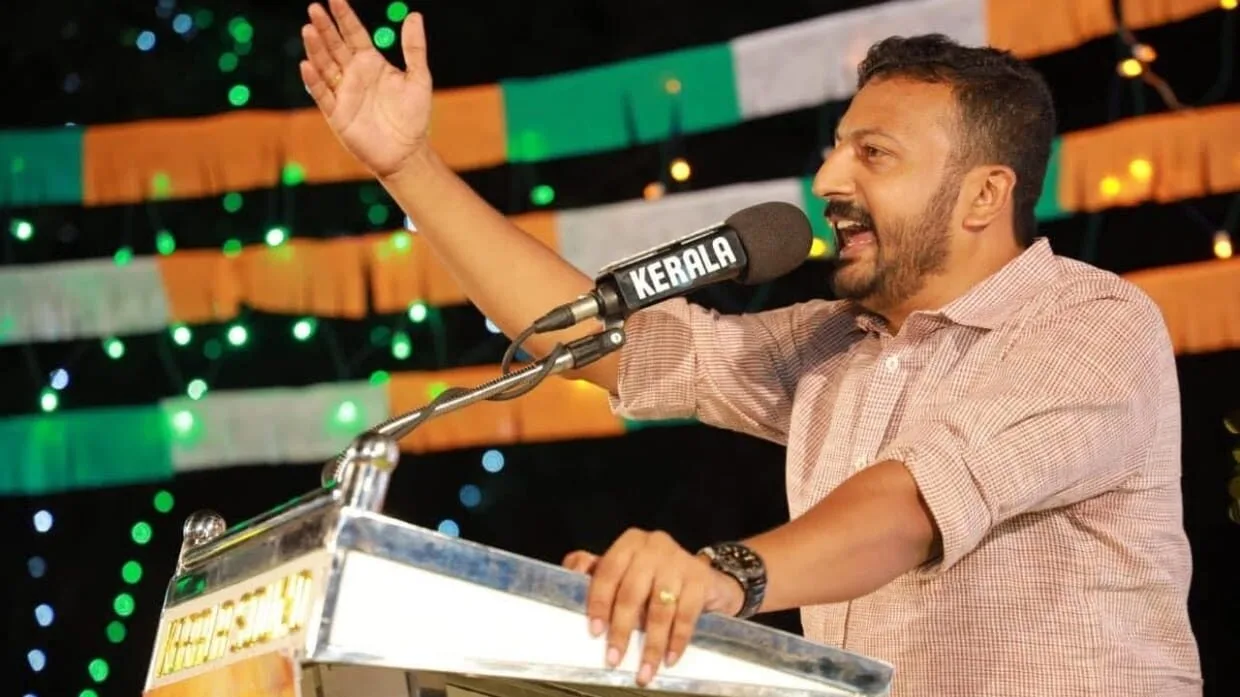
More than at protest grounds or party gatherings, Rahul’s face became a familiar presence on television news debates and across social media walls. Ordinary voters online hailed the “young blood” as a vibrant promise for the ailing Indian National Congress. Not a single leader — not even his predecessor and “comrade” Shafi Parambil — has tapped into the power of social media in the manner that Rahul did: organised, shrewd, and garnering a huge ‘fan following’.
The face in the ‘households’
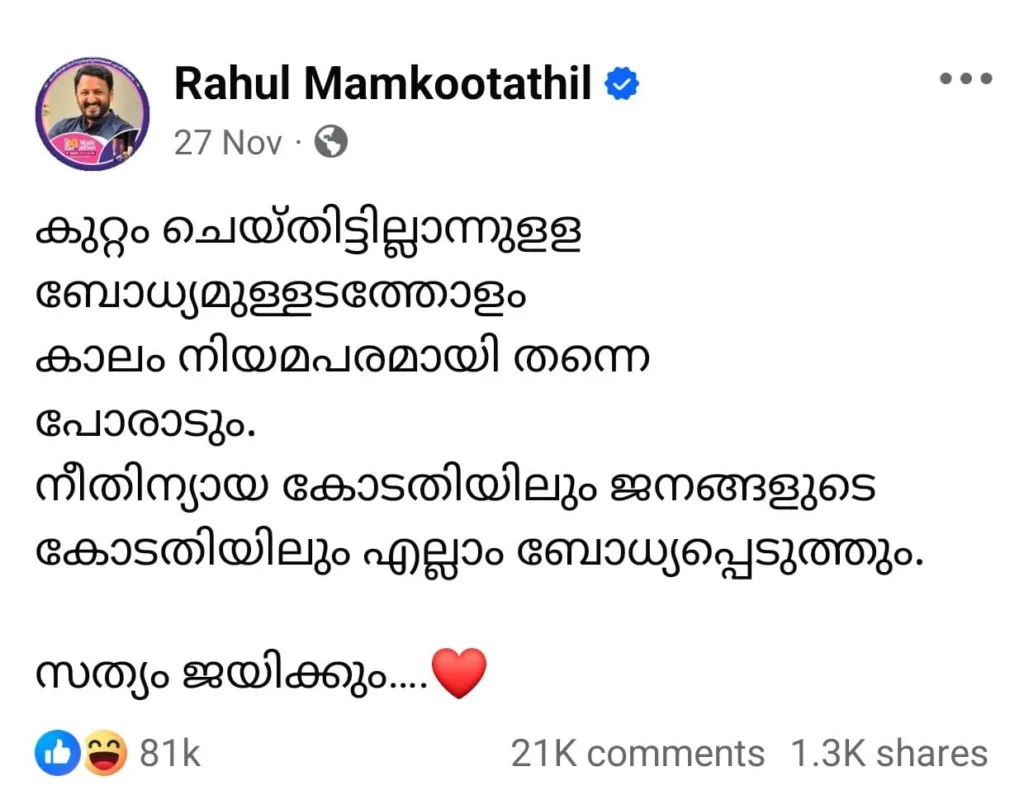
“As long as I have the conviction that I haven’t done anything wrong, I will continue to fight legally. I will prove everything in the court of law and the court of the people. Truth will win.” The last Facebook post shared by Rahul Mamkootathil on November 27 garnered over 80,000 likes and 1,300 shares.
One of the 20,000 comments on the post read like this: “Rahul, move forward legally. Full support. Oommen Chandy was also called a rapist in the media trial. What happened then? Chandy sir was a scapegoat that the ‘presstitutes’ got then. Now that scapegoat is you.” The comment itself has over 1,200 likes.
Rahul Mamkootathil’s active Facebook page has more than six lakh followers. It became active around September 2020. Till February 2021, he attracted fewer than 500 engagements per post. That began to change when he became an active presence in television news debates and started posting snippets of his arguments on his social media handles.
The first breakthrough came on February 20, 2021, when he posted a clip from a prime-time debate on Mathrubhumi News, where he was seen speaking about the flawed PSC appointments by the Kerala government. The video got over 92,000 views and more than 2,000 likes. Comments praised his speaking prowess and said he should have entered channel debates earlier. A week later, another Mathrubhumi debate got him 1 million views, more than 10,000 likes, and 1,300 shares.
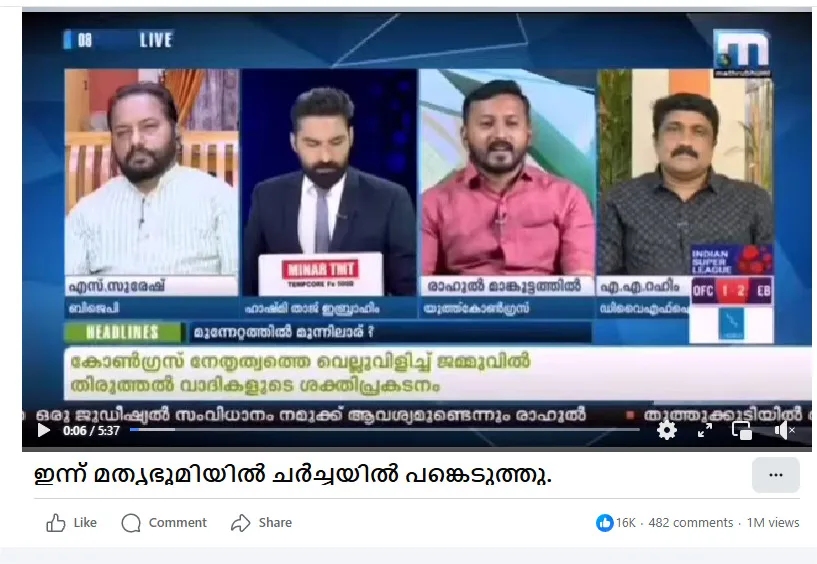
In retrospect, that must have been the moment Rahul realized the immense potential of the digital world to boost his political growth.
In March, he posted 19 channel debate snippets, which consistently garnered between 50,000 and 5 lakh views. He participated in debates on a wide array of topics, including faith, irregularities in voters’ lists, the love jihad controversy, and Pinarayi Vijayan’s PR work. The comment sections often highlighted the “proper homework he does” for these debates, as he was seen speaking with the support of official documents such as Parliament and Assembly question answers, court orders, and official statistics — something none of his contemporary Congress spokespersons had done on public platforms.
In these debates, he made remarks such as, “CPI(M) is the breeding centre for BJP in Kerala,” which drew a significant amount of ire from Kerala’s Left. Over time, he was seen making pointed comments about prominent CPI(M) leaders, including Pinarayi Vijayan and P.K. Kunjananthan. The tone of scoffing in his captions gave his posts huge traction, and ‘fans’ celebrated them as ‘political fearlessness’.
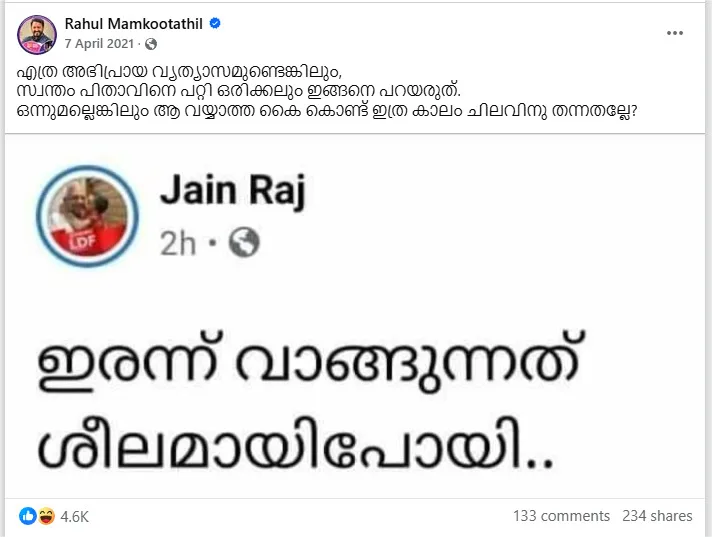
By the next year, every one of his posts began gathering around 10,000 likes on average. He documented the programmes and protests of the Youth Congress and other activities in professional, high-quality videos and photos.
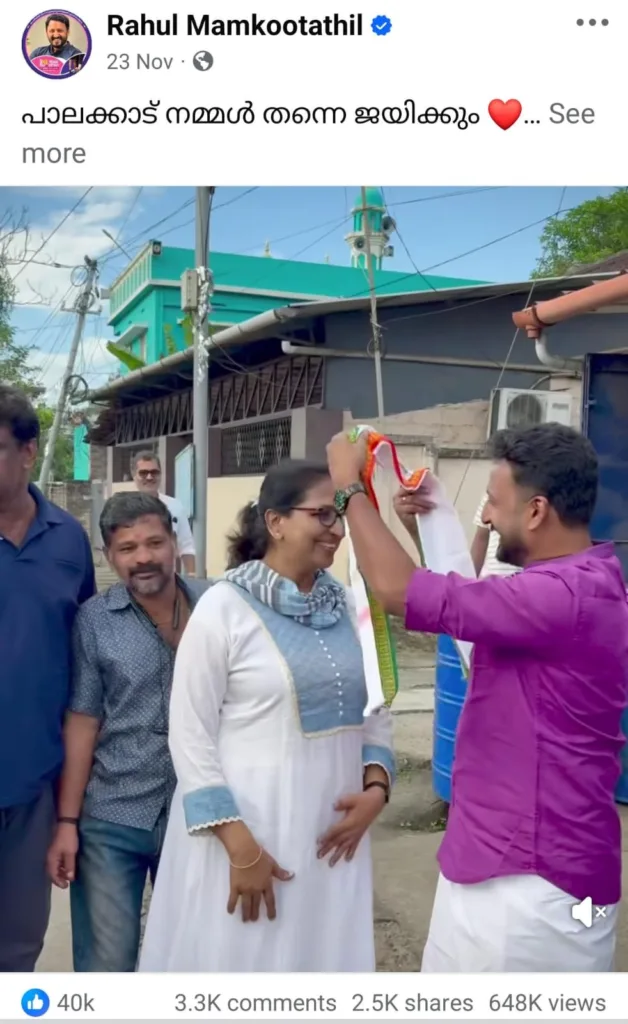
Rahul also utilised the power of Instagram and Facebook reels very effectively early on. Even after he stepped down from Congress positions in August, he posted reel videos of him campaigning in Palakkad, carrying forward the activities of the SMILE housing scheme (SMILE is an MLA’s initiative to construct and provide houses to eligible families in the Palakkad constituency) taking part in the Kalpathi Ratholsavam (an annual temple festival in Palakkad), and even personal celebrations. They continued to garner around 20,000–50,000 likes.
‘Pages of Praise’
When the first complaint was filed, a huge uproar broke out on social media, attacking the survivor tooth and nail. It came from people holding official positions in the Congress to entertainment pages that are not usually associated with politics. All of them tried to project the entire episode as an attempt to destroy the rising career of Rahul Mamkootathil.
There are many pages, accounts, and groups on Facebook and Instagram that identify themselves as “fans” or “supporters” of Rahul. Many of these were formed around 2021–22, the period when he rose to prominence. These pages have been an important source of amplifying his views and activities, framing him as “the firebrand youth of the Congress.” One such page, called the “Rahul Mamkootathil Brigade,” is a Facebook page with over 25,000 followers. The page was last active in 2023. They had a multitude of Rahul’s pictures, with captions praising his courage, his public statements and activities.
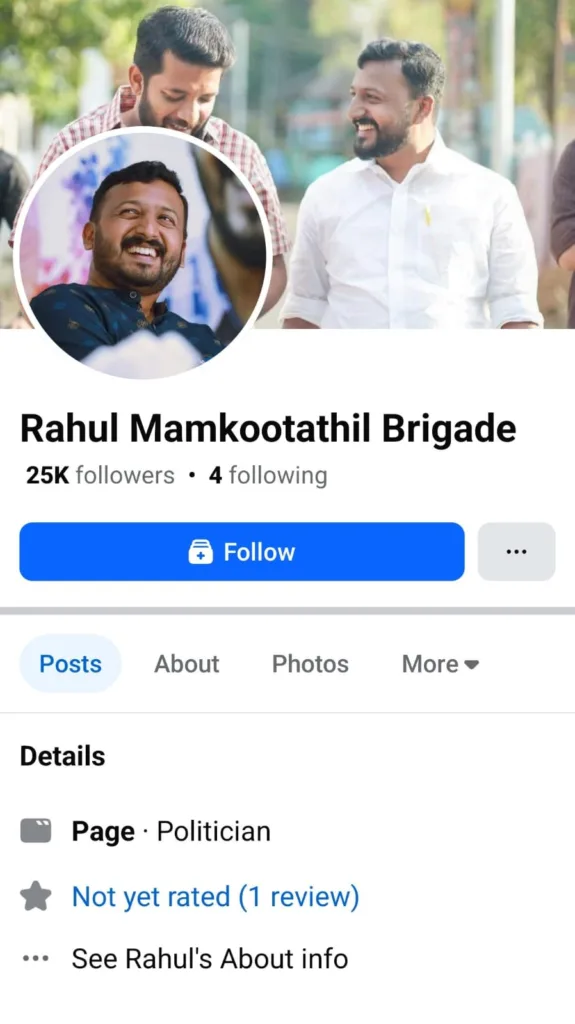
Another public group, called the “Rahul Mamkootathil followers,” was started in 2021 and is still active. The group has 2,703 members (23 members were added in the last week). Most of the recent posts talk about how this issue is used as a smokescreen to shield the Sabarimala issue and about CPI(M) members who have previously been accused in sexual assault cases.
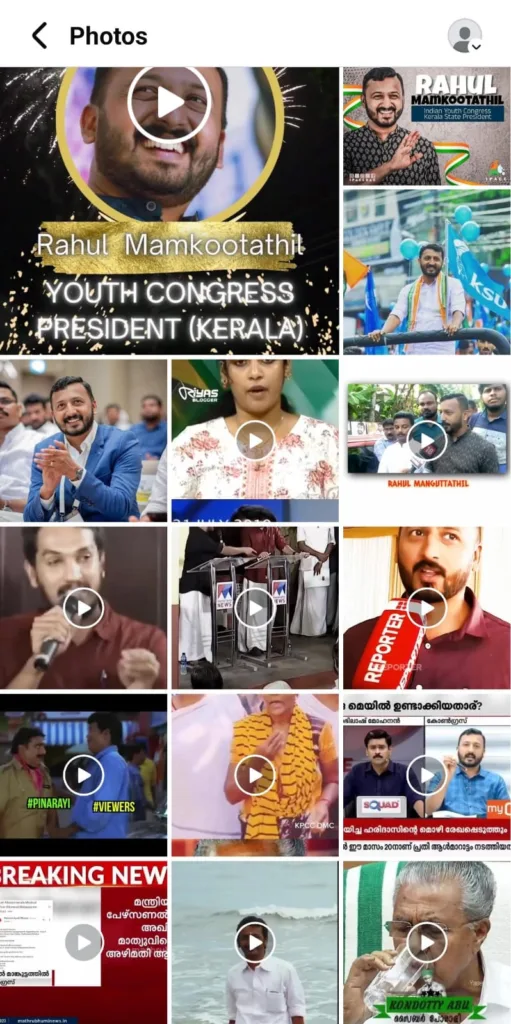
Groups such as Rahul Mamkootathil Fans Association, Rahul Mamkootathil Supporters, and other similar pages have over 2,000 members each. Back in 2023, these groups posted photos of Rahul with captions like “a man of powerful words” and “powerful orator.” They also regularly featured Rahul’s prime-time discussions and speeches. Similar accounts on Instagram also have over 30,000 followers and have been active in Rahul’s election campaigns and activities undertaken as an MLA.
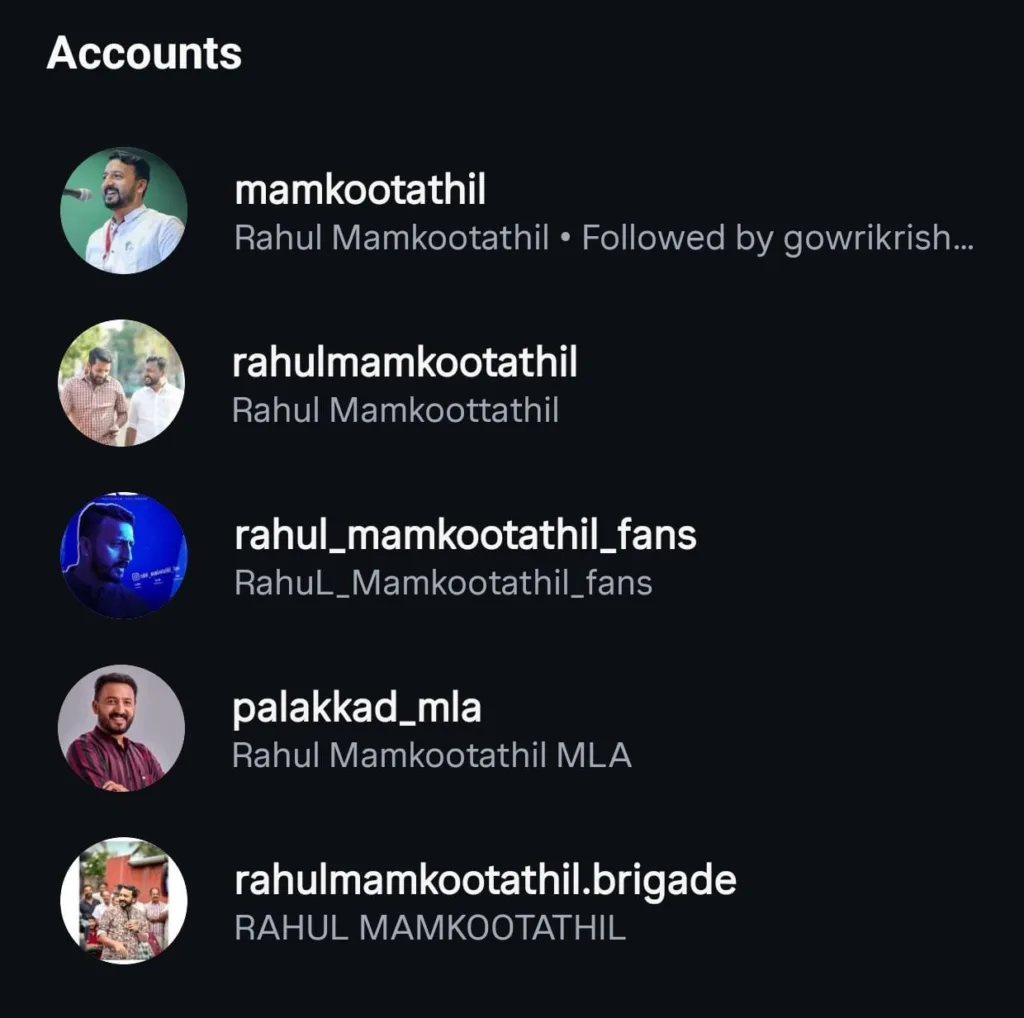
More than these ‘open fans’ wooing over him, many so-called “neutral” pages have also played a role in promoting his presence. Mollywood Connect posted a picture of him with the caption “unconditionally with him” on November 27. Tracing back to 2023, pages like Kalayanthayani Kazhchakal, which has over 1 million followers, posted a video of Rahul speaking against Veena Vijayan, Chief Minister Pinarayi Vijayan’s daughter. The page captioned it, “You could have stopped killing him, but you went on to cut him into pieces,” a remark suggesting how brutally he roasted the CPI(M).
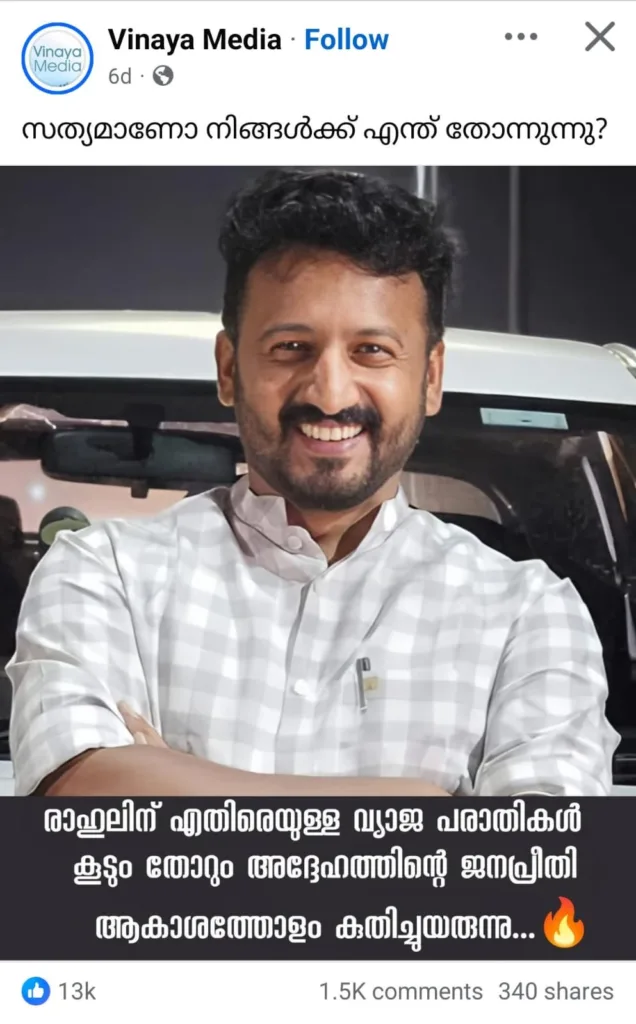
In the course of his massive social media growth, Rahul was also featured on many entertainment pages, hailing him as an “upcoming star.”
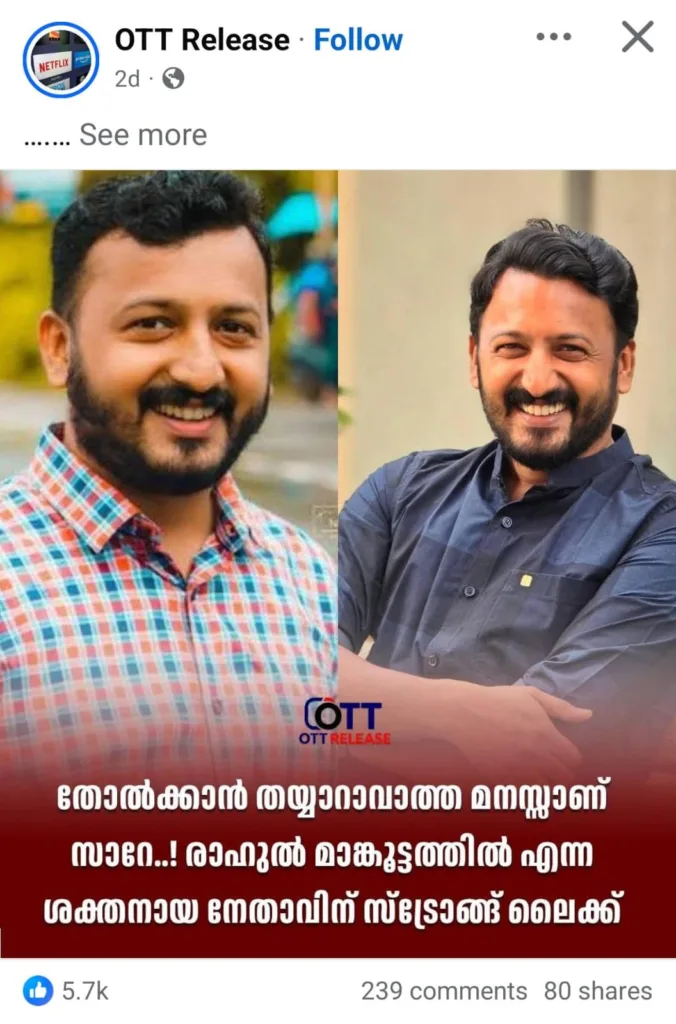
As many critics have noted, the induction of young party workers is always a welcome move in politics. However, if it shrinks to mere “displays of action” on social media, there are bound to be serious repercussions. How a leader forged his way to higher positions in a parliamentary party through the strategic support of a planned social media presence is plainly evident in the case of Rahul Mamkootathil. However, it also raises ethical questions about where to draw the line when one relies entirely on the nuances of such strategies. It led to a dramatic rise, but the ‘dedicated fans’ also turned their loyalty into an assault on survivors of severe trauma.
What awaits the fallen leader in the realms of social media that once raised him, and the courts of justice, remains to be seen in due course.