
Do Trade Unions Stall Growth? A Data Check
Strikes are often blamed for slowing industry—but the data tells a different story. Across sectors and states, growth continues despite labour unrest, challenging a long-held belief.
The idea that worker strikes and stubborn trade unions are holding back industrial growth has been around for a long time. It is often repeated in films, literature, and now on social media. But this widely held belief does not match the facts. The data tells a different story. Are workers and trade unions really the villains standing in the way of economic progress? Government statistics suggest otherwise. This is a special report prepared by OBC on International Workers’ Day.
A workers’ strike that began on April 13 in Noida, Uttar Pradesh, has now gone on for more than two weeks. The strike, which demands higher basic wages, has achieved some success so far. Yet, in the comment sections of news reports—and in public discussions more broadly—you often see the same reaction: “This strike will destroy the industry.”
This reaction was not limited to the Noida strike. Similar claims were made during the Samsung plant strike in Chennai in 2024 and the Indian Oil refinery strike in Panipat earlier this year. The idea that worker strikes are harmful to the nation continues to dominate public opinion. But do labour disputes really slow down industrial growth? OBC takes a closer look.
The Labour Bureau Report
The Labour Bureau, under the Union Ministry of Labour, publishes an annual report on industrial disputes in India. The latest report, Statistics on Industrial Disputes, Closures, Retrenchments and Lay-offs in India, was released in 2023. When we compare the data in this report with the Gross State Value Added (GSVA) of different states, one thing becomes clear: labour disputes have little to do with economic and industrial growth.
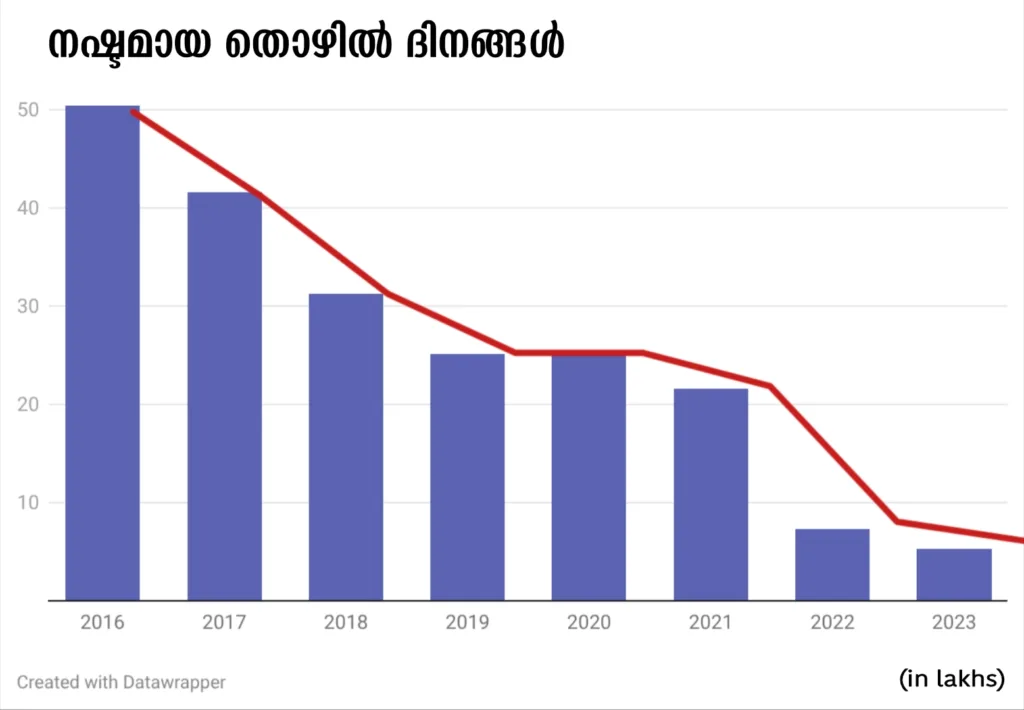
According to the report, there were 50 industrial disputes across the country in 2023. Of these, 42 were handled by state governments, while the rest were at the national level. The term “industrial disputes” includes both worker strikes and employer-led lockouts, where owners shut down operations. The report only counts disputes that affected more than ten workers.
Food Manufacturing Sector
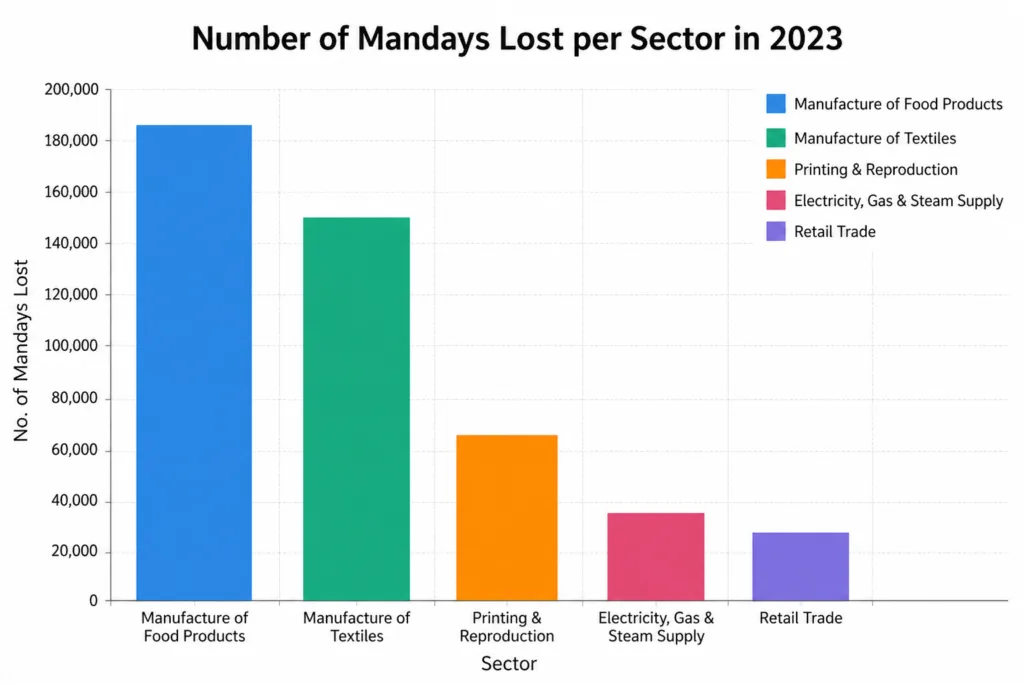
The report shows that most disputes in 2023 occurred in the manufacturing sector. Out of 50 disputes, 34 (68%) were in this sector. Within manufacturing, the food sector recorded the highest number of working days lost.
In 2023 alone, 1,85,529 working days were lost in food manufacturing—37.5% of the national total. (“Working days lost” refers to the total number of workdays missed due to disputes. For example, if 10 workers miss one day, that counts as 10 working days lost)
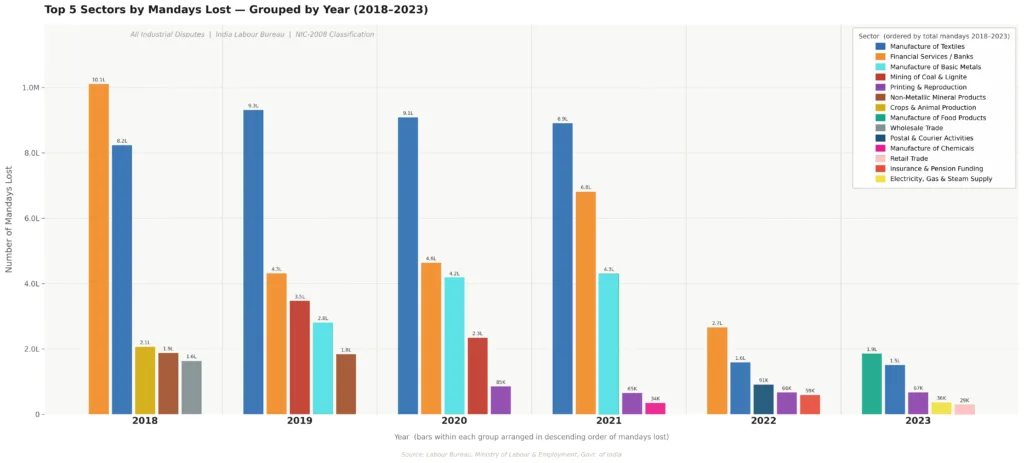
We examined Labour Bureau data from 2016 to 2023. In six of those years, food manufacturing had the highest number of working days lost. At first glance, this may seem serious. But the bigger picture tells a different story.
Government data shows that the food manufacturing sector still grew by 5.35% during this period. The Press Information Bureau, citing the Ministry of Labour, notes that the sector has become an important part of the economy in terms of GDP, jobs, and exports.
In short, even the sector with the most lost workdays continued to grow steadily.
Textile Manufacturing Sector
The textile sector also saw a high number of lost working days during this period. The ongoing Noida strike includes many garment workers. In July 2025, textile workers in Ludhiana also went on strike against the new Labour Codes.
Labour Bureau data shows that textile manufacturing was among the top five sectors for lost working days from 2019 to 2023, ranking second in 2023.
But did this affect growth? The answer is no. From 2019–20 to 2025–26, the textile sector grew at an average rate of about 10% per year. In 2023, exports from this sector rose by 4.7%.
Basic Metals Sector
The basic metals sector is another often affected by labour disputes. Since 2015, it has regularly appeared among the top sectors for working days lost. Between 2019 and 2021, it ranked first for three straight years.
However, production data tells a different story. According to the Index of Industrial Production (IIP) for 2024, this sector made the largest contribution to industrial output, at 7.8%.
In simple terms, even sectors with frequent disputes continue to grow.
State-wise Data
The Labour Bureau also provides state-level data, including the number of disputes, working days lost, and production losses. This data again leads to the same conclusion: labour disputes do not slow down overall growth.
If the common belief were true, states with more disputes should show weaker growth in their GSVA. But that is not what the data shows.
Kerala
In 2023, Kerala recorded the highest number of working days lost. It also has the largest number of registered trade unions in the country—over 13,000.
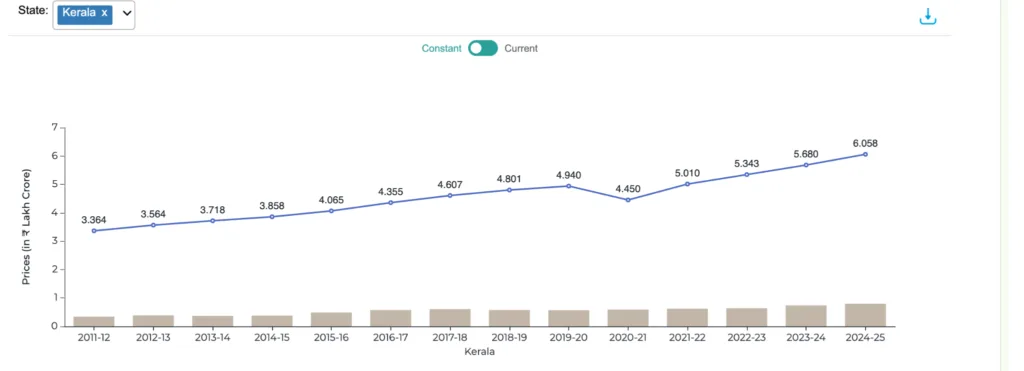
That partly explains the higher number of workdays lost. Interestingly, Kerala had only three disputes in 2023, two of which were lockouts. But these few disputes led to a large number of lost workdays because many workers took part.
Even so, Kerala’s industrial growth was not affected. In 2023–24, the state’s manufacturing sector grew by 15.32%—its highest growth in seven years.
Tamil Nadu
Tamil Nadu recorded the highest number of disputes in 2023—15 in total, or 30% of the national figure. These disputes led to 145,808 working days lost.
Despite this, the state’s manufacturing sector grew strongly. In 2023–24, GSVA in manufacturing increased by about 12.59%, compared to just 0.83% the previous year.
During the 38-day strike at the Samsung plant in Sriperumbudur in 2024, the company reported major losses. Yet the state’s overall industrial growth still improved.

This shows that while strikes may cause short-term losses, they do not stop long-term growth.
West Bengal
West Bengal is often cited as an example of how labour movements can damage industry. But research challenges this claim.
A 2011 study by the University of Connecticut found no strong link between worker strikes and industrial decline in the state. In fact, many shutdowns were due to employer-led lockouts, not worker strikes.
The study also pointed to the central government’s Freight Equalisation Policy of 1952, which reduced Bengal’s natural advantage by making raw materials equally available across states. This played a major role in shifting industries elsewhere.
Further Evidence
Other studies support the same conclusion.
A 2022 study using Labour Bureau data found that labour disputes do not affect long-term industrial growth. Most disputes are short and temporary. While they may cause losses for a brief period, they do not have lasting effects. The study also found that the number of disputes has decreased over time in many states.
The claim that worker strikes destroy industries is not supported by data. Strikes can cause short-term disruptions, but they do not lead to long-term decline. At the same time, strikes are one of the ways workers assert the value of their labour. History shows that many worker rights were won through such struggles.
So while strikes may slow things down for a short time, they have not stopped industrial growth in India.
(This is an AI-assisted translation of an article originally written in Malayalam, produced under editorial supervision)