From Civic Sense to Crime: How Japan-Based X Accounts Target Indians
Japan’s proposed India-Japan workforce exchange has become a target for online anti-Indian narratives. OBC traces how Japan-based X accounts use isolated incidents, recycled videos and misleading claims to portray Indians as uncivilised, criminal and a threat to Japanese society.
On 29 August 2025, the Prime Minister’s Office in India issued a press release detailing an action plan for Human Resource Exchange and Cooperation to facilitate the movement of workers, students, and skilled professionals between India and Japan. The plan set an aspirational target of exchanging more than 500,000 people between the two countries over five years, including 50,000 skilled personnel and potential talents from India to Japan.
On 30 July, Minister of State for External Affairs Kirti Vardhan Singh informed the Rajya Sabha that the initiative focuses on capacity building and skill development through vocational training, internship programmes, exchanges of researchers and students, and the promotion of Japanese language education in India.
OBC traced a series of social media posts on X that were shared at regular intervals, highlighting the alleged drawbacks for Japan of accepting migrants from India.
This OSINT report examines online hate targeting the proposed exchange of skilled workers between Japan and India.
‘Indians have low civic sense ’, claim Japanese X accounts.
In July, a video allegedly showing an incident on the Delhi metro surfaced online, displaying a group of women crawling under automated gates to avoid paying the fare. Children accompanying them were also seen imitating their actions. The footage drew online criticism, with users questioning the women’s behaviour and raising concerns about civic sense and the apparent lack of intervention by security personnel.
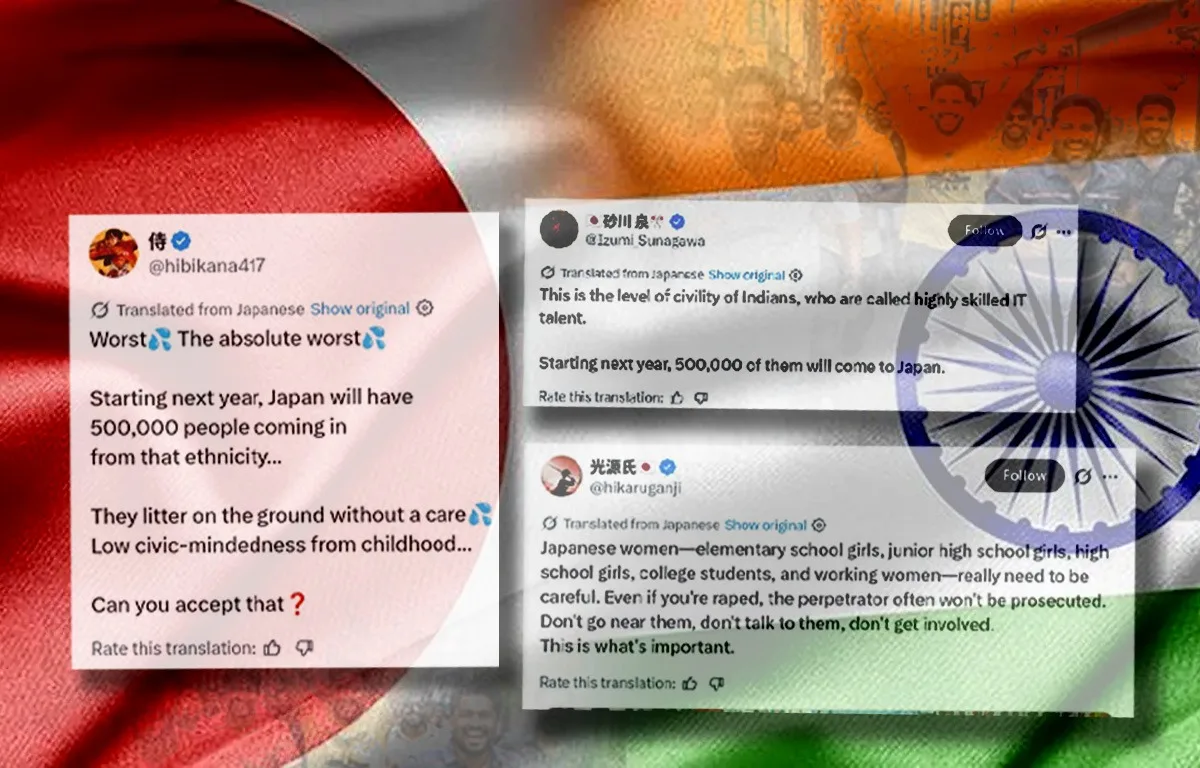
On 25 July, the Japan-based X account @hibikana417 shared a video. It claimed that Indians were an ethnic group with a ‘negative level’ of civic sense, before asking whether Japan would remain the same after 5,00,000 people arrived.

As of 9 September, the post had garnered 10,700 views, 416 likes and 203 reposts.
The responses to the post extended the criticism beyond the incident depicted in the video. Several users framed the incident as evidence of the alleged consequences of increased immigration and multiculturalism, suggesting that such incidents would become common in Japan if more Indians were allowed to migrate to Japan.
One user stated that their perception of Indians had changed because of the video, while another blamed foreign migrants for wider problems in Japan.
On 7 September, the same video was shared by another Japan-based X account, @karei719016, which described the incident as representative of the ‘civility’ of Indians and questioned whether they could be considered highly skilled talent.

Two separate Japan-based X accounts shared the same video on 6 September and 7 September.
On 6 September, the account @Izumi_Sunagawa shared the footage and described the women’s actions as representative of the ‘civility of Indians’, while linking the incident to the proposed arrival of 5,00,000 people in Japan.

On the following day, @karei719016 shared the same video with a similar narrative, questioning whether Indians described as highly skilled IT talent possessed civic sense. The post again linked footage of a specific incident in India to the proposed human resource exchange between India and Japan. The post projected a generalised view of Indians’ civic sense based on the incident captured in the viral video.
After sharing the video on 25 July that allegedly depicts Indian women evading security gates at Delhi Metro, X account @hibikana417 shared another video on 6 August that reportedly shows a group of children refusing to pick up the trash they had dropped after Ameana Finds, a Russian Tourist, called them out.

The footage also shows the children deliberately littering the street to tease her.
The video, initially shared on Ameana Finds’ personal Instagram account, caused an online outrage in October 2025. We identified that the same video was recycled in August 2026 to propagate a generalised view that Indians have low civic sense and that even Indian children are not trained on how to behave in public spaces. @hibikana417 used the video to promote a negative narrative about Indian migrant workers who could come to Japan.
Portraying Indians as criminals
The narrative was not limited to civic sense; several Japanese accounts also suggested that welcoming Indian professionals could ‘derail’ Japan’s law and order. On 6 May, X account @zetu_rrr shared a post claiming that Japan is planning to accept workers from India despite what the account describes as a high crime rate in India. The post presents several crime-related statistics, including claims that India’s murder rate is 12 times higher than Japan’s and that its reported rape rate is 31,677 cases per year, while suggesting that many crimes go unreported.
The footage shared in the post reportedly shows what appears to be the body of a suspicious young woman lying outside a boundary wall in Punaichak, Patna, Bihar.

The post then links these claims to India’s policy of sending workers to Japan, stating that Japan could receive 100,000 Indian workers per year and questioning whether criminal background checks based on an Indian “certificate of no criminal record” would be sufficient.
On 15 August, another Japanese X account, @hikaruganji, warned Japanese women and girls to be cautious around what it described as “foreign men”. Alongside a synthetic image showing a group of Indian men in Japan, the post tells women to avoid approaching, speaking to or becoming involved with them, while claiming that even in cases of rape, perpetrators often escape prosecution, thereby portraying Indian men as a threat to Japanese women.

In response to the post, one user wrote, “I live overseas. Soon half a million people from India, the world’s rape capital, will be coming in, and rape will become an everyday occurrence. Indians rape children and the elderly too.” Another user stated, “Japan might end up needing to escort kids to and from school too, huh. In the end, the working class will probably cry out in agony.”
Video from Bangladesh shared as that from India.
Among the chain of posts that roughly started to circulate online since October 2025 targeting Indians, we also found visuals from Bangladesh falsely shared as footage from India. On 20 July, a Japanese X account @miracle_358 shared a video under the headline ‘Smartphone Thefts Rampant in India’. The footage shows an individual standing alongside a moving train, swinging a stick towards a passenger holding a mobile phone in the doorway, attempting to snatch the device.

The caption further links the alleged thefts to the proposed arrival of 500,000 Indian personnel in Japan, framing Indian migration as a potential social and security concern.
As of 10 September, the post had received over 35 lakh views.
An examination of the viral video revealed that the train featured in it is run by Bangladesh Railway, not Indian Railways. This confirms that a video from Bangladesh was widely shared as if it were from India.
The posts examined by OBC show a recurring pattern of using isolated incidents, misleading narratives and unrelated visuals to portray Indians as a threat to Japan’s civic order and public safety. In several cases, these narratives were directly linked to the proposed India-Japan human resource exchange, turning a bilateral workforce initiative into a vehicle for anti-Indian sentiment. The posts show how X accounts can use social media to amplify isolated incidents and construct a negative narrative around an entire nationality.

Sujith A
Open Source Intelligence Researcher and Mis/Disinformation tracker. Passionate about investigations and a big fan of Sherlock Holmes.
View all posts by Sujith A