Same Accounts, Different Crises: Mapping India’s Online Hate Ecosystem on X
From boycott campaigns to communal flashpoints, the same high- reach X accounts repeatedly reappear across India’s biggest online controversies. This OSINT investigation maps the recurring ecosystem that amplifies hashtags, misinformation,and hate narratives between 2019 and 2026.
In 2020, during the COVID-19 lockdown phase, the hashtag #CoronaJihad gained traction on X following a Tablighi Jamaat gathering that occurred in New Delhi. The hashtag was widely shared online using misleading claims and recycled videos to portray Muslims as deliberately spreading the virus.
In August 2022, hashtags such as #BoycottLaalSinghChaddha and #BoycottBrahmastra continually trended on X as boycott campaigns targeted some of Bollywood’s biggest releases. In the case of Laal Singh Chaddha, the 2022 Hindi film starring Amir Khan, his previous remarks about the rising intolerance in India had been resurfaced. He expressed this opinion at a public event organised by The Indian Express during the eighth Ramnath Goenka Excellence in Journalism Awards 2015. The 2022 bollywood film Brahmastra, which featured Ranbir Kapoor in the lead role, faced similar scrutiny. This was followed by an old video in which actor Ranbir Kapoor jokingly referred to himself as a ‘beef person’, prompting allegations that he had insulted Hindu sentiments. Similarly, in September 2022, Saif Ali Khan’s ‘Vikram Vedha’ also faced backlash on X, citing that the actor named his son after an Islamic ruler.
Previous reports by Offbeat Concerns have examined hate campaigns, boycott trends, and misleading claims targeting communities, public figures, and companies. Across multiple investigations, the same pattern emerged. Boycott campaigns against brands such as Surf Excel, Tanishq, FabIndia, Lenskart, and Malabar Gold & Diamonds were fuelled by recurring hashtags, communal framing, and rapid amplification on X. Our investigations also documented how false claims targeting iD Fresh Food and Lulu Mall spread through the same ecosystem, turning isolated posts into nationwide outrage.
The pattern extended beyond corporate targets. A separate OSINT investigation found that Kerala itself became the subject of sustained online campaigns linking the state to religious conversion, demographic change, extremism, and anti-Hindu narratives through recycled videos, misleading captions, and coordinated amplification. Despite the different targets, the methods remained remarkably consistent.
Using public posts, fact-checks, archived material, and hashtag searches, this OSINT report maps a set of X accounts active between 2019 and 2026. The list includes ideological pages, media-style handles, influencers, and anonymous accounts.
Not all of them play the same role. Some introduce a narrative. Others give it reach through reposts, commentary, and repeated hashtags. The available evidence does not establish that every account is centrally coordinated. However, it does show a recurring pattern: different targets, different hashtags, and often the same accounts.
This report traces how online outrage became a repeatable ecosystem.
From Outrage to Infrastructure
These online outrages often start with a short video, an unverified claim, a film scene, a political speech, or a local incident. But once a narrative finds an audience, it quickly moves beyond the original post.
Between 2019 and 2026, this pattern became increasingly visible on X. Hashtags turned isolated incidents into national debates. Boycott calls were repeated across accounts. Old videos were recirculated with new captions. Claims that had already been debunked often returned during a fresh controversy.
While the majority of these campaigns were communal in nature, others targeted films, companies, journalists, public figures, or states such as Kerala. For example, Surf Excel’s Holi advertisement was framed as an attack on Hindu sentiments, Tanishq’s interfaith ‘Ekatvam’ campaign was pushed into a ‘Love Jihad’ controversy, FabIndia faced backlash for using the Urdu phrase ‘Jashn-e-Riwaaz’ for a Diwali collection, and Lenskart was targeted through viral claims that it had banned Hindu symbols in the workplace.
The fact that these trends depend on accounts with large followings and similar political lines — which often initiate them, helping the narrative travel further and remain visible for longer — gives the outrage the shape of an infrastructure.
The Accounts Behind the Trends
We focus on ten X accounts that have frequently appeared in online campaigns involving communal claims, boycott calls, and hostile narratives targeting religious minorities. A common thread among these accounts is their substantial online reach and repeated propagation of fake news, communal narratives, and boycott trends.
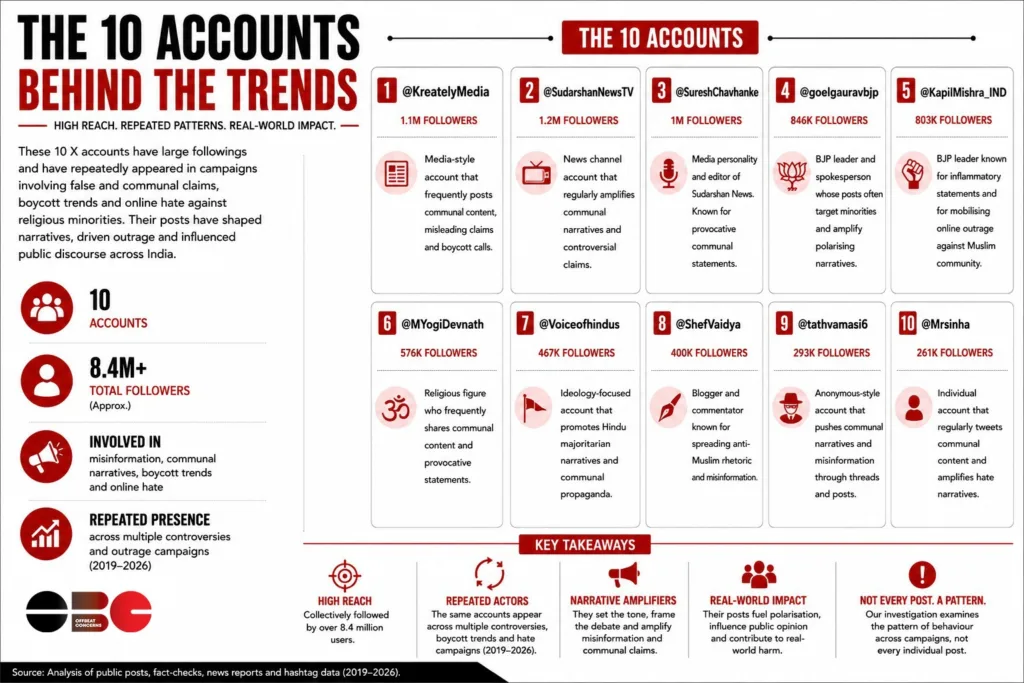
Their influence does not rest only on follower counts. A post from a prominent account can give a claim legitimacy, introduce it to a larger audience, or provide material for smaller accounts to repeat. Once that happens, a narrative can travel across X through screenshots, reposts, replies, and hashtags.
The accounts examined surfaced across three broad categories of online outrage: communal narratives, boycott campaigns and misinformation. Between 2019 and 2026, the accounts appeared in trends targeting advertisements, films, companies and public figures. The targets ranged from Surf Excel and Tanishq to FabIndia, Malabar Gold & Diamonds, A.R. Rahman and Bollywood films such as Laal Singh Chaddha, Brahmastra and Vikram Vedha. Although the triggers varied, the campaigns often relied on repeated hashtags, screenshots, reposts and calls for economic or cultural boycotts.
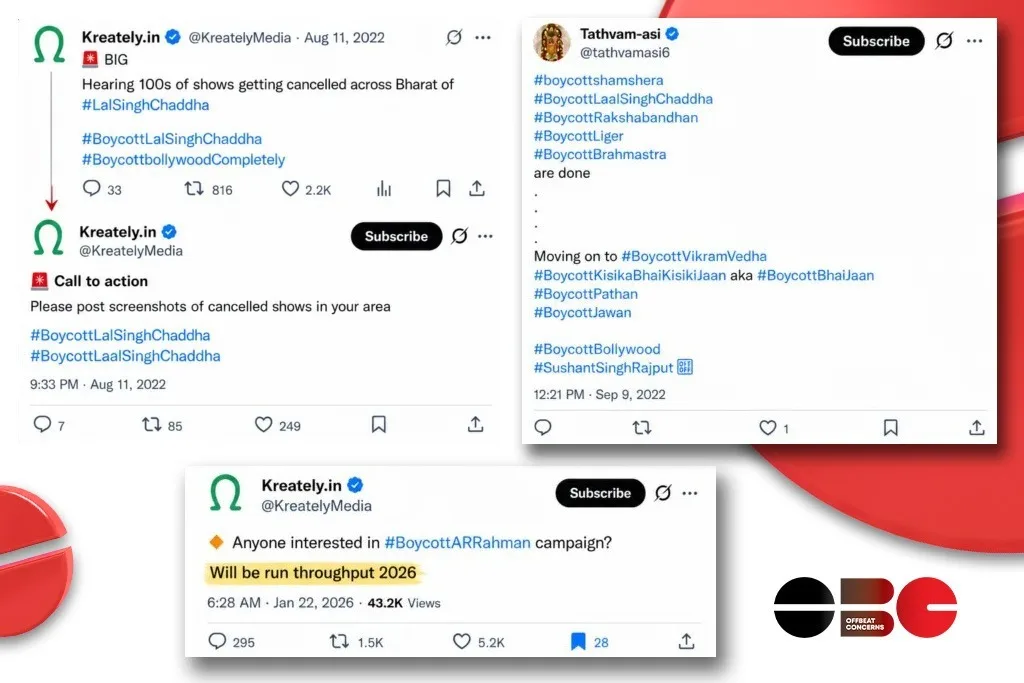
The third category involved misinformation and misleading claims. Fact-checks, News reports, and previous Offbeat Concerns investigations have identified multiple instances in which old videos, unrelated visuals, or misleading captions were circulated during communal controversies. In several cases, the same accounts that appeared in boycott campaigns also featured in the spread or amplification of disputed claims. Taken together, these incidents reveal a recurring pattern.
The Same Accounts Across Boycott Trends
The overlap becomes clearer when boycott trends are viewed over time. Between 2019 and 2026, the same set of accounts appeared across campaigns targeting brands, films, tourism, public figures, and organisations.
In 2019, @SudarshanNewsTV and @SureshChavhanke were involved in posts around #BoycottSurfExcel. A year later, @SureshChavhanke, @MeghUpdates, and @SudarshanNewsTV appeared in the #CoronaJihad conversation, while @KreatelyMedia, @tathvamasi6, @SudarshanNewsTV, and @SureshChavhanke featured in posts around #BoycottTanishq.
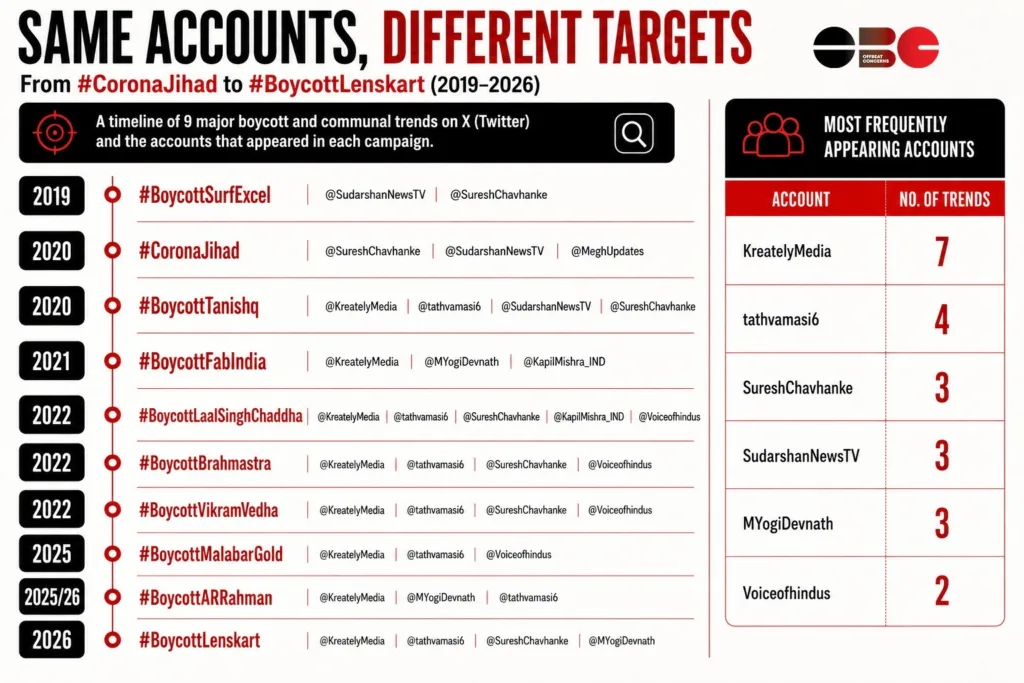
The pattern continued. @KreatelyMedia appeared in campaigns such as #BoycottFabIndia, #BoycottLaalSinghChaddha, #BoycottBrahmastra, #BoycottVikramVedha, and #BoycottARRahman. Other accounts reappeared alongside it: @MYogiDevnath, @KapilMishra_IND, @tathvamasi6, @Voiceofhindus, @MeghUpdates, and @ShefVaidya.
The recurrence of accounts suggests that boycott trends were not simply isolated reactions to separate events. They were sustained by an online ecosystem in which familiar accounts could return to push or amplify a new controversy.
Kerala as a Regional Target
Kerala was often targeted through online claims linking the state to religious conversion, extremism, alleged demographic change, and anti-Hindu hostility. An earlier OSINT investigation found that these narratives were pushed through recurring hashtags, misleading captions, and old or unrelated visuals.
Local incidents were routinely reframed as evidence of a wider communal crisis. For example,on October 22, 2025, @KreatelyMedia widely circulated footage of a private educational institution in Maharashtra as evidence of gender segregation in Kerala.
Furthermore, @KreatelyMedia amplified the #BoycottMalabarGold campaign by falsely suggesting that the company’s scholarship programme favoured Muslims. The account further targeted Kerala-based travel creator Maheen Shajahan, framing his visit to Sree Durga Bhadra Devi Temple, located in Aravallikkavu near Thodupuzha, Kerala, as an act of disrespect to the Hindu religion and amplified the communal outrage.
Similarly, on April 26, 2025, @tathvamasi6(Tathvam-asi) falsely claimed that footage of an Indian Union Muslim League rally protesting the Waqf Amendment Act showed Kerala Muslims celebrating Pakistan after the Pahalgam attack. The account also played a key role in propagating the #BoycottMalabarGold and frequently amplified ‘love jihad’ narratives by sharing videos of interfaith couples with communal captions.
The overlap with this investigation is notable. @KreatelyMedia and @tathvamasi6, both included in the wider dataset, were identified in the Kerala-focused probe as amplifying misleading or communal claims. It shows how accounts active in national outrage and boycott cycles could also turn a regional target into a wider online controversy.
The observed pattern between 2019 and 2026 suggests that online outrage in this ecosystem does not emerge as a series of isolated reactions but rather as a recurring, structured amplification cycle. Across multiple controversies ranging from brand boycotts and film-related campaigns to communal narratives and regional targeting, the same set of high-visibility accounts repeatedly appears, helping to shape, reinforce, and extend the reach of emerging hashtags.
Sujith A
Open Source Intelligence Researcher and Mis/Disinformation tracker. Passionate about investigations and a big fan of Sherlock Holmes.
View all posts by Sujith A