
Hormuz: The World’s Internet Chokepoint-Mapping the Fiber-Optic Cables Running Through a War Zone
Beneath the Strait of Hormuz lies one of the world’s most critical internet corridors. As conflict in the Gulf deepens,the undersea fiber-optic cables powering global data,finance and cloud networks are emerging as a new geopolitical pressure point.
The Iran war has moved beyond bombs and missiles, with countries focusing on diplomatic and strategic approaches to pressure each other. Since the start of the war on February 28, after the United States and Israel launched large-scale airstrikes, Iran has displayed strong control over the Strait of Hormuz, from controlling the energy shipments passing through it to increasing naval and drone deployments in the area to regulate the movements of authorized ships. By doing so, Iran has, in effect, derailed the global energy supply chain. Iran also formed the Persian Gulf Strait Authority, a body overseeing trade shipments passing through the strait.
Apart from energy trade, the Strait of Hormuz is strategically important to the global internet. This is because of the undersea fiber optics cables lying beneath the strait which facilitate internet connectivity across continents. A week ago, Iran warned of the disrupting these undersea cables if the United States does not agree to its demands..
This OSINT report explores the nature of these cables, their significance to global internet connectivity, and the potential consequences if Iran chooses to disrupt them.
What are undersea fiber optics cables?
People often imagine the internet as an invisible flow of data that is transmitted by satellites and huge towers. In reality, most of the global internet runs through physical cables laid across the seabed. These are undersea fiber optic cables-long strands of glass, often thinner than a human hair-protected by multiple layers of insulation and armour.
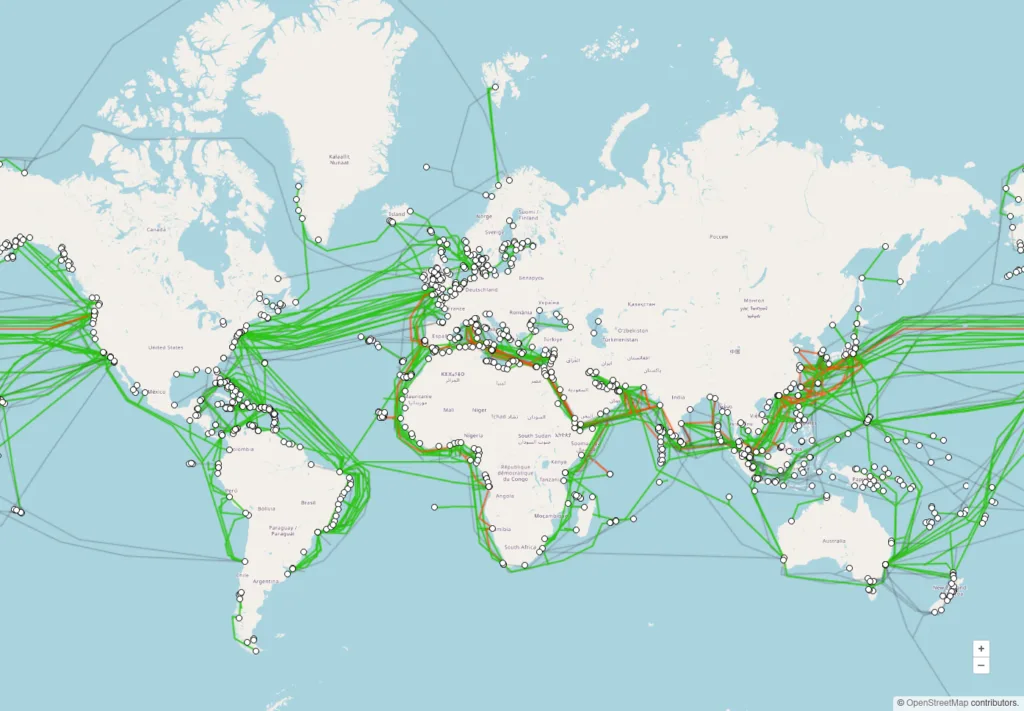
These cables carry almost everything that moves across the modern internet including financial transactions, cloud services, banking systems, video calls, social media traffic, military communications, and government data. Hundreds of active submarine cable systems connect continents through networks of landing stations spread across coastal cities and strategic maritime corridors.
Several of these cable systems pass through or near the Gulf region, linking Asia with the Middle East and Europe. The Strait of Hormuz is one of the key areas.
The cables passing through Hormuz
Important cables passing through the Strait of Hormuz are AAE-1 (Asia Africa Europe-1), FALCON, Gulf Bridge International (GBI), Tata TGN-Gulf, SEA-ME-WE Systems, and FIG (Future Infrastructure). Let’s look into these cables in detail.
AAE-1 (Asia Africa Europe-1)
AAE-1 is one of the major submarine cable systems linking Asia with Europe through the Middle East. Stretching nearly 25,000 kilometres, the system connects Hong Kong to France through multiple landing points across Southeast Asia, South Asia, the Gulf region, and Europe.
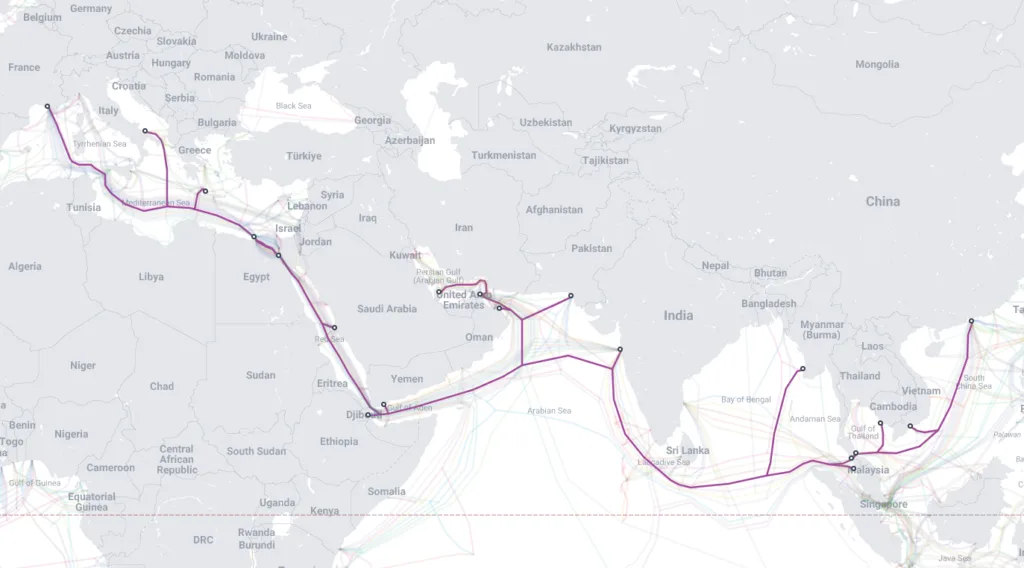
Key landing points for AAE-1 include Hong Kong, Vietnam, Thailand, Malaysia, Singapore, India, Oman, UAE, Qatar, Saudi Arabia, Egypt, and Europe. Telecom companies such as China Unicom, Djibouti Telecom, Hyalroute, Metfone, Mobily, National Telecom, OTEGLOBE, Ooredoo, PCCW, Pakistan Telecommunications Company Ltd., Reliance Jio Infocomm, Retelit, TIME dotCom, TeleYemen, Telecom Egypt, VNPT International, Viettel Corporation, Zain Omantel International, and e& owns it.
FALCON
FALCON links South Asia, the Gulf region, and parts of North Africa through the Arabian Sea and the Gulf. Operated by Global Cloud Xchange (GCX), the cable system was designed to connect several Gulf states through a ring-shaped network extending towards South Asia and Egypt.
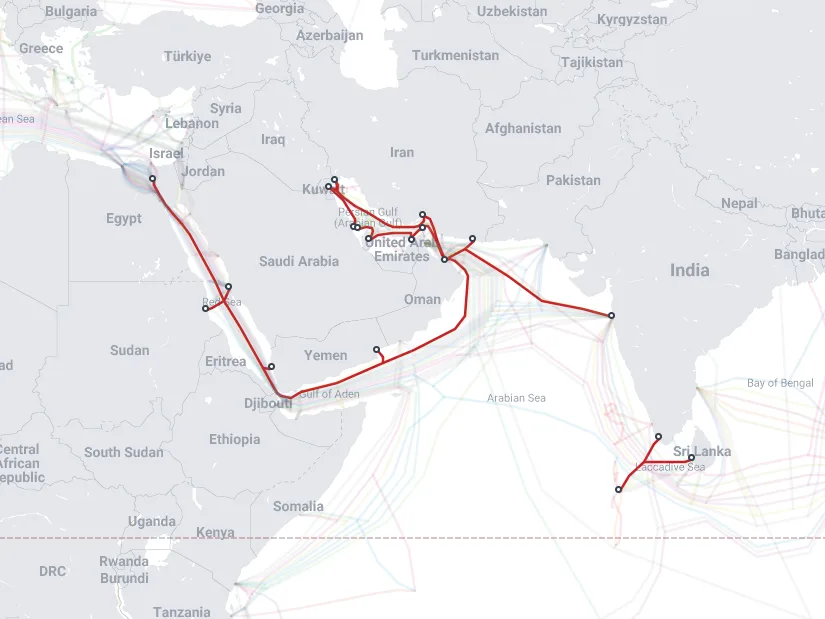
Key landing points for FALCON include India, Sri Lanka, Oman, the United Arab Emirates, Qatar, Bahrain, Kuwait, Saudi Arabia, Sudan, and Egypt. The system has a strong presence in the Gulf region, with several landing points located close to maritime corridors connected to the Strait of Hormuz and the Gulf of Oman.
The cable is owned and operated by Global Cloud Xchange (formerly FLAG Telecom/Reliance Globalcom). It supports telecom connectivity, enterprise communication, internet traffic, and regional data exchange across multiple Gulf countries and South Asian networks.
Gulf Bridge International (GBI)
Gulf Bridge International (GBI) is built primarily around the Gulf region. Headquartered in Qatar,Gulf Bridge International connects several Gulf countries through a regional cable system extending towards Europe and Asia.
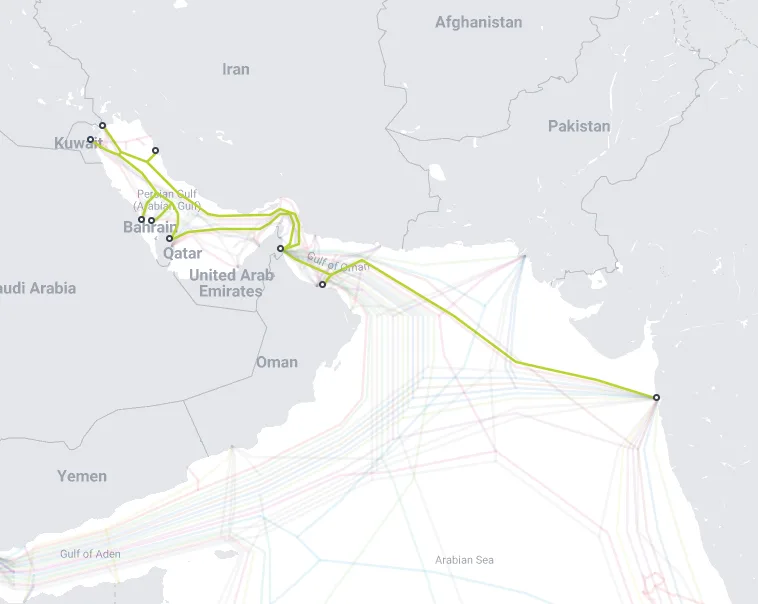
Key landing points for the GBI network include the United Arab Emirates, Qatar, Bahrain, Kuwait, Saudi Arabia, Iraq, and Oman. The system also connects Europe and Asia through additional international links.
The network supports telecom traffic, enterprise communications, financial systems, cloud infrastructure, and regional internet exchange across the Gulf states.
Tata TGN-Gulf
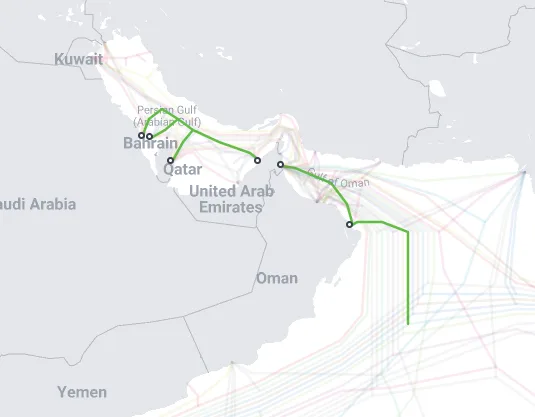
Tata TGN-Gulf connects the Gulf region with India and wider international telecom networks. Operated by Tata Communications, the system forms part of Tata’s larger global network infrastructure spanning Asia, the Middle East, Europe, and North America.
SEA-ME-WE Systems
SEA-ME-WE, short for Southeast Asia–Middle East–Western Europe, is a group of submarine fiber optic cable systems linking Southeast Asia with the Middle East and Europe. The SEA-ME-WE network includes SEA-ME-WE 4, SEA-ME-WE 5, and the upcoming SEA-ME-WE 6.
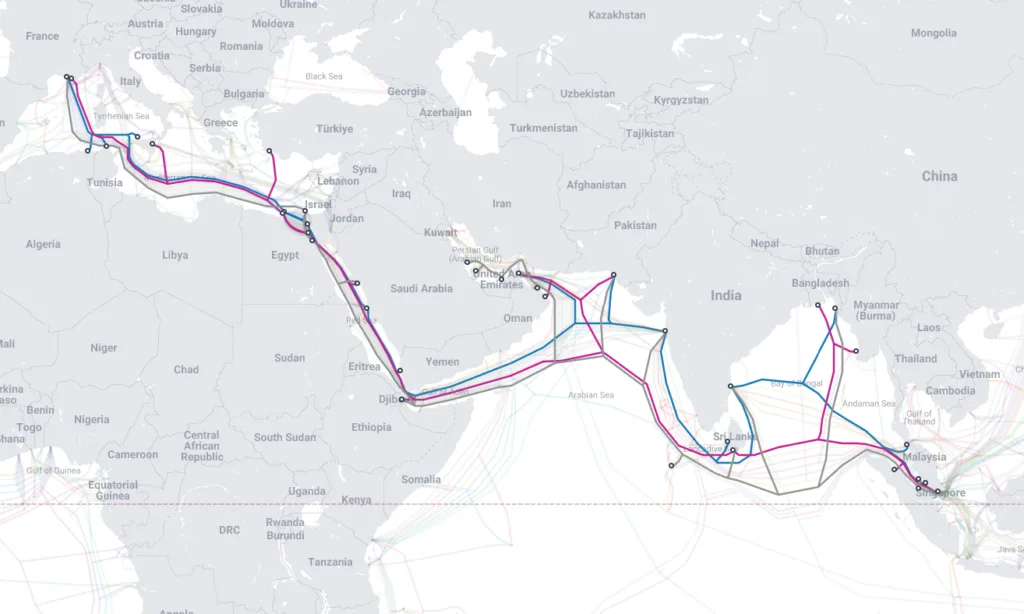
Key landing points across different SEA-ME-WE systems include Singapore, Malaysia, Thailand, Myanmar, Bangladesh, Sri Lanka, India, Pakistan, the United Arab Emirates, Oman, Saudi Arabia, Egypt, Italy, and France and the systems support a significant share of telecom connectivity, enterprise communication, internet traffic, and financial data exchange between Asia and Europe.
These submarine cable systems are owned and operated by consortia of leading international telecommunication operators, including firms like China Telecom, Singtel, Orange, and Bharti Airtel.
FIG (Fiber in the Gulf)
FIG, short for fiber in the Gulf, is a planned submarine and terrestrial fiber optic cable project intended to connect the Gulf region with Europe through Iraq and Turkey. The project is being developed as an alternative digital corridor linking the Gulf with European networks while reducing dependence on the region’s existing maritime chokepoints.
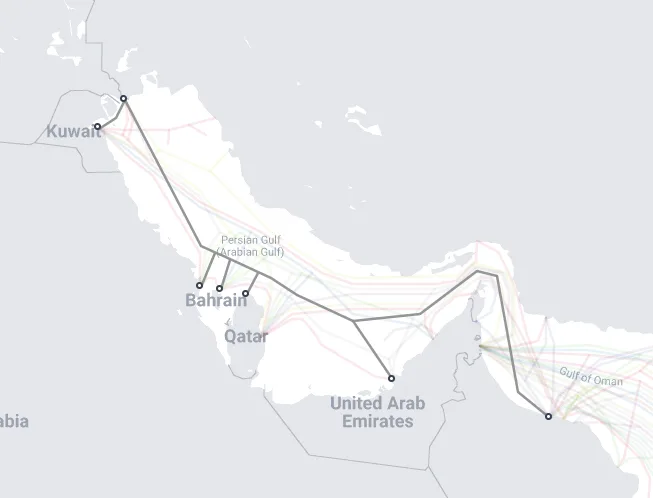
FIG is owned by Ooredoo, a leading international telecommunications company headquartered in Doha, Qatar. Countries linked to the proposed route include the United Arab Emirates, Saudi Arabia, Iraq, Turkey, and several destinations in Europe
What happens if Iran disrupts the undersea cables in Hormuz?
If cables operating through the Hormuz corridor are disrupted, the immediate impact would likely not be a complete internet blackout. Modern cable systems are built with redundancy, allowing traffic to be rerouted through alternative pathways. However, previous incidents involving damaged undersea cables have shown that even partial disruptions can slow connectivity, increase latency, overload backup routes, and affect cloud-based services across regions.
In 2024 and 2025, damage to multiple cable systems in the Red Sea affected internet connectivity in parts of South Asia, the Middle East, and Europe. Companies including Microsoft, warned of increased latency and slower cloud performance after disruptions involving systems such as SEA-ME-WE 4, IMEWE, AAE-1, and FALCON.
Undersea cables support financial transactions, enterprise communication, banking systems, cloud platforms, and international data exchange. Reuters reported that analysts warned that disruptions affecting these systems could lead to e-commerce disruptions, delayed financial transactions, and broader economic consequences.
How does Hormuz connect to India’s internet infrastructure?
India is also deeply connected to the cable systems passing through the Strait of Hormuz. The submarine cable networks AAE-1, FALCON, Tata TGN-Gulf, and SEA-ME-WE systems have landing points in India, namely Mumbai, Thiruvananthapuram, and Chennai, involving Indian telecom operators such as Reliance Jio, Bharti Airtel, and Tata Communications.
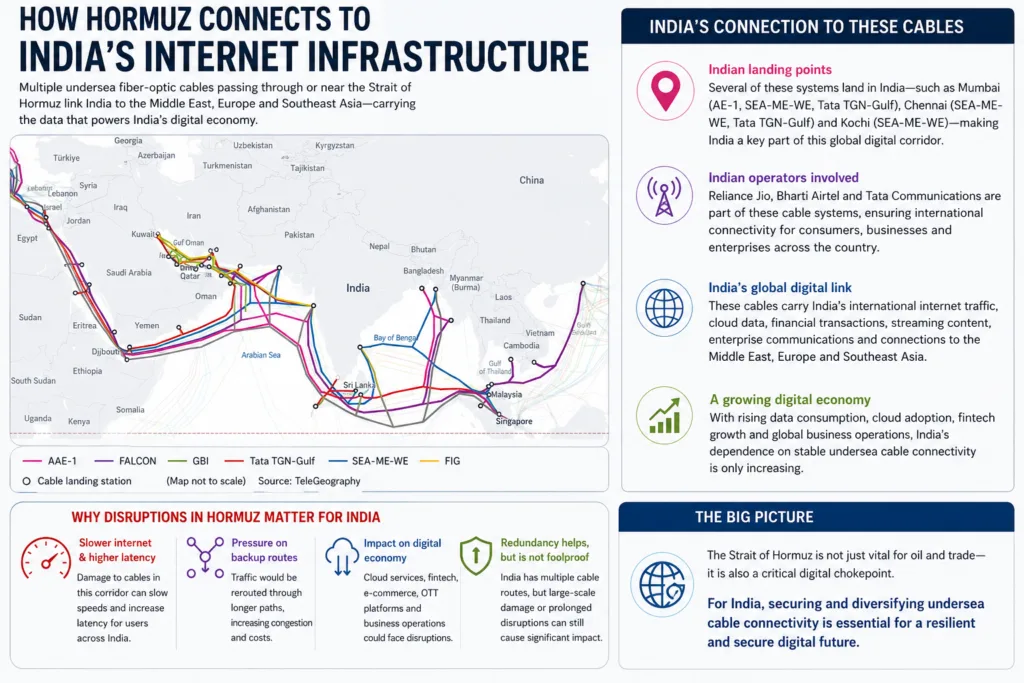
These systems support a significant share of India’s international internet traffic and link the country with the Middle East, Europe, and Southeast Asia. Any kind of disruption of latency in these undersea cables could have a lasting effect on India’s digital economy.
IRGC call for a fee on Hormuz undersea cables
According to a media report associated with the Islamic Revolutionary Guard Corps (IRGC),Iranian officials are devising a three-step plan to charge for the use of undersea cables located beneath the Strait of Hormuz. The plan includes an annual charge on tech giants for the cables passing through the Strait. The report also indicated that Iran wants major technology companies such as Microsoft, Amazon, and Meta to comply with Iranian laws.
Will internet costs rise?
If this comes into effect , it will have a ripple effect on the global internet. It could result in higher subscription costs for internet services. Another issue involves connectivity itself. If operators begin avoiding routes passing through Hormuz because of political or legal risks, internet traffic may need to be rerouted through longer alternative pathways. While global cable systems are built with redundancy, rerouting can still increase latency and place additional pressure on backup infrastructure.
Recent discussions, in IRGC-linked media around submarine cables show that digital infrastructure is now being framed alongside energy and shipping as another layer of strategic influence. Whether the proposals materialise or not, they reflect a broader shift in how states are beginning to view undersea internet infrastructure in conflict zones.While cable disruptions may not immediately trigger a direct increase in consumer internet tariffs, they can substantially raise operational costs for telecom operators and cloud providers. Traffic rerouting, higher latency, repair expenses and dependence on the backup infrastructure may eventually translate into higher service costs across the digital economy.

Sujith A
Open Source Intelligence Researcher and Mis/Disinformation tracker. Passionate about investigations and a big fan of Sherlock Holmes.
View all posts by Sujith A