Damming the Dissent: How the Arunachal Government is Controlling the Narrative
As protests against the proposed Siang mega-dam intensify, the Arunachal Pradesh government faces mounting questions over its response. From a Rs 10.91-crore PR campaign and restrictions on social media accounts to arrests, search warrants, and internet shutdowns, OBC examines how dissent is being contained and how the narrative around the project is being controlled.
A mega dam is being projected as a symbol of development in Arunachal Pradesh. But in the Siang Valley, where communities are resisting the proposed project, the story is increasingly about something else-the shrinking space for dissent.
The proposed 11,200 MW Siang Upper Multipurpose Project, India’s most ambitious hydroelectric project to date, is now at the centre of massive protests, as indigenous communities such as the Adi, Galo, Nyishi, Apatani, and Idu Mishmi have mounted fierce opposition to it. For these communities, the Siang is more than just a river; it is Ane Siang, their Mother, and is core to their farming, faith, and identity.
The unrest reached its peak on 23 October, 2026, when a 12-hour bandh in Pasighat escalated into arson and violence. As opposition to the proposed project amplified, the Arunachal Pradesh government responded with arrests, internet shutdowns, restrictions on social media accounts and a Rs 10.91-crore PR contract to suppress dissent. The protests have also raised bigger questions: who profits from large projects and who is exploited, whose interests come first, and what steps are taken to protect local communities’ rights.
OBC examined the Arunachal Pradesh state administration’s multilayered response to the growing protests in the Siang Valley, tracing how PR campaigns, digital censorship, police detentions, and communication blackouts are being deployed to systematically control the narrative and suppress dissent against the mega-dam project.
The methods of state repression
1. The exclusive paid PR contract
According to an Indian Express report, state-run NHPC awarded Mumbai-based Concept Public Relations an ₹8.73-crore contract in July 2025, later increased to approximately ₹10.91 crore through November 2026, to conduct a multi-tiered PR campaign in the cities of the Siang basin, Itanagar, and New Delhi.
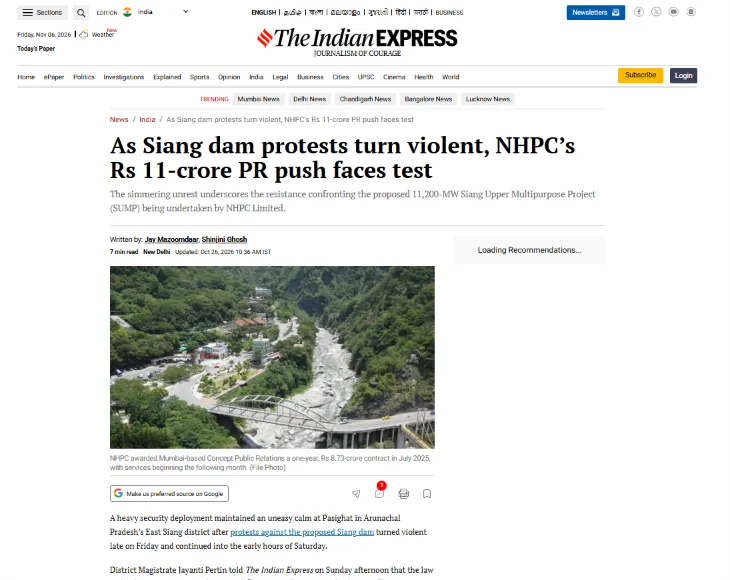
The campaign involved more than 30 PR executives, local social media influencers, and community elders. It promoted coverage across print, TV, and YouTube to present the 11,200-MW dam as a positive livelihood opportunity.
2. Paid influencers generating PR content
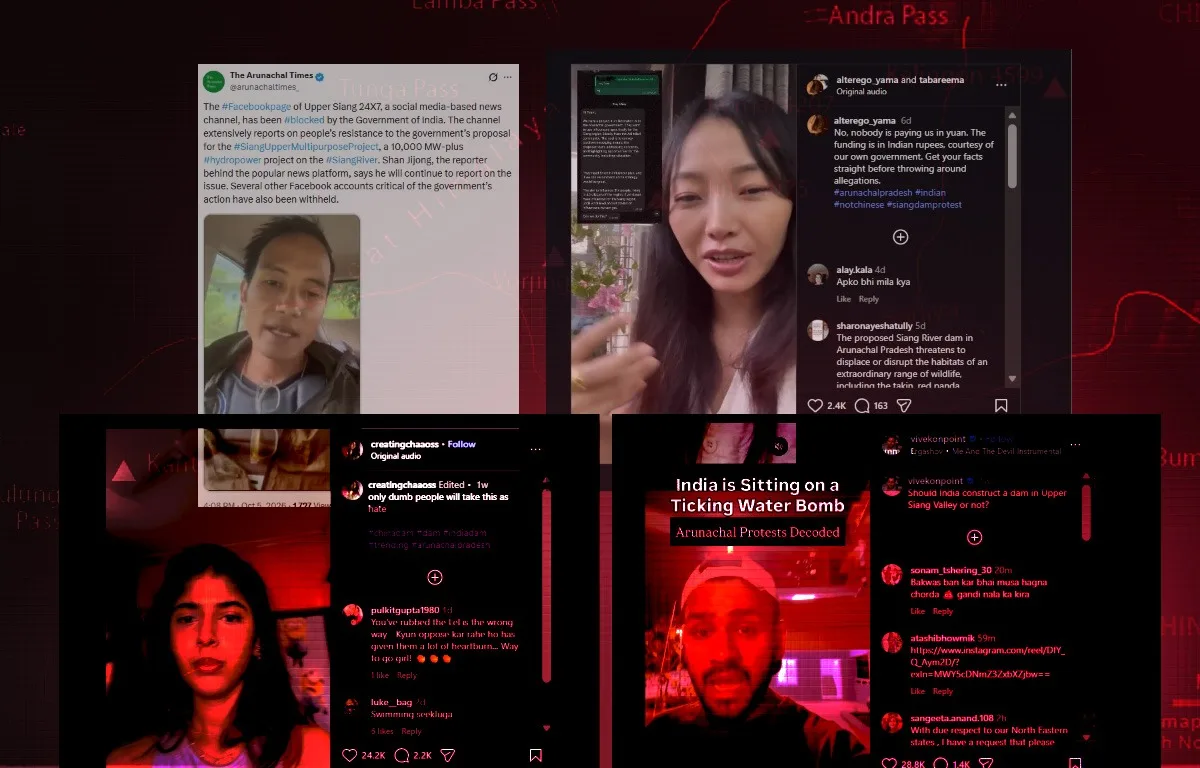
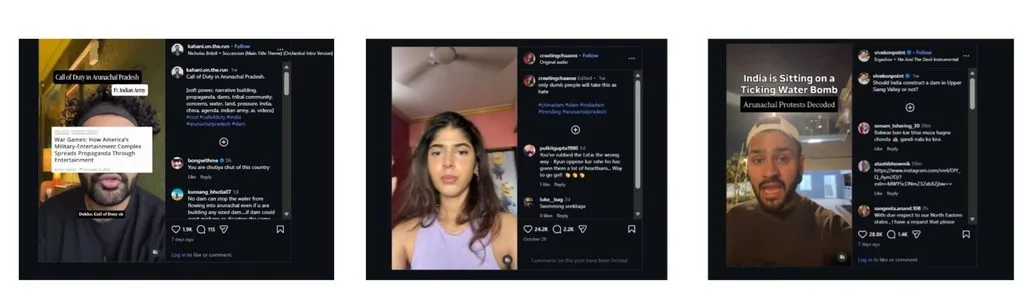
Various right-wing social media accounts are producing content questioning the legitimacy of the protests in Arunachal Pradesh. Right-wing social media influencers primarily push reel content from two angles: one frames the dam as an urgent matter of national security, arguing that India must match China’s upcoming dam project to secure water rights and regional security; the other accuses the protesters of being a threat to national security, calling them ‘converted people’, ‘Chinese spies’, ‘andolan jeevis’, and ‘anti-nationals’, who are giving up the Siang River to China.
On 31 October, actress Taba Reema posted a video on social media alleging that PR firms had contacted content creators and offered to pay them for reels promoting the dam’s supposed benefits. “A few months ago, I also received an email from PR agencies,” Reema said, “with a list of talking points and an offer for payment per reel. Now, every piece of content I see follows the same script.”
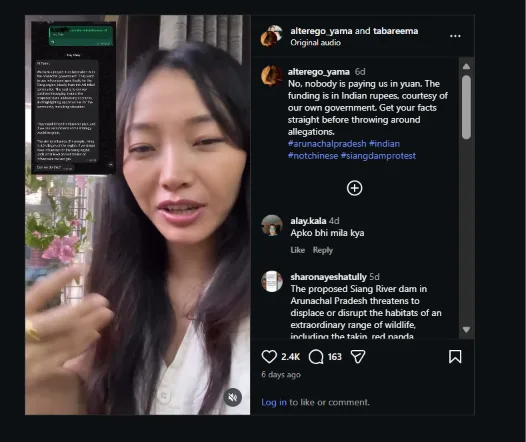
Reema added that while many Arunachali creators have turned down these offers, agencies have started using outsiders to spread pro-dam messages.
3. Censoring anti-SUMP digital spaces.
The OBC team tried to access these account pages and found they were not available in India.
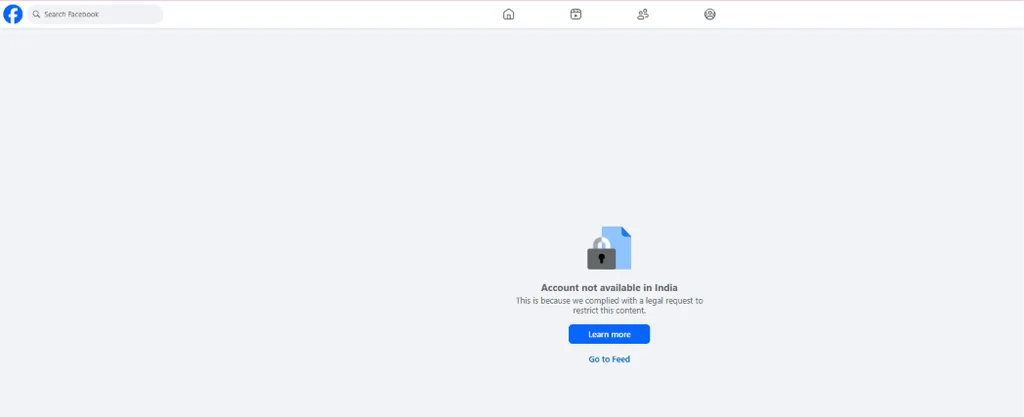
Various accounts, including the social media accounts of activists, journalists and news outlets that support the anti-SUMP movement, are restricted. This includes the accounts of Aborman Anbo, Activist & Advocate Ebo Milli, Save Aborland, the Adi Bane Kebang United General Secretary and Spokesperson, and Upper Siang News 24×7.
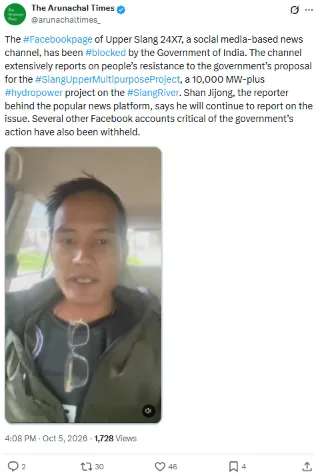
On 5 October, The Arunachal Times posted a video on X featuring Shaan Jijong, managing director of Upper Siang News 24×7, who stated that the outlet’s official Facebook page had been disabled. He also added that the Facebook pages of activists Ebo Mili and Katon Moyong had reportedly been taken down.
Similarly, Tadak Nalo, founder and president of the political party Arunachal Frontier Tribal Front (AFTF), released a video statement after his Facebook account, ‘Tadak Nalo for Revolution’, was restricted within India under the Information Technology Act. Describing the situation in Arunachal Pradesh as “emergency-like,” Nalo alleged that fundamental rights, including freedom of speech and expression, were being heavily suppressed, noting that users must access the platform from outside the country to view his content.
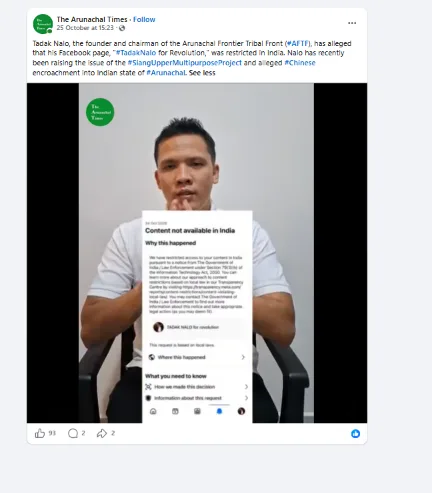
4. Detaining the protesters and journalists
According to a Times of India report, Arunachal Pradesh Police have detained four activists, Adum Tayom, Omak Paron, Okut Paloh, and Oson Paron, all residents of Geku in Upper Siang district under the Arunachal Pradesh Unlawful Activities (Prevention) Act (APUAPA), 2014.
Meanwhile, The Wire reported that journalist Tongam Rina, deputy editor of The Arunachal Times, is among four people against whom Arunachal Pradesh Police have sought search warrants over the 23 October violence in Pasighat town.
On 29 October, the X account @nit_set, the official handle of Nitin Sethi, founding editor of The Reporters’ Collective, shared the search warrant document issued against protestors, including senior journalist Tongam Rina and activist Ebo Mili.
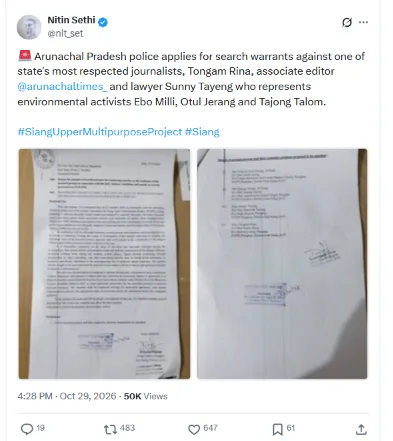
The warrant lists them as ‘accused persons’ and states that searches were ‘necessary to establish the individual roles of the accused, ascertain their alleged involvement in the offences and collect relevant material evidence’.
Tongam Rina, deputy editor of The Arunachal Times, condemned the police surveillance and search warrants issued against her and lawyer Sunny Tayeng in a post on X. She said that this kind of intimidation would not stop her journalism or activism. She also urged the public to keep supporting the arrested anti-dam protesters and the people of Siang Valley.
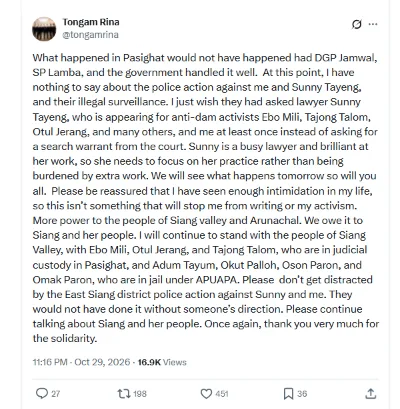
She also reiterated her support for the people in Arunachal, stating, “At this point, I have nothing to say about the police action against Sunny Tayeng and me, and their illegal surveillance,” she posted on X. “More power to the people of Siang Valley and Arunachal. We owe it to Siang and her people.”
5. The Internet blackout
According to an X post by The Arunachal Times, on 2 November, authorities shut down internet services in Upper Siang as local indigenous farmer, youth, and student groups launched a 36-hour total shutdown across the district to demand the immediate release of protesters detained under the state’s harsh preventive detention law (APUAPA).
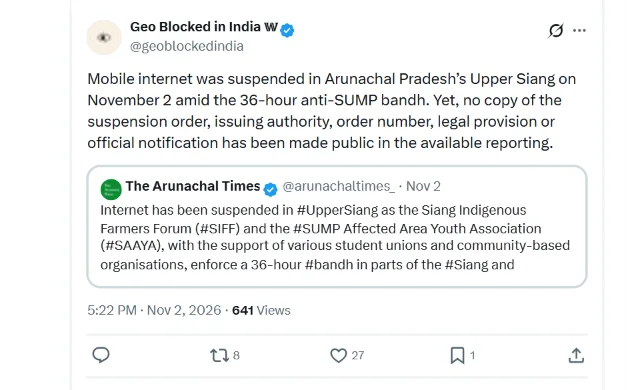
The OBC analysis found that the government response to the Siang protests has gone far beyond regular policing. Activists were detained under the APUAPA. Police have sought search warrants against a journalist, her lawyer, and two others that do not explain how they were connected to the 23 October violence. Internet services were suspended in Upper Siang, and the pages of activists and news outlets covering the movement were not available in India. Meanwhile, NHPC’s Rs 10.91-crore contract with a PR agency was intended to build support for the project.
When a project that could submerge villages and displace lakhs of people is pushed forward along with arrests, restrictions, and paid PR campaigns, the people living along the river have very little chance to be heard. If a dam or any project of such scale is to be built, a transparent process involving independent evaluation and open consultation with experts would be more appropriate than silence or dissent.