State Elections: BJP Spends ₹5.39 Cr on Google Ads in a Month, Congress Far Behind
An OSINT look at Google and Meta ads ahead of the 2026 state elections—big spends, nonstop campaigns, and BJP on top. Want to know how much the others are spending? We have the details
As the 2026 assembly elections approach, political advertising on digital platforms has picked up pace. Data from Google and Meta shows a sharp rise in activity, with a large share of it driven by high spending on Google Ads, particularly by the Bharatiya Janata Party (BJP) over the last 30 days.
In April 2026, the Indian states of Assam, Tamil Nadu, West Bengal, Kerala, and the Union Territory of Puducherry are scheduled to conduct the 2026 Legislative Assembly Elections. Two major political parties, Bharatiya Janata Party (BJP) and Indian National Congress (INC), are gearing up with their election campaigns.
These campaigns extend beyond on-the-ground efforts, with parties making significant investments in Google and Meta Ads.
This OSINT investigation reveals how the BJP and the INC spent on Google Ads nationally in the last thirty days. The report also dives into how the Left Democratic Front (LDF), the BJP, and the INC are utilising Meta Ads as part of their strategy for the upcoming assembly elections in Kerala.
Google Ads
Data from Google’s advertiser transparency reports over the last 30 days gives a clear view of how political ads are being deployed, where the money is going, how often ads are being pushed, and which regions are being prioritised.
As of April 2, the Bharatiya Janata Party (BJP) has spent ₹5.39 Crore across 2,682 ads over 30 days. The scale is hard to miss. This is not a short campaign cycle. It runs daily, with spending usually falling between ₹10 Lakhs and ₹60 Lakhs. The pattern shows a steady push, keeping ads in circulation without long gaps. On the other hand, the Indian National Congress has spent ₹47 Lakhs across 195 ads. The daily spending of INC falls between ₹4 Lakhs and ₹24 Lakhs.
| Category | BJP | INC | OSINT Insight |
| Total Spend | ₹5,39,35,750 | ₹47,56,500 | BJP’s overwhelming financial dominance ensures saturation-level visibility across platforms. |
| Number of Ads | 2,682 | 195 | BJP’s far higher ad volume allows continuous presence; INC’s limited volume restricts reach. |
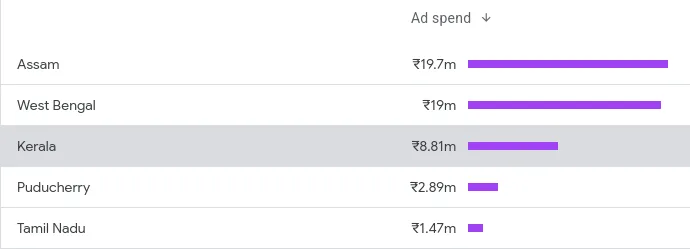
| Top States by Spend | Assam (₹1,97,00,000), West Bengal (₹1,90,00,000), Kerala (₹88,10,000), Puducherry (₹28,90,000), Tamil Nadu (₹14,70,000) | Assam (₹36,20,000), Puducherry (₹7,73,000), Tamil Nadu (₹2,50,000), Tripura (₹56,500), West Bengal (₹30,300) | BJP prioritizes major battlegrounds (Assam, WB, Kerala), while INC focuses on smaller territories like Puducherry. |
| Ad Formats | Video: 78.2% (₹4,07,00,000)Image: 21.8% (₹1,14,00,000) | Video: 83.2% (₹39,60,000)Image: 16.8% (₹7,98,000) | Both are video-first, but BJP’s scale translates into far greater reach and impact. |
| Daily Spend Peaks | ₹1,00,00,000 – ₹6,00,00,000 | ₹4,00,000 – ₹24,00,000 | BJP maintains continuous high-pressure campaigning, while INC’s rhythm is smaller and less disruptive. |
A large share of the BJP’s spending is concentrated in a few states. Assam accounts for roughly ₹1.97 Crore, followed closely by West Bengal at around ₹1.9 Crore. Kerala stands out with ₹88.10 Lakhs, which is a significant allocation for a single state. Smaller amounts are spread across Puducherry, Tamil Nadu, and a few others, but the focus remains on a handful of key regions.
The majority of the budget is being allocated to video content. Approximately ₹4.07 Crore, which is nearly 78 percent of the overall amount, has been spent on video advertisements. At this scale, video is not solely focused on reach. It continues to appear frequently, which fosters familiarity over time.
Similar to the BJP, a major portion of the INC’s Google Ad spending is also concentrated to fewer states. Assam takes the largest share at about 37.4 Lakhs, followed by Puducherry at around ₹7.74 Lakhs and Tamil Nadu at roughly ₹2.50 Lakhs. Other states appear in much smaller amounts, and Kerala stands in the thirteenth position with a very nominal amount on around 117 Ads, with majority of the ads being images.

Video is again the main format here, with about ₹39,60,000, which is over 83 percent of the total spending going into it.
What comes through in the data is not just how much is being spent, but how it is being spread out over time and place. Some campaigns run wide and stay active across multiple regions, while others stay focused on fewer areas with a lighter footprint.
These tools make it possible to track movement, attention, message frequency, and sustained regional activity in BJP’s Google Ads.
What does the analysis of Meta Ads of the Last Seven Days reveal?
The polling in Kerala will be held on April 9, and the analysis of the Meta Ads reveals a compelling picture where the INC, BJP, and the ruling LDF are showcasing their digital firepower.
We noticed that from March 24 to March 30, INC spent ₹25.31 Lakhs on Meta Ads that strongly focused on the 18-30 age group. BJP’s spending stands slightly lower than the INC’s at ₹19.24 Lakhs, with ads keeping a balanced approach towards the audience aged between 18 and 44. Aside from the BJP and INC, LDF has spent ₹3.95 Lakhs on Meta Ads between March 24 and March 30, strongly focusing on the age group between 18 and 30.
| Category | INC Kerala | BJP Keralam | LDF Keralam |
| Total Spend | ₹25,31,443 | ₹19,24,703 | ₹3,95,959 |
| Age Targeting | Strong focus on 18–30 age group | Balanced across 18–44, some older groups | Strong focus on 18–30 age group |
Our analysis of the Meta Ads shows three different ways of running campaigns. INC’s ads are mostly small, usually between ₹3,000 and ₹79,000, with occasional higher bursts reaching ₹50,000 to ₹80,000. The messaging stays narrow, built around “കേരളം ജയിക്കും, യുഡിഎഫ് നയിക്കും” and a welfare pitch like the ₹25 lakh Umman Chandy health insurance scheme. Hashtags are barely used, and the targeting leans more towards younger audiences.
BJP’s ads operate at a higher value range, typically between ₹50,000 and ₹2,99,000, pointing to fewer but heavier pushes. The messaging is spread across multiple lines, from “മാറ്റം തുടങ്ങാം” and “മാറ്റത്തിന്റെ കാറ്റ് മോദിക്കൊപ്പം” to policy references like Mudra loans, IIT Palakkad, and railways, along with direct attack lines such as “CPM Congress മതിയായ്”. Hashtags are used extensively, including #NDA4VikasitaKeralam and #PoliticsOfPerformance, and the targeting is wider, covering both younger and older groups.
LDF sits in the middle in terms of amount spent per ad, which is around ₹20,000 to ₹25,000, running consistently rather than in spikes. The messaging focuses on continuity, using “മറ്റാരുണ്ട് LDF അല്ലാതെ” and highlighting governance and welfare delivery. Hashtags like #Vote4LDF and #LifeMission are used to reinforce that line, and the targeting remains largely youth-focused with some outreach to older voters.
| Category | INC Kerala | BJP Keralam | LDF Keralam | OSINT Insight |
| Total Spend (range) | Mostly micro-campaigns: ₹3,000 – ₹79,000 per ad, occasional higher bursts (₹50k–₹80k) | Larger campaigns: ₹50,000 – ₹2,99,000 per ad, multiple high-value pushes | Medium size campaigns, but consistent: ₹20,000 – ₹25,000 per ad | BJP runs fewer but higher-value ads, INC spreads budget across many micro-campaigns, LDF operates at low-budget symbolic scale. |
| Core Messaging | Slogan: “കേരളം ജയിക്കും, യുഡിഎഫ് നയിക്കും” (“Kerala will win, UDF will lead”)Welfare promise: ₹25 lakh Umman Chandy health insurance | Slogans: “മാറ്റം തുടങ്ങാം” (“Let change begin”), “മാറ്റത്തിന്റെ കാറ്റ് മോദിക്കൊപ്പം” (“Winds of change with Modi”)Policy showcases: Mudra loans, IIT Palakkad, railwaysAttack lines: “CPM Congress മതിയായ്” (“Enough of CPM & Congress”) | Slogan: “മറ്റാരുണ്ട് LDF അല്ലാതെ” (“Who else but LDF?”)Highlights developmental goals achieved under 10-year LDF tenure | INC = single slogan + welfare promise; BJP = multi-pronged narrative (development, Modi-branding, anti-rival attacks); LDF = incumbency defense + continuity messaging. |
| Hashtags | Minimal hashtag use | Heavy hashtag branding: #NDA4VikasitaKeralam, #PoliticsOfPerformance, #MattathinteKaattuModikkoppam, #CPMCongressMathiyaayi | Hashtags: #Vote4LDF, #KeralaElections, #LDF, #LDFKERALAM, #SocialWelfare, #LifeMission, #KSRTC | BJP leverages hashtags for virality and narrative warfare; INC underuses hashtags; LDF uses hashtags to reinforce welfare + governance identity. |
| Demographic Targeting | Youth-heavy (18–34), some older population targeted for welfare ads | Broad (18–44 balanced), also older groups (45–64, 65+) for development/attack ads | Youth-heavy (18–40), some older population targeted for welfare ads | INC and LDF both chase youth vote with welfare promises; BJP spreads across youth + middle-aged voters, widening reach. |
The analysis details the behavioural patterns of political parties in Google Ads and Meta Ads during this election cycle. What stands out is how each campaign is structured differently: one spread across many small ads, one built on higher-value pushes with multiple narratives, and one running steadily with a focus on continuity.
Sujith A
Open Source Intelligence Researcher and Mis/Disinformation tracker. Passionate about investigations and a big fan of Sherlock Holmes.
View all posts by Sujith A