

Indian Elections: Who’s Betting And Why It Matters
On election day in Kerala, something moved. Not an exit poll, not a leak — just a quiet shift in numbers on a crypto platform most Indians have never heard of. What it means, nobody can say for certain.
Kerala completed polling on April 9, but activity around the elections is not limited to the ground. On Polymarket, a US-based prediction market, users are placing money on outcomes across several state elections, including those where voting has yet to take place.
Tamil Nadu and West Bengal, both scheduled to vote on April 23, already show clear positions on the platform. Users are backing outcomes before any votes are counted, and in some cases, before polling has even begun.
In Kerala, the market shifted during polling hours. In other states, positions are being built ahead of voting, without any confirmed data. The numbers reflect trades at a given moment, not ground-level verification.
This report explores these shifts by analysing publicly available data. By examining how the odds moved during key events and relating these patterns to broader trends, we can better understand both the possibilities and limitations offered by this type of market analysis.
What is Polymarket and how does it operate?
Polymarket is a cryptocurrency-based prediction market platform founded by Shayne Coplan, a New York University dropout, during the COVID-19 pandemic. He became a billionaire in October 2025 after Polymarket secured a $2 billion in funding from Intercontinental Exchange Inc, the New York Stock Exchange’s (NYSE) parent company.
The platform allows users to trade on the outcome of real-world events using a prediction market model. Participants buy “Yes” or “No” contracts tied to specific outcomes, with prices typically ranging between 0 and 1. These prices are often read as the market’s implied probability of an event occurring.
The platform covers a range of topics, including elections, geopolitical developments, and economic events. Prices update in real time as trades are placed, reflecting the balance between buyers and sellers at any given moment.
Unlike opinion polls, which rely on sampled responses, prediction markets are driven by financial positions taken by users. At the same time, the prices reflect market activity rather than verified information, and can shift based on trading behaviour, liquidity, and participant expectations.
How do the predictions happen?
On Polymarket, each event is set up as a question with defined outcomes. Users take positions by buying shares in either outcome. A “Yes” share pays out if the event happens, while a “No” share pays out if it does not.
Prices move with each trade. If more users buy into one outcome, its price rises and the price of the opposing outcome falls.” This movement is often read as a change in probability, but it is driven by trades, not confirmed data.
The size of the market also matters. In thinner markets, a small number of large trades can shift prices quickly. This makes it difficult to treat price changes as a direct measure of wider sentiment.
The Curious case of the Kerala election Polymarket prediction
In the days leading up to the vote, the market on Polymarket showed a steady lead for the Congress-led United Democratic Front (UDF). This trend remained largely unchanged until polling began.
On April 9, as voting was underway, the pattern shifted. During the course of the day, the odds moved sharply. The earlier lead narrowed and then reversed, with the Communist Party of India (Marxist)-led Left Democratic Front (LDF) moving ahead by a wide margin. CPI(M) leads the graph on April 9 with 70% chance of winning, followed by the Indian National Congress (INC) with 31%, and Bharatiya Janata Party (BJP) with less than 1%.
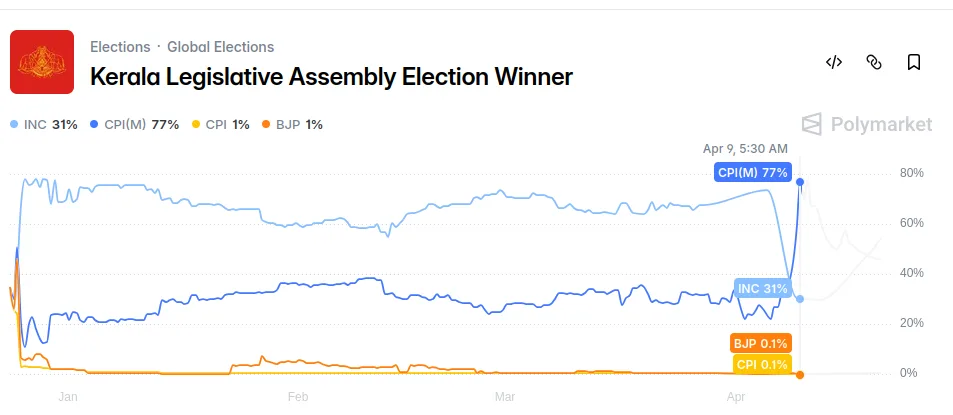
The change took place during active polling hours and did not follow any confirmed release of election data. There were no official trends or verified figures at the time that could explain a shift of that scale.
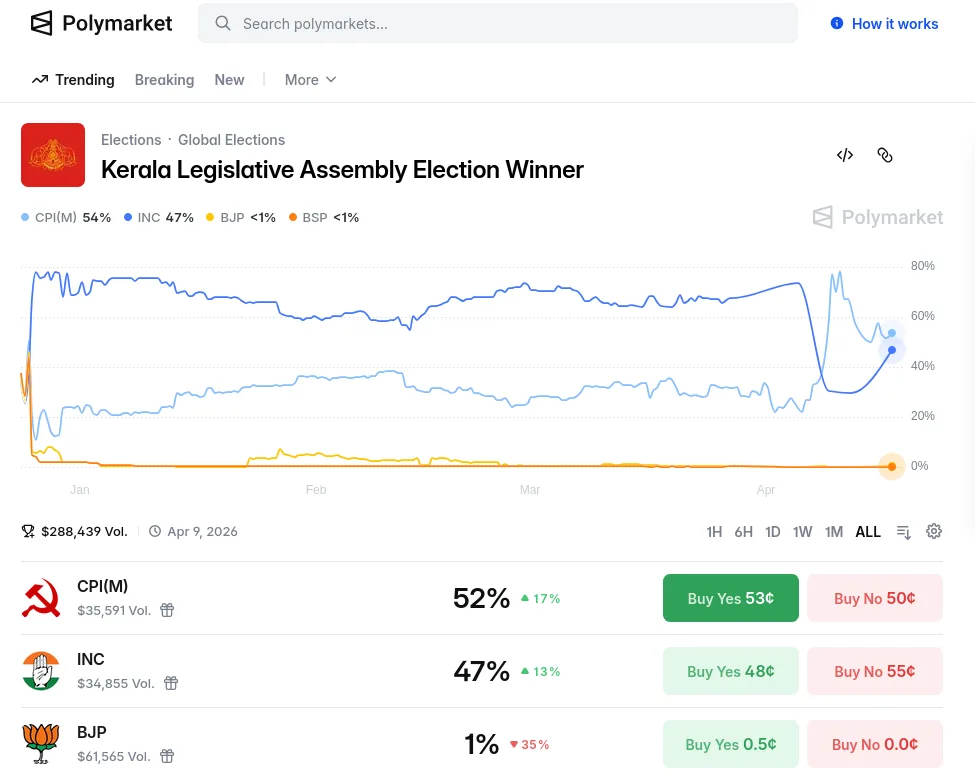
The timing and speed of the movement stand out. While the change can be tracked on the platform, the trigger behind it is not clear from publicly available information.
Other state elections predicted
Beyond Kerala, markets on Polymarket are also active for states where polling is yet to take place, including Tamil Nadu and West Bengal, both scheduled for April 23. These markets reflect how users are positioning themselves ahead of voting, not actual ground trends or confirmed data.
Assam
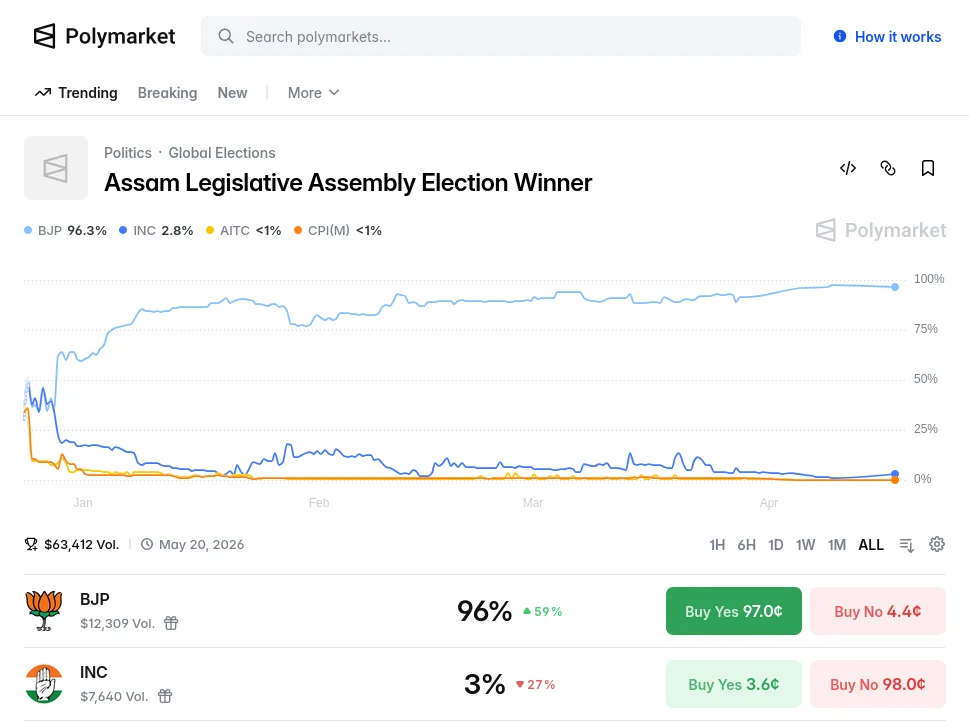
Assam shows the strongest trend. BJP is far ahead, and there has been little change in that position over time. The prediction uses May 20, 2026, as a reference date.
Puducherry
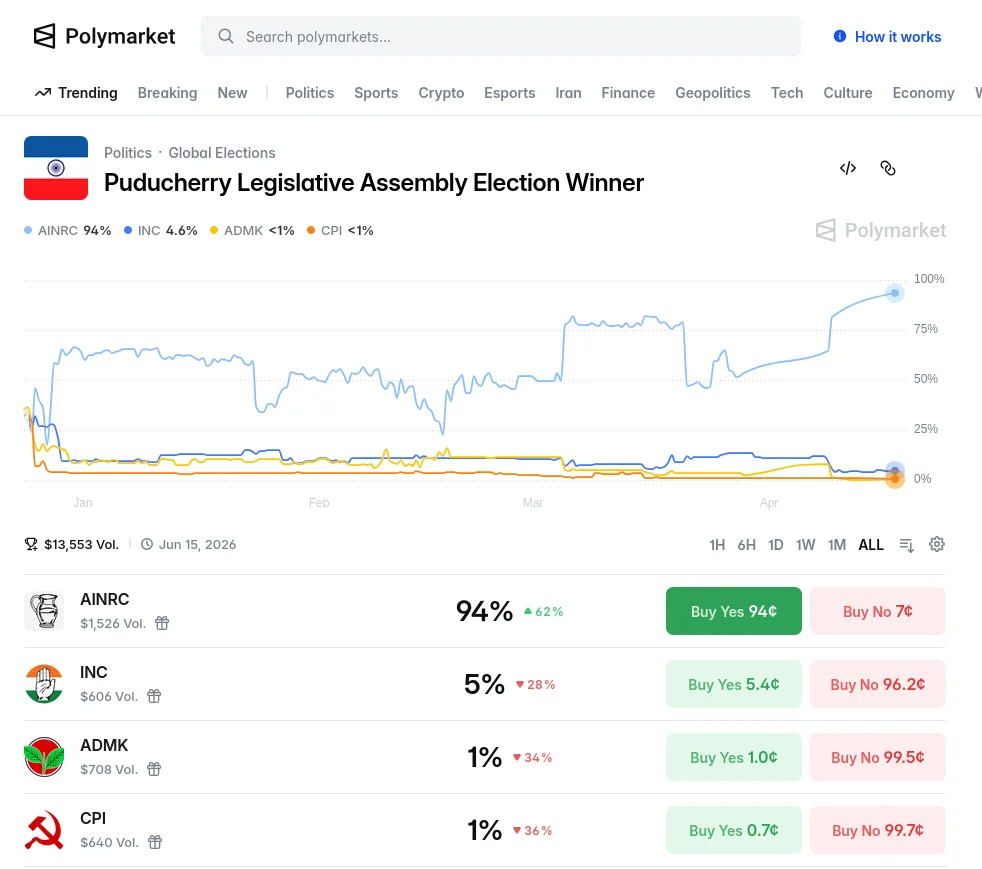
Keeping June 15, 2026, as the reference date, this market is almost one-sided. The All India N. R. Congress (AINRC), backed by the Bharatiya Janata Party (BJP), leads the chart, while other parties are barely being picked.
Tamil Nadu
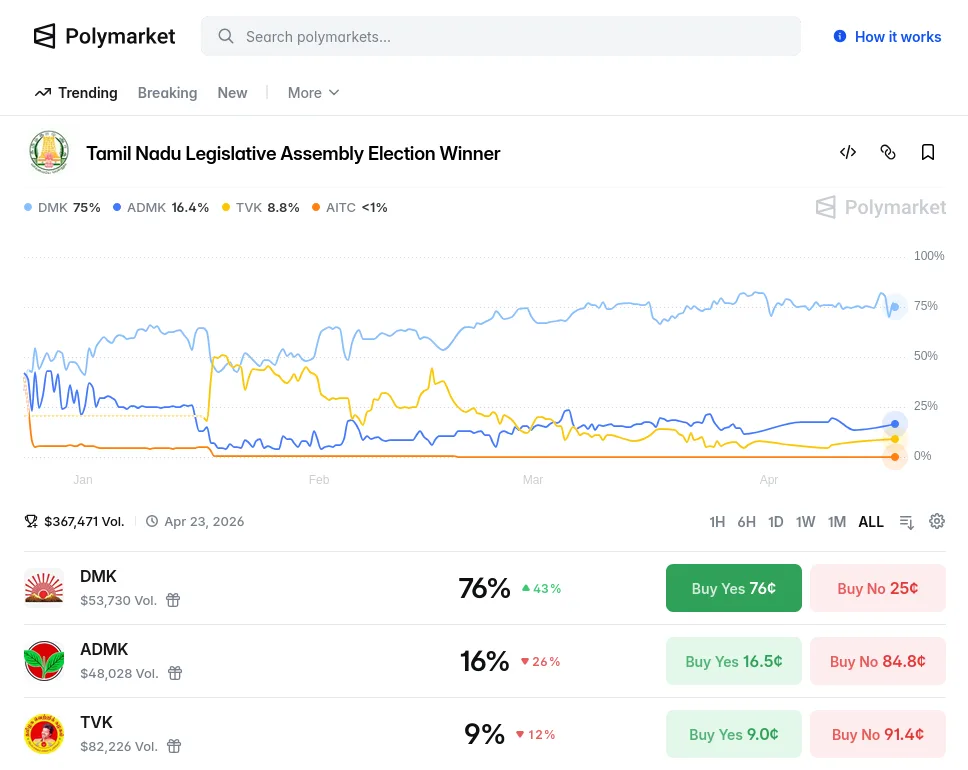
Using April 23, 2026, as a reference date, Tamil Nadu shows a clear favourite. The Dravida Munnetra Kazhagam (DMK) is far ahead, and the gap has stayed wide, suggesting most traders are sticking with that position.
West Bengal
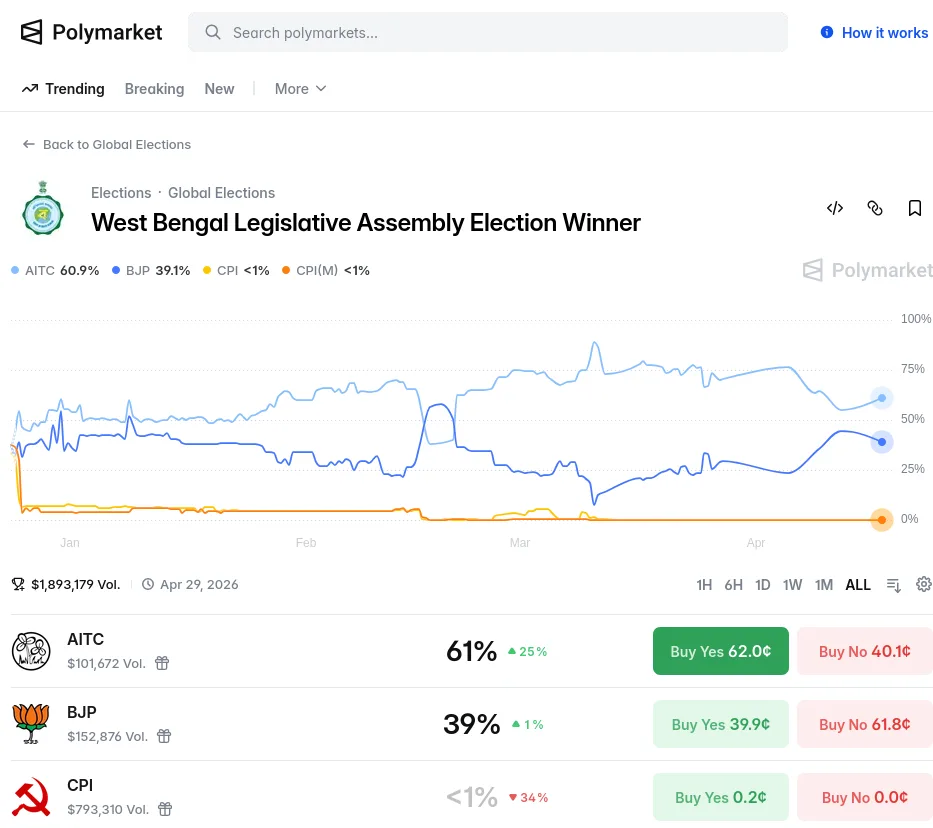
Here, most users are backing the All India Trinamool Congress (AITC). The Bharatiya Janata Party (BJP) follows behind, while the rest of the parties have almost no presence in the market.
Across these states, the pattern is simple. The numbers show where people are putting money, not what is actually happening on the ground. A strong lead in the market can come from steady support or from a few large bets pushing the numbers in one direction.
What the numbers can and cannot tell us
Prediction markets like Polymarket offer a live view of how people are betting on political outcomes. The numbers move fast, react to trades, and often give the impression of certainty. But what sits behind them is not always clear.
The Kerala swing during polling hours stands out for its timing and speed. No confirmed data explains the shift, and that leaves room for multiple possibilities. It could reflect new information reaction, speculative trading, or the weight of a few large bets.
Across other states, the pattern looks calmer. Strong leads stay in place, with limited movement. That can suggest confidence, or just low activity on the other side of the market.
What these markets show is not the result, but the bet. They reflect belief at a given moment, shaped by who is trading and how much they are willing to risk. For now, they sit on the edge of election coverage, watched by a small group but capable of shaping perception if they gain wider attention.

Sujith A
Open Source Intelligence Researcher and Mis/Disinformation tracker. Passionate about investigations and a big fan of Sherlock Holmes.
View all posts by Sujith A