
The Environmental Price of India’s AI Ambitions.
India’s race to become a global AI and cloud computing hub is bringing unprecedented investment in hyperscale data centres, but as projects multiply, concerns over water consumption, energy demand and ecological sustainability are emerging alongside promises of economic growth.
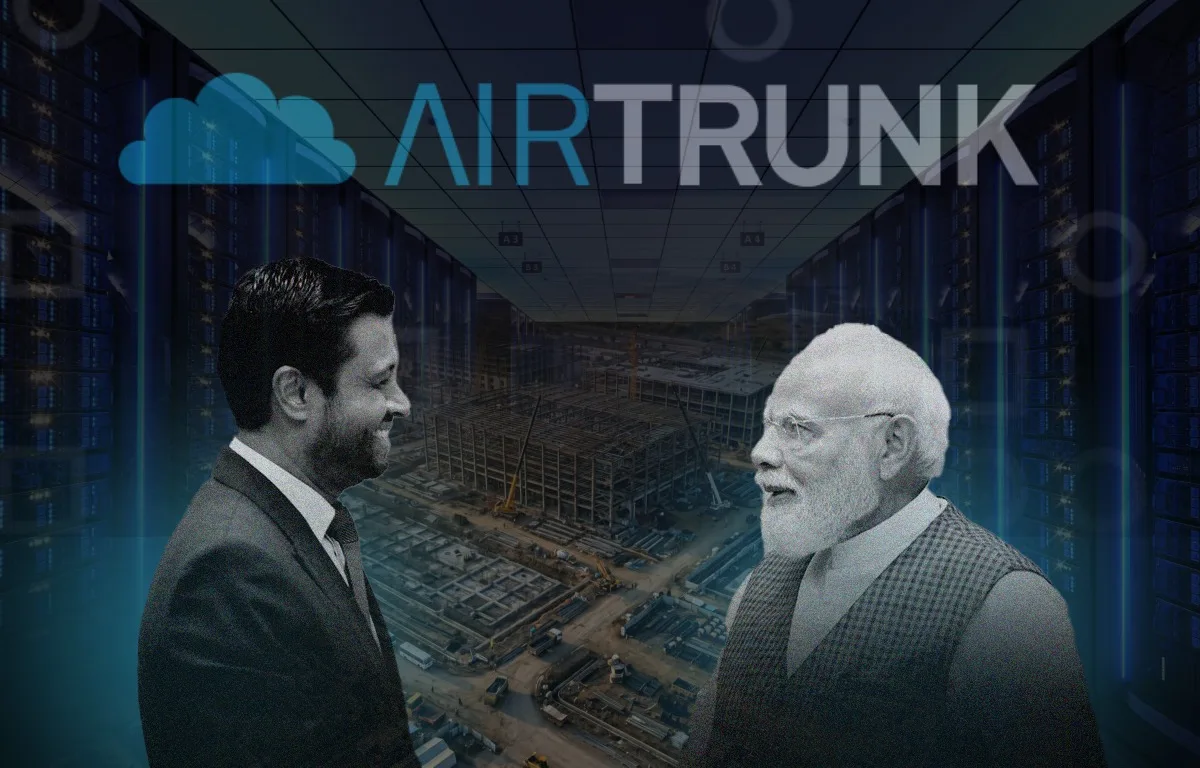
On June 5, the CEO of AirTrunk, Robin Khuda, met Prime Minister Narendra Modi, leading to a major infrastructure deal. AirTrunk is an Australian hyperscale data centre company, and the announcement came after it acquired Indian data centre developer Lumina CloudInfra in April 2026. The Prime Minister endorsed AirTrunk’s plan to invest around ₹3 lakh crore and develop 5 GW of data centre capacity in India.
Yet data centres are not merely digital infrastructure; behind them lies a significant physical footprint. Large facilities consume significant amounts of electricity, require extensive cooling systems, occupy large tracts of land, and increasingly compete for water resources in regions already facing environmental pressures.
This report dives into the proposed deal and the organisation behind it, along with the environmental challenges that have accompanied similar developments in other parts of the world.
Prime Minister Narendra Modi shared details of his discussion with AirTrunk CEO Robin Khuda on his official X account on June 5. In the post, he described the plan as one of the ‘largest proposed investments’ in the country’s digital infrastructure ecosystem. He further suggested that such investments will become pillars in positioning India as a cloud computing and AI hub.

Screenshot of the X post shared on June 5.
While the company has not publicly disclosed the location of every proposed facility, as per AirTrunk’s statement released by ANI, the company’s development pipeline in India includes 600 MW across Mumbai, Chennai, and Hyderabad, indicating that it would support up to 600 MW of electrical power consumption for servers, networking equipment, cooling systems, storage infrastructure and supporting operations.
For AirTrunk’s 3 GW data centre project, which is valued at ₹2 lakh crore, Maharashtra Chief Minister Devendra Fadnavis and AirTrunk CEO Robin Khuda also exchanged a letter of intent related to land allotment at the Raigad-Pen Growth Centre,a planned integrated smart city and business hub in Maharashtra.
In December 2024, Blackstone, along with Canada Pension Plan Investment Board, acquired AirTrunk through an acquisition deal worth 24 billion Australian dollars.
Founded in 1985 and headquartered in New York, Blackstone is the world’s largest alternative asset manager, known for its investments in real estate, private equity, infrastructure, and private credit. With the acquisition of a controlling stake in KIMSHEALTH in late 2023, Blackstone entered India’s healthcare sector.
Apart from the investment in Airtrunk, Blackstone invested $1.2 billion in Neysa Networks, an Indian AI cloud platform in February 2026. Blackstone also committed upto $600 million in equity to support the deployment of 20,000 Graphic Processing Units across India, further expanding it’s presence in the country.
Concerns raised over AirTrunk’s data centre project in Australia
Several of AirTrunk’s large-scale projects have attracted opposition from residents, schools, environmental groups, and community organisations, particularly in Australia, where concerns have centred on water consumption, electricity demand, air quality, noise, and the cumulative impact of hyperscale data centres on surrounding communities.
Concerns regarding AirTrunk’s proposed SYD4 data centre campus in Kemps Creek, Western Sydney, came to public attention in April 2026 after submissions to the New South Wales Department of Planning, Housing and Infrastructure were published online. The proposed 52-hectare development, which would have a power capacity of 1.2 GW and consume an estimated 22.4 million litres of water annually, caused objections from schools, community organisations, local residents, and public authorities.
The school authorities in the locality raised concerns regarding air quality, noise, diesel storage facilities, and the proximity of power infrastructure to the schools, arguing that the long-term impact of hyperscale data centres on neighbouring communities remains insufficiently understood. They have also raised the concern that the project’s environmental documentation did not adequately address cumulative impacts, emergency access, water supply resilience, and electricity reliability for nearby community facilities, including a retirement village. Penrith City Council objected to the proposal, arguing that the site was not suitable for a development of such scale. Separately, the New South Wales Environmental Protection Authority informed the state government in April , 2026, that the Environmental Impact Statement did not provide sufficient information on air quality, noise, greenhouse gas emissions, and waste management.
Ecological concerns
According to a February 2026 report published by the Council on Energy, Environment and Water (CEEW), a not-for-profit policy research institution and climate think tank based in New Delhi, India’s data centres consumed an estimated 150 billion litres of water in 2024, a figure expected to more than double by 2030. The report notes that Mumbai hosts nearly a quarter of India’s operational data centres, followed by Chennai, Hyderabad, and Bengaluru, making these cities central to the country’s digital infrastructure expansion.
Water availability remains one of the most significant concerns. Data centres generate large amounts of heat and often depend on water-intensive cooling systems to maintain operations. The report estimates that a 100 MW hyperscale data centre can consume nearly two million litres of water per day for cooling. As artificial intelligence workloads increase, rack densities inside data centres continue to rise, increasing cooling requirements and placing further pressure on local water resources. It specifically highlights Mumbai, Chennai, Hyderabad, and Bengaluru as cities where growing data centre clusters must compete with residential, industrial, and municipal water requirements. Continued data centre expansion in these cities could increase pressure on already stressed urban systems.
Mumbai and Chennai present a distinct challenge. Both cities have emerged as major data centre hubs due to their proximity to submarine cable landing stations and international connectivity. However, facilities in these regions are exposed to coastal flooding, cyclones, and sea-level rise. In April 2026, the National Green Tribunal noted that Maharashtra had eight overexploited groundwater assessment units and 164 illegal groundwater extraction structures identified by the Central Ground Water Authority.
According to the Dynamic Groundwater Resource Assessment Report 2025 released by the Ministry of Jal Shakti, among India’s major metropolitan areas, Hyderabad is the worst-affected by groundwater depletion. Greater Hyderabad has 26 groundwater assessment units classified as either ‘critical’ or ‘overexploited’, the highest among India’s major metropolitan regions. Officials attribute the situation to rapid urbanisation, extensive borewell drilling, and inadequate groundwater recharge infrastructure.
Water usage perspective
Water consumption of a data centre is calculated using Water Use Efficiency (WUE). It measures the effectiveness of a system in converting water supplied into a productive output. As per AirTrunk’s 2025 sustainability report, WUE for FY25 is 0.89 L/kWh, and netWUE, recognising recycled water usage.is 0.40 L/kWh. Based on these values, we calculated the water consumption of the data centre for an hour, a day, a month and a whole year.
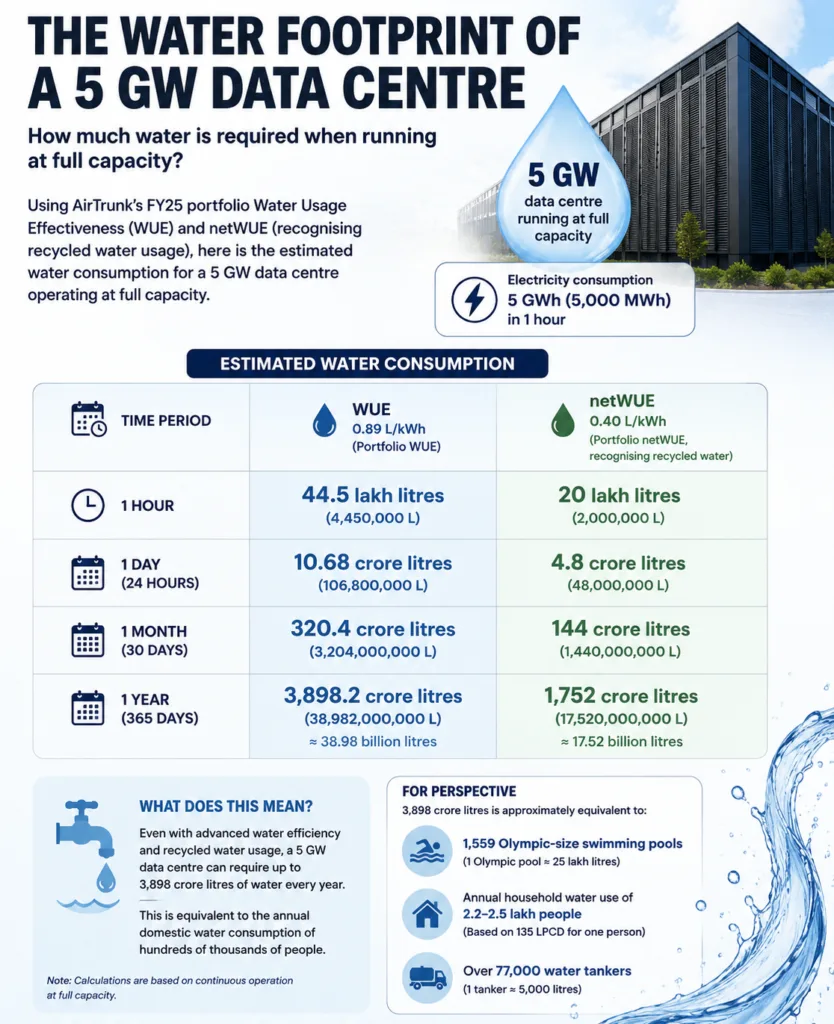
The image illustrates the estimated water consumption of a 5 GW data centre operating continuously at full capacity.
It suggests that a 5 GW data centre operating continuously at full capacity would consume approximately 44.5 lakh litres of water every hour. This translates to around 10.68 crore litres per day, 320.4 crore litres per month, and nearly 3,898 crore litres annually. Even when the netWUE of 0.40L/kWh is considered, a facility of this scale would still require an estimated 1,752 crore litres of water each year.
Similar concerns have been raised by independent researcher Dr A. Shaji George in his report ‘Data Centres and Water Crisis in India: Why Digital Infrastructure Could Drain Our Wells Dry by 2030,’ published on December 25,2025. He says, ”The decisions of the coming years will be what will make the goals of India in the field of data centers a silicon mirage that disappears when people open the tap and can find them empty, or a digitally sustainable base that other countries will be imitating. The decision is ours to make.”
Other Indian companies investing in data centres
AirTrunk is not the only company investing in data centre expansion in India. In February 2026, the Adani Group announced plans to invest US$100 billion in renewable-powered, AI-ready data centres by 2035 through AdaniConneX.
According to a Reuters report dated June 10, Reliance will build a 168 MW AI-ready data centre in Jamnagar, Gujarat,which will be leased by Meta. The deal follows India’s February 2026 announcement of long-term tax relief for foreign companies using India-based data centres.
HRF raises concerns over data centre project in Visakhapatnam
In May 2026, the Human Rights Forum (HRF), an independent civil liberties and democratic rights organization, demanded an immediate halt to the proposed Vizag Hyperscale Data Centre in Visakhapatnam, citing the ecological sensitivity of the project site near the Kambalakonda Wildlife Sanctuary and its Eco-Sensitive Zone.
Following a visit to the site, HRF alleged that trees and vegetation had already been cleared and parts of the landscape altered. The organisation also questioned the project’s environmental approvals, arguing that a development of such scale should undergo a more rigorous assessment process. HRF further warned that hyperscale data centres require substantial amounts of water and energy, raising concerns about additional pressure on local resources in a region already experiencing groundwater depletion and water stress.
AirTrunk’s proposed ₹3 lakh crore investment is among the largest commitments announced so far, but it is only one part of a much wider race to build the infrastructure that will power the country’s digital future.
Experiences from Australia show that data centres often bring questions about water consumption, energy demand, land use, and environmental sustainability alongside promises of investment and economic growth. As projects move from announcements to construction, policymakers, regulators, and local communities will face the challenge of balancing digital infrastructure ambitions with the pressures such developments may place on natural resources and surrounding ecosystems.

Sujith A
Open Source Intelligence Researcher and Mis/Disinformation tracker. Passionate about investigations and a big fan of Sherlock Holmes.
View all posts by Sujith A