The Fault in Our Data: How AI Astrology Rewrites Reality
What the astrology app knows about you, and what it is doing with that knowledge.
Human beings are pattern-recognition machines. The same cognitive architecture that reads weather in clouds also finds meaning in coincidence and personal truth in sentences written for millions. Psychologists call this the Barnum effect, the near-universal tendency to accept vague, general statements as accurate descriptions of oneself. ‘You have a great need for other people to like and admire you. You tend to be critical of yourself. Read those and feel seen.’ Most people do. It is not a character flaw. It is simply how the mind processes statements about itself, and it is the foundational mechanism that makes astrology, in any form, psychologically compelling.
What AI does is take this compulsion and build a precision delivery system around it. Predictions become more specific. The language learns, across multiple interactions, to hit harder. The human brain – which cannot reliably tell the difference between genuine insight and very good pattern-matching – registers the output as recognition. As known.
But recognition is not a neutral experience. It activates. And when it arrives packaged with a prediction – this week will test your patience; Thursday holds possibility; avoid major decisions until the 18th – the brain does not file it as data. It files it as knowledge. The distinction matters enormously because knowledge changes behaviour. You approach Thursday differently. You hold back on the decision. The prediction has already begun to shape the life it claims only to be reading.
Uncertainty is the baseline condition of human existence. Navigating this – learning to act without knowing what comes next – requires a specific kind of tolerance: the ability to sit in the question, make a decision with incomplete information, and accept that the outcome may not be what you intended. AI astrology proposes something else entirely: that you don’t have to develop that tolerance at all. That the chaos has a pattern, the pattern is legible, and the machine can read it for you.
This is not comfort. It is avoidance dressed as wisdom. And the distinction matters not just philosophically but neurologically – because the ability to tolerate uncertainty is a skill, and skills that go unused, atrophy. A user who begins consulting the app before a difficult conversation gradually stops asking: What do I actually think about this? What do I want? What am I afraid of? Over months, the reflex to consult replaces the reflex to reflect. The person does not become more spiritually attuned. They become less capable of trusting their own judgment – and less aware of it.
This is the dependency AI astrology builds, and it is more insidious than addiction to a substance, because it does not feel like loss. It feels like guidance.
For some users, the engagement becomes compulsive – not unlike the loop that keeps people returning to social media. The ritual of checking produces temporary relief; the relief creates the need for the next check. It is worth naming what that loop clinically resembles: the checking behaviour, the temporary anxiety reduction, the return of anxiety, the urge to check again. The app doesn’t cause OCD. But it is architecturally indistinguishable from an anxiety-management system that functions by never actually resolving anxiety, only deferring it.
The midnight query is the clearest evidence. AI astrology apps log the exact timing of user interactions, and the heaviest usage clusters around sleeplessness, relationship rupture, financial fear. The app is not being consulted as a spiritual practice. It is being reached for the way a person reaches for a drink or a cigarette – as a response to a feeling that has become intolerable in the body. Temporary relief is not a resolution. It is repetition with a delay. Over time, the psychological profile that emerges is not of someone who has found peace through cosmic guidance. It is of someone whose threshold for tolerating uncertainty has steepened, who needs more frequent reassurance, in higher doses, to achieve the same temporary calm.
What AI astrology sells is not horoscopes. It sells the feeling of certainty in a life that structurally refuses to provide it. And in doing so, it constructs something that deserves a more precise name: an altered reality.
Real life is constitutively unpredictable. When you decide to trust someone, you are doing so without guarantee. When you take a professional risk, you are staking something real against an outcome you cannot control. AI astrology constructs a parallel version of that world, a digital buffer zone where every uncertainty becomes a query, every query produces a prediction, and the prediction becomes the ground on which decisions are made. Not your own assessment of the situation, not your own appetite for risk. The app’s version of events.
The altered reality is not obviously different from the real one. That is what makes it dangerous. You still wake up, go to work, have the conversation, and invest. But the internal process that led you there has been quietly replaced. You are no longer navigating your actual life. You are navigating the app’s model of it.
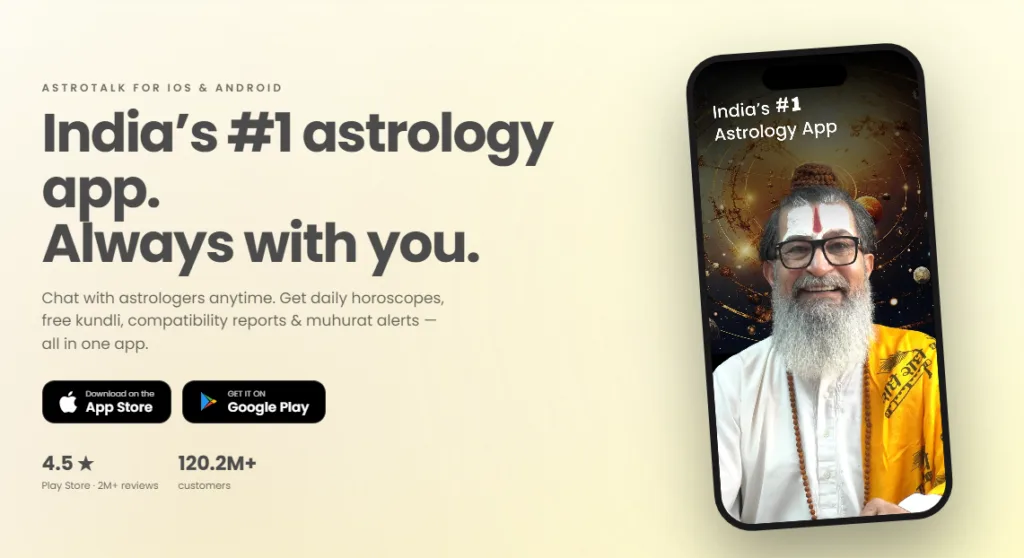
Someone identified this gap in the market and built an industry around it. AstroTalk, founded in 2017, reported operating revenues of ₹651 crore in financial year 2024, climbing to approximately ₹1214 crore in financial year 2025. The platform hosts over 13,000 astrologers, has crossed 50 million downloads on Google Play, and is preparing for an IPO expected between late 2026 and early 2027. This is not a spiritual enterprise. It is a data-driven consumer technology company that has correctly identified human anxiety about the future as one of the most scalable markets in the world.
The most sophisticated thing about AI astrology as a product is not the prediction engine. It is the framing. When a financial advisory app tells you what to do with your money, you understand it has interests, that it might be wrong, that you retain the responsibility to make the final call. When an astrology app tells you this is not an auspicious week for major decisions, the claim arrives cloaked in cosmic authority, not a recommendation, but the universe speaking. Questioning the prediction is subtly but consistently reframed as a failure of faith rather than a reasonable exercise of critical judgment.
Astrology has no valid scientific explanation. There is no peer-reviewed evidence of a causal mechanism linking planetary position to personality traits or life outcomes. The apps know this. Their users, on some level, also know this. And yet the system works – because the AI has become good enough at personalisation that the output feels like evidence. The Barnum effect, scaled and optimised by machine learning, becomes experientially indistinguishable from genuine insight.
Now consider what you actually handed over.
AI astrology apps typically collect your birth date, time, and place; your name and contact details; your device location; the timing and frequency of your queries, which correlates reliably with anxiety cycles; and, in apps offering live consultations, the actual content of those conversations. A 2025 Surfshark privacy study of the ten most popular astrology apps in the US found that every single one collected some form of user data, and half tracked users across third-party platforms for advertising.
Nebula, the highest-grossing US astrology app, collected 12 data types – more than twice the group average – sharing data with Facebook, Apple, and Amazon. Co-Star collected 8 data types, including contacts and coarse location. The app Moonly suffered a breach exposing data from 6 million users, including exact GPS locations, dates of birth, and email addresses.
But the real hazard is not identity theft. Because these apps log the exact timing of your queries – your midnight panics over health, heartbreak, or money – a leak doesn’t just expose your password. It exposes your psychological fault lines to anyone with the interest to exploit them. Therapists are legally obligated to protect information of exactly this sensitivity. Astrology apps are not. In India, full enforcement of the Digital Personal Data Protection Rules is not expected until May 2027, leaving tens of millions of users generating intimate data daily for platforms with limited accountability. Compatibility assessments compound this further: when you submit a partner’s or family member’s details for a chart reading, people who never agreed to be part of the transaction are included anyway.
The social consequences of the altered reality are already visible. Relationships are entered or exited based on chart compatibility. Career opportunities are declined because Mercury is retrograde. When predictions fail – when the compatible relationship ends badly, when the auspicious week turns disastrous – the response is not to question the system. Failed predictions do not undermine the dependency. They deepen it. The logic is self-sealing: the app was right, but you misread it; the stars were aligned, but something in you wasn’t; try again, ask again, go deeper. Hundreds of small choices – who to trust, whether to speak, when to act – are no longer being made from inside a person’s own experience of their life. They are being made from inside the app’s version of it.
The person living in the altered reality does not know they have left the real one. That is the design.
None of this reflects gullibility. It reflects the entirely rational desire to make sense of a world that does not offer sense on request. What is new and what deserves scrutiny is the infrastructure that has grown around that desire. The infrastructure that takes the desire, wraps it in cosmic language, feeds it data, and returns it as dependency.
The stars, whatever they mean, have never known your password. The app does. And it is not finished with you yet.
(Disclaimer: OBC encourages a diversity of ideas. The opinions expressed in articles may not necessarily reflect our editorial position.)