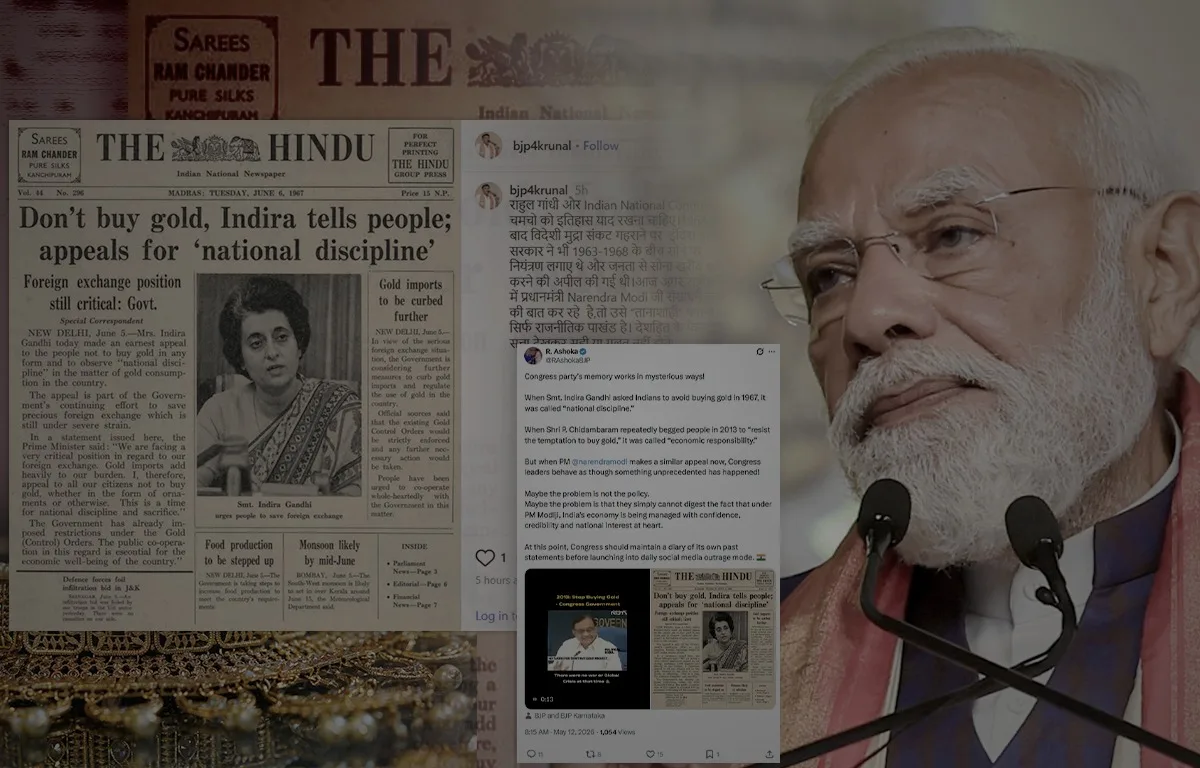
The Hindu’s Reputation Hijacked to Defend Modi
An AI-generated fake front page of The Hindu was circulated to defend Narendra Modi after his appeal to avoid gold purchases and reduce fuel consumption. The fabricated image falsely claimed that Indira Gandhi had made a similar appeal in 1967. The fake was shared not only by social media users, but also by Times Now and R. Ashoka, Karnataka’s Leader of the Opposition.
Prime Minister Narendra Modi, during a public meeting in Hyderabad, India, hinted at depleting forex reserves and urged citizens to rely more on public transport, increase the use of electric vehicles (EVs), and revive Covid-era practices such as remote work and virtual meetings. He also called for avoiding unnecessary foreign travel and gold purchases for a year, while encouraging support for locally made products, among other measures.
The opposition criticised the Prime Minister, with the Leader of the Opposition, Rahul Gandhi,stating that the twelve-year rule of National Democratic Alliance (NDA) government at the centre has jeopardised the country’s fuel security and foreign reserves.
Meanwhile, social media users shared a photo purportedly showing the front page of The Hindu dated June 6, 1967, featuring former Prime Minister Indira Gandhi and suggesting that she had made a similar public appeal. However, the image is AI-generated and fake.
What is going viral and where?
On May 12, a Facebook user shared the image along with a Malayalam caption. The post defends Prime Minister Narendra Modi’s recent appeal for fuel conservation and reduced gold purchases by comparing it with similar appeals made by previous Congress governments during periods of economic stress, including the 1991 Gulf War and the 2013 fuel crisis. It argues that such measures were earlier framed as necessary for the country’s financial stability, but are now being criticised because they were made by Modi. The post also links the appeal to rising global oil prices amid the ongoing Gulf conflict and portrays critics of the Prime Minister’s request as acting against national interest.
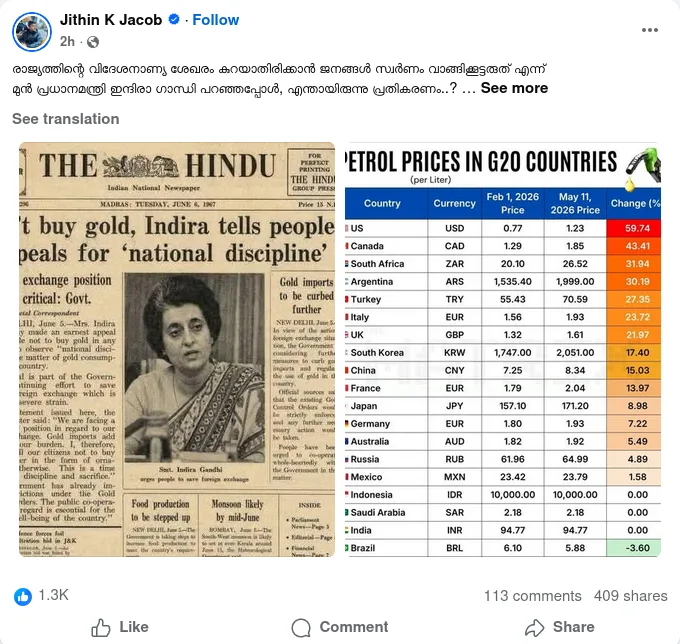
As of May 12, the post garnered 1,300 likes, 409 shares, and 113 comments.
Believing the photo to be true, a user commented, “On this occasion, remembering the golden age of the Iron Lady when she needed a letter from the Tehsildar to buy ten sacks of cement.” Another user remarked “Anything said or done in national interest is anathema to Rahul. Now I, too, doubt his citizenship.”
Bahudaiva Viswasi Matharamanu Matharan (ബഹുദൈവ വിശ്വാസി മാത്രമാണ് മതേതരൻ ), a user whom we earlier found propagating fake news and communal hate on Facebook constantly, has also shared the photo.
We also noticed that the image is viral on right-wing groups on Facebook.
Fake spread by political leaders and mainstream media
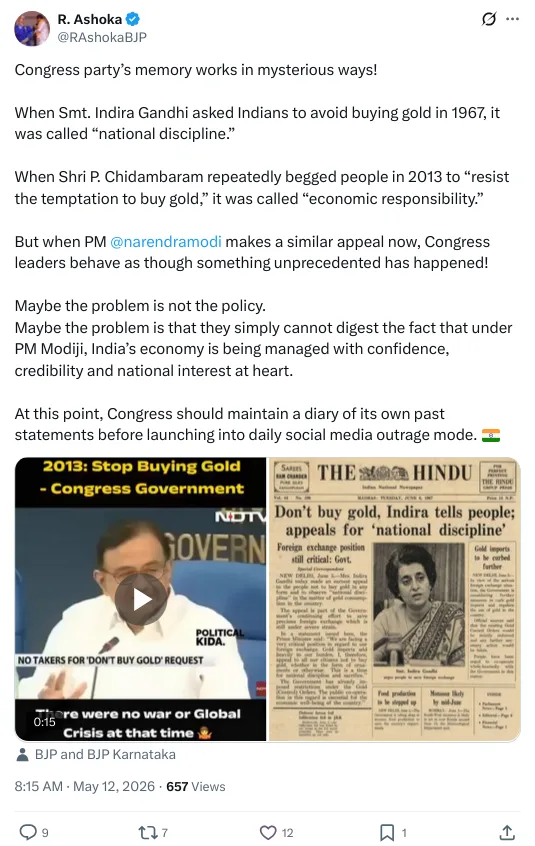
R. Ashoka,a Bharatiya Janata Party leader and the Leader of the Opposition in the Karnataka Legislative Assembly, also shared the photo on X (formerly Twitter).
In his post, R. Ashoka said that when Indira Gandhi appealed to people to avoid buying gold in 1967, it was seen as “national discipline,” and when P. Chidambaram urged citizens in 2013 to resist buying gold, it was framed as “economic responsibility.” He argued that similar appeals by Narendra Modi are now being criticised only because they come from him.
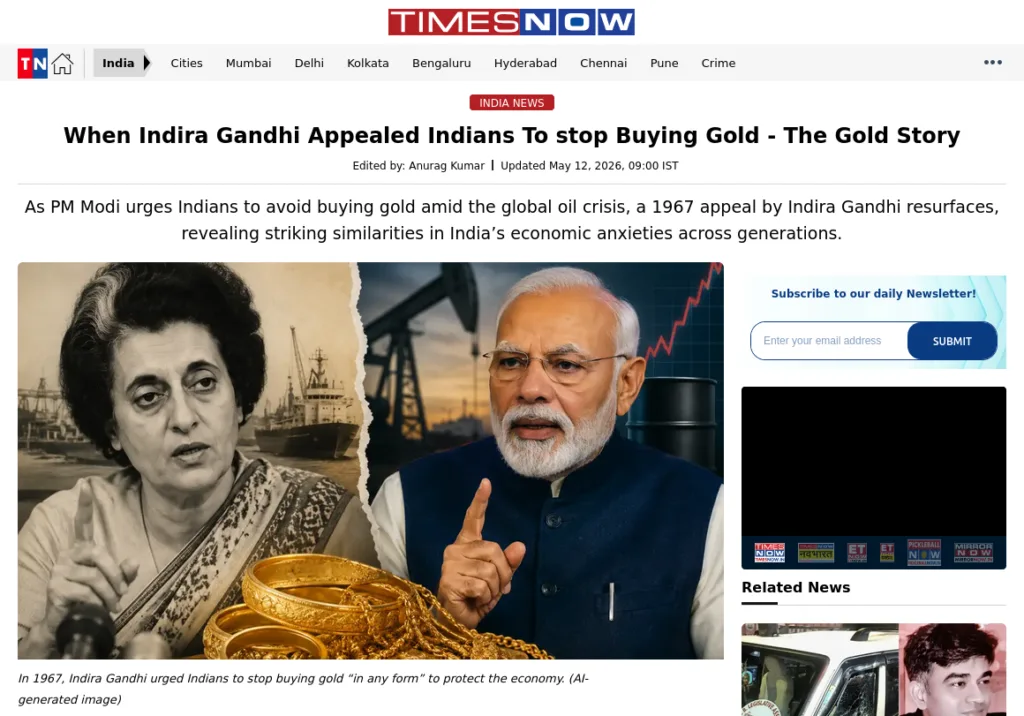
News media outlet Times Now also fell for the viral image and reported it. The article published on May 12 reads, “As PM Modi urges Indians to avoid buying gold amid the global oil crisis, a 1967 appeal by Indira Gandhi resurfaces, revealing striking similarities in India’s economic anxieties across generations.”
How did we verify?
We analysed the viral image and found no edition of The Hindu dated June 6, 1967, matching the one depicted in the post. During 1966–67, India faced a depletion of foreign exchange reserves, and then Prime Minister Indira Gandhi advocated the devaluation of the rupee.
The ‘1991 Project’, a website maintained by the Mercatus Center at George Mason University in Virginia, United States of America (USA),includes a timeline of the 1966 Devauation. It suggests that Indira Gandhi persuaded her cabinet and senior socialist leaders within the Indian National Congress to support the devaluation of the rupee as a way forward. The value of the rupee was subsequently reduced by 57 per cent after which India was promised annual financial assistance worth 900 million Dollar for three years.
Furthermore, we subjected the photo to AI detection.
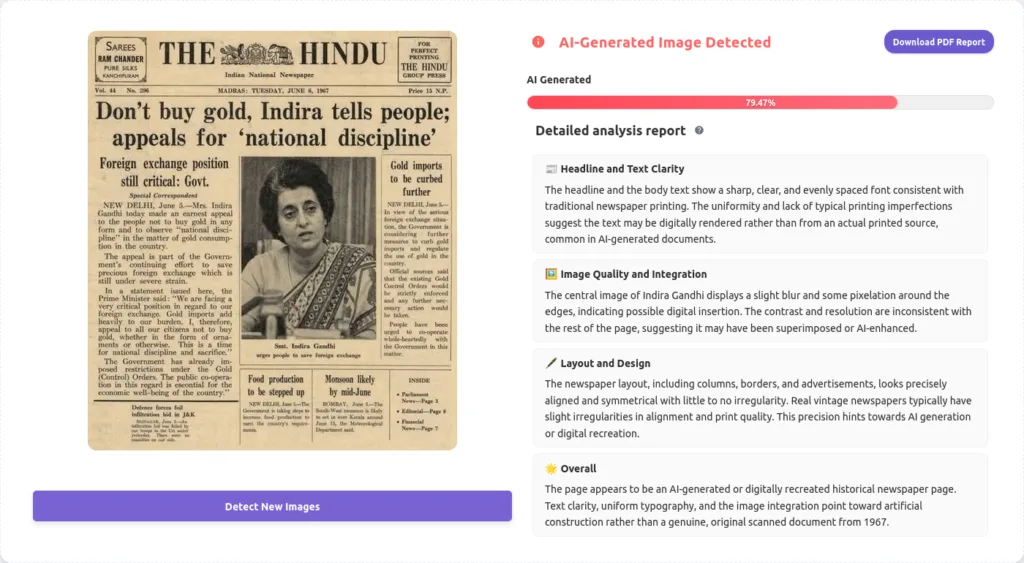
The AI-detection platform Mydetection.in indicates that the viral image is 79.47 % AI-generated. The detection results also suggest discrepancies with the headline, text clarity, layout and design. It also cites a high probability that the viral photo is ‘an artificial construction’, rather than an original scanned document from 1967.
Additionally, Suresh Nambath,Editor-in-Chief of The Hindu, confirmed to OBC that the viral newspaper front page was fake. He said that The Hindu had never published such a page.
On May 12, B. Kolappan, political journalist at The Hindu also shared the original front page of the newspaper dated June 6, 1967,
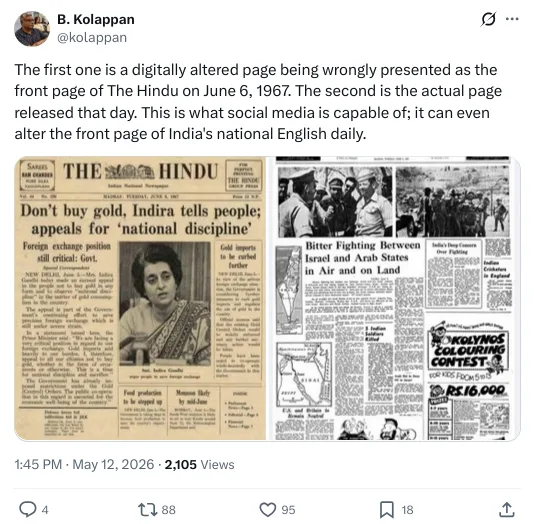
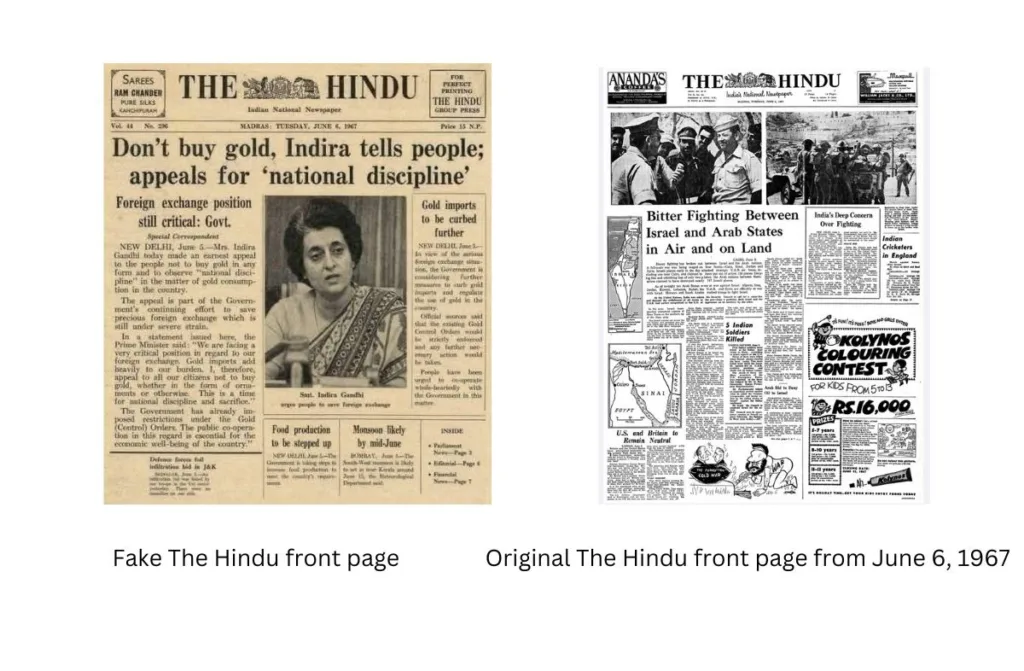
Using AI-generated images to spread fake news and propaganda has become rampant nowadays. But hijacking the hard-earned credibility of a national newspaper for the same purpose is rarer — and far more alarming. The incident highlights how easily AI-generated political misinformation can blend into real-world narratives.

Sujith A
Open Source Intelligence Researcher and Mis/Disinformation tracker. Passionate about investigations and a big fan of Sherlock Holmes.
View all posts by Sujith A