The World’s Energy Frontiers: How Offshore Basins Shape Global Geopolitics
The battle for energy is no longer fought only on land. Beneath the world’s oceans lie vast offshore basins that fuel economies, shape maritime disputes, and influence global power. This OSINT analysis maps the underwater geography driving 21st-century geopolitics.
While much of the world’s attention remains focused on onshore oil wells, refineries, and pipelines, offshore sedimentary basins beneath the oceans are of global significance. Formed over millions of years through geological processes, these offshore basins contain some of the world’s most productive oil and natural gas resources. In today’s world, these submerged energy points underpin global energy security, influence maritime strategy, and decisively shape geopolitical competition.
This OSINT analysis maps the world’s major offshore energy basins and shows how geography beneath the sea continues to shape power above it.
Mapping the world’s offshore energy frontiers
Although commercially productive offshore basins are relatively few in number, they contain some of the world’s largest recoverable hydrocarbon resources.
According to the International Energy Agency’s (IEA) 2018 report, Offshore Energy Outlook 2018, more than a quarter of the world’s oil and natural gas supply is produced offshore, with production concentrated in regions such as the Middle East, the North Sea, Brazil, the Gulf of Mexico and the Caspian Sea.
Several of the world’s most productive offshore basins also lie within regions of heightened geopolitical significance. The Persian Gulf remains central to global energy security because a substantial share of internationally traded crude oil and liquefied natural gas passes through the Strait of Hormuz. At the same time, the South China Sea combines offshore hydrocarbon potential with overlapping maritime claims and one of the world’s busiest commercial shipping corridors.
What is an offshore energy basin?
An offshore energy basin is a sedimentary geological province beneath the seabed where organic-rich sediments accumulated over millions of years and, under suitable conditions of heat and pressure, generated hydrocarbons. These basins contain reservoirs of crude oil and natural gas trapped beneath impermeable rock layers, making them the primary targets for offshore exploration and production.
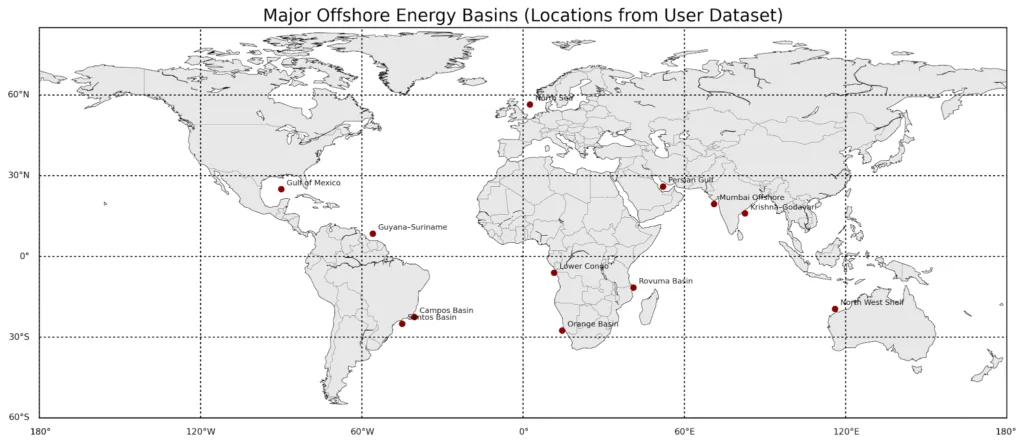
Commercially productive offshore provinces are concentrated along a handful of continental margins spanning the Middle East, the North Sea, the Gulf of Mexico, South America, Africa, South Asia and Australia.
While offshore basins provide the geological foundation, it is individual energy projects that determine their commercial significance. Large-scale developments such as Safaniya in Saudi Arabia, Johan Sverdrup in Norway, Búzios in Brazil and Liza in Guyana have transformed their respective basins into major centres of global energy production.
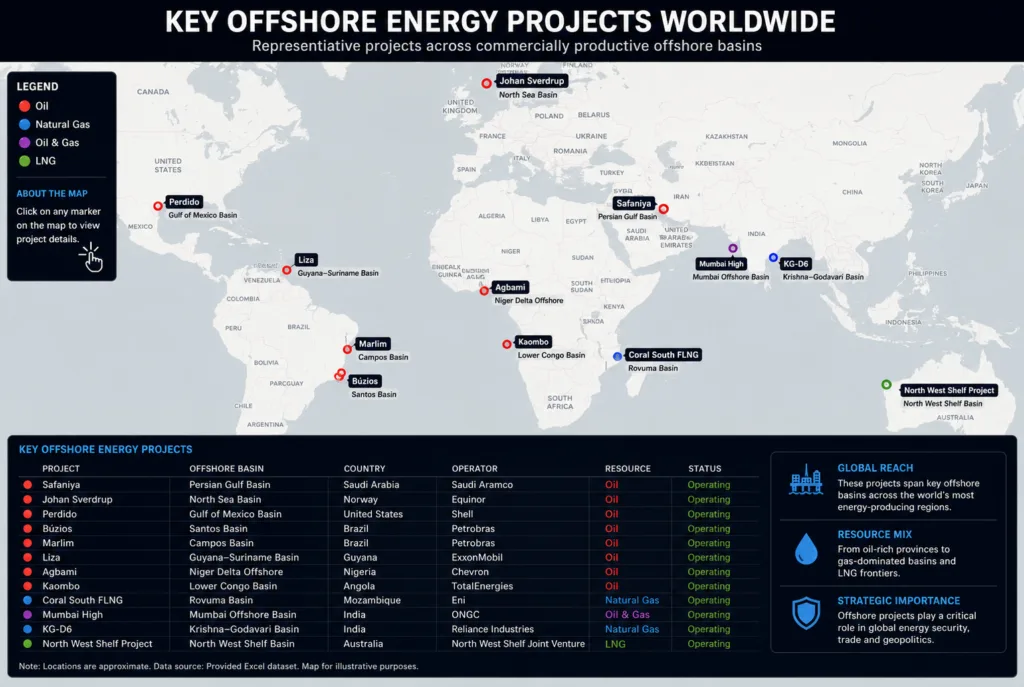
Projects such as Kaombo (Angola), Coral South FLNG (Mozambique), Mumbai High and KG-D6 (India) evidently illustrate the diversity of offshore developments, with new developments increasingly concentrated in South America, Africa and the Indian Ocean. These projects suggest a global shift in offshore energy production.
Offshore Energy and Geopolitics
Offshore hydrocarbon resources have long influenced maritime boundary negotiations, diplomatic relations and national security policy. Unlike many onshore reserves, offshore oil and gas resources are often located within or near Exclusive Economic Zones (EEZs), where overlapping maritime claims can complicate exploration and development. Offshore basins have increasingly become arenas of strategic competition, as countries strive for energy security and to strengthen their maritime presence.
Offshore energy production is only one component of the global energy system. Once extracted, crude oil, natural gas and liquefied natural gas must be transported through a network of strategic maritime chokepoints before reaching international markets. Strategic chokepoints such as the Strait of Hormuz, Bab el-Mandeb, Suez Canal, Strait of Malacca, Turkish Straits and the Panama Canal facilitate the movement of crude oil, natural gas and liquefied natural gas from major offshore basins to refineries and consumers worldwide. According to the U.S. Energy Information Administration (EIA), these waterways collectively handle a substantial share of global seaborne energy trade, making them critical to international energy security.
According to the United Nations Conference on Trade and Development (UNCTAD), the disruption of the Strait of Hormuz during the ongoing conflict in Southwest Asia resulted in direct supply cuts in the petrochemical sector in Southeast Asia and economic pressure in Southwest Asia. The global oil scarcity, along with inflation in energy and consumer costs, also affected Europe and the Americas.
The Offshore Infrastructure race
While public sector companies such as ONGC continue to dominate offshore hydrocarbon production, private companies are increasingly investing across the offshore value chain.
In the Mumbai Offshore Basin, Adani Welspun Exploration Limited (AWEL) is advancing the integrated development of the Tapti–Daman offshore gas project, marking one of the country’s notable private investments in offshore natural gas production. According to Sandeep Garg, managing director of Welspun Enterprises, the gas production from the Tapti-Daman sector project is set to begin by 2028.
Modern offshore developments rely on an extensive ecosystem of specialised vessels, subsea engineering, floating production systems, cable-laying ships and offshore logistics. Beyond upstream exploration, the Adani Group is also expanding its presence in offshore marine services through Adani Ports and Special Economic Zone (APSEZ), with investments in specialised offshore support vessels and subsea engineering capabilities.
According to a report by The Ken published on June 22, the global energy industry is increasingly shifting beyond offshore hydrocarbon production towards a broader ecosystem of offshore infrastructure and specialised maritime services. Alongside conventional drilling operations, the demand for offshore support vessels, subsea engineering, floating LNG facilities, offshore wind infrastructure and underwater cable networks is growing.
It also cites the movement of Adani Ports and Special Economic Zone Limited’s offshore support vessel Energy Savannah (to be renamed Astro Atlas) in the North Sea and the Eastern Mediterranean as an example of India’s emergence in this expanding offshore services market.
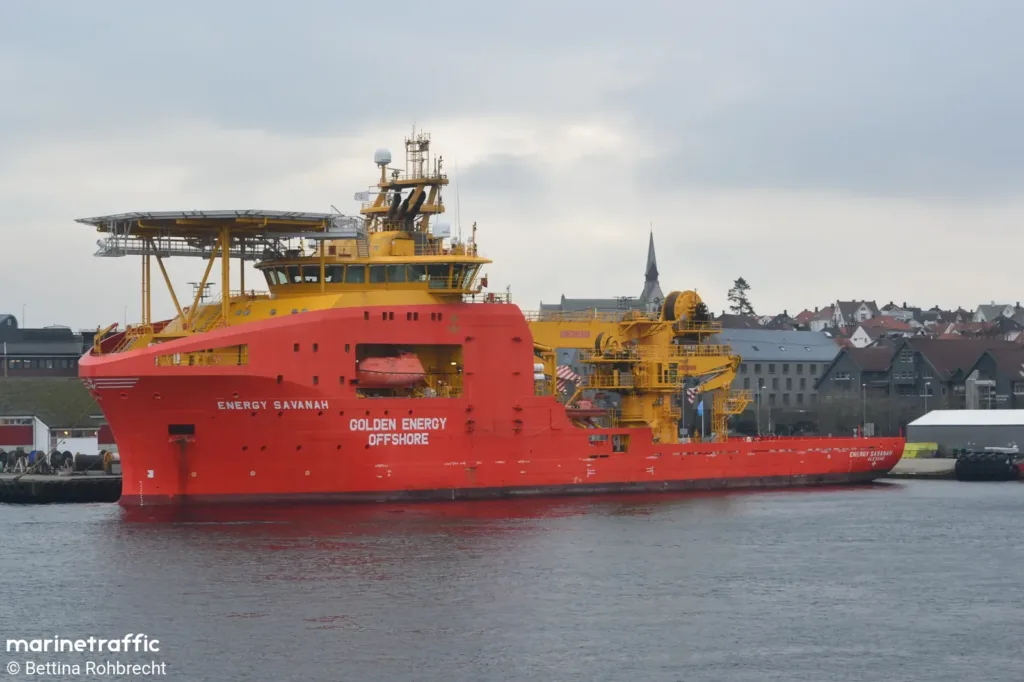
We found that the vessel is currently located in the Eastern Mediterranean.
The analysis shows that offshore energy basins are far more than geological formations beneath the seabed. They have evolved into strategic assets that shape global energy security, maritime trade and geopolitical competition. As offshore exploration expands into deeper waters and countries invest in the infrastructure needed to support it, the importance of these submerged energy frontiers is likely to grow.

Sujith A
Open Source Intelligence Researcher and Mis/Disinformation tracker. Passionate about investigations and a big fan of Sherlock Holmes.
View all posts by Sujith A