You are being watched ! How Sanchar Saathi Turns Your Phone into a Surveillance Tool
The Union government sells it as a citizen-friendly safety tool, and the telecom regulator calls it an “anti-fraud innovation.” But behind the polished pitch, Sanchar Saathi is rapidly emerging as one of the most powerful and least questioned surveillance infrastructures India has ever seen, with opposition parties now up in arms against it. What began as a platform to detect fake SIM cards and stolen phones has quietly expanded into a system capable of mapping every user’s communication network, linking phone numbers, devices, Aadhaar details, and behavioural patterns into a single centralised database.
In a country where democratic institutions are under stress, the rise of Sanchar Saathi raises urgent questions. Who watches the watchers? What safeguards protect ordinary citizens? And what happens when a tool built to police cyber fraud becomes a tool to police dissent? As India heads into another election-heavy year, Sanchar Saathi may reshape not just how we communicate, but how much freedom we have while doing so.
Widely criticised as an attempt to put a “government spy in citizens’ pockets,” the Union government’s Department of Telecommunications (DoT) is going ahead with its directive requiring smartphone manufacturers to pre-install the state-owned cyber security app Sanchar Saathi on all handsets sold from March 2026. For older phones, the government has ordered manufacturers to push the app through software updates.
The DoT has said that the order must be implemented within 90 days, and failure to comply will invite action under the Telecommunications Act 2023, the Telecom Cyber Security Rules 2024, and other applicable laws. All companies have been asked to file compliance reports within 120 days.
What is the Sanchar Saathi App?
The Sanchar Saathi web portal was launched in May 2023 by the then Minister of Communications, Electronics and IT, Ashwini Vaishnaw. At the launch, he said the platform was designed to prevent identity theft, forged KYC, and banking frauds carried out through misuse of mobile phones. The Sanchar Saathi mobile app was introduced later in January 2025. It allows users to check a device’s IMEI (International Mobile Equipment Identity), report lost or stolen phones, and flag suspected fraudulent communications.
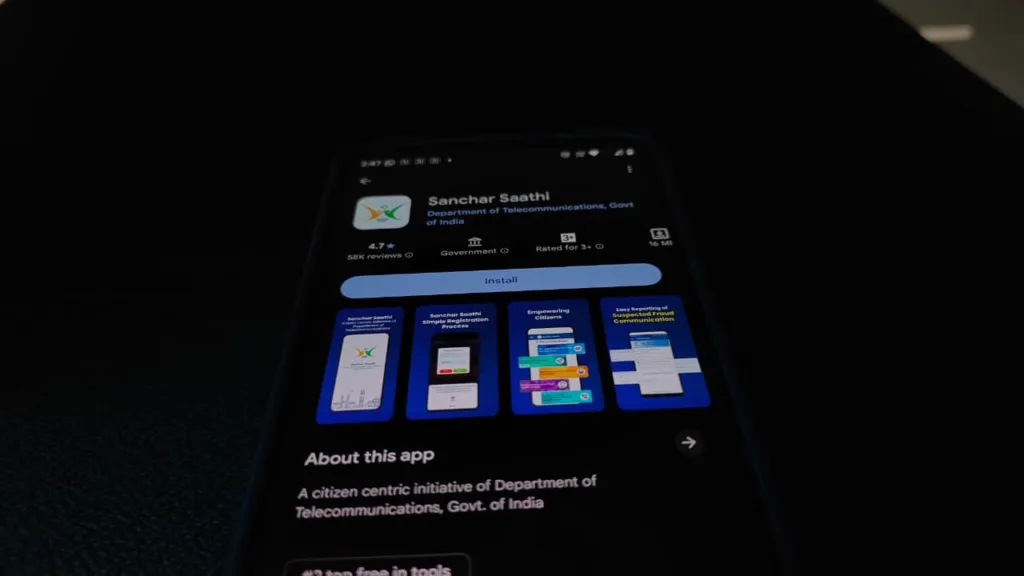
So far, the app has been voluntary. As per government data, it already has over one crore users. The Sanchar Saathi portal claims that more than 42 lakh mobile phones have been blocked and 26 lakh devices traced through the initiative.
The Looming Threats
Communications Minister Jyotiraditya Scindia told the Lok Sabha on 3 December, 2025 that the app, Sanchar Saathi, is incapable of snooping on users and will never be used for that purpose. Responding during the question hour, he said the government is open to revisiting its November 28 directive to smartphone manufacturers if citizens raise genuine concerns.
“Snooping is neither possible nor will it ever be,” Scindia said in Parliament, adding that the government led by Prime Minister Narendra Modi is committed to ensuring that people retain full control over their own digital security. He repeated the statement later in a post on X.
Earlier, he had told the media that the app was entirely optional, noting that users could delete it if they wished and were under no obligation to register. He said it could be removed at any time.
However, the directive specifically states that the application must be “readily visible and accessible” to users, and that its functionalities cannot be “restricted or disabled.” According to the app’s privacy policy, it can make and manage phone calls, send messages, access call and message logs, access photos and files, and use the phone’s camera.
The Internet Freedom Foundation (IFF) warned that the mandate turns every smartphone sold in India into a platform for state-mandated software that users cannot refuse or remove. The order cites “telecom cyber security” as its justification but does not define the app’s functional scope. The IFF noted that while the app is currently presented as a “benign” IMEI checker, it could easily be repurposed to scan for banned applications or read SMS logs in the name of fraud detection. The government is effectively asking every smartphone user to accept a tool that could permit broad surveillance on their personal device, without basic democratic safeguards.

Dr. T. M. Thomas Issac, former Finance Minister of Kerala, flagged serious security concerns in a Facebook post. He wrote that while Pegasus “snooped through the window like a thief,” Sanchar Saathi “walks in through the front door and installs a camera in the bedroom in the name of safety.”
Pegasus, a military-grade spyware developed by Israeli firm NSO Group, has reportedly been used in India against politicians, journalists, and activists, according to the Pegasus Project investigations.
A Privacy Nightmare
According to several cybersecurity activists and social commentators, the Modi government is attempting to turn India into a “complete surveillance state,” arguing that the app gives the state access to the operating system layer of a user’s phone. “Once that layer is opened, it cannot be closed again,” they warned.
“The social graph is a digital mapping of individuals and their relationships. By analysing call logs, contact lists, and messages, big data tools can identify who you interact with, your interests, your habits, and much more. This allows the state to build a comprehensive picture of the personal, political, social, and economic relationships of citizens”, explains Kerala-based social commentator Ashish Jose Ambat.
Ashish Jose also pointed to the use of a DRM ID in the app’s Java files. “This unique device ID remains consistent even after uninstalling the app or performing a factory reset, which means the state can track you through permanent device fingerprinting even if you change your SIM or format your phone,” he said.
He further cautioned that, with storage permissions, the app could “read, modify, or even plant files on a phone remotely.” According to him, this raises the fear that “incriminating content could be planted on a device,” similar to what investigators allegedly did in the cases of Father Stan Swamy and Rona Wilson.
Mounting Concerns
Congress general secretary K. C. Venugopal said on X (formerly Twitter) that the right to privacy is an intrinsic part of the fundamental right to life and liberty. Calling the directive “beyond unconstitutional,” he described it as part of a “relentless assault on the constitutional rights of Indian citizens” and demanded an immediate rollback.
CPI(M) General Secretary M. A. Baby condemned the move as a direct attack on the fundamental right to privacy. He noted the absence of public consultation or discussion and said that forcing state-level spyware onto every device is not fraud prevention but a drive toward total digital surveillance.
Following the Supreme Court judgment in K. S. Puttaswamy vs Union of India in 2017, privacy was recognised as a fundamental right under Article 21. Critics argue that the Digital Personal Data Protection (DPDP) Act 2023 already prioritises state authority over privacy. Sanchar Saathi, they say, further entrenches this climate of surveillance and raises fears that “Big Brother” will monitor Indian citizens every passing second.
Update : Following widespread outrage, the Union government rolled back the mandatory pre-installation of the app on December 3. The government claimed that since many users have ‘voluntarily’ downloaded the app, there was no longer a need to make it mandatory.