From SIR to CJP: Tracking BJP’s Digital Narratives Across Six X Accounts
Six BJP-affiliated X accounts, similar narratives: targeting CJP, discrediting anti-SIR protests and defending SIR—an analysis of how memes, hashtags and viral videos amplified these messages across regional accounts.
Following the change in leadership of the BJP IT Cell on 17 August 2026, the party’s official social media accounts continued to promote narratives about the Special Intensive Revision (SIR) of electoral rolls and protests demanding the resignation of Chief Election Commissioner Gyanesh Kumar. Several BJP state accounts on X posted content targeting the protests and the Cockroach Janata Party (CJP), which had organised demonstrations demanding the CEC’s resignation.
This OSINT investigation examines the posting patterns and recurring narratives across six BJP-affiliated accounts on X, namely @BJP4Delhi, @BJP4Maharashtra, @BJP4Karnataka, @BJP4Keralam, @BJP4TamilNadu, and @BJPforGenZ, between 17 August and 28 October 2026, tracking their posting activity, recurring narratives, hashtags and false claims.
It also examines how these accounts propelled the campaign titled ‘Save Democracy, Remove Anarchy’, BJP’s nationwide campaign announced on 23 October 2026 to counter the opposition’s criticism of the Special Intensive Revision (SIR) and the anti-SIR protests. The central theme of the campaign focuses on defending the SIR process and portrays anti-SIR voices as attempts to create ‘anarchy’ and mislead the public.
Narrative analysis
While analysing the posts shared by the accounts @BJP4Delhi, @BJP4Maharashtra and @BJP4Karnataka, we found several recurring narratives surrounding CJP, the anti-SIR protests and demands for the resignation of the Chief Election Commissioner, Gyanesh Kumar.
While the accounts used different language and formats, their messaging repeatedly associated CJP with opposition parties, questioned the legitimacy of the protests and defended SIR as a necessary exercise to clean up the electoral rolls.
CJP as an extension of the Congress and AAP
One of the recurring narratives across the three accounts was the portrayal of the CJP as a political proxy of opposition parties rather than an independent movement. However, the framing varied between the state units.
The BJP Delhi account repeatedly associated CJP with Aam Aadmi Party (AAP) leader Arvind Kejriwal, referring to the organisation as the ‘Kejriwal gang’, ‘B team’ and ‘goons’. On 18 October, @BJP4Delhi shared a post alleging that Rahul Gandhi and Arvind Kejriwal helped gather Pakistani citizens to defame India during Dhruv Rathee’s London protest held on 17 October.
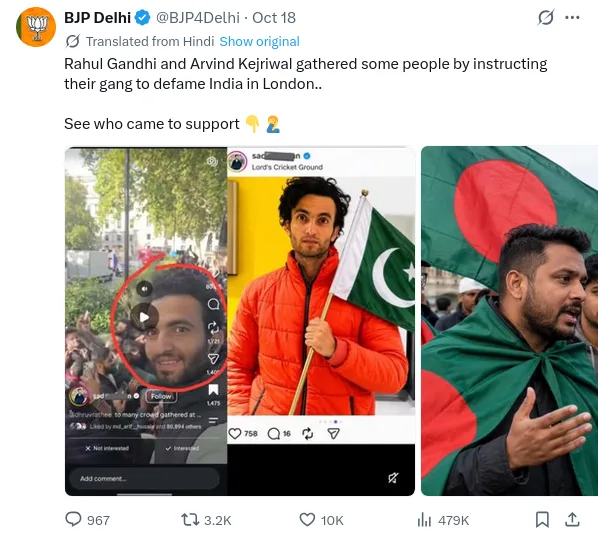
The screenshot of the X post shared on 18 October.
However, OBC’s verified report published on 20 October revealed that the claim was misleading. The report found that @BJP4Delhi used fully AI-generated images and also used the digitally altered Instagram photo of Saddamhusen Makarani, a London-based Indian citizen, to portray him as a Pakistani citizen.
The BJP Maharashtra account adopted a different approach. On 1 September, it amplified a statement by Maharashtra Chief Minister Devendra Fadnavis, who described CJP as the ‘Congress Jitao Program’. The account subsequently repeated this framing in its posts, including one on 16 October, which claimed that CJP was effectively the Congress party.
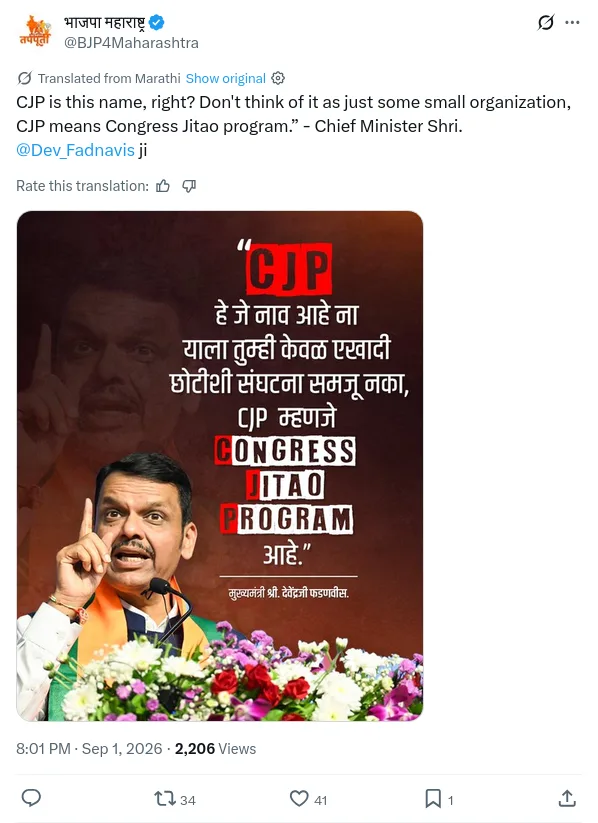
The screenshot of the X post shared on 1 September.
Similarly, the BJP Karnataka account described CJP as a ‘Congress-sponsored joker party’ and a ‘toolkit gang’. On 16 October, it published a Kannada-language post using these descriptions alongside the hashtags #CJPExposed and #ToolkitGang. Two days later, it also accused Congress of funding CJP and anti-national elements.
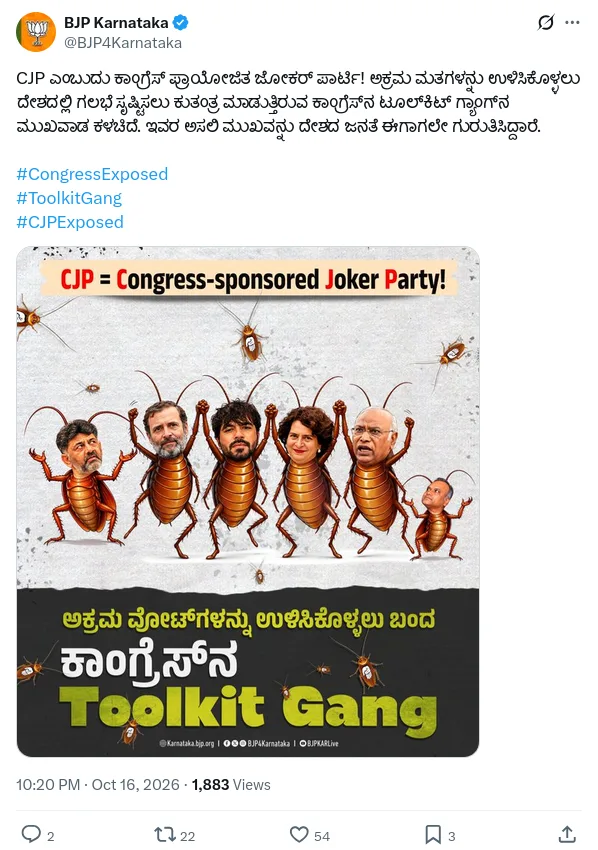
The screenshot of the X post shared on 16 October.
‘Vote chori’ claims and the defence of SIR
Another prominent narrative involved rejecting allegations of electoral fraud and claims that 13 crore voters had been removed from the electoral rolls through SIR. The three accounts repeatedly defended the revision process, arguing that it was intended to remove deceased, duplicate, fake and ineligible entries.
On 19 October, BJP Delhi rejected the claim that 13 crore voters would be deleted, maintaining that SIR was intended to remove fake and duplicate entries.
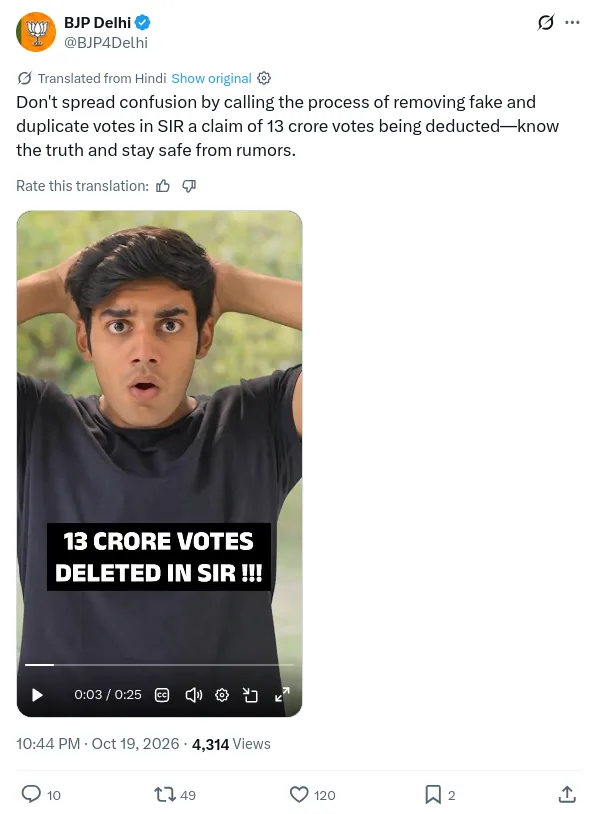
The screenshot of the X post shared on 19 October.
The Maharashtra unit also published posts containing electoral data to counter allegations of ‘vote chori’.
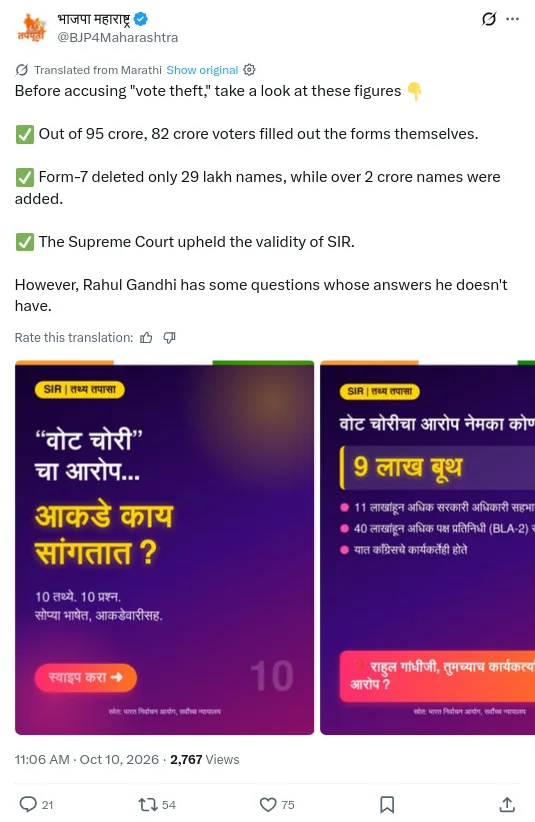
The screenshot of the X post shared on 10 October.
The X account @BJP4Karnataka also circulated posts defending SIR, including content highlighting the addition of new Gen-Z voters. It drew on historical references to previous SIR exercises to counter criticism of the current process.
On 26 October, the account claimed that 10 of the 12 previous SIR exercises had taken place under Congress governments.
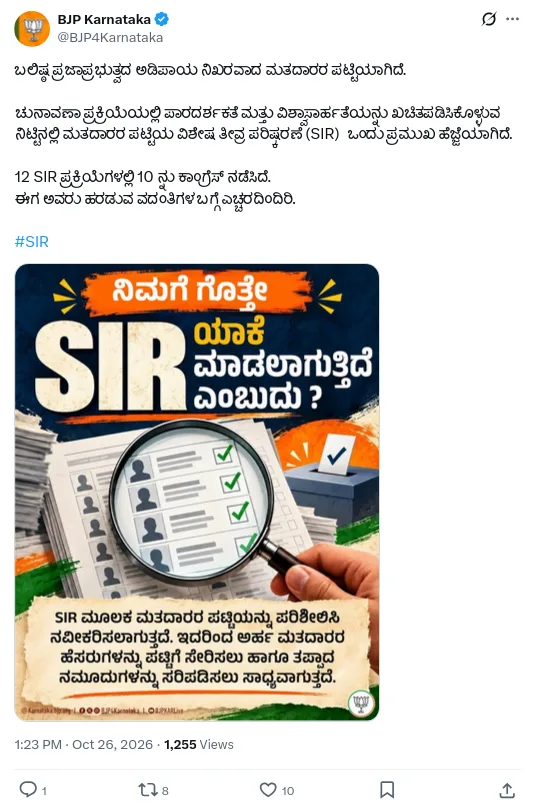
The screenshot of the X post shared on 26 October.
Protests portrayed as attempts to create anarchy
The three accounts also repeatedly framed the anti-SIR protests and demonstrations against Gyanesh Kumar as politically motivated attempts to create disorder. Posts highlighted alleged disruptions to public life, particularly emphasising the impact of the demonstrations on traders and businesses.
On 18 October, BJP4Delhi published a post claiming that CJP’s demonstrations were causing difficulties to the public as well as the traders. The Karnataka account shared similar content, including videos featuring traders complaining about the impact of the protests on their livelihoods. Both accounts used these posts to question the legitimacy of the demonstrations.
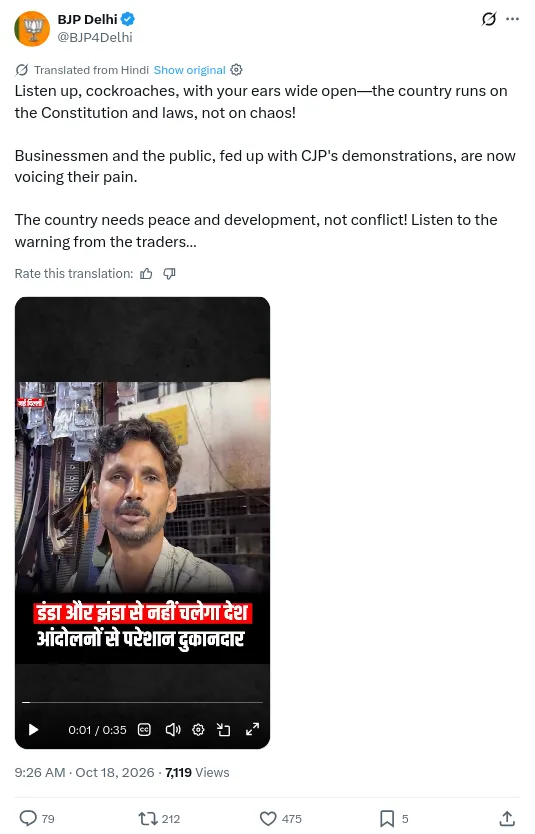
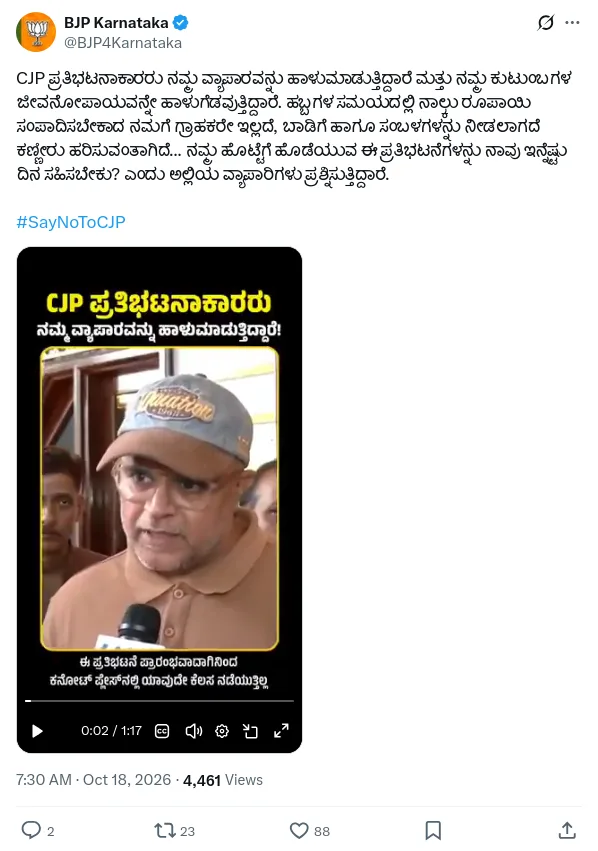
The screenshot shows X posts shared on 18 October.
The X account BJP4Maharashtra amplified a similar argument by sharing a statement by Defence Minister Rajnath Singh on 16 October. The post portrayed the protests as attempts to create anarchy for political power rather than genuine opposition to SIR or Gyanesh Kumar.
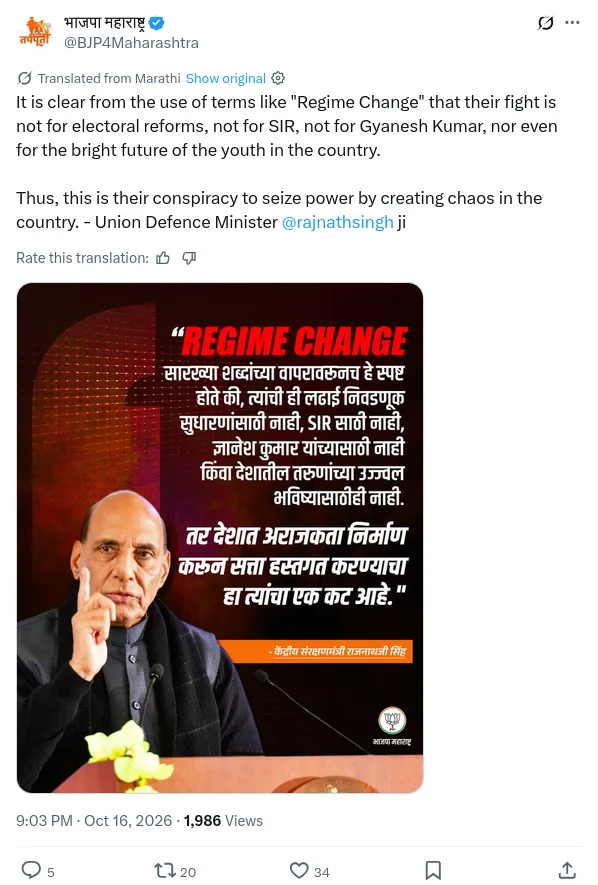
The screenshot of the X post shared on 16 October.
Defending Chief Election Commissioner Gyanesh Kumar
The BJP Delhi account also published content defending Gyanesh Kumar against demands for his resignation. On 21 October, it described him as an IAS officer rather than a politician and noted the presence of the Leader of the Opposition in the appointment process.
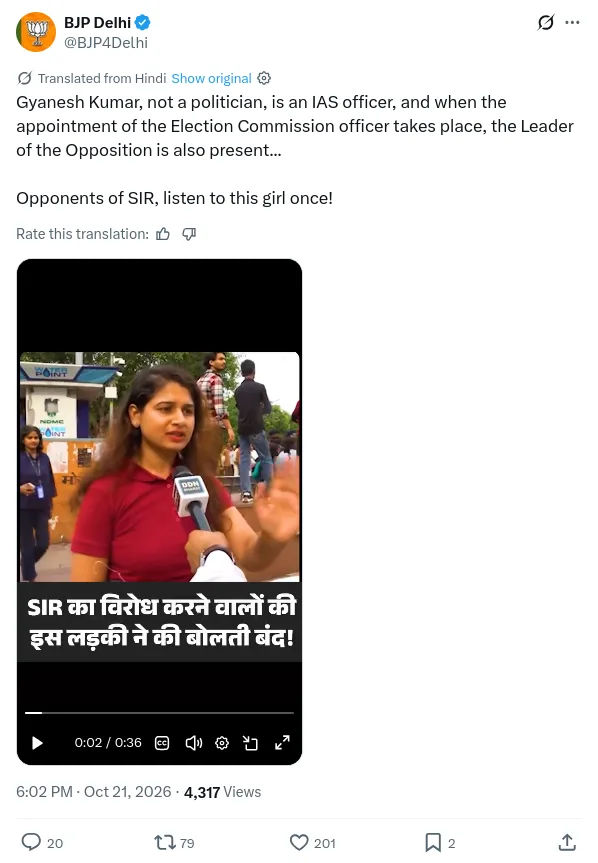
The screenshot of the X post shared on 21 October.
Opposition accused of double standards
Another narrative involved accusing opposition parties of selective outrage and hypocrisy. The BJP Maharashtra account, for instance, published a post on 17 October questioning the Congress, AAP and CJP over what it described as their silence on the government allegedly using force against student protesters in Kerala, while criticising the SIR process and the demonstrations against Gyanesh Kumar.
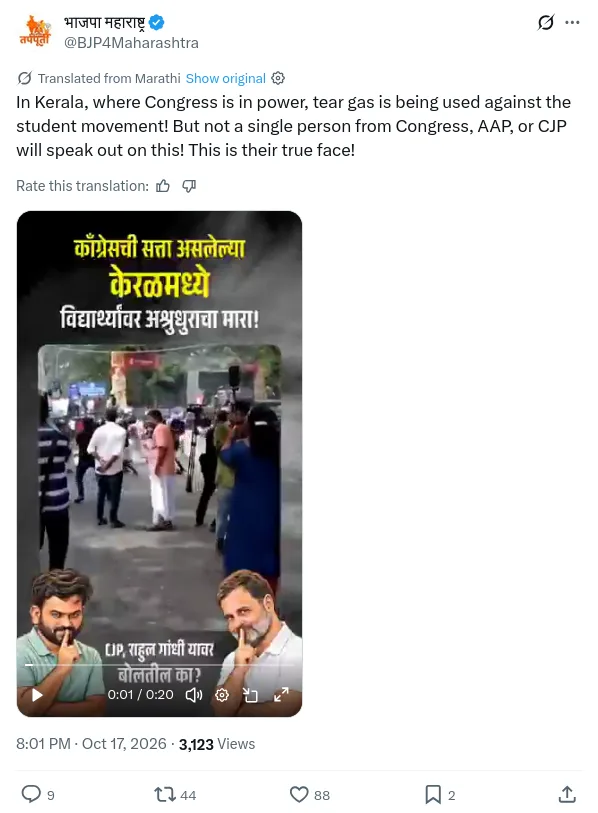
The screenshot of the X post shared on 17 October.
The footage does not show a student protest in Kerala; rather, it captures a protest held in Thiruvananthapuram, Kerala, dated 16 October, where police used tear gas to disperse a Bharatiya Janata Yuva Morcha (BJYM) march towards the Kerala Assembly demanding the resignation of Leader of the Opposition Pinarayi Vijayan over the CMRL-Exalogic pay-off case.
Across the three accounts, the recurring messaging followed a similar pattern: CJP was associated with opposition parties, the protests were portrayed as politically motivated and disruptive, and SIR was defended as a legitimate electoral exercise.
BJPforGenZ – memes, emojis and sarcasm
Unlike the BJP state-unit accounts, @BJPforGenZ adopted a more informal and meme-driven approach while targeting the CJP and its supporters. The account frequently used Gen-Z slang, sarcastic captions, emojis, and viral videos to convey its political messaging. Its posts portrayed CJP as a political outfit attempting to create anarchy and destabilise the country, while repeatedly associating the organisation with Congress and Arvind Kejriwal.
One of the prominent narratives pushed by the account was that CJP’s protests were part of an attempt at ‘regime change’. On 18 October, it published posts comparing the situation in India with regime change operations in Afghanistan, claiming that similar attempts had been made in India but had failed.
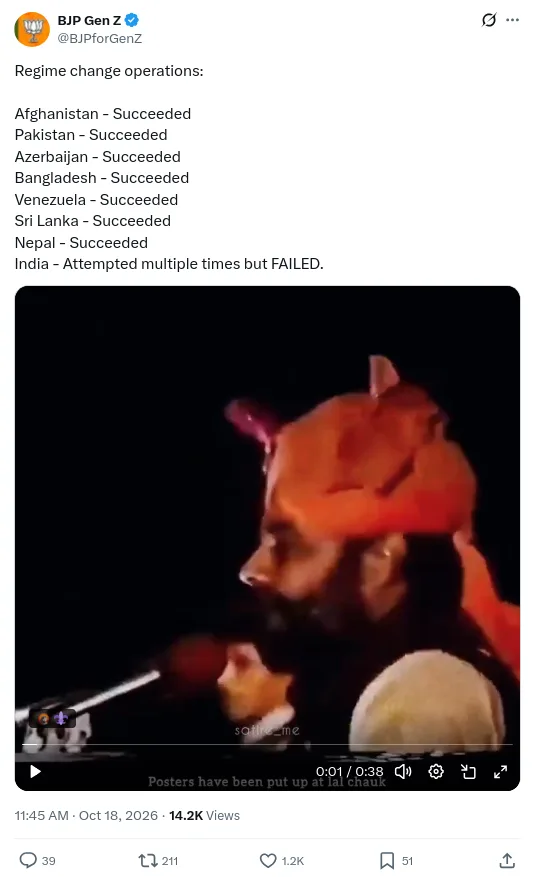
The screenshot of the X post shared on 18 October.
Another post shared on 18 October featured a video showing protesters in France attacking police vehicles. The post suggested that CJP wanted a similar situation to unfold in India and claimed that Prime Minister Narendra Modi had saved the country from it.
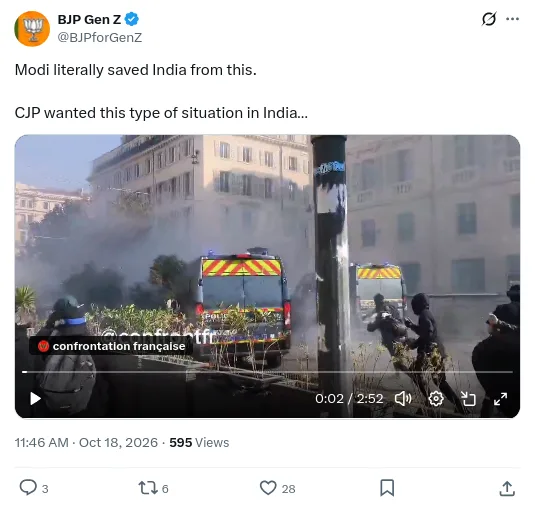
The screenshot of the X post shared on 18 October.
Similar to the BJP’s state X accounts, BJPforGenZ also repeatedly associated CJP with Congress and Kejriwal. In one post, it shared an older post by CJP founder Abhijeet Dipke expressing support for Kejriwal, captioning it ‘A love story written in hell’. In another, it referred to CJP as ‘CJP naxali’ while accusing the organisation of playing political games at the expense of traders.
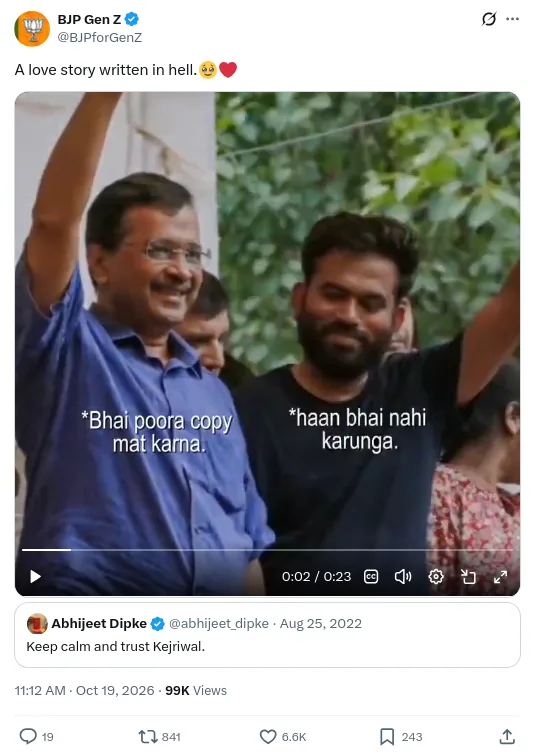
The screenshot of the X post shared on 19 October.
The account also circulated videos featuring traders complaining about the impact of the CJP protests on their businesses. One post described the festival season as crucial for traders and accused CJP and Congress of jeopardising their livelihoods through protests.
Another post praised Delhi Police for its action against CJP protesters and leaders at Jantar Mantar. The account linked the police action to a warning that India could face a situation similar to France’s, using the comparison to portray the protests as a threat to public order. The post used clips from the Dhurander movie with dramatic music while quote-posting an Islamophobic post targeting the protest in France.
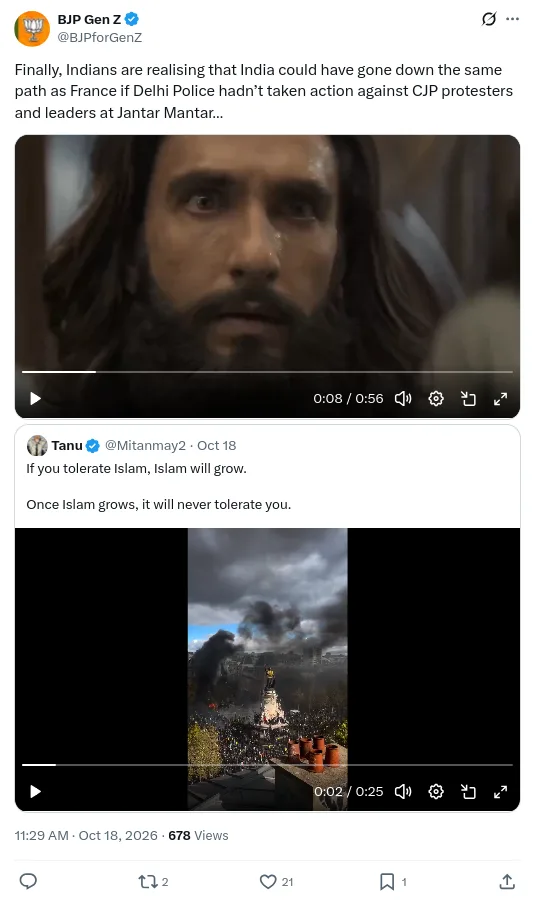
The screenshot of the X post shared on 18 October.
The account’s language sounded more Gen Z-friendly. It frequently used expressions such as ‘Bhai Hindi Mein Likh Le’ and ‘Rahul, it’s done bro’, accompanied by emojis and sarcastic captions. It also directly engaged with the CJP account through mocking replies.
Unlike the state-unit accounts, which made extensive use of structured campaign hashtags, @BJPforGenZ relied more on viral videos, short captions and meme-style content. Its posts also included material with communal undertones.
On 19 October, the account also shared a viral video which suggests that Pakistanis and Bangladeshis sang India’s national anthem during Dhruv Rathee’s London protest against electoral roll irregularities in India on 17 October. Union Minister Kiren Rijiju also amplified the claim.
However, OBC, in its verified report published on 20 October, clarified that the visual predates the London protest and depicts an event in London in August 2026 commemorating the independence of India and Pakistan. People belonging to both countries had attended the event.
Overall, @BJPforGenZ used a communication style that included internet slang, humour, sarcasm and viral content to target CJP and opposition leaders.
Its messaging extended beyond allegations of political affiliation and disruption, introducing claims of regime change and comparisons with events in other countries. Some of its posts also incorporated communal rhetoric.
What does analysis of @BJP4Keralam & @BJP4TamilNadu reveal?
Between 17 August and 28 October 2026, both accounts focused largely on defending SIR and countering the opposition’s allegations of voter deletion. However, their messaging reflected different regional priorities.
@BJP4Keralam combined national SIR narratives with local political attacks. Its Malayalam posts accused the Congress and Left of spreading misinformation and using organisations such as CJP to create instability. The account frequently used hashtags including #SaveDemocracyRemoveAnarchy and #APAKADAMPolitics. Its direct engagement with CJP was limited.
@BJP4TamilNadu, meanwhile, focused on attacking Rahul Gandhi and Tamil Nadu leaders who supported anti-SIR protests. Its posts questioned the opposition’s claims about voter deletions and repeatedly highlighted previous SIR exercises under Congress governments. The account amplified #RealityOf13CroreVoters, but made very few direct references to CJP.
Overall, both accounts echoed the wider BJP narrative defending SIR, but placed greater emphasis on local political criticism than on CJP itself.
Anatomy of the #SaveDemocracyRemoveAnarchy
On 23 October, the BJP announced a nationwide ‘Save Democracy, Remove Anarchy’ campaign. The campaign framed protests against the Special Intensive Revision (SIR) and related opposition campaigns as threats to democracy and public order.
However, the hashtag #SaveDemocracyRemoveAnarchy was not adopted uniformly across the six BJP accounts examined. Its use was concentrated primarily around @BJP4Maharashtra, with @BJP4Keralam emerging as a secondary contributor. The remaining four accounts showed no significant use of the hashtag in the posts reviewed.
BJP Maharashtra was the most active in promoting the hashtag, repeatedly linking it to the defence of SIR, criticism of the CJP protests and attacks on Rahul Gandhi and the Congress. Examples include posts that question Rahul Gandhi’s position on SIR and portray the protests as an attack on democracy.
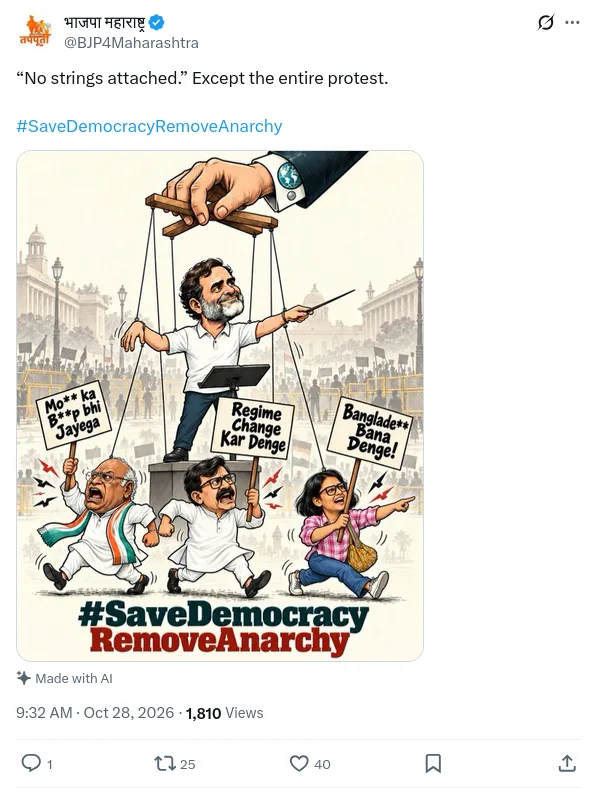
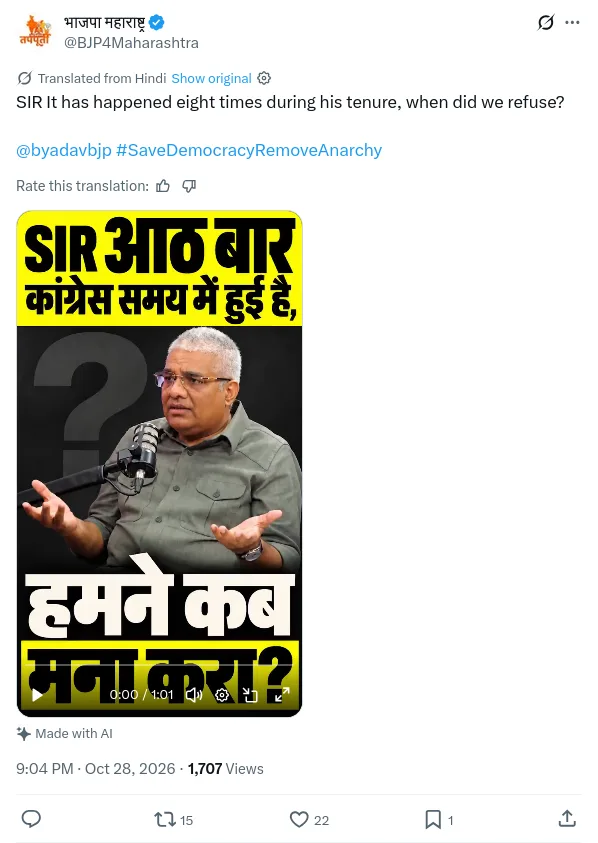
The screenshot of the X post shared on 28 October.
BJP Keralam also used the hashtag regularly, often alongside #APAKADAMPolitics. Its posts framed opposition protests as acts of anarchy and presented the party’s response as a campaign to protect democracy. The account also used the hashtag to target Rahul Gandhi and Congress leaders, while announcing its 3 November march in Thiruvananthapuram, Keralam.
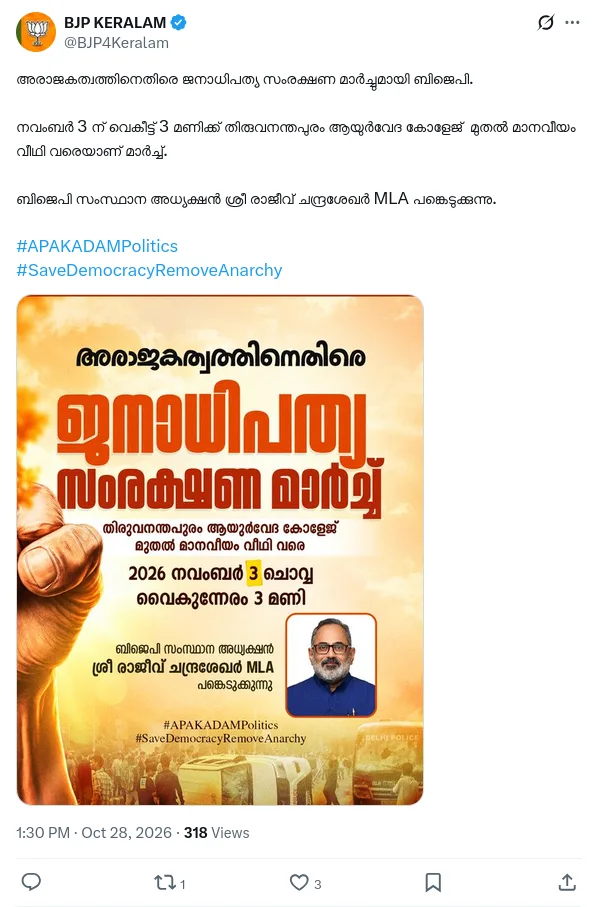
The screenshot of the X post shared on 28 October.
The analysis of these six BJP-affiliated accounts shows how the party’s narratives around SIR and the CJP protests were adapted for different regional audiences and platforms. While the BJP’s Delhi, Maharashtra and Karnataka accounts repeatedly linked CJP to opposition parties and portrayed the protests as attempts to create disorder, @BJP4Keralam and @BJP4TamilNadu focused more on defending SIR and targeting local political opponents.
@BJPforGenZ adopted a different approach, using memes, sarcasm and viral videos to communicate similar themes. The repeated use of certain hashtags, claims and formats points to common narrative themes across the accounts, although these similarities alone do not establish central coordination. It reveals how BJP-affiliated accounts amplified and adapted recurring political narratives to counter the Anti-SIR protest and the demand to arrest CEC Gyanesh Kumar, while challenging the legitimacy of the CJP protests.
Additional reporting by Sneha M and Khadeeja Saniyya.

Sujith A
Open Source Intelligence Researcher and Mis/Disinformation tracker. Passionate about investigations and a big fan of Sherlock Holmes.
View all posts by Sujith A