After the ECI Exposé: Tracking Criticism, Abuse and Backlash
From attacks on the investigation to “toolkit” allegations and personal abuse targeting journalist Ritika Chopra, OBC traces how criticism of the ECI spread across X and Instagram — and how the focus shifted from the story to the journalist.
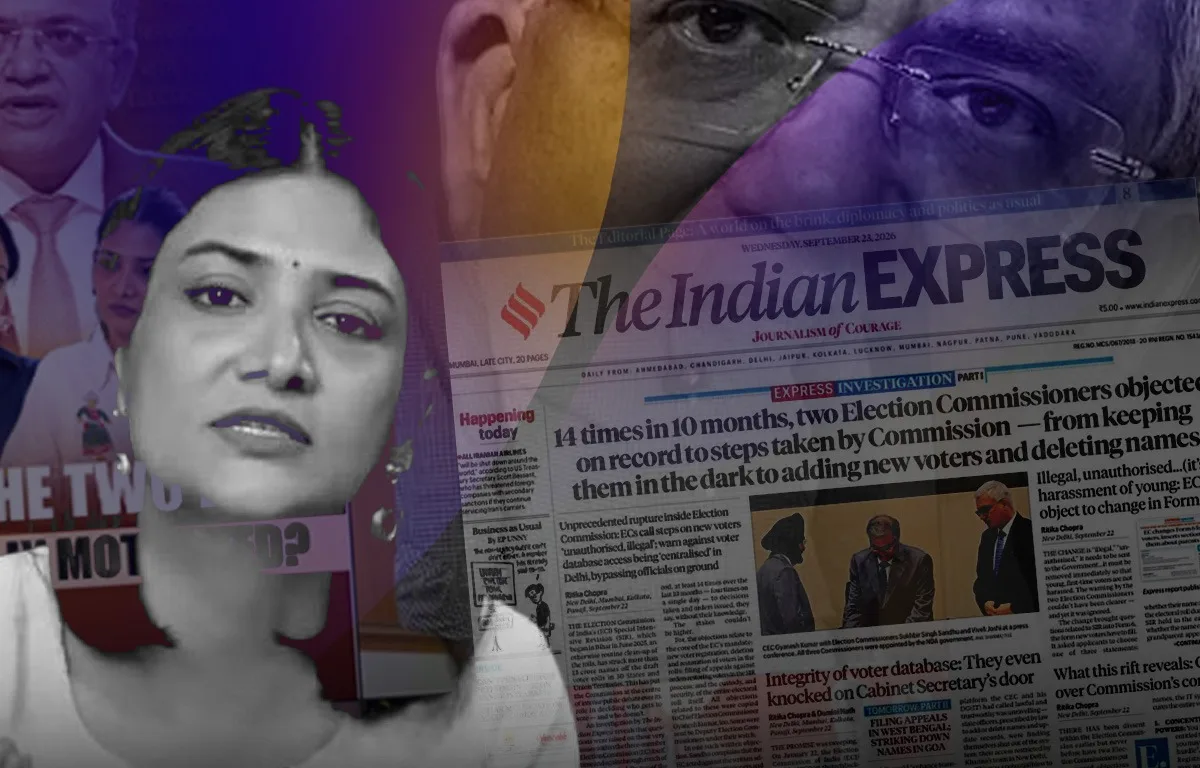
On 23 September, The Indian Express published an investigation examining disagreements within the Election Commission of India over several decisions, including issues related to the Special Intensive Revision of electoral rolls and Form 6, which quickly became a subject of debate on X. The backlash did not remain confined to X; articles and posts from platforms such as OpIndia and The Pamphlet also entered the discussion. At the same time, Ritika Chopra’s personal Instagram account also became the target of critical and abusive comments.
But how did the backlash develop? Which narratives emerged around the investigation, and which accounts helped amplify them? Did the discussion remain focused on the ECI’s decisions, or did it increasingly shift towards the journalist who reported them? And what does the activity across X and Instagram reveal about the nature and spread of the backlash?
Offbeat Concerns analysed posts, accounts and interactions across X and Instagram to trace the online response following the publication of the ECI investigation.
This OSINT report examines the narratives that emerged, the accounts that amplified them and the nature of the response directed towards Ritika Chopra.
Questioning the ECI’s record
Several social media users shifted the focus from the current allegations concerning the Election Commission to the record of former election commissioners.
One of the narratives that emerged questioned the political affiliations of former election commissioners after their tenure. On 23 September, the X account Right Wing Wire (@RightWingWire26) shared a post referring to former Chief Election Commissioners T.N. Seshan, M.S. Gill and V.S. Ramadevi. The post highlighted their political associations after leaving office, including M.S. Gill’s subsequent entry into the Congress and V.S. Ramadevi’s tenure as Governor of Karnataka. It framed these examples as a counterpoint to discussions about the ECI’s present functioning.
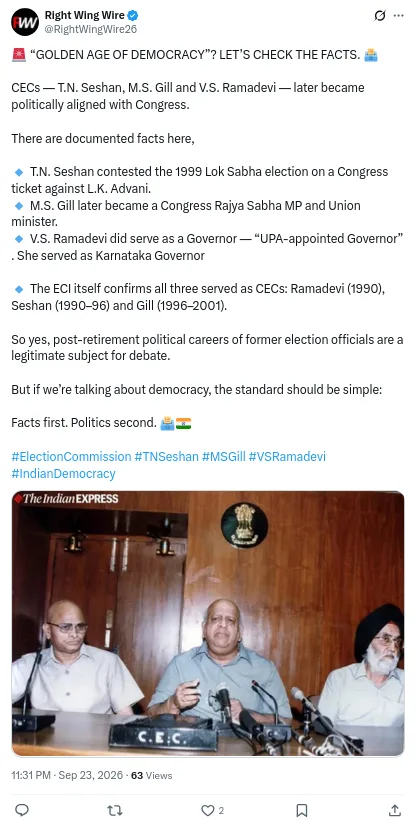
As of 23 September, the post had received limited engagement.
A similar post shared by Rishi Bagree (@rishibagree) amplified the narrative.
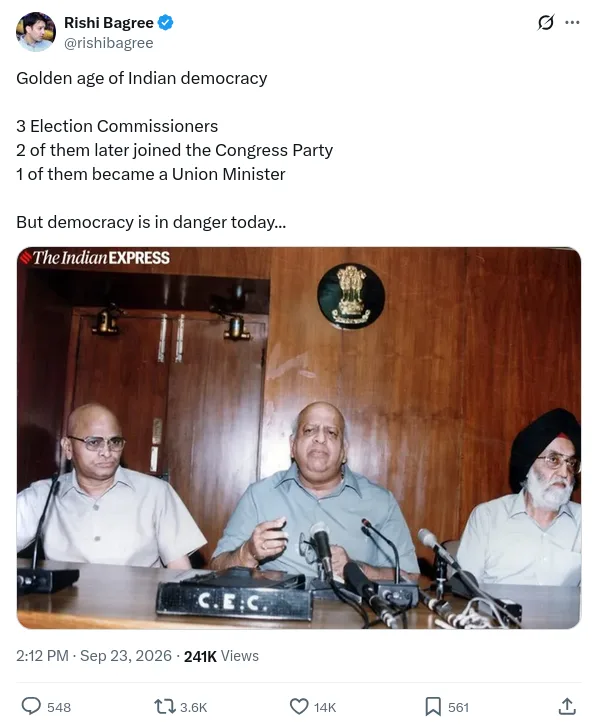
As of 26 September, his post had received significantly more engagement, with 241,000 views, 3,600 reposts and 14,000 likes.
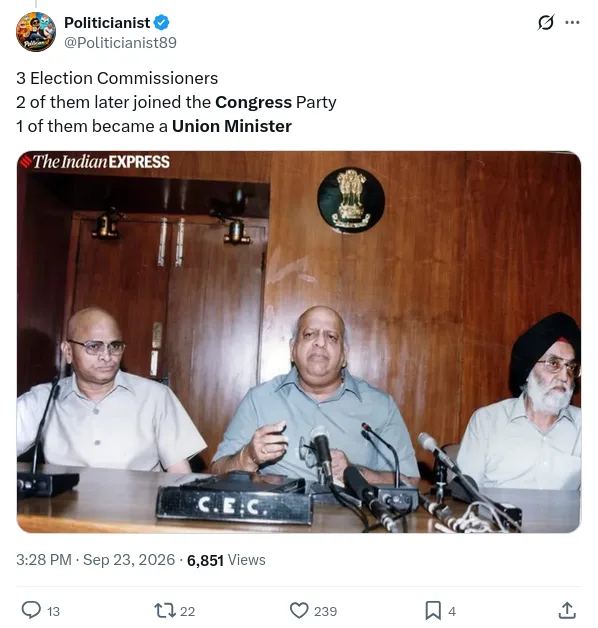
On 23 September, the X account Politicianist (@Politicianist89) replied to Chopra’s post about her ECI investigation with a post that closely resembled Rishi Bagree’s.
Form 6
According to The Indian Express investigation, the online application process was changed in July to include a question linked to the Special Intensive Revision (SIR). New applicants were reportedly asked whether they, their parents, or grandparents were on the electoral roll for the last SIR. The report stated that applicants could not proceed without answering the question.
The investigation further reported that Election Commissioner Vivek Joshi had raised concerns over the change in May, arguing that Form 6 could not be altered without amending the relevant rules. Sukhbir Singh Sandhu subsequently agreed with Joshi’s objection. After The Indian Express first reported the change in July, on 13 August Sukhbir Singh Sandhu stated that it was “unauthorised and illegal” and should be removed immediately.
On 23 September, Ravinder Sachdeva (@ravi0304) replied directly to a post by Ritika Chopra and shared screenshots of Form 6, asking, “Where is this question on this FORM 6?”
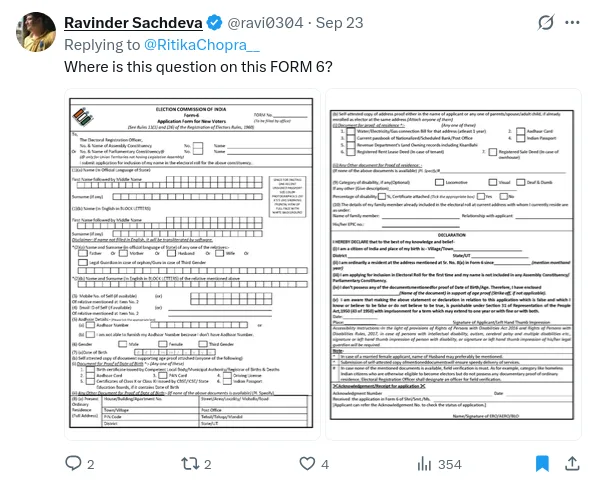
In another reply, Sachdeva stated that there was no such question on the Form 6 downloaded from the ECINET website. He also pointed out that the form could be downloaded, printed, filled in and submitted rather than being completed exclusively online.
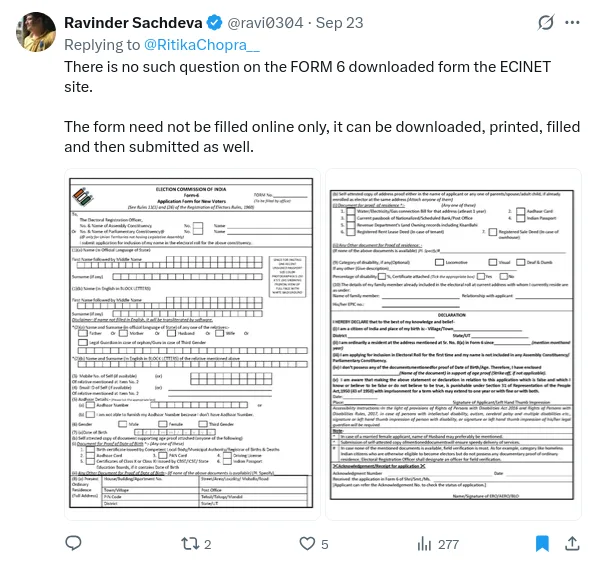
However, The Indian Express report published on 23 September highlights that the disputed question remained in the online portal until 21 September.
The ECI has since disputed the claim that Form 6 itself was changed. According to an India Today report dated 24 September, the ECI stated that the existing Form 6 remained unchanged and that the SIR-related requirement was introduced as an additional declaration alongside it.
ADR and DIGIPUB targeted
On 23 September, the Times of India published a report titled “This raises questions about transparency and credibility of EC”, featuring Maj Gen (retd) Anil Verma, head of Association for Democratic Reforms (ADR), discussing The Indian Express investigation into objections raised by Election Commissioners Sukhbir Singh Sandhu and Vivek Joshi.
Anil Verma reportedly said that if the two commissioners had raised objections that were not acted upon, this raised questions about the ECI’s transparency, decision-making and credibility.
ADR had previously challenged the constitutionality of the SIR process before the Supreme Court.
The 24 September thread posted by Vijay Gajera (@VijayGajeraO) alleges that the Association for Democratic Reforms (ADR), which has challenged the ECI before the Supreme Court, has allegedly received funding from organisations including the Ford Foundation, Omidyar Network and Thakur Family Foundation.
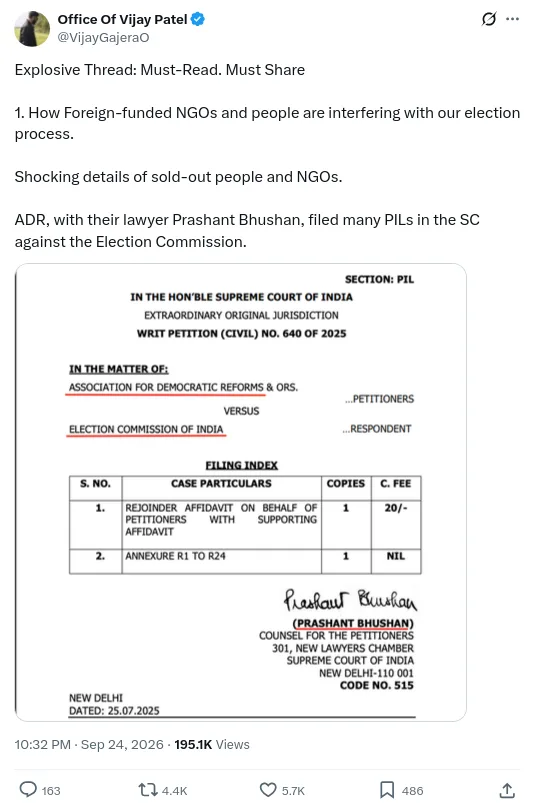
The thread describes the Ford Foundation as “CIA-affiliated” and attempts to connect the organisations and individuals it identifies to a wider foreign-influence network. It cites declassified CIA documents to allege that the Ford Foundation had previously partnered with the CIA on projects involving political and psychological warfare.
The thread also turns its attention to DIGIPUB (formerly known as DIGIPUB News India Foundation), an Indian non-profit organisation representing the digital-only news media ecosystem, describing it as a “digital cartel”. It names DIGIPUB chairperson Dhanya Rajendran and internal committee member Bezwada Wilson, and further alleges that DIGIPUB’s members and associated organisations have received funding from foreign foundations. The X account uses these claims to suggest that foreign-funded organisations are influencing India’s electoral and political processes.
OpIndia and The Pamphlet enter the debate.
On 23 September, The Pamphlet published two articles addressing the investigation. One questioned whether disagreements between Election Commissioners should be interpreted as evidence of institutional weakness, arguing that the ECI’s multi-member structure allows its members to record differing views before decisions are taken. The article cited the Commission’s own response that written observations and differing views are part of institutional deliberation. OpIndia also presented the matter on similar lines.
A second Pamphlet article placed the investigation within the wider political debate over the ECI, arguing that Opposition parties had increasingly made the Commission a focus of their electoral criticism. It referred to The Indian Express report on the 14 objections and questioned whether criticism of the poll panel was being used to explain the Opposition’s election failures.
Copy-pasted posts raising the ‘toolkit’ cry
We found a series of identical posts on X by The Jaipur Dialogues, Amitabh Chaudhary, Uttam Mohanty, Ranjit Valmik, and Atul Sharma between 23 and 24 September, accusing critics of the Election Commission of being part of a toolkit. Several of these posts were shared as a direct response to Ritika Chopra’s X post shared on 23 September.

Ritika Chopra’s Instagram targeted
Meanwhile, Ritika Chopra’s Instagram account also came under criticism following the publication of the investigation. Comments on her posts accused her of “paid journalism”, “yellow journalism”, “fake news” and spreading a “left-wing narrative”, while others described the report as a “planted story” or claimed that she was seeking publicity.
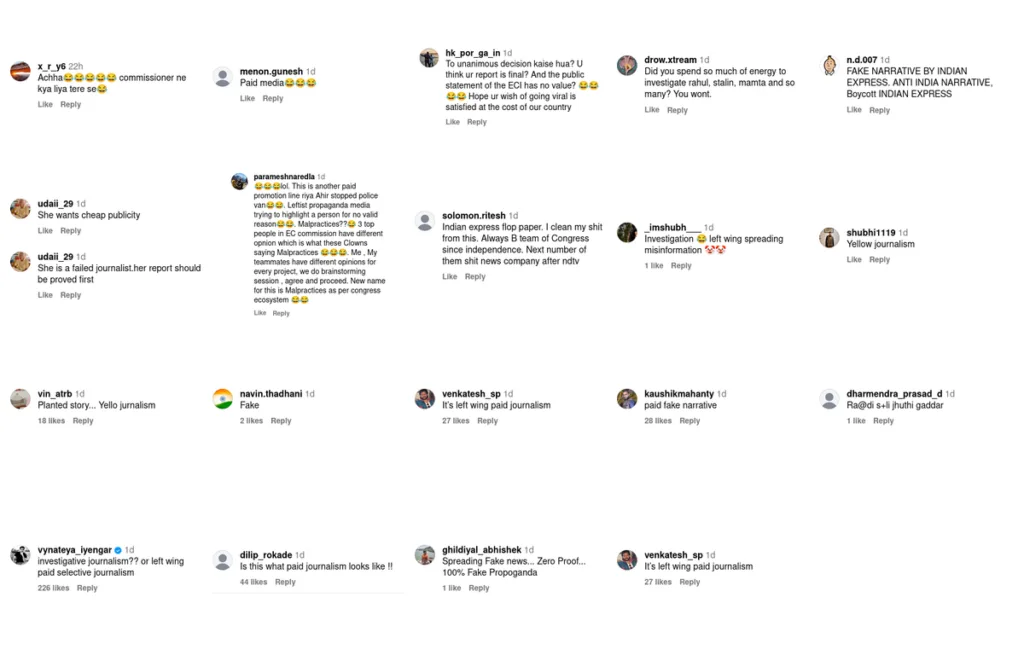
Some comments specifically questioned the investigation’s credibility and suggested that the claims should be proved first. Others went beyond criticism of the report, directing personal remarks at Ritika Chopra.
The reviewed comments show that the backlash was not limited to questioning the findings of the ECI report, but also extended to attacks on the journalist and her professional credibility.
OBC analysis reveals that the backlash following The Indian Express investigation extended beyond questioning the report’s findings, with narratives around the ECI’s record, Form 6, ADR and DIGIPUB gaining traction across social media. The response also included repeated or closely similar posts on X and personal attacks directed at journalist Ritika Chopra on Instagram.

Sujith A
Open Source Intelligence Researcher and Mis/Disinformation tracker. Passionate about investigations and a big fan of Sherlock Holmes.
View all posts by Sujith A