How Onam Is Turned Into a Communal Battleground on Social Media
Onam has long been a festival that brings Malayalis together, cutting across religion, caste and community. But over the past few years, social media has turned that shared celebration into a religious tug-of-war, with Hindutva voices claiming Onam’s Hindu identity is under threat, while conservative Muslim voices attack Muslims who celebrate it. A festival that belongs to all Malayalis is being pulled into a divisive contest over religion, identity and belonging.
As the spirit of Onam sweeps across Kerala, everyone, regardless of caste, community, or religion, comes together to celebrate the festival with joy and unity. However, numerous social media platforms are using this opportunity to turn this occasion into a battleground for divisive narratives and communal tensions.
Organiser, the mouthpiece of the Rashtriya Swayamsevak Sangh (RSS), published an article titled ‘Reclaiming Onam’ on 24th August.
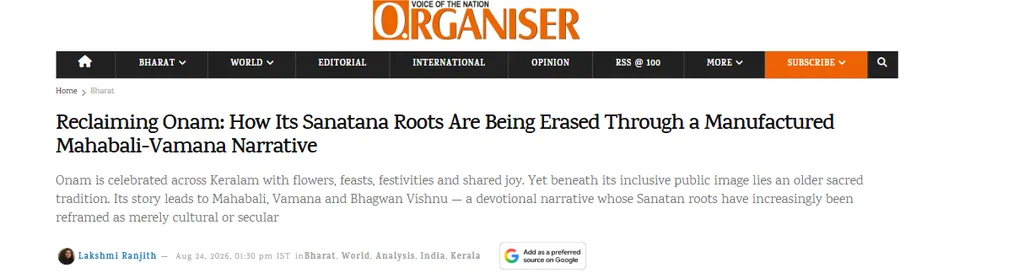
The article argues that the festival’s ideal of Sanatana roots is being erased through a manufactured Mahabali-Vamana narrative. One of the primary arguments of this article is its definition of the current ‘secular Onam’ as a 20th-century political invention.
This is not the right wing’s recent attempt to sanitise the secular festival. In 2016, Amit Shah was the centre of controversy after he greeted people with ‘Vamana Jayanti’ instead of Onam wishes. By reiterating the label of regional festival to a broader Hindu nationalist frame.
Many Hindutva social media accounts, particularly those based in northern India, have alleged that Onam is being stripped of its Hindu identity. These accounts argue that omitting Vamana, an avatar of Vishnu, secularly reinterpreting Mahabali, and framing Onam solely as a cultural festival contribute to this perceived erasure.
One of the most viewed and widely shared videos was by @GudumbaSatti.
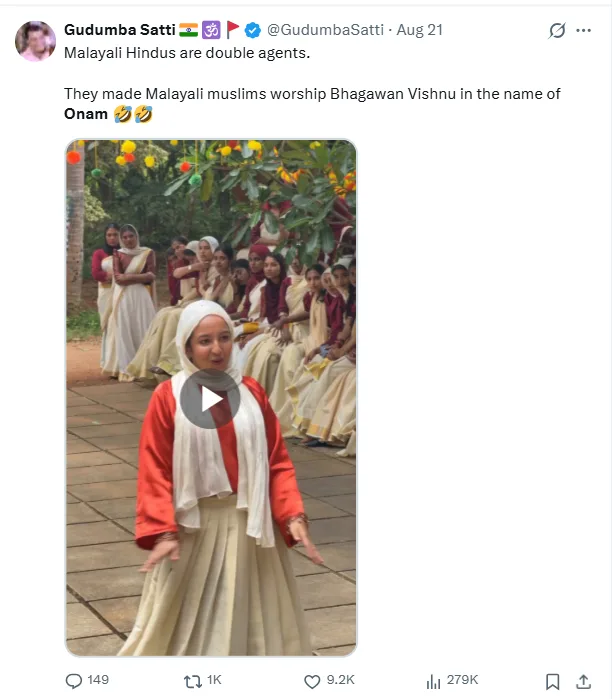
On August 21, He unleashed sarcastic remarks at Malayali Hindus, branding them as ‘double agents’. He alleged that these very Hindus have cunningly orchestrated tricking Malayali Muslims into worshipping Bhagawan Vishnu under the innocent facade of Onam celebrations. This post quickly gained traction, with more than 279,000 views and over 9.2k likes.
Derogatory attacks on Muslim women
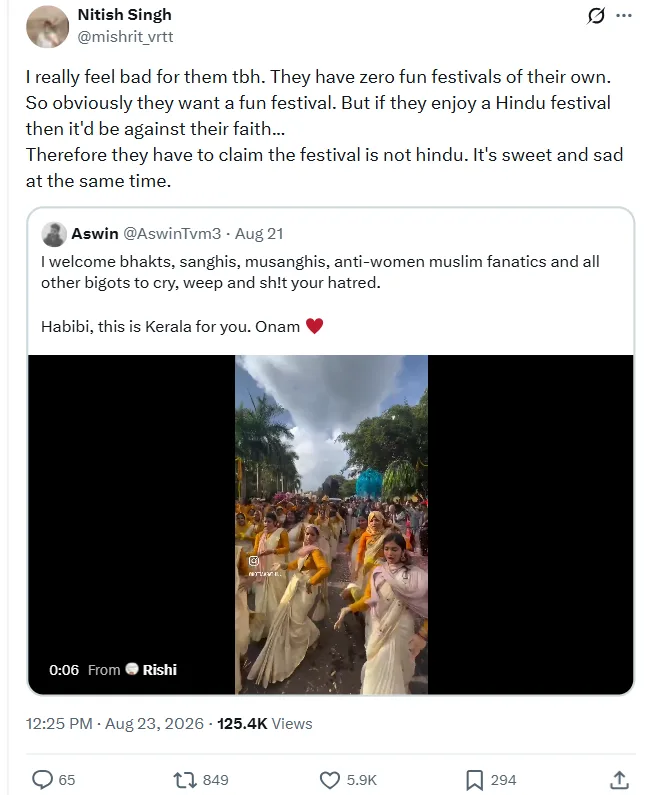
In a post shared by Nitish Singh, who has the X username @mishrit_vrtt, he commented in a patronising tone. “I really feel bad for them . They have zero fun festivals of their own. So obviously they want a fun festival. But if they enjoy a Hindu festival then it’d be against their faith. Therefore, they have to claim the festival is not Hindu. It’s sweet and sad at the same time.”
Another user, @Parikshit_K_, openly used derogatory words.
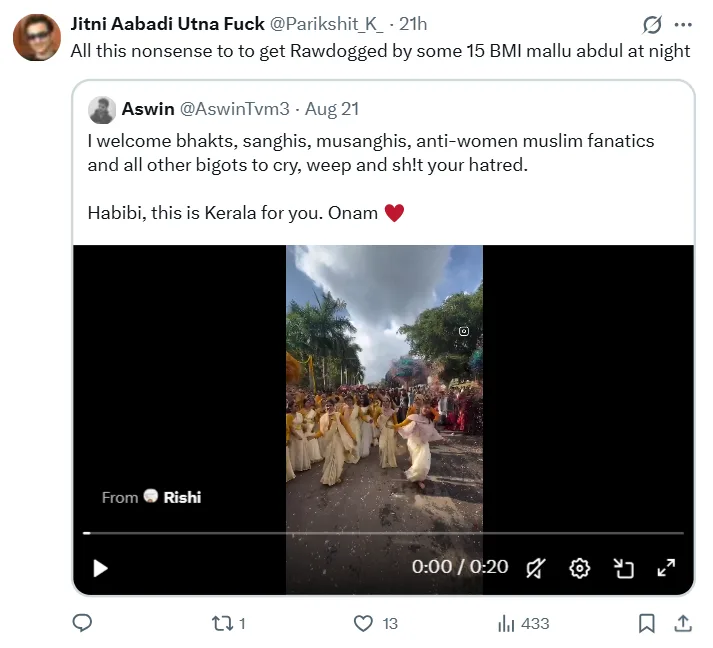
He said: “All this nonsense to get Rawdogged by some 15 BMI mallu abdul at night.
Weaponising caste to spread hate
Another series of posts by user @Ashwinsamoathk used caste slurs to incite hatred against another user’s religious identity, as he promoted a secular perspective on Onam.
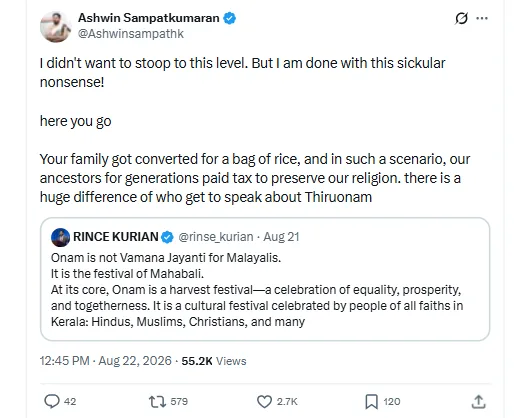
Another series of posts by user @Ashwinsamoathk used caste slurs to incite hatred against another user’s religious identity, as he promoted a secular perspective on Onam. On August 22, he posted, “I didn’t want to stoop to this level. But I am done with this sickular nonsense! Here you go; Your family got converted for a bag of rice, and in such a scenario, our ancestors for generations paid tax to preserve our religion. There is a huge difference in who gets to speak about Thiruonam.” As of August 24, the post has garnered more than 55,000 views on X with over 2.7k likes.
In another post by @AnuSatheesh5 on 23rd August. She calls the idea of secularism in Onam an ‘agenda’.
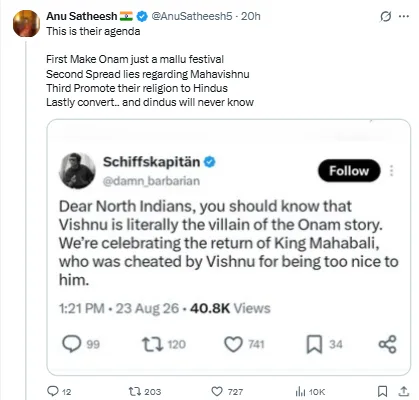
She further goes on to add, ‘First Make Onam just a Mallu festival. Second, spread lies regarding Mahavishnu. Third, promote their religion to Hindus. Lastly convert… and Hindus will never know.”
On the other hand, social media handles of many conservative Muslim religious circles are seen vehemently opposing Muslim participation in Onam based on theological grounds.
‘Traitor of the religion’ is the new rallying cry
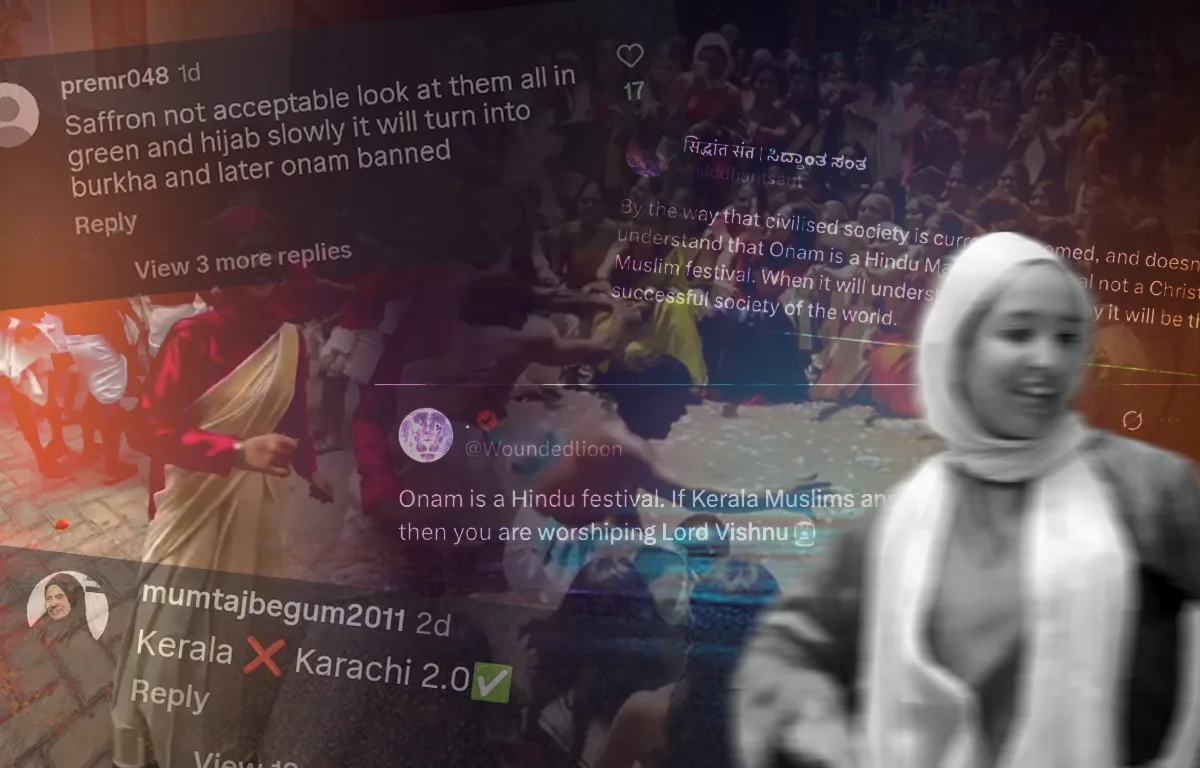
With Onam celebrations throughout the state, social media feeds are filled with celebrations, with students and teachers enjoying the event. But significant attention was given to many hijabi students who were seen celebrating Onam on their campuses.
This ignited a series of social media posts from various muslim conservative handles who used emotionally charged narratives to label the participants as traitors to Islam.
On August 24, user @pikafortheworld posted a video on X featuring young Muslim schoolgirls dancing joyfully during an Onam celebration. But the caption launched a scathing attack against the students.
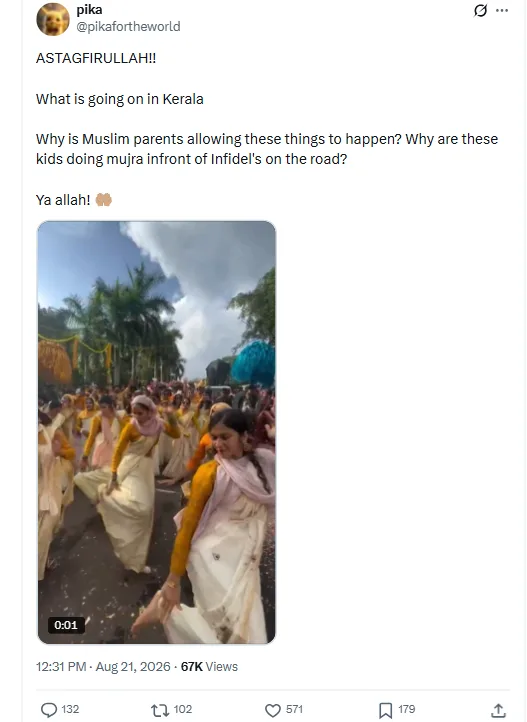
It said, “ASTAGFIRULLAH!!! What is going on in Kerala! Why are Muslim parents allowing these things to happen? Why are these kids doing mujra in front of infidels on the road? Ya, Allah!” The post had garnered more than 67000 views and more than 500 likes as of August 26.
On the same day, another X user, Asma AnjumK55718, shared a video of the Onam celebrations.
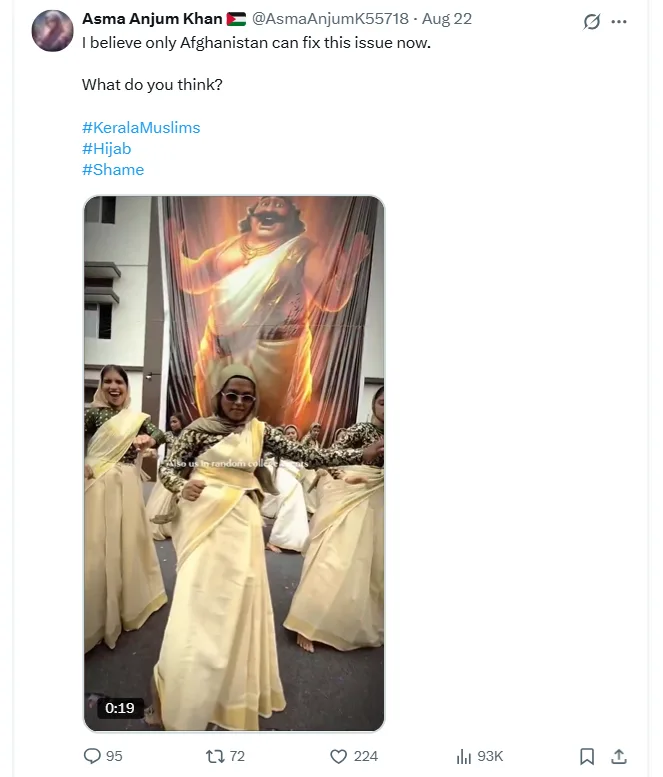
The caption took the controversy to an extreme, reading: “I believe only Afghanistan can fix this issue now.” The post has amassed more than 93k views and over 200 likes.
Polarising comments
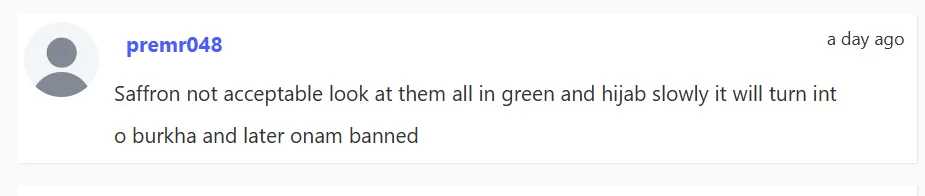
Across various social media platforms, comment sections under posts featuring Onam celebrations of female muslim students are often subjected to deeply hateful and offensive remarks. On Instagram, a user named @premr048 accused the dancing girls. He commented, “Saffron not acceptable; look at them all in green and hijab. Slowly it will turn into burkha, and later onam banned.”
Yet again, manyright-wing social media handles are attempting to recast Onam as ‘Vamana Jayanti’ while propagating objectionable remarks about the conversion of women, labelling them as straying from ‘Sanatan’ Dharma.
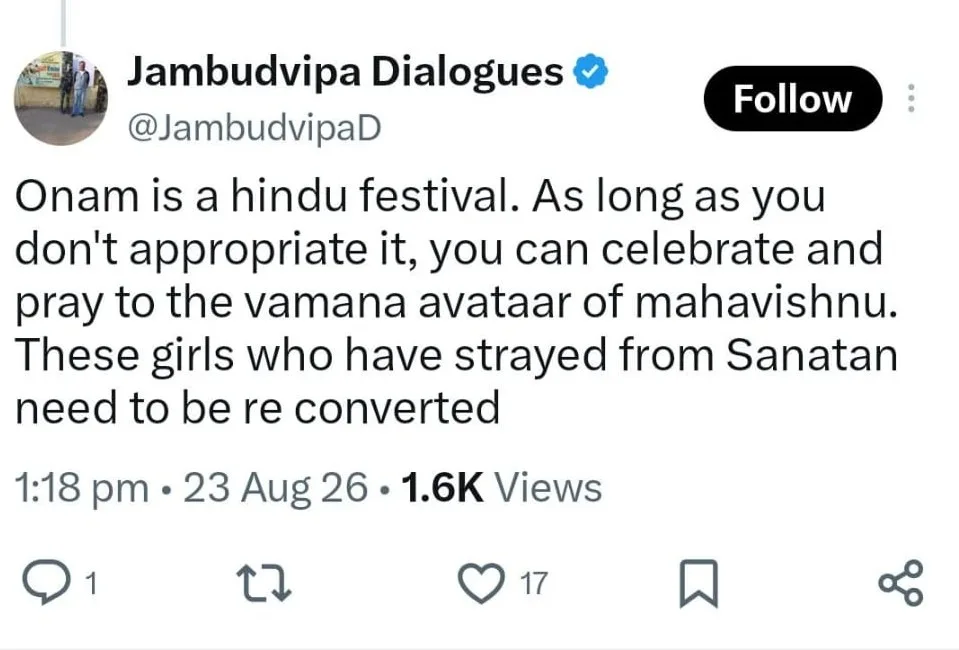
The user with the handle @JambuvipaD stated, “Onam is a hindu festival. As long as you don’t appropriate it, you can celebrate and pray to the vamana avataar of mahavishnu. These girls who have strayed from Sanatan need to be re converted.” The post had received over 1,600 views as of August 25.
An Instagram user named @bscrochetcrafts posted offensive comments and expletives under an Instagram reel of the page @teamhinduunited.in featuring Kerala Muslim girls celebrating Onam.
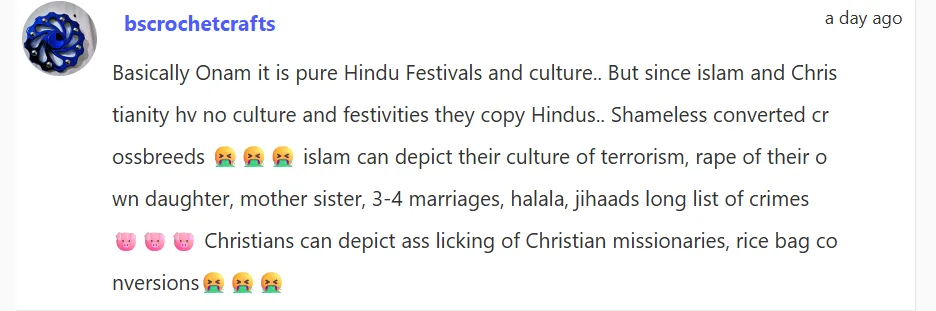
He posted a comment labelling muslims and Christians as ‘converted crossbreeds’. He additionally said, “Islam can depict their culture of terrorism, rape of their own daughter, mother, sister, 3-4 marriages, halala, jihaads, long list of crimes 🐷🐷🐷 Christians can depict ass licking of Christian missionaries, rice bag conversions🤮🤮🤮 “
A tug of war
These two post spectra show how the same cultural event is interpreted through opposing ideological lenses. While Hindutva accounts rephrase the secular and pluralistic nature of Onam as a denial of Hindu identity, conservative Muslim voices describe the same inclusive festivities as a betrayal of their Islamic faith. Although the two groups are at opposite ends of the ideological spectrum, they both use the same strategies: language charged with emotion, slurs based on caste and gender, and accusations of ‘betrayal’ to turn a common cultural event into a religious tug-of-war.
It is difficult to overlook the irony. In Kerala, Onam has always enjoyed enduring popularity because it transcends religious divisions and brings together Hindus, Muslims, and Christians in a shared celebration of the harvest and the return home. The online ridicule and anger around Onam this year reveal more about the state of our divided society than about the festival itself.