
Strikes Across Lebanon: A Pattern Emerges
This report maps Israeli airstrikes across Lebanon between April 6 and 14, 2026, using publicly available data, visual evidence, and on-the-ground reporting. The OSINT analysis challenges the notion of narrowly targeted attacks, revealing a pattern that extends beyond military sites into both urban and rural civilian life, while acknowledging gaps where details remain unclear.
In early April 2026, Israeli military operations in Lebanon continued as diplomatic efforts to pause the fighting began to take shape. Ahead of talks in Washington between Israeli and Lebanese officials, statements from both sides point to an uncertain path toward de-escalation.
On April 14, in Washington, Lebanon’s Culture Minister Ghassan Salame stated that the immediate aim of the discussions is to bring Israeli operations to a halt, describing the meeting as a step toward a pause in fighting, if not a ceasefire. He also acknowledged Lebanon’s limited position going into the talks and said that any move to disarm Hezbollah would take time and depend on a broader reduction in violence.
At the same time, strikes have been reported across parts of Lebanon, along with accounts of an ongoing Israeli ground offensive in the south. Statements from Hezbollah indicate that any outcome from the talks may not be accepted by the group.
This report examines the strikes in Lebanon alongside these parallel diplomatic efforts, tracking how events have unfolded, what can be verified, and what remains unclear.
Locations targeted in the airstrikes
On April 8, Israeli airstrikes hit central areas of Beirut, including commercial and residential neighbourhoods, in what Lebanese authorities described as the deadliest day of the conflict so far. The strikes came hours after a ceasefire was announced in the U.S.-Israel war with Iran, which Israel said did not apply to Lebanon.
In the following days, several airstrikes were reported on numerous other parts of Lebanon. Media coverage pointed to strikes in the capital, along the southern border, and further inland, suggesting a wider span.
OBC compiled reported Israeli attacks across Lebanon after April 6, based on information from multiple news sources. It focuses on where strikes were reported, the type of areas affected, and what has been described in initial coverage. The aim is to map the geographic spread of the strikes and identify patterns in how they were carried out, while keeping a clear distinction between reported claims and what can be independently verified.
| Date (Reported) | Location | Type of Area | What was Reported | Source |
| April 7–8, 2026 | Beirut (central & southern suburbs) | Urban / Capital | Multiple strikes across the city; reports of high-intensity strike waves, including near-simultaneous hits | Reuters (Report) |
| April 8–9, 2026 | Bekaa Valley (eastern Lebanon) | Rural / Eastern region | Strikes reported in eastern Lebanon, indicating expansion beyond southern frontlines | Reuters (Report) |
| April 10–11, 2026 | Nabatieh district | Urban + semi-urban | Airstrikes causing casualties across multiple towns | Al Jazeera (Report) |
| April 10–11, 2026 | Bint Jbeil | Border town/ conflict zone | Strikes alongside reports of ground operations | The Associated Press (Report) |
| April 10–13, 2026 | Tyre (Sour) | Coastal city | Repeated strikes; includes the reported hit near a Lebanese Red Cross facility | Reuters (Report) |
| April 10–13, 2026 | Sidon (Saida) & surrounding areas | Coastal / urban | Strikes reported in and around the city | Al Jazeera (Report) |
| April 12–13, 2026 | Bazouriyeh, Kfar Tibnit, Sir el Gharbiyeh, Choukine | Villages (South Lebanon) | Artillery and airstrikes reported across multiple villages | Al Jazeera (Report) |
| April 12–13, 2026 | Haniyeh, Qlaileh, Mansouri, Bayt Yahun, Tayr Harfa, Majdal Zoun, Sammaaiyeh | Villages (South Lebanon) | Clustered strikes across smaller localities | Al Jazeera (Report) |
OBC mapped the locations of reported Israeli attacks across Lebanon using the corresponding coordinates. Each point on the map corresponds to an area identified in news reports and geospatial references, providing a visual sense of how the strikes are distributed across different parts of the country. The markers indicate general locations and do not represent exact strike coordinates, but help in understanding the broader spread of reported activity.
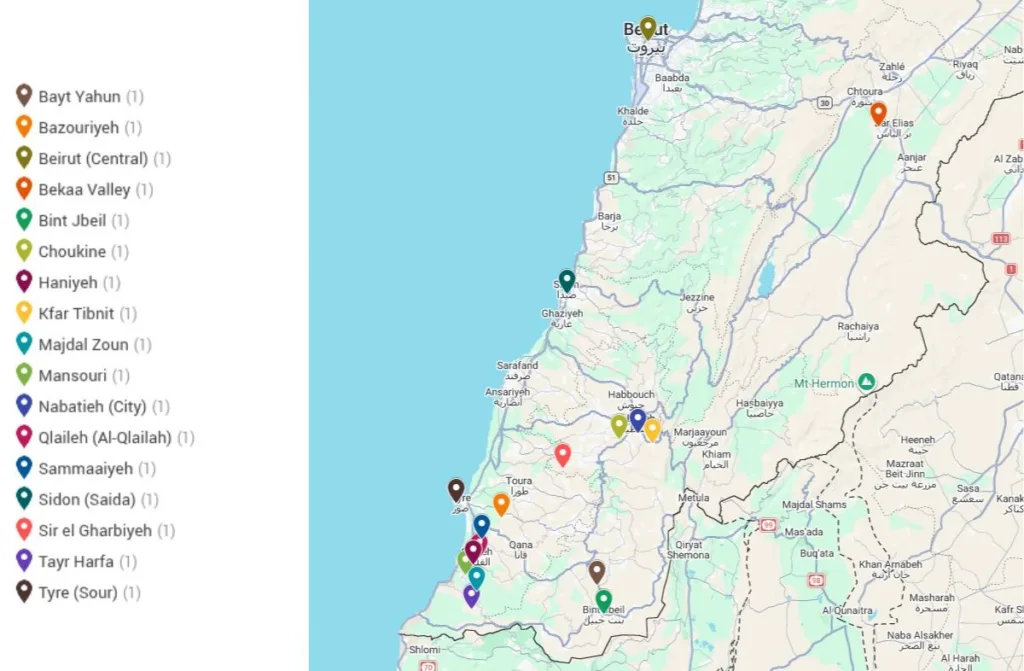
The map shows that reported airstrikes are not confined to a single zone but are spread across multiple regions of Lebanon. A clear concentration can be seen in southern Lebanon, particularly around border towns and nearby villages, indicating a sustained focus in that area. At the same time, strikes in Beirut and the Bekaa Valley point to activity beyond the southern frontline. Taken together, the distribution suggests a multi-area pattern of operations rather than isolated incidents, with both urban centres and smaller localities appearing in the reporting.
According to the Associated Press report on April 8, at least 182 people were killed, and hundreds were injured, as multiple waves of strikes were carried out across the city of Beirut. Visuals from the ground showed apartment buildings hit, fires across several locations, and emergency responders searching through debris, while Israeli officials stated that the targets included Hezbollah infrastructure. Local officials and residents, however, reported that several of the areas struck were civilian in nature.
Lebanese Red Cross Hit
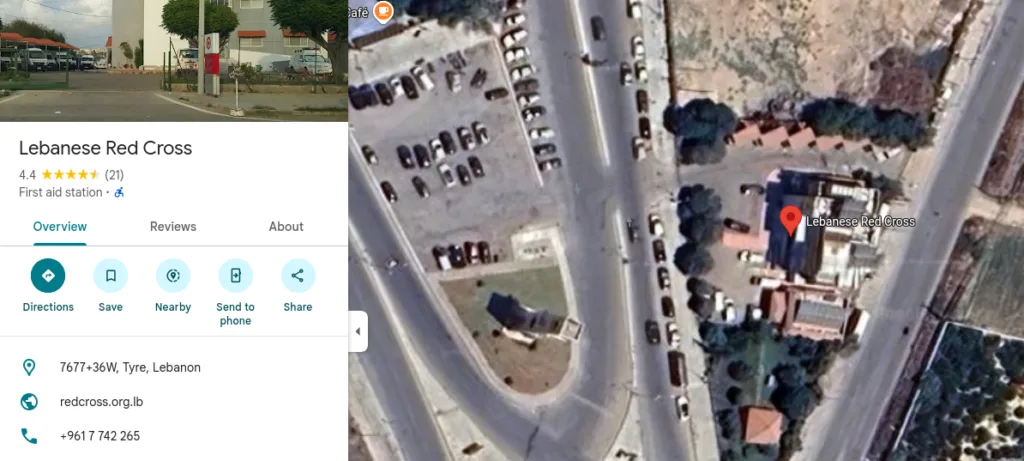
On April 13, an Israeli strike was reported near the entrance to Lebanese Red Cross offices in Tyre, a coastal city in southern Lebanon. According to reports, the strike killed a wounded person who was being transported to the centre, while also damaging several Lebanese Red Cross vehicles and shattering windows at the facility.
Following the April 8 strikes, reactions from across the international community reflected both condemnation and divisions over how the situation should be handled.
Global Condemnation
According to Al Jazeera, multiple countries and international bodies criticised the scale of the attacks and their impact on civilians, while also raising concerns about the ceasefire not extending to Lebanon.
The United Nations condemned the strikes and called for an immediate halt to hostilities, as several countries, including France, Spain, and Qatar, pushed for Lebanon to be included in the ceasefire framework.
As per the Moneycontrol report, the Lebanese authorities indicated that 2,020 people lost their lives in Israeli strikes since the beginning of the war in March 2026 between Israel and Iran-backed Hezbollah.
At the same time, statements from the United States indicated that Lebanon was being treated separately from the Iran truce, highlighting a lack of agreement among key actors on the scope of de-escalation.
Based on publicly available information, the strikes can be traced across multiple regions of Lebanon, including Beirut, southern areas, and the Bekaa Valley. The distribution of reported locations points to activity beyond a single front, with both urban centres and smaller localities appearing in the reporting.
At the same time, limitations remain. In several cases, exact strike points, target profiles, and sequences could not be independently confirmed. The findings presented here are therefore based on reported locations and available visual and textual evidence, and should be read within those constraints.

Sujith A
Open Source Intelligence Researcher and Mis/Disinformation tracker. Passionate about investigations and a big fan of Sherlock Holmes.
View all posts by Sujith A