Identity as Target: Asif Ali Trending for the Wrong Reasons
In the lead-up to polls in Kerala, a wave of misinformation has once again engulfed Asif Ali. This piece explores how such narratives spread, who amplifies them, and why they often escalate into identity-based attacks.
Kerala will head to the polling booths in 11 days. This time, celebrity candidates are in the fray across parties and alliances. However, actors and other popular figures in the Malayalam film industry often maintain a safe distance from politics, especially from political parties. They tend to uphold a diplomatic silence when controversies arise, particularly those involving politics.
Actors who deviate from this approach are often targeted by opposing groups and frequently subjected to coordinated online attacks.
One such actor is Asif Ali.
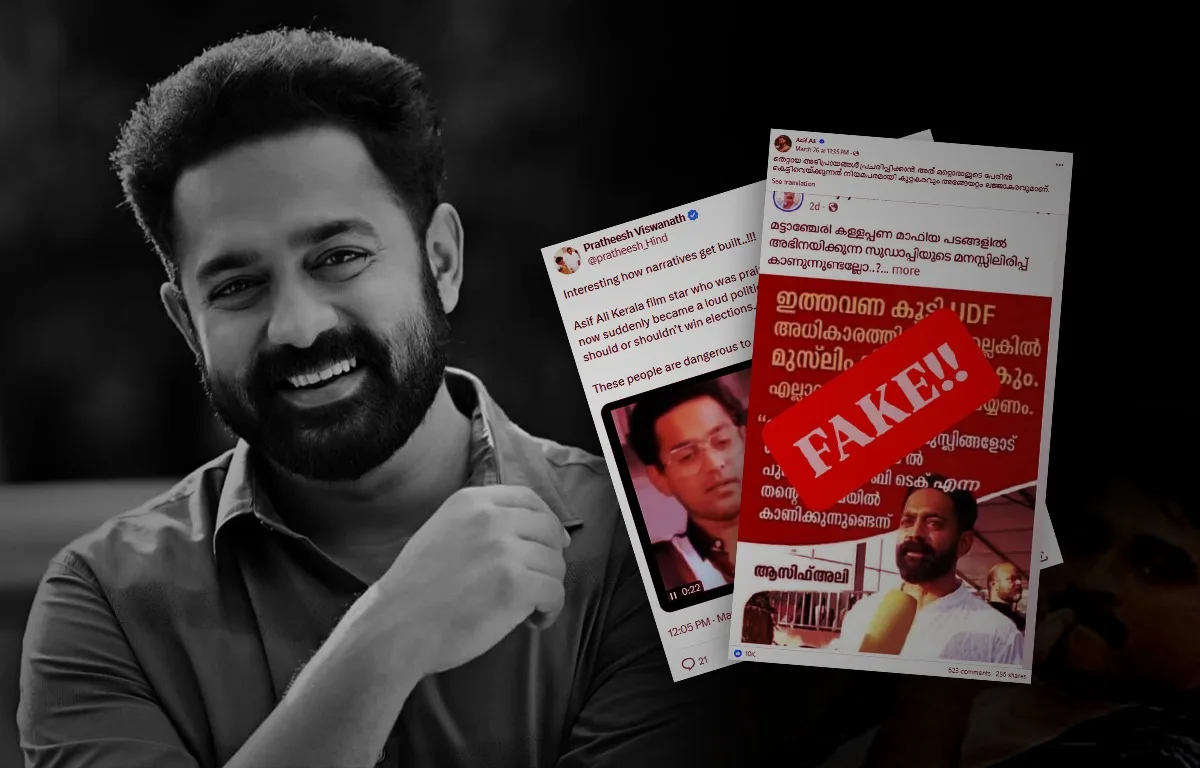
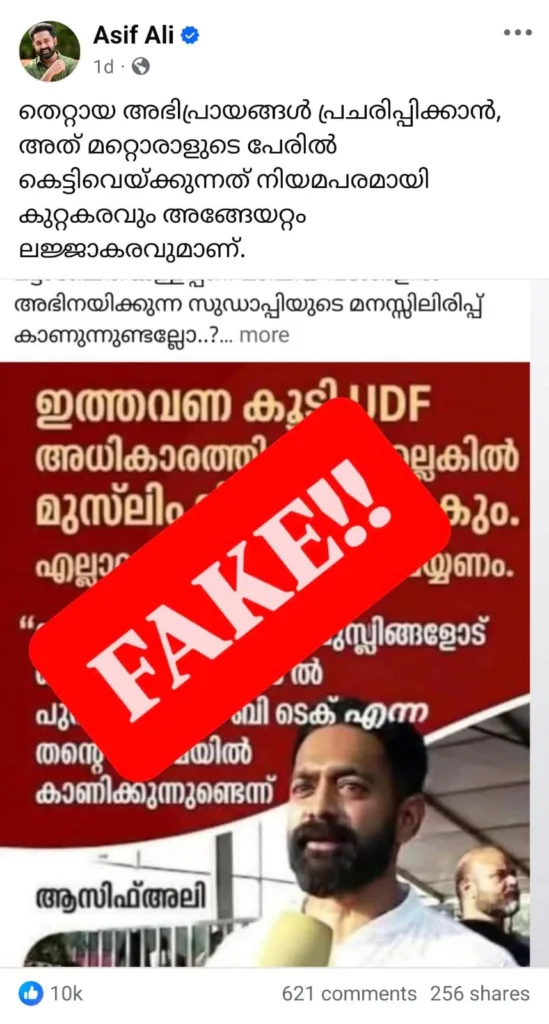
Asif Ali has recently been in the news for an entirely different set of reasons. On 26 March, he shared a Facebook post featuring a screenshot of a user named K. P. Ajayakumar, in which an opinion about the upcoming elections was attributed to the actor. He flagged the claims in the screenshot as fake and stated, “Attributing false statements to someone else in order to spread misinformation is both legally punishable and extremely shameful.” His comment section featured a mix of responses, with some users supporting him while others criticised his perceived political stance.
This is not the first time Asif Ali has made headlines for reasons beyond his profession. He has been targeted earlier as well—for expressing his views openly, for his opinions, and most notably, for his religion.
What lies behind the recurring buzz around the actor? Why does he become a target? And which groups have targeted him at different points in time?
What is driving the latest controversy surrounding Asif Ali?
The screenshot claimed that the actor said that if the UDF does not come to power in Kerala in this election, its constituent party, the Muslim League, would be finished. It also claimed that he urged everyone to vote for the UDF and stated that what the Sangh Parivar is doing to Muslims is reflected in his 2018 film BTech. The card, carrying Asif Ali’s name and photo, presents these claims as his statement.
The caption written by the user in Malayalam (in the screenshot) translates to:
“Can you see the mindset of this ‘Sudappi’ who acts in films funded by black money from the Mattancherry mafia? Hindus who claim to uphold secularism and blindly support such people will not see this…”
‘Sudappi’ is a colloquial term used locally to refer to alleged “Islamic extremists.” It originates from the label used for members or supporters of the Social Democratic Party of India (SDPI), though its usage has since broadened beyond that context.
The post shared by K. P. Ajayakumar—the one highlighted by Asif Ali—has since been removed. Currently, the only active Facebook post is from a user named Sanal Kumar, posted on 26 March, carrying the exact same image and caption. His account has more than 4,000 followers and has consistently shared posts aligned with right-wing, BJP-leaning narratives.
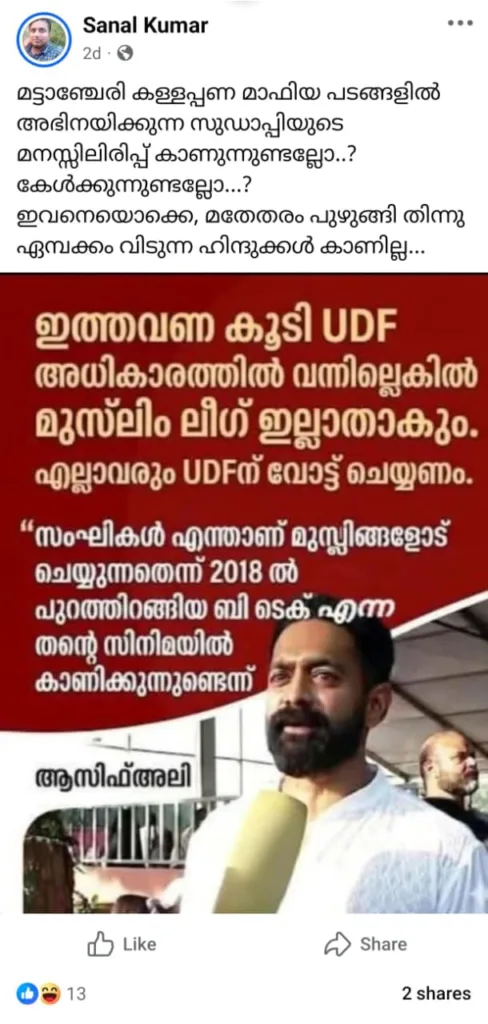
Another user, M. S. Radhakrishnan, also shared the same post on 26 March, which is currently restricted in India. The post had garnered around 20 shares, and the comments were largely targeted at the actor’s religion.
One comment read, “An artist can have politics, but he should not be an extremist. Mammootty is a greater actor than him, but he does not think like this.” Another user wrote, “Education alone is not enough; common sense is needed. It is natural, because he has received madrasa education.”
This account has more than 12,000 followers and is also a frequent peddler of fake and fabricated right-wing narratives. On average, it shares more than 10 such posts each day.
Politics and the Attacks on Religious Identity
In his latest media interactions, Asif Ali reiterated that he has no desire to enter politics, even though he comes from a political family background. He said this in response to a question about whether he would campaign for Ramesh Pisharody, who is contesting as a UDF candidate from the Palakkad constituency.
However, this has not stopped the attacks.
On 23 March, an X (formerly Twitter) user, Pratheesh Viswanath, founder of Hindu Seva Kendra, shared a video clip from an old interview of Asif Ali, in which he spoke about a childhood fascination with fugitive gangster Dawood Ibrahim.
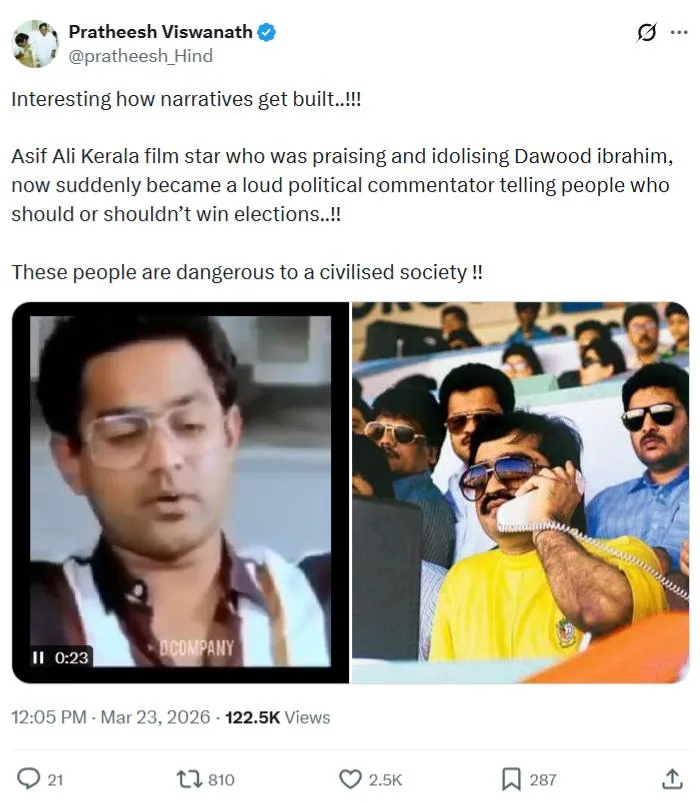
The video was captioned: “Asif Ali, a Kerala film star who was praising and idolising Dawood Ibrahim, has now suddenly become a loud political commentator telling people who should or shouldn’t win elections…!! These people are dangerous to a civilised society!”
The post appeared to reference the earlier debunked claim that Asif Ali had urged people to vote for the UDF. It has garnered over 1,22,000 views and around 2,500 likes.
The comments under the post followed a similar pattern of targeting and vilification. One user wrote, “Mattancherry mafia. Anti-national activist through the film industry.” Another claimed that in his birthplace, Muvattupuzha, certain groups raise children idolising figures like Osama bin Laden and Abu Bakr al-Baghdadi—framing it as a broader cultural issue.
Several other comments labelled the actor a “jihadi” and accused his films of promoting anti-Hindu narratives. One user, @rajiv71_agrawa, went as far as to say that the country needs “unknown gunmen” to “clear out such traitors and Hinduphobic termites.” In his bio, the user describes himself as a “proud Sanatani.”
‘Mattancherry Mafia’ and Hate Campaigns
The term used in these captions suggests that he is an actor associated with films linked to the so-called “Mattancherry Mafia.” But what does this mean?
“Mattancherry Mafia” has emerged as a derogatory label frequently used on social media to describe a perceived circle of filmmakers and actors in the Malayalam film industry. It has since evolved into a politically and communally loaded term.
Right-leaning critics and sections of social media use it to allege that a “lobby” with Islamist leanings or Left-progressive ideologies is influencing or controlling the narrative of Malayalam cinema. In many cases, the label is disproportionately directed at Muslim filmmakers and artists, including figures like Aashiq Abu and Khalid Rahman. Asif Ali is the latest addition to this alleged “mafia.”
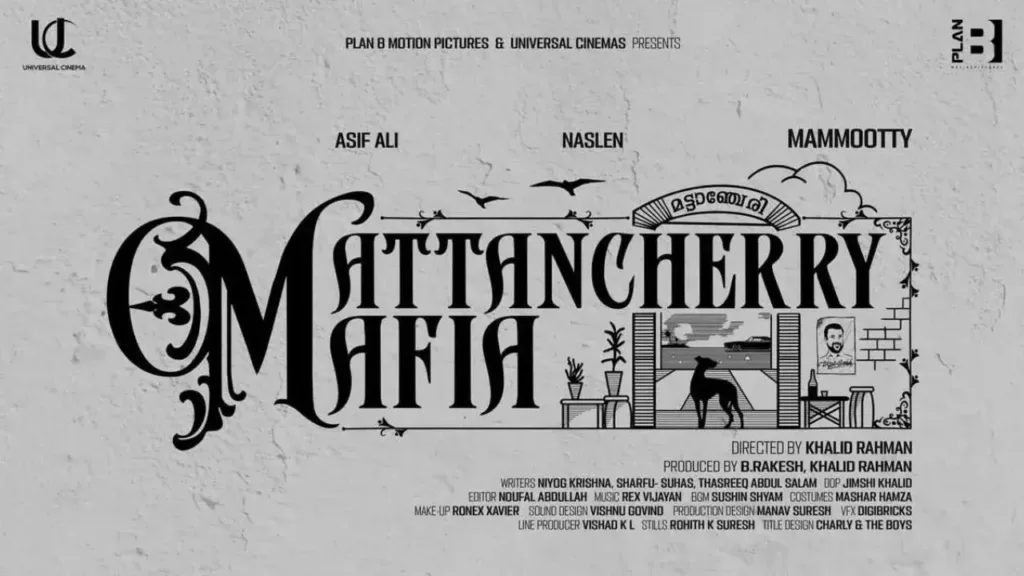
Ironically, the first look of a film titled Mattancherry Mafia, starring Mammootty, Asif Ali, and Naslen Gafoor, and directed by Khalid Rahman, was released on 20 March.
A Pattern of Consistent Targeting
Several artists with Muslim names, those who have spoken against right-wing politics, or those associated with positions not aligned with right-wing ideology have faced targeted harassment online by sections of the Sangh ecosystem.
Even Mohanlal, often seen as politically neutral and at times perceived as sympathetic to the right, was not spared when L2: Empuraan faced backlash over its portrayal of the Gujarat riots.
Mammootty has also been a frequent target, both due to his religious identity and his role as chairman of Kairali TV, which is linked to the CPI(M). Similarly, director Aashiq Abu has faced sustained trolling and attacks for his progressive positions in both his films and public life.
Filmmaker Kamal and actor Manju Warrier have also faced backlash at different points. Kamal was drawn into controversy over the playing of the national anthem at the International Film Festival of Kerala (IFFK), while Manju Warrier faced criticism for acting in a biopic on writer Kamala Das, a progressive literary figure who later converted to Islam.