Is Kerala India’s ‘Drug Capital’? A Data Check on Rahul Gandhi’s Claim
Did Rahul Gandhi get the facts right when he called Kerala India’s “drug capital”? Official data shows the state leads in registered drug cases—but trails far behind in seizure volumes and drug quantities compared to several other states. Here’s a closer look at what the numbers actually say—and what they don’t.
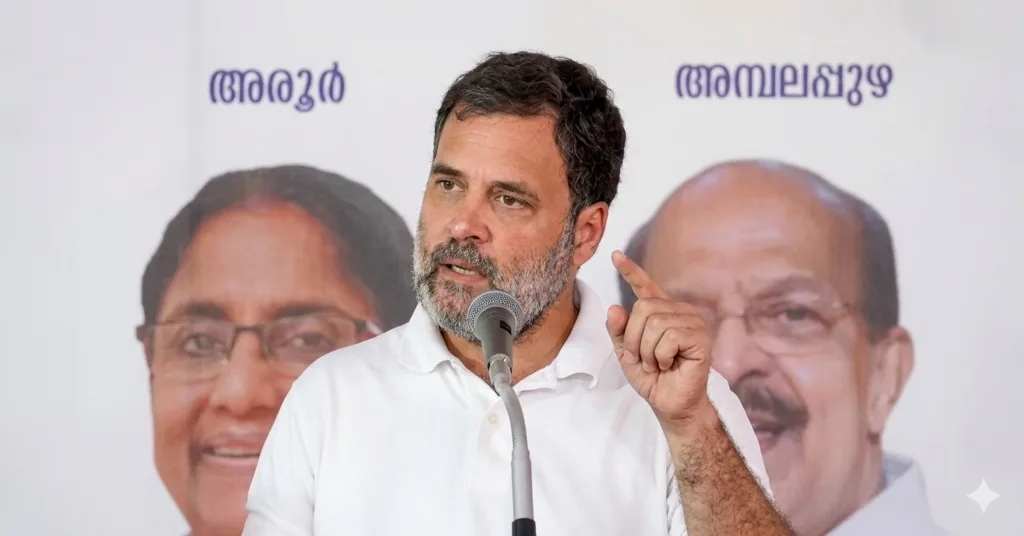
On April 4, as the election campaign in Kerala was at its frenzied peak, Congress leader and Leader of the Opposition Rahul Gandhi repeated an age-old claim during a campaign speech in Alappuzha district.
“Keralam has become the drug capital of India, ranking number one in the country,” he told a cheering audience, alongside a slew of claims suggesting that Left rule has brought the state to shambles.
As newspapers and television channels report drug-related cases, seizures, and arrests almost every day—and as the police, the Narcotics Control Bureau, and other agencies note a rise in such cases—the claim raised by the Opposition leader can sound both convincing and alarming. It had also been a major campaign issue for the Congress during the 2025 local self-government (LSGD) elections. V. D. Satheesan too echoed this claim, raising it during political debates in 2025 as part of the Opposition’s broader criticism of the government.
But is this claim really accurate and substantiated by official data? What do government statistics say about drug seizures and cases in the state? And compared to other states, does Kerala actually rank the highest? Can the label “drug capital of India” truly be justified?
We fact-checked this claim using publicly available data.
What does official government data reveal?
The Kerala Police’s official website states that a total of 36,314 cases under the Narcotic Drugs and Psychotropic Substances (NDPS) Act were registered in 2025. This marks a significant increase from the 27,530 cases reported in 2024 — an approximate rise of 32%.
As per data from the Excise Department, 8,622 cases were registered till August 2025 (with subsequent data not available in the public domain). In comparison, the department recorded a total of 8,160 cases in 2024.
This indicates a clear upward trend in the number of cases reported in the state.
In Punjab — another state with a well-documented drug problem — police registered 29,784 FIRs and made 39,867 arrests under the “Yudh Nashiyan Virudh” campaign, launched on March 1, 2025.While these figures are comparable and trail closely behind Kerala’s, they still remain lower in terms of total cases registered.
However, consolidated figures for the full year 2025 are not yet available in the public domain, making direct comparisons incomplete and somewhat unreliable. This leaves the data fragmented and not strictly comparable across states.
More importantly, absolute numbers alone are not the best way to assess the scale of a drug problem. So, how should it be measured?
A more meaningful approach would be to assess the issue using several key indicators—such as seizure volumes by drug type rather than just case counts, along with conviction rates and trends over time.
Taken together, these indicators can provide a more accurate and nuanced understanding of the broader issue, and help evaluate the veracity of such viral claims in a comprehensive manner.
Quantity of Seizures
The Narcotics Control Bureau (NCB)’s 2024 state-wise data on total drug seizures presents a markedly different picture. While Kerala recorded the highest numbers of cases and arrests that year, the actual quantity of drugs seized across categories remains comparatively low.
According to NCB data for 2024, Kerala ranks 20th in ganja seizures and also trails behind several other states in the quantity of synthetic drugs seized. A total of 4,482 kg of ganja was seized from the state during the year.
In comparison, Odisha topped the list with an enormous 1,43,761 kg of ganja seized, followed by Maharashtra with 55,351 kg and Andhra Pradesh with 53,983 kg.
Meanwhile, Punjab stands out for a different reason. Despite relatively lower ganja seizures, it recorded the highest heroin seizure in the country (1,150.68 kg)—accounting for nearly 44% of the total heroin seized nationwide—indicating a distinct trafficking pattern compared to states dominated by cannabis seizures. With a seizure of 24.27 kg of MDMA (a psychedelic drug), Kerala ranks fourth among states. Andhra Pradesh tops the list with a seizure of 75.09 kg, followed by Karnataka (51.52 kg) and Uttar Pradesh (26.74 kg).
The Statistical Gap in Rahul Gandhi’s Claim
Rahul Gandhi’s claim is partially true—or more precisely, a selective half-truth. Kerala does rank first in the total number of drug cases filed in 2024, with 27,701 cases—accounting for 28.6% of all cases in India, registered by a single state.
Maharashtra, with 14,553 cases, is a distant second—Kerala alone registered nearly double its count—while Punjab comes third.
However, what this actually reveals is a sharp contrast: states like Odisha and Rajasthan, which rank very high in terms of drug quantities seized, appear much lower in case counts—suggesting fewer but larger, bulk seizures, as opposed to a high volume of smaller cases.
Drug law enforcement agencies have seized nearly 39 lakh kg of cannabis-based drugs across India since 2020, according to government data presented in Parliament in February this year. Odisha alone accounts for more than 27% of these total recoveries, underscoring its dominance in large-scale cannabis seizures.
Notably, Kerala does not feature among the top states in this list either.
Chief Minister Pinarayi Vijayan told the Assembly in 2025 that Kerala recorded a 442% increase in NDPS cases over the past 15 years. In response, the state adopted a zero-tolerance approach towards drugs, launching extensive awareness campaigns and intensified anti-drug operations.
The resulting spike in the number of reported cases and arrests is largely attributed to such aggressive enforcement drives, including widespread raids and searches.