The Panopticon Comes to Protest
Facial recognition, AI smart glasses, biometric databases, and thousands of cameras weren’t deployed to prevent an exam paper leak—they were deployed after students demanded accountability. This piece traces how surveillance is reshaping dissent in India, where the fear of being watched may prove more powerful than the act of watching itself.
There is a particular kind of prison that needs no bars, and we are all living in it.
Jeremy Bentham designed a prison in 1785 and called it the Panopticon: a circular building of cells wrapped around a single central tower, from which a guard could observe any inmate at any moment, but the inmate could never tell whether they were being watched at that moment. The genius of the design was that it achieved a new mode of exerting mind over mind. You don’t need to watch everyone all the time. You need everyone to believe you might be. Hence, you assume they must act accordingly.
Nearly two centuries later, Michel Foucault, in Discipline and Punish (1975), argued that Bentham’s prison had become a blueprint for modern forms of power. The Panopticon, he suggested, was never simply a prison design; it was a political technology. Once people believe they might be observed, they begin regulating their own conduct as though they were always being watched. The state doesn’t need soldiers on every corner. It needs citizens who have learned to police their own conduct, just in case.
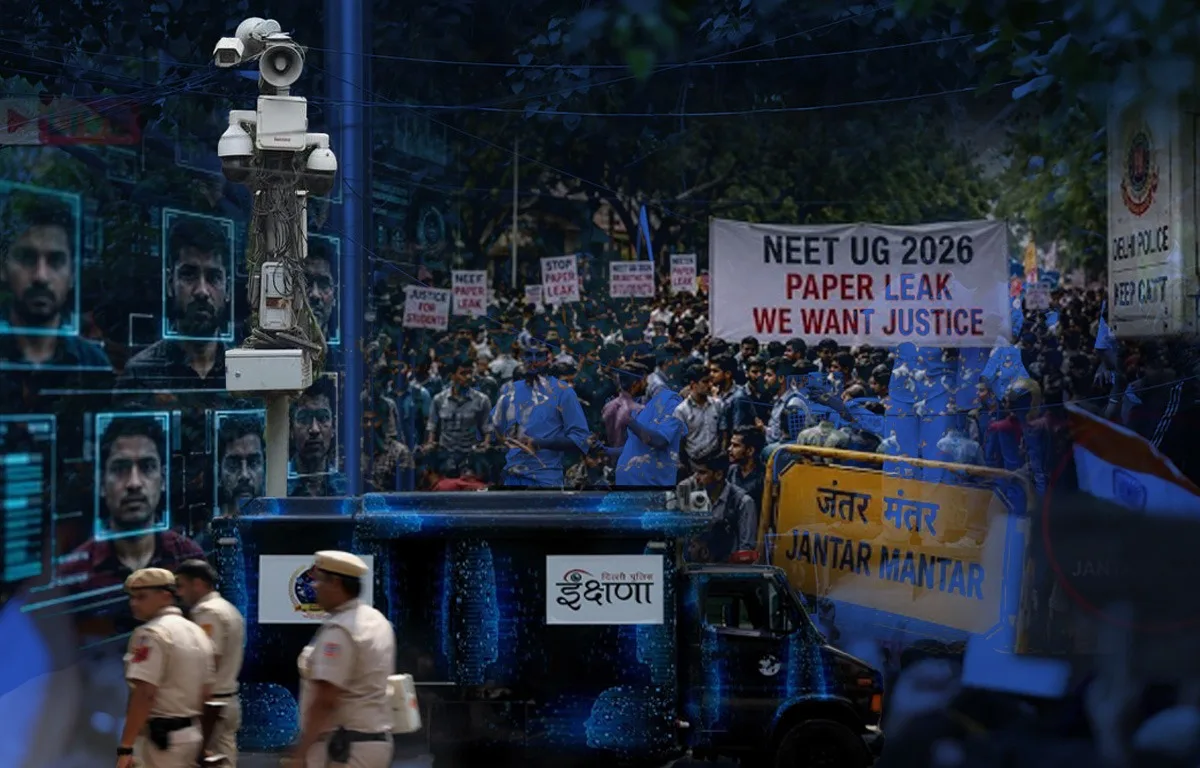
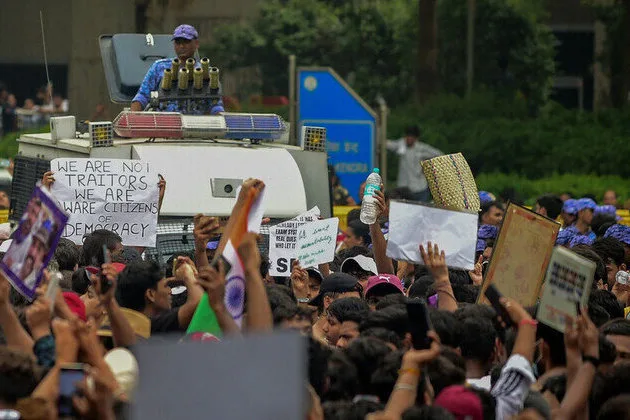
Two hundred and forty-one years later, that design principle is running on live video feeds outside Jantar Mantar, New Delhi, pointed at a crowd of exam-reform protesters who have not been accused of plotting anything more dangerous than a sit-in.
The Mechanism of Surveillance
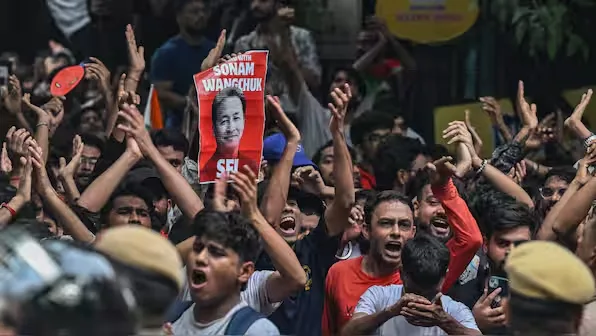
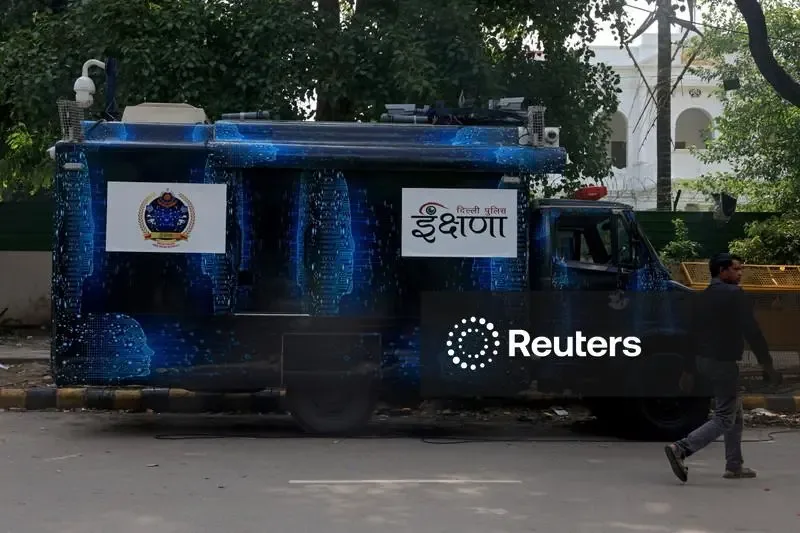
Since June 20, when the Cockroach Janta Party and a coalition of student groups began their sit-in at Jantar Mantar demanding accountability for the NEET-UG 2026 paper leak, Delhi Police has assembled what can only be described as a small surveillance apparatus around a protest about a botched exam. The inventory, as reported by Brut India and The News Minute included a permanent observation tower, dedicated Facial Recognition System units at key entry and exit points, the Ikshana mobile surveillance vehicle – eight cameras, 360-degree coverage, originally built for the 2023 G20 Summit – now repurposed to scan a crowd of students, AjnaLens smart glasses running facial matches through an earpiece alert and a separate app, Abhigyan, extending the capture to fingerprints via the national identification database.
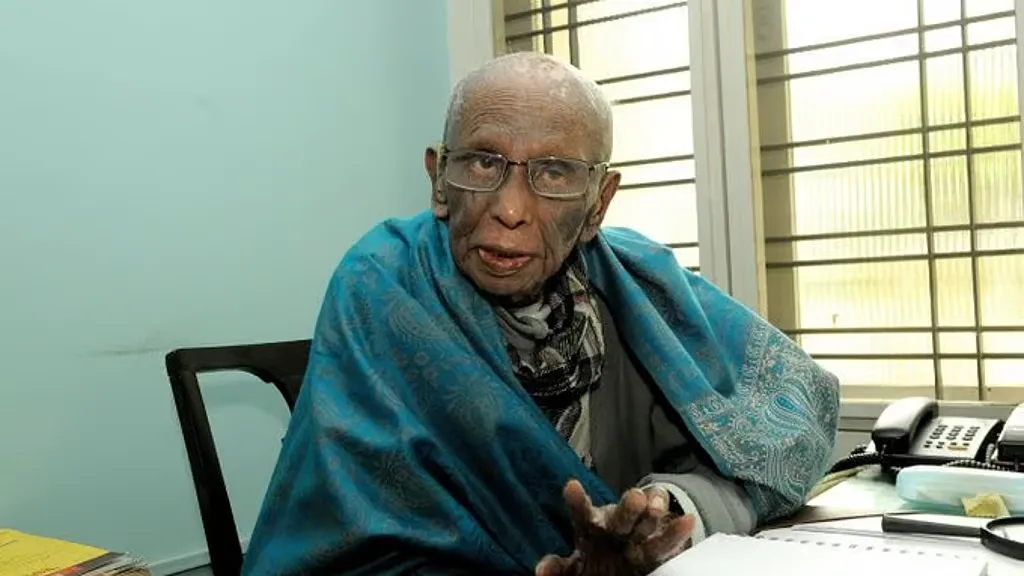
A Supreme Court petition filed by CPI(M) Rajya Sabha MP A.A. Rahim lists all of it feeding into the National Automated Fingerprint Identification System and the Crime and Criminal Tracking Network, part of a citywide net of some 25,000 cameras.
The stated purpose is narrow: to identify individuals with existing criminal records who might be present in the crowd. According to ANI and Open Magazine, Delhi Police says the Facial Recognition System flagged 2,873 people with prior criminal histories at the protest sites between July 20 and 25; 989 of them were reportedly linked to serious offences, including murder, sexual assault, robbery, kidnapping, and POCSO Act violations. On its face, that sounds like ordinary policing. A facial match cross-checked against a watchlist, flagged for human review. Nothing especially sinister about that, surely.
Except nobody outside the police department has actually seen that list. Every account of the 2,873 figure, across ANI, The Sentinel, and Organiser, traces back to unnamed ‘sources’, not a released register of names or case numbers. There is no public indication that anyone flagged was informed they had been flagged, nor is there any publicly known mechanism to contest a mistaken match. A number this large, cited this confidently, deserves the same scrutiny as any other unverifiable government claim.
Off-the-Shelf Surveillance
The most unsettling item on that list isn’t the van or the fingerprint app. It’s a pair of sunglasses. Visuals from the protest site showed Delhi Police personnel wearing Meta’s Ray-Ban AI smart glasses – consumer hardware, available to anyone, that carries a camera, a microphone, and an on-device AI assistant, and can photograph or record video on a spoken command without the wearer ever raising a phone. Delhi Police has never publicly explained how or why they were being used, or what happened to the footage afterwards. There is no chain of custody, no audit trail, and no procurement record, because this isn’t police-issue equipment procured through any accountable process. It is off-the-shelf consumer technology that an officer can put on without any publicly disclosed procurement or operating protocol.
The detail did not go unnoticed in Parliament. In the Lok Sabha, DMK MP Dayanidhi Maran raised the issue directly, accusing Delhi Police of using the glasses to scan, identify and hunt down student protesters. His framing cut close to the bone: “Peaceful young people protesting paper leaks and exam fraud are treated like criminals. The government’s priority is clear: protect the PM’s image and crush the students… How long will we let our children be tracked and thrashed like cattle while the same government lectures Meta about free speech?” He also pointed to what he described as a contradiction: a government that has, in other contexts, publicly criticised Meta’s platforms over content moderation and free expression was, through its own police force, using Meta’s consumer smart glasses during protest policing.
Another issue raised concerns the deployment itself. Newslaundry has reported that Additional Deputy Commissioner of Police Sandeep Lamba, filmed slapping a woman protester during the march to Parliament, and since quietly removed from the Jantar Mantar posting, was separately seen wearing the same kind of glasses at the protest site. The fact that the same officer accused of assaulting a demonstrator was also seen wearing the surveillance hardware raises legitimate questions about how such recordings are used, retained and supervised. The smart glasses are now explicitly named in Rahim’s Supreme Court petition, filed alongside the FRT vans and the fingerprint app as part of a surveillance stack the petition says was deployed ‘without any statutory authority’.
The unprotected exam papers
Here’s the part that should trouble anyone inclined to accept the ‘law and order’ framing at face value: this entire apparatus – the vans, the smart glasses, the fingerprint app, the command centre – appeared only once students started gathering in anger. It was nowhere to be found during the years when NTA’s examinations kept collapsing into scandal, leak after leak, cycle after cycle, each costing lakhs of students their years and, in some, their lives. No comparable investment in technology, data forensics, or institutional urgency was ever directed at the agency whose repeated failure sparked the protest in the first place. The state’s most sophisticated instruments of watching were reserved entirely for the people angry about the failure, never for the failure itself.
The Questions That Remain Unanswered
No credible account of the NEET-UG protests describes a terrorist threat. Protesters and opposition leaders have maintained that the demonstration was peaceful until police moved in. Tear gas followed, and disputed reports of pellet-gun injuries surfaced, all separate and serious matters currently before courts. Even if an account proves accurate, violence during a protest, however troubling, is a public-order problem. It is not, by itself, evidence of the kind of fixed and distinct threat that legal doctrine has historically required before a state escalates from ordinary policing to biometric mass surveillance.
That distinction matters because courts that have actually grappled with this question have explicitly drawn it. Legal scholarship on American policing has stressed that courts have rejected justifying protest surveillance on the basis of a vague, omnipresent fear of unrest; what the law demands is something concrete and specific to the event at hand, not a generalised anxiety about crowds. In the UK, the landmark Bridges ruling against South Wales Police’s use of live facial recognition found the force’s discretion ‘impermissibly wide’ precisely because it wasn’t tethered to any specific, articulable threat.
India’s own constitutional test, laid down in Justice K.S. Puttaswamy v Union of India (2017), asks whether any state action reaching into the right to privacy has a legal basis, pursues a legitimate objective, is proportionate, and is the least restrictive option available. India has no dedicated statutory framework specifically regulating police use of facial recognition technology, leaving deployments to rely on general policing powers and fragmented legal provisions. Meanwhile, the Digital Personal Data Protection Act, 2023, exempts government security functions from most of its constraints, meaning the very statute meant to protect data essentially waives the police through.
The Hunt After the Protest
The machinery isn’t confined to cameras at a protest site. On July 27, Delhi Police, in plainclothes, arrived at AKG Bhavan, the CPI(M)’s national headquarters, attempting to arrest Aishe Ghosh, the former JNUSU president who has been at the forefront of the CJP-aligned protest. The warrant, police said, related to a 2021 case from a Banga Bhawan demonstration, unconnected to the present agitation. CPI(M) Rajya Sabha MP John Brittas physically blocked the officers, noting they carried no visible warrant document and no identification, and alleged that Ghosh had been shadowed for days beforehand. The police eventually left without making the arrest.
Whether that shadowing ran through the same camera and facial recognition network built around Jantar Mantar is not something anyone has established on the record; that would be speculation dressed as fact. But the timing does the work the technology doesn’t need to: a four-year-old warrant, unexecuted for years, suddenly actioned in plain clothes during a visit to a political party’s headquarters, in the same week the government had publicly assured protesters they would not be targeted. The message that is sent does not require proof of a specific surveillance trigger. It only requires coincidence to be noticed.
The Haunt That Follows
The protest itself paused on July 25, when Union Education Minister Dharmendra Pradhan resigned. What has followed is arguably more revealing than the protest was. Within days, Left student organisations were back at Jantar Mantar, not to protest NEET. Still, to protest what they called the ‘criminalisation’ of the students and youth who had taken part, describing a crackdown they said was reaching well beyond Delhi into Bihar, Bengal, Kerala, and other states. Solidarity demonstrations broke out across Kerala over the same issue. The Cockroach Janta Party has since accused the Centre of breaching the terms of its own July 25 settlement, which included a promise to withdraw FIRs against protesters and has set up a nationwide legal aid cell, backed by a ₹1 crore fund, specifically to defend people still facing prosecution for having shown up.
This is the second half of the panoptic bargain, and it is the part that makes the surveillance retroactively coherent. The cameras, the smart glasses, and the facial recognition units were never about controlling the crowd in the moment. They were building the archive that makes the ‘after’ possible. The quiet FIR, the warrant from an old case suddenly worth executing, the arrest in another state weeks later, once the television cameras have moved on and the story no longer trends.
Spilling Fear
On July 21, a day after Delhi Police used lathi-charges and tear gas against the CJP’s Chalo Sansad march, Kerala Chief minister V.D. Satheesan personally travelled to Delhi and joined a separate solidarity sit-in outside the Prime Minister’s residence at 7, Lok Kalyan Marg, organised by the Congress leadership itself rather than the student groups, alongside Congress president Mallikarjun Kharge, Rahul Gandhi, and Priyanka Gandhi Vadra. He publicly condemned the crackdown, saying students had ‘been brutally attacked in the national capital’ and that ‘the approach of suppressing protests and dissent has no place in a democracy’.
While he was saying that in Delhi, Kerala Police under his own government had booked nearly 5,000 people in cases across multiple districts connected to solidarity protests held in Kerala over the same NEET issue. Those booked included ordinary participants as well as public figures, among them the Malayalam rapper Vedan, booked in Ernakulam simply for his part in the demonstrations. The state government did not dispute that these cases existed.
The scale of the cases also raises an obvious question: by what criteria were thousands of participants identified for prosecution, when the government itself later concluded there had been no serious violence?
What confirms this beyond any doubt is what happened next: on July 31, Kerala’s own Home Minister, Ramesh Chennithala, announced that the state government had decided to withdraw all these cases, directing the State Police Chief to halt further proceedings. His stated reason, ‘these are general law-and-order cases… ” There was no serious violence’ is itself an admission that the cases were filed on thin grounds in the first place.
So the sequence, entirely on the current government’s own record, is: a Chief Minister who called protest suppression undemocratic in Delhi; police under his own administration filing thousands of cases against people for doing in Kerala exactly what he was doing in Delhi; and a walk-back only after the political cost became visible. Separately, in the same window, Kerala Police booked a private citizen, Raju of Puthenvelikkara, over a Facebook post the police called defamatory to Satheesan personally, after a complaint lodged not by a neutral party but by a Congress Block Vice President.
A third case, days later, makes the pattern harder to dismiss as a coincidence. Ahmed Kabeer, a PDP activist in Alappuzha, had his phone taken into police custody after he posted criticism of the Kerala government over the state’s ongoing power cuts, a crisis serious enough that a bedridden patient in Palakkad died after his oxygen concentrator lost power during load-shedding. Once again, the complaint came from a Congress worker, not from police acting on their own initiative. And once again, Alappuzha South police didn’t even register a formal case before calling Kabeer in and seizing his device for ‘scientific examination’ – a phrase that raises concerns about an exploratory search rather than a narrowly tailored investigation. The phone was eventually returned. The message, by then, had already been delivered.
Any government that governs through manipulation, rather than accountability, eventually needs a panopticon of some kind, because the lie requires more policing than the truth ever would.
The Architecture of Fear
A state doesn’t need to arrest a single protester to change the protest. It only needs the protesters to suspect they might be watched, matched, and filed away for later. Delhi Police may well be right that many of the thousands flagged have genuine criminal histories unrelated to the protest. That is not really the point. A facial-recognition system operating alongside an unpublished watchlist, consumer camera glasses worn by the same officer accused of assaulting a protester, a warrant executed at a party office in the same week as a promise not to retaliate, and a crackdown that follows protesters home to their own states after the cameras leave Jantar Mantar, none of that needs to produce a single wrongful arrest to succeed. It only needs to be known to exist.
The Panopticon never depended on filling every prison cell with guards. Its power lay in uncertainty, in making people behave as though they were always being watched. Bentham imagined the architecture. Foucault explained the politics. The question facing a constitutional democracy is whether liberty can survive once surveillance no longer needs walls, uniforms, or even a signboard.
(Disclaimer: OBC encourages a diversity of ideas. The opinions expressed in articles may not necessarily reflect our editorial position.)