How the ‘Cockroach Party’ Became an Online Political Flashpoint
What began as a viral satire has escalated into a wider online controversy involving political accusations, identity-based targeting, and competing narratives over legitimacy and intent. The Cockroach Janata Party movement’s explosive growth has been met with fierce pushback from the right wing. Supporters and critics are clashing over its origins, credibility, and the coordinated campaigns surrounding it.
On May 15, during an open court hearing, the Chief Justice of India, Justice Surya Kant, said: “There are youngsters like cockroaches, who do not get employment or have any place in the profession. Some of them become media, some of them enter social media, RTI activists and other activists, and they start attacking everyone”. The next day, facing massive backlash from Indian youth, he clarified that his remarks had been misquoted and that he was specifically criticising individuals who had entered the legal profession through fake degrees.
But the ‘damage’ had already been done.
A spontaneous satirical internet ‘party’ called the Cockroach Janata Party (CJP) was born that day. Its Instagram account amassed more than 20 million followers in less than a week, surpassing the follower counts of both the BJP and the Congress, before i founder Abhijeet Dipke claimed that it had been hacked. On May 21, the X account of the CJP was also withheld in India. Government officials said the Information and Broadcasting Ministry had raised concerns that the platform was posting inflammatory content that could ‘threaten India’s sovereignty and national security’.
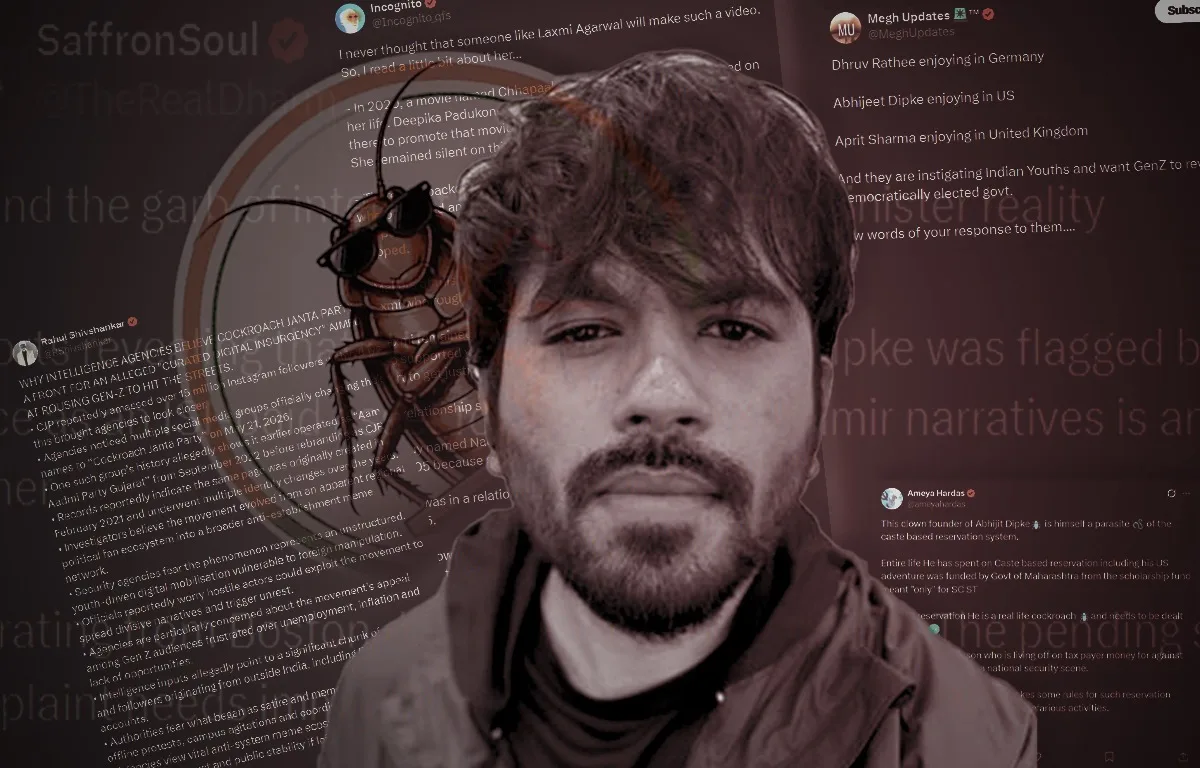
The party’s ‘founder’, Abhijeet Dipke, was reportedly a social media volunteer for the Aam Aadmi Party. Amidst the noise, he had also revealed himself to be a Dalit. The right wing social media ecosystem is aggressively attacking the movement, primarily by focusing on Abhijeet’s caste and political identity, while also ridiculing the ‘anti-national’ elements supporting the CJP. The hate campaigners accuse the movement of being ‘anti-national’, and claim that the massive follower count achieved within such a short span of time is not organic.
“No wonder the accounts were taken down”
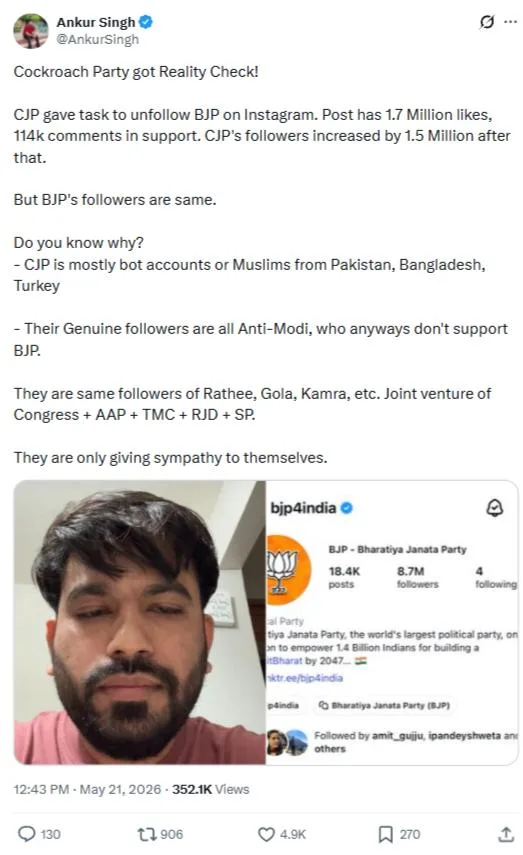
On May 21, an X user named Ankur Singh posted two screenshots—one from Abhijeet Dipke’s video post and another from the Instagram account of the BJP. The caption read, ‘Cockroach Party got a reality check!’ He went on to say that the CJP’s followers are mostly bot accounts or Muslims from Pakistan, Bangladesh, and Turkey. He also claimed that their genuine followers are all anti-Modi and do not support the BJP. The post ended with the remark that they are ‘only giving sympathy to themselves’.
This account is followed by Prime Minister Narendra Modi.
The post has garnered more than 3.5 lakh views as of May 23. It has also received nearly five lakh likes and over 900 reposts.
One user commented: “The unchecked rise of radicalised Gen Z elements from ‘peacefuls’ is becoming a serious long-term threat to national stability and social harmony. India needs more strong, decisive leadership like Amit Shah ji and NaMo and a strong nationalist ecosystem backing them for the next 50 years to safeguard the nation’s future”.
Another user said that “fools should have gone after real issues rather than saying unfollow BJP”, and referred to them as ‘brainless dumps’.
Some comments also questioned whether the BJP and Modi government had become so ‘scared’ that they legally blocked the CJP account, asking, ‘What the hell happened to free speech and freedom?’
A large part of the hate campaign against the CJP movement frames the narrative that its huge follower count is not organic, but the result of organised bot activity linked to rival factions such as the AAP, TMC, and Congress. They claim that the takedown by X is due to bots being detected, and nothing else. These narratives have been further intensified after Dipke posted on May 23 that the Instagram account had been hacked.
Personal attacks as a weapon
Since the movement went viral, right-wing users have been actively trying to trace the background of its founder, Abhijeet Dipke. A point that has drawn particular criticism is that he is settled in the United States.
On May 22, he posted a screenshot of a WhatsApp chat showing a video of a man that was sent to him along with threatening messages. The messages in Hindi translate to: “I have found your father’s house. See what happens this evening”.
Abhijeet, in his post, questioned whether the authorities would take action against the threats received by his family in India.
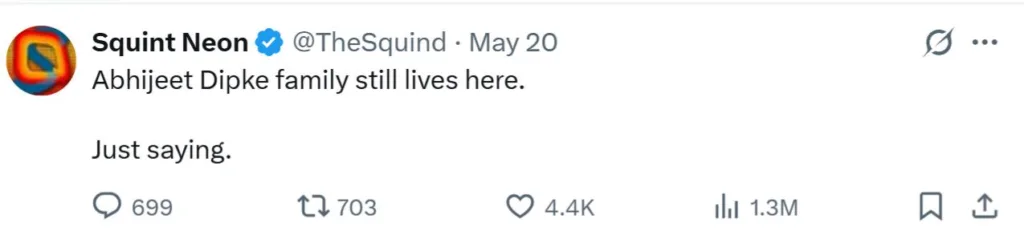
An account called ‘Squint Neon’, which openly describes itself as a ‘political Hindutva spreader’, posted a message on May 20 stating, ‘Abhijeet Dipke family still lives here. Just saying’. The post had gained more than a million views and about 4,500 likes as of May 23.
One user commented, “Just saying what? Elaborate please. Sounds like you are suggesting harassment of his family”. Some users also tagged the Delhi Police, urging them to take action against what they described as an open threat.
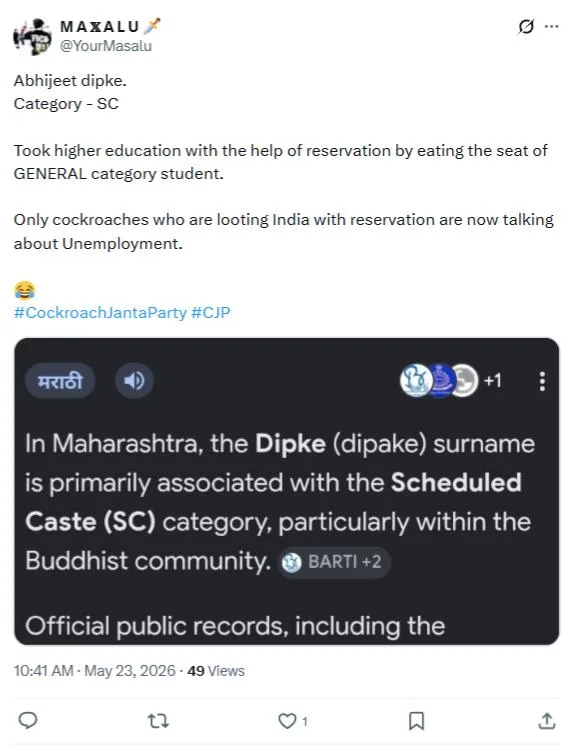
Abhijeet has also said that he has been facing caste-based harassment since he disclosed his Scheduled Caste identity. One particular post described him as ‘a parasite of the caste-based reservation system’. It further stated that without reservation, he is a ‘real-life cockroach’ and ‘needs to be dealt with firmly’.
Another user, Tajinder Bagga, who is also followed by Narendra Modi on X, posted a video of a man speaking to a crowd, alleging that the person is Abhijeet Dipke speaking during the anti-CAA/NRC protests of 2020. In the caption, he wrote: “Who is Modi to ask about my religion? We won’t allow CAA and NRC to be implemented. We won’t show papers. Manusmriti is not the Constitution. — Abhijeet Dipke, Cockroach Janata Party”.
As of May 23, the post has garnered about 3 lakh views and is being widely shared by various Hindutva handles. One user commented that the individual ‘needs to be booked at the earliest possible opportunity’ and that his activities ‘must be kept under surveillance’, warning that he may become a ‘Frankenstein if not checked in time’.
The ‘Aam Aadmi’ link
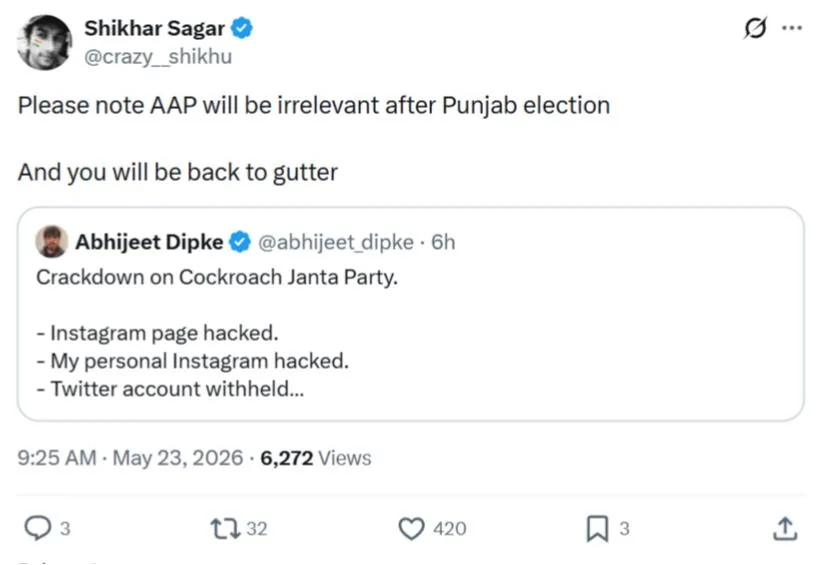
Many accounts have also pointed to an alleged AAP link. One user posted, “Please note AAP will be irrelevant after the Punjab election, and you will be back to the gutter.”
A separate post titled ‘Meet the team behind Cockroach Janata Party’ alleged that Abhijeet Dipke and political content creator Dhruv Rathee are part of the so-called CJP and linked both of them to AAP. It further claimed that they have consistently supported AAP narratives, never criticised the party, and were actively promoting its messaging even before the launch of CJP. The post also alleged that despite later projecting neutrality, the same individuals and ecosystem continued to operate with unchanged narratives, questioning how the Cockroach Janata Party could be considered politically neutral.
What a spontaneous movement born out of political frustration can ultimately achieve is something that only time will tell. However, the consistent intolerance shown by the right-wing ecosystems towards movements that challenge them is reflected in the organised and often hostile cyber campaigns faced by such individuals and groups. In several instances, this has extended beyond criticism to personal attacks and even open threats directed at family members.
As the CJP has built momentum and progressive voices closely watching its trajectory, these forces appear to be mobilising their broader online machinery to discredit the movement and weaken its influence in order to preserve the status quo. Whether the movement—or the individuals behind it—can withstand such an organised and expansive network remains to be seen.