The Propaganda Spray on Cockroaches: Tracking Viral Fake Statistics and Protest Narratives Surrounding CJP
As the Cockroach Janta Party (CJP) gained traction online, a parallel wave of misinformation quickly followed. Viral posts attempted to portray the movement as Pakistan-backed, while fabricated audience statistics and unverified protest calls spread widely across social media platforms. This report traces the origin of those claims and examines how India’s latest online movement became the subject of competing narratives, propaganda, and online disinformation campaigns.
On May 23, Sonam Wangchuk expressed his support for the online movement Cockroach Janta Party (CJP). He urged the government to address the youth movement’s demands, instead of attempting to suppress them digitally.
Meanwhile, several online critics of the system have viewed the sudden rise of CJP with skepticism, while right-wing groups appeared to be trying to discredit the movement with false and baseless claims. In our previous reports, OBC revealed how online right-wing hate targeted CJP and its founder, Abhijeet Dipke. As the movement gained traction, several claims began circulating across social media platforms. Viral posts alleged that the majority of CJP’s followers were from Pakistan, while others attempted to portray old protest footage from Bihar and Noida as recent agitation linked to the movement. At the same time, viral messages calling for an on-ground human chain protest in Bengaluru triggered police warnings and public confusion.
This report examines the misinformation and competing narratives that emerged online around the Cockroach Janta Party within days of its emergence.
The viral infographic
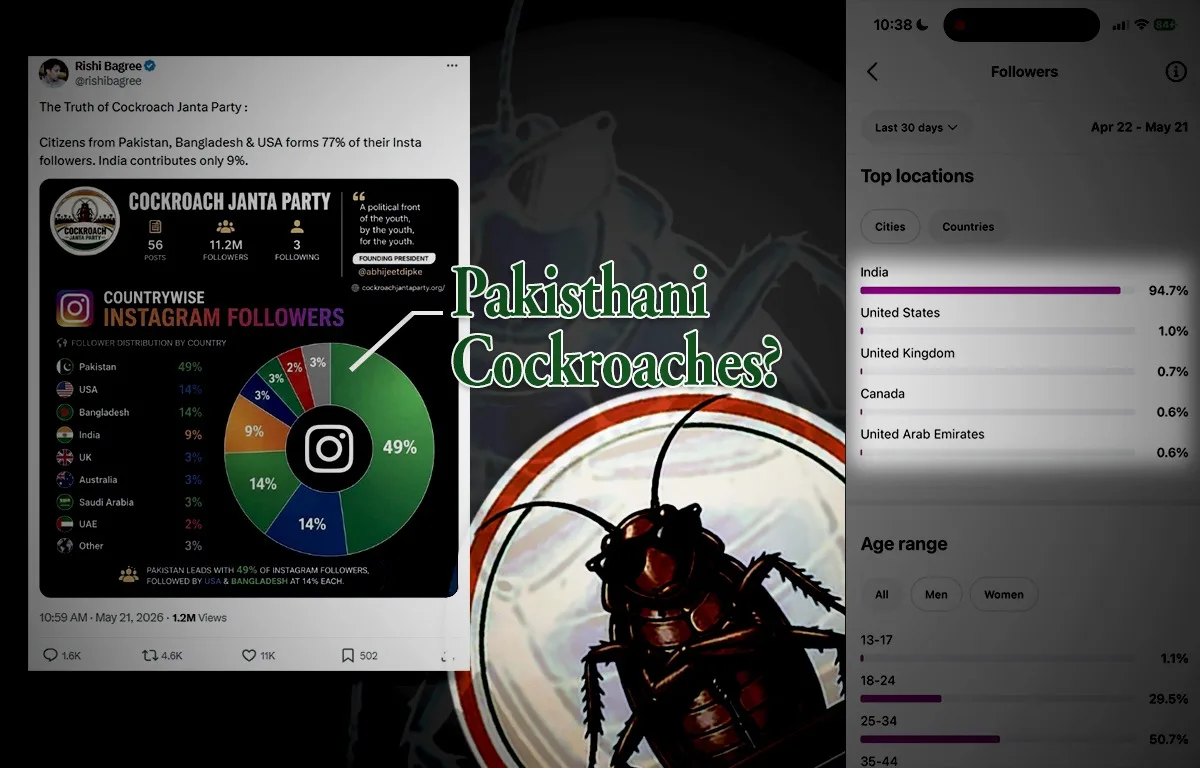
On May 21, Rishi Bagree (@rishibagree) shared an image on X that shows the follower distribution of CJP’s Instagram account. It claimed that the majority of the followers were from Pakistan. The caption of the post reads, “The Truth of Cockroach Janta Party: Citizens from Pakistan, Bangladesh & USA forms 77% of their Insta followers. India contributes only 9%.” This account has previously been flagged by fact-checkers for sharing false narratives online.
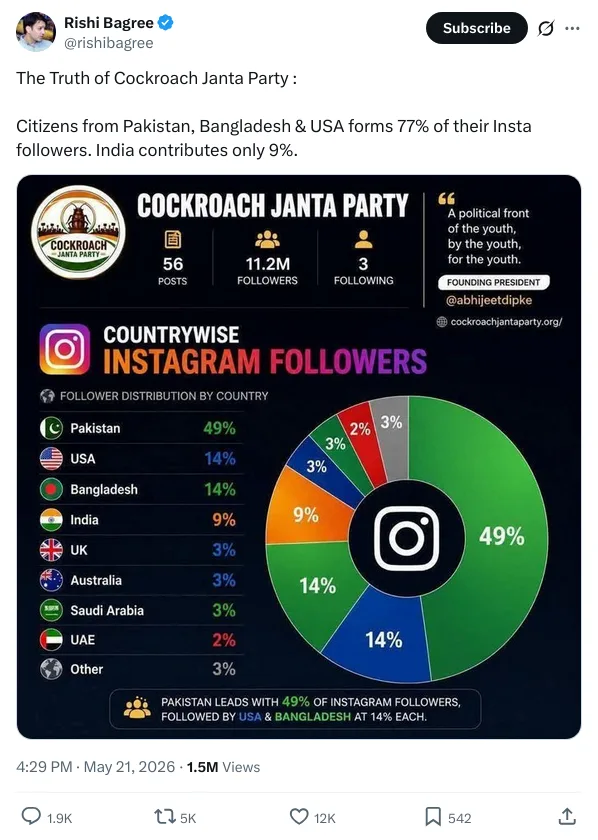
As of May 25, the post had garnered 15,00,000 views, 12,000 likes, and 5,000 reposts.
Calling the image fake, one user stated, “This image is fake and clearly AI-generated, yet the BJP IT gang seems so desperate and afraid that propaganda is now their go-to strategy. When facts stop working, misinformation takes over. What an absolute shame.”
Supporting the claim made in the post, a user remarked, “Indian Gen-Z should ask one simple question: If India is so hopeless, why are these influencers choosing to live permanently in the West instead of returning to fix the country themselves? Slowly, the masks of all these cockroaches will fall off.”
The photo suggests that around 49% of the followers of CJP on Instagram were from Pakistan, with Indian followers accounted for just 9%.
We found that on May 21, Tajinder Bagga (@TajinderBagga), National Secretary of the Bharatiya Janata Yuva Morcha (BJYM), initially shared the infographic referring to CJP as the ‘Pakistan Janta Party’.
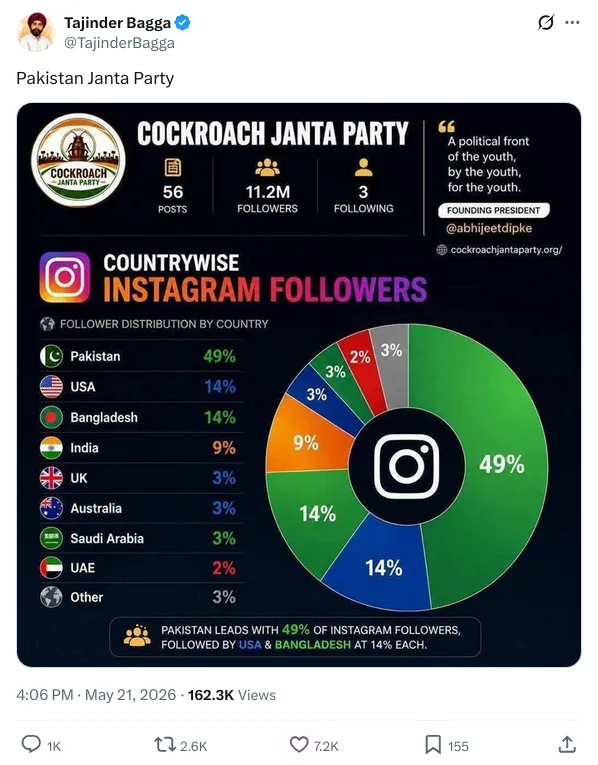
Responding to the post, several users questioned the authenticity of the statistics depicted in the image and demanded an apology for spreading ‘false information’.
Later on May 23, amplifying the claim, the Union Minister of Parliamentary Affairs Kiren Rijiju took to his official X account and stated that he pitied those who sought followers from Pakistan and the ‘George Soros gang’. He further stated that India has a highly energetic youth population who could be genuine and valuable followers, and there is no need for validation from the ‘anti-India gang’. In conclusion, the Union Minister said that India remained stable during the present Southwest Asia crisis due to the government’s efficient management.
We examined the viral statistics and noticed that no third-party utility available online could provide the follower distribution of an Instagram account. Such information is only made available to the account user through Instagram’s built-in analytics, thus suggesting that the viral image may have been fabricated.
As a response to Kiren Rijiju’s X post, on May 23, CJP founder Abhijeet Dipke shared a screen recording revealing the audience demographics during the timeline April 22 to May 21, which he said had been recorded before CJP’s Instagram account was taken down.
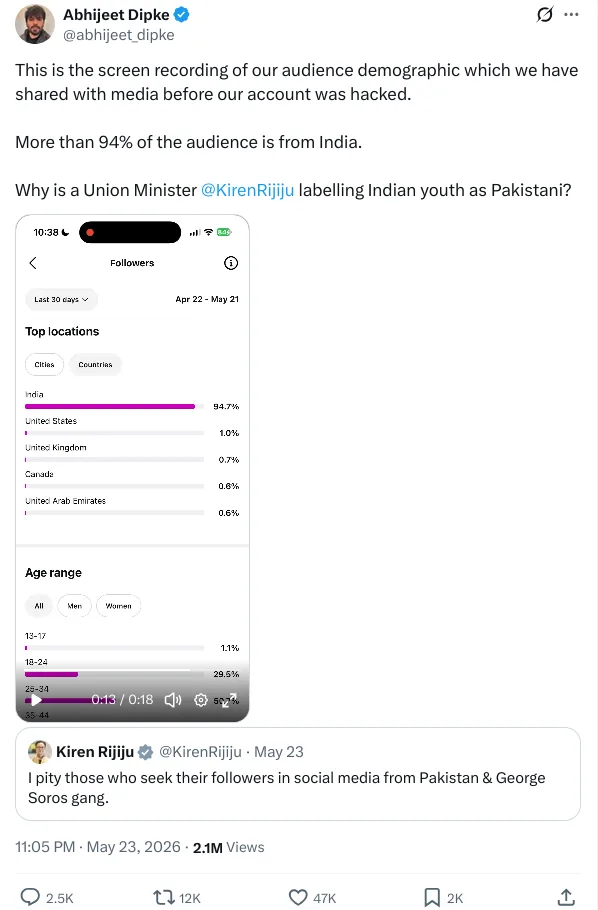
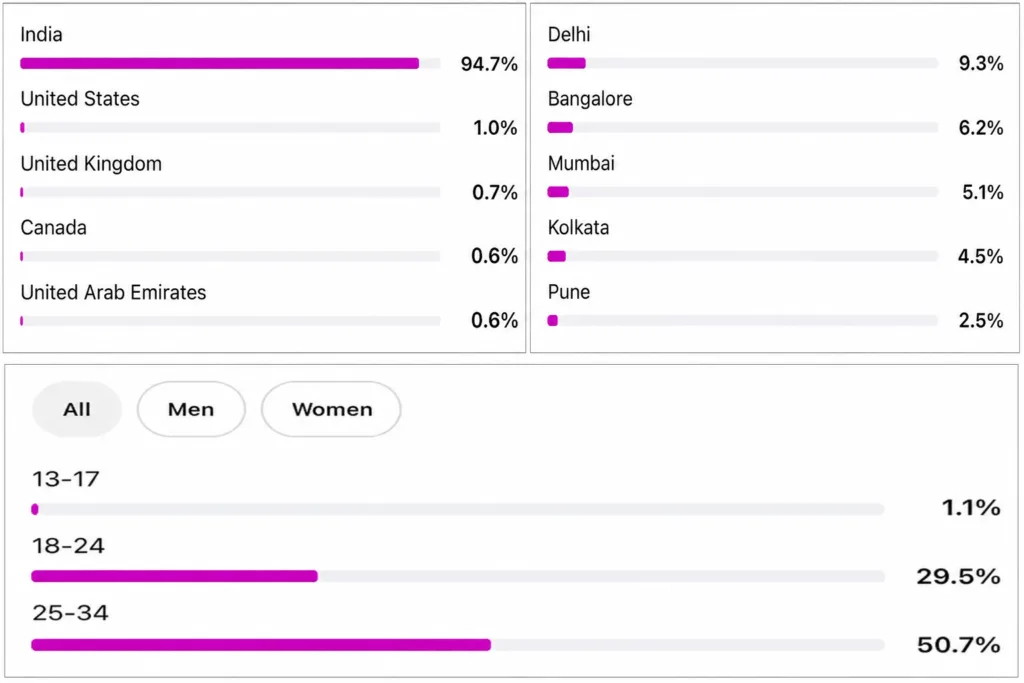
According to the screen recording, the audience from India stood at 94.7% with the majority of them coming from cities like Delhi, Bengaluru, Mumbai, Kolkata, and Pune. It also shows that of all the users interacting with the CJP Instagram account, individuals aged between 25 and 34 topped the list with 50.7%.
CJP’s call for a human chain in Bengaluru
On May 22, the Bengaluru police cautioned the public against participating in or circulating social media posts related to a proposed ‘peaceful human chain’ programme purportedly organised by a group calling itself the ‘Cockroach Janata Party Karnataka’ near Town Hall on May 24. According to the police, viral posts on social media had called on people to gather in large numbers in front of Town Hall for the event.
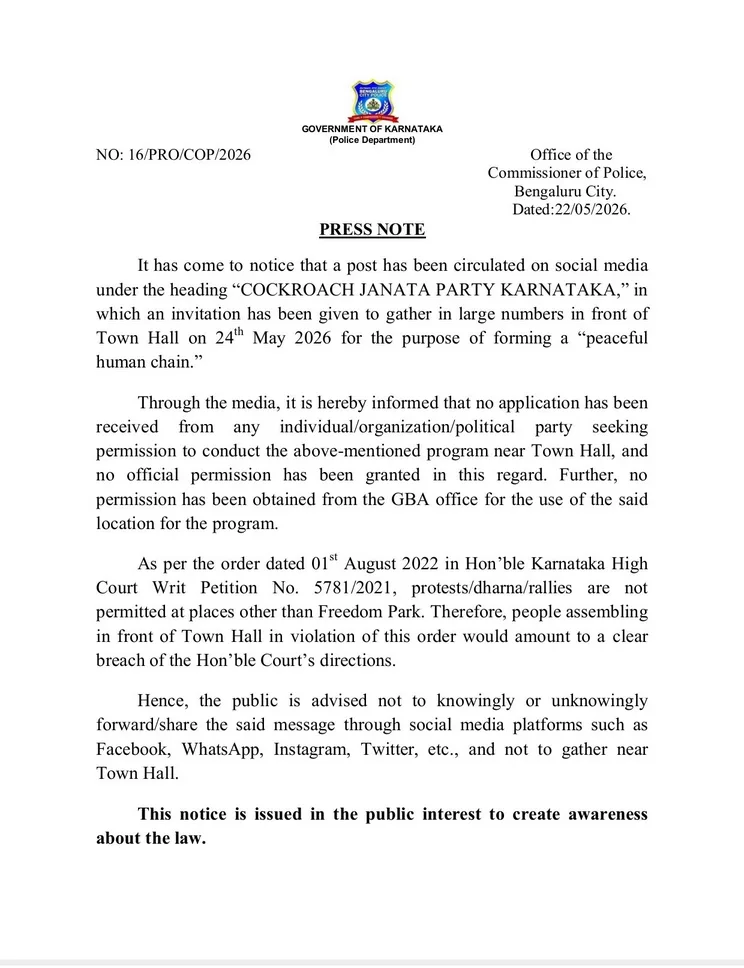
In a press note, the Bengaluru City Police clarified that no individual, organisation, or political party had sought permission to conduct such a programme. The police further stated that neither the Bengaluru police nor the Greater Bengaluru Administration (GBA) had granted approval for the use of the venue. In its statement, the Bengaluru police advised the public not to forward or circulate the viral message through social media platforms such as Facebook, WhatsApp, Instagram, and X, either knowingly or unknowingly. The police also urged people not to gather near Town Hall in connection with the proposed programme.
The viral card in Kannada calling for the gathering at Town Hall in Bengaluru reads, “All cockroaches and fans of Cockroach Janata Party, come, let’s show our power, let’s send a message to the self-righteous administration. Come, let’s give the message of the cockroaches. There are no leaders here; we are our own leaders, there is no organization here, the organization is the citizens joining hands.”
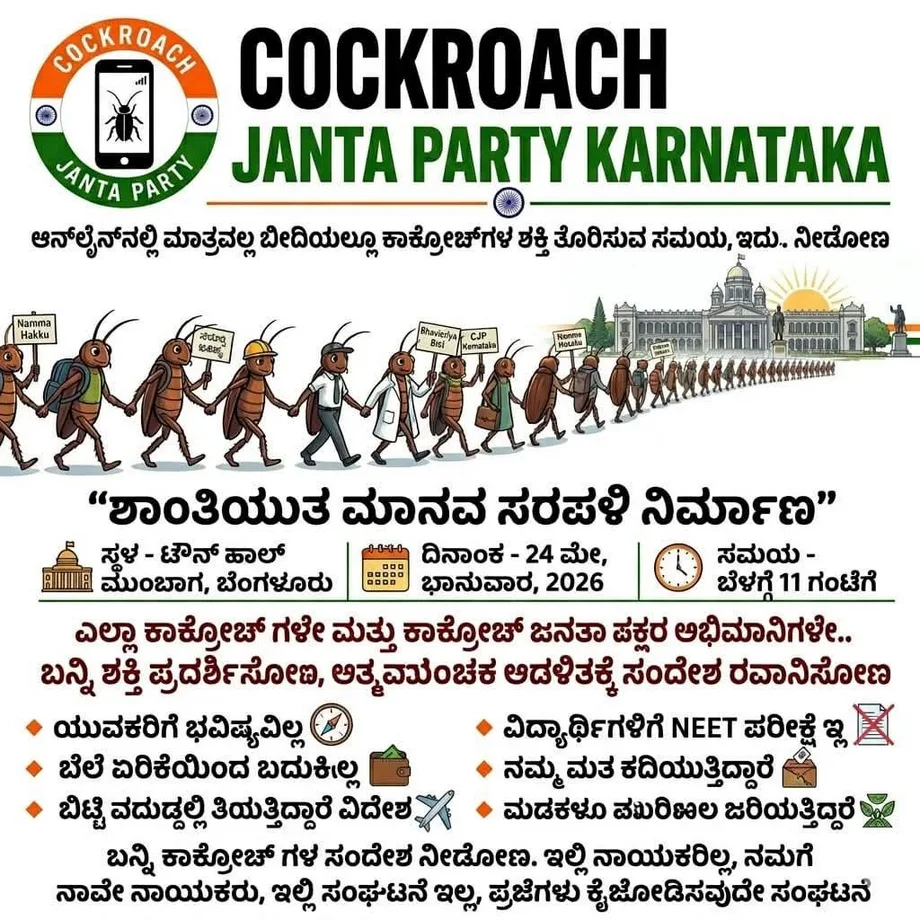
We examined the card and observed that none of the current social media profiles of the Cockroach Janta Party have posted any image of that kind.
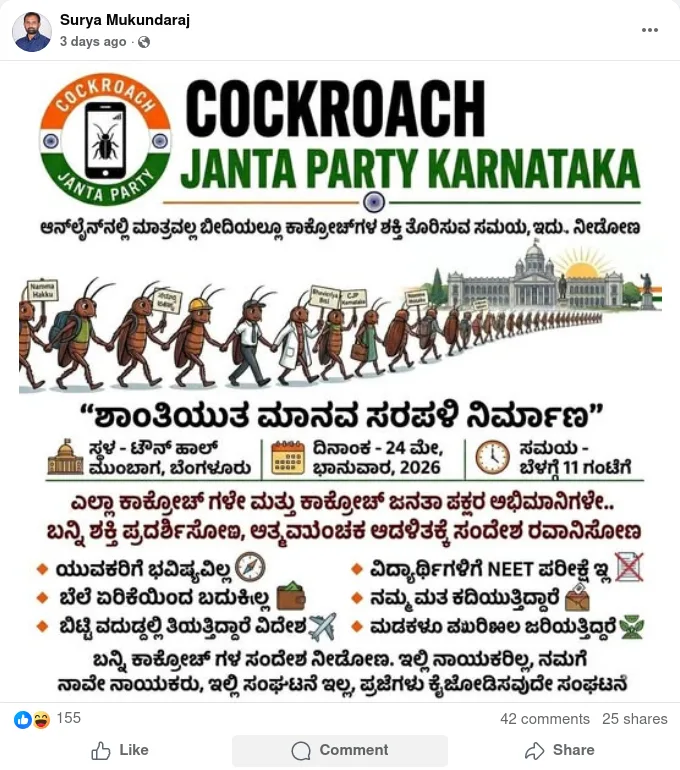
Additionally, we found that the earliest available post featuring the viral card was shared by a Tumakuru-based Facebook user, Surya Mukundaraj, on May 22. According to his personal website, he is a lawyer and serves as the General Secretary of the Law, Human Rights and Right to Information Department of the Karnataka Pradesh Congress Committee.
On the same day, Mohan Gowda, Spokesperson, Hindu Janajagruti Samiti, Karnataka (according to the X bio), based in Bengaluru, shared the image, tagging the Bengaluru city police and Bengaluru Commissioner of Police, enquiring whether the police had granted permission to the proposed gathering at the Bengaluru Town Hall.
In light of these events, the Cockroach Janta Party has issued a clarification and rejected calls for on-the-ground protests or demonstrations in a video message shared on May 23.
From fabricated audience statistics and unverified mobilisation calls, the rise of the Cockroach Janta Party was quickly followed by competing online narratives. While the movement remains largely internet-driven, the misinformation surrounding it highlights how rapidly viral political trends in India are reshaped, amplified, and weaponised across social media platforms.

Sujith A
Open Source Intelligence Researcher and Mis/Disinformation tracker. Passionate about investigations and a big fan of Sherlock Holmes.
View all posts by Sujith A