
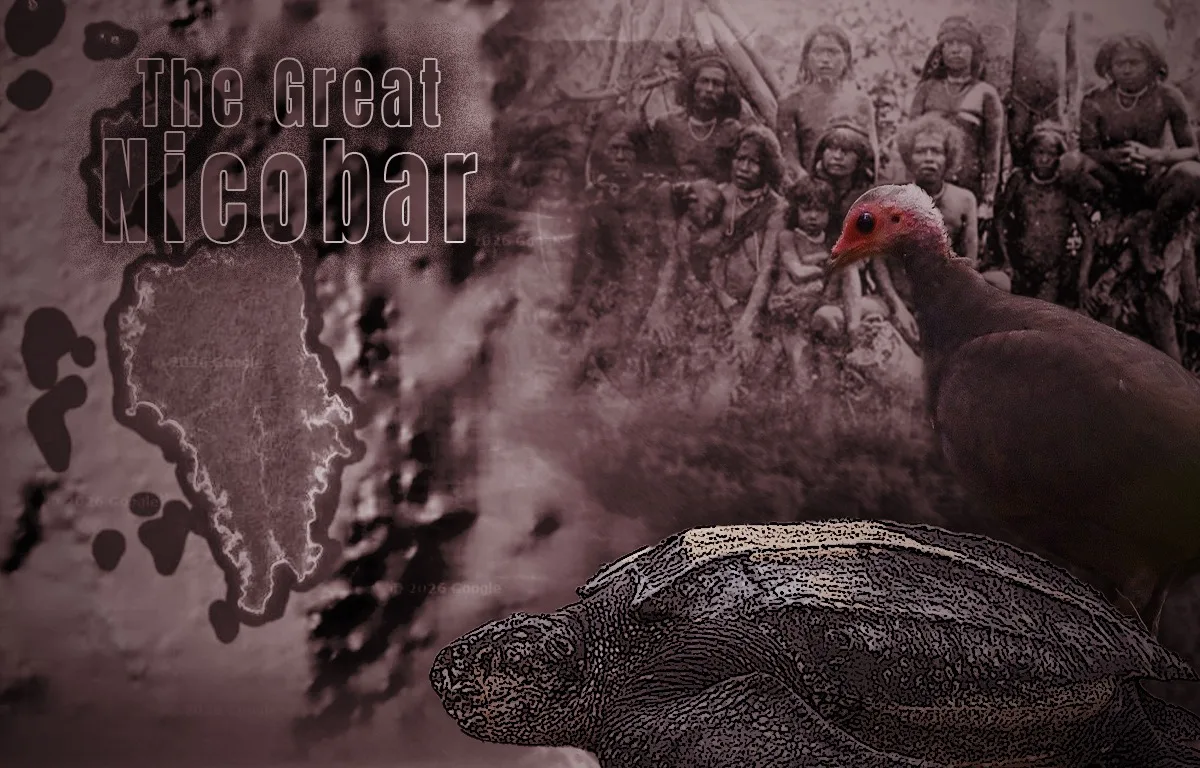
Concrete Over Canopy: The Great Nicobar Project
Ancient rainforests, nesting leatherback turtles, coral reefs and indigenous tribal reserves stand at the centre of India’s biggest island megaproject. As bulldozers move closer to one of the country’s last intact ecosystems, scientists, conservationists and tribal rights activists are raising alarm over what could be lost forever.
The Great Nicobar project is a ₹72,000–₹80,000 crore mega infrastructure plan and represents a large-scale development on a sparsely populated island ecosystem. On April 29, after visiting the Andaman and Nicobar Islands, the leader of the opposition, Rahul Gandhi, slammed the project, citing it as a grave threat to the environment and indigenous communities. On May 1, the central government released a detailed clarification on the project, underscoring its strategic importance.
On May 3, the Indian National Congress (INC) stated that the government had failed to address the concerns surrounding the project and demanded a parliamentary review.
These recent scenarios have sparked renewed public interest in the matter, and this detailed OSINT investigation sought to provide a full picture of the project, its effects on the rich flora and fauna of Great Nicobar, controversies and apprehensions surrounding it, along with the perceived strategic importance for India.
What is the Great Nicobar Project?
The Great Nicobar Project is a massive three-phase infrastructure project led by NITI Aayog and implemented by Andaman and Nicobar Islands Integrated Development Corporation Limited (ANIIDCO).
The project aims to develop Great Nicobar,the southernmost island of the Andaman and Nicobar Islands, into a major economic and strategic hub. Covering ~166 sq km, the project anchors around Galathea Bay and other key areas such as Indira point and Campbell Bay.
Key components of the project are;.
- Transhipment port (Galathea Bay)
- International airport
- Township
- Power plant
The project’s implementation is planned in three distinct phases over the next 30 years, as mentioned below.
- Phase I (2025–35): Focuses on initial development, covering 72.12 sq. km.
- Phase II (2036–41): Further infrastructure expansion covering 45.27 sq. km.
- Phase III (2042–47): Final development phase covering 48.71 sq. km.
Using openly available information, we mapped the proposed locations for the project.
The fragile ecology of Great Nicobar
Great Nicobar is not just a remote island, but a biodiversity hotspot featuring the Great Nicobar Biosphere Reserve encompassing two national parks. The island’s unique ecosystem is known for the Megapode sanctuary and diverse, endemic species.
Presently protected areas,Great Nicobar:
Campbell Bay National Park
Location: Northern and central part of southern Great Nicobar Island, near Campbell Bay.
Coordinates: 7°06’14.3″N 93°45’19.8″E
Key feature: One of the largest intact tropical rainforest zones in the Nicobar Islands, known for dense evergreen forests and high endemic biodiversity.
Galathea National Park
Location: Southern part of Great Nicobar Island, extending towards Galathea Bay and Indira Point.
Coordinates: 6°50’21.8″N 93°50’53.9″E
Key feature: Contains coastal rainforest and marine ecosystems, including a major nesting ground for the Leatherback sea turtle.
The denotified wildlife sanctuaries and species at risk
In January 2021, the National Board for Wildlife (NBWL) denotified the Megapode Wildlife Sanctuary. The standing committee of the board observed that since the 2004 Tsunami, the Megapode Islands had been submerged and ceased to exist. In the same meeting, the Galathea Bay Wildlife Sanctuary too was denotified, paving the way for the development project on the Island.
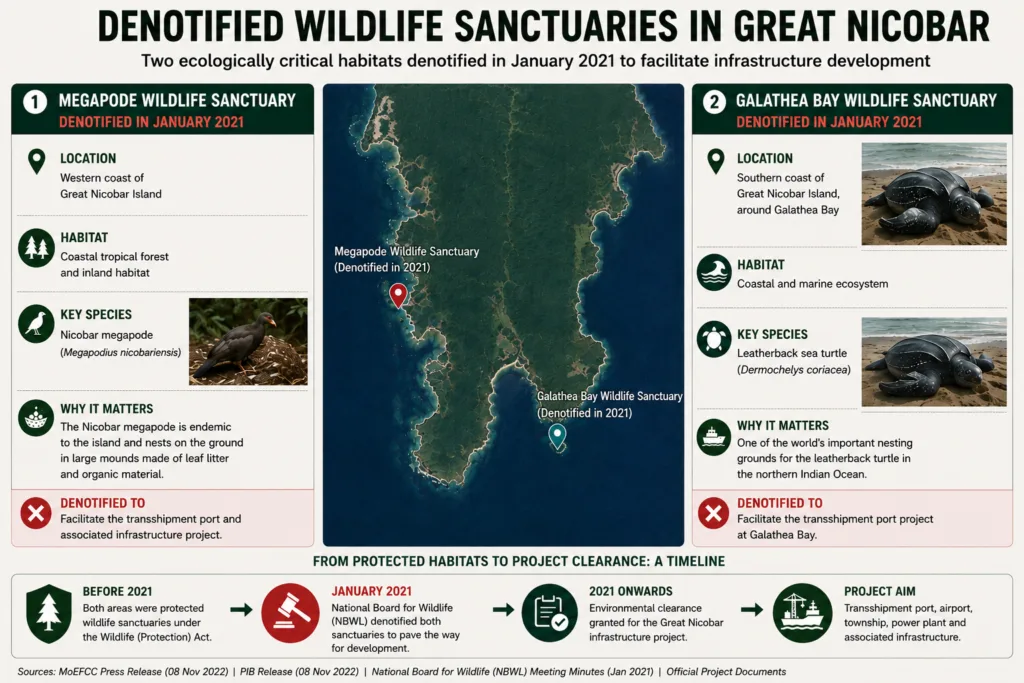
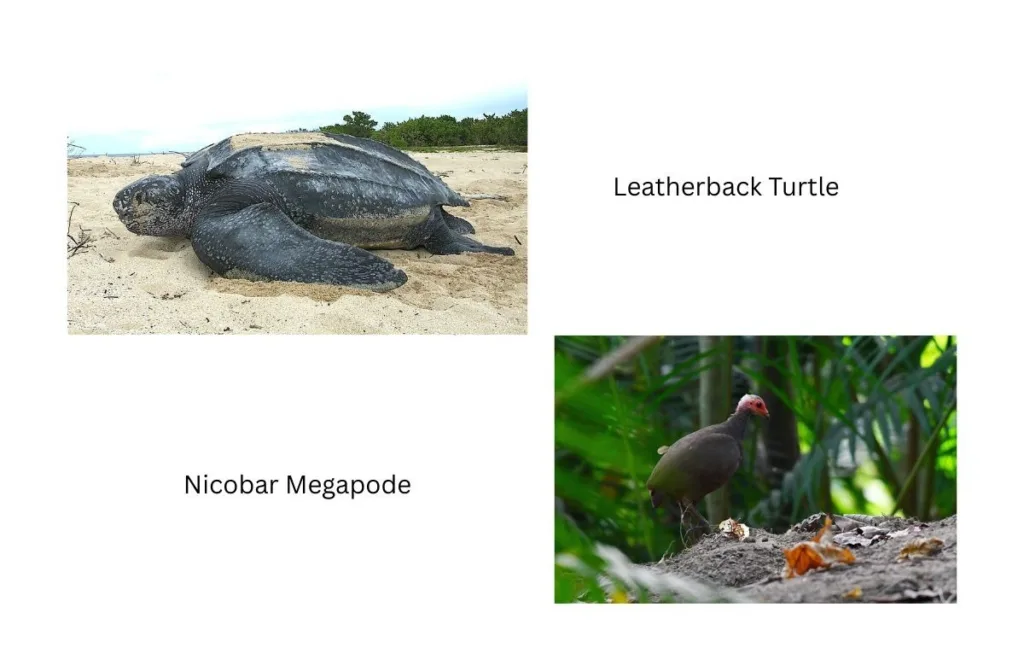
At Galathea Bay, the proposed transhipment port overlaps with one of the world’s most important nesting grounds for the Leatherback sea turtle in the northern Indian Ocean. Dredging, increased ship traffic, and shoreline modifications could disturb nesting beaches and nearby marine habitats. On the other hand, the Nicobar Megapodes nest on the ground and build large mound nests using leaf litter and organic material from the forest floor, which makes them dependent on stable forest conditions and undisturbed coastlines.
Impact on coral reefs
The coral reefs situated on the southern side are an integral part of the marine ecosystem of the island that sustains aquatic life and also acts as a natural protector of the shoreline. Environmental experts have pointed out that the possibility of increased sedimentation in the water due to the dredging work would harm the coral reefs and reduce water clarity.
Tribal reserve lands and questionable consent process
According to the Government, Great Nicobar Island currently has 751.07 sq km officially marked as Tribal Reserve land. Out of the 166.10 sq km proposed for the Great Nicobar project, 84.10 sq km overlaps with Tribal Reserve areas. The government states that after excluding already-settled revenue land, around 73.07 sq km of Tribal Reserve land has been proposed to be denotified for the project.
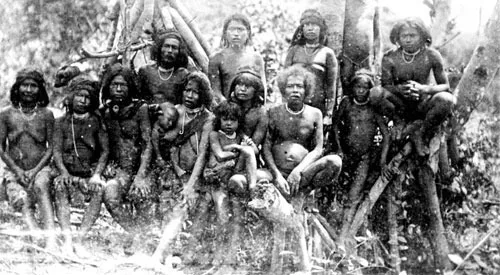
Large parts of Great Nicobar are notified as tribal reserve land. The island is home to the Shompen tribe and the Nicobarese people, both recognised as Particularly Vulnerable Tribal Groups (PVTGs). While the Nicobarese largely live in coastal settlements, the Shompen community is spread across the island’s interior forests with limited contact with the outside world.
The island’s ecology, environment, and indigenous communities are safeguarded by several regulations, including the Scheduled Tribes and Other Traditional Forest Dwellers (Recognition of Forest Rights) Act, 2006 (FRA), and the Forest (Conservation) Act, 1980, along with notifications such as the EIA Notification, 2006, and the CRZ Notification, 2011.
The consent process for the Great Nicobar project reportedly violated the Forest Rights Act (FRA) and failed to properly involve the Shompen tribe and Nicobarese people. According to the report, before clearances were issued for the project, forest rights under the FRA hadnever been formally settled on the tribal reserve land. It further indicates that the authorities showcased resolutions passed by representatives from the Andaman Adim Janjati Vikas Samiti (AAJVS), an autonomous, fully funded society under the Andaman & Nicobar Administration, as evidence of tribal consent, despite objections from tribal councils and legal experts.
Tribal Council members of Little and Great Nicobar alleged that they were pressurised by the Nicobar district administration to give up a portion of their ancestral land and were asked to sign a “surrender certificate”.
It is evident that heavy industrialisation and township settlements on the island under the Great Nicobar Project will have an adverse effect on the island’s overall ecological balance.
“The Great Nicobar project starkly revealed the utmost confidence,fearlessness and speed with which operative laws were disregarded and twisted” says FRA expert C. R. Bijoy. While talking to Off Beat Concerns, he said that all the concerned statutes as the Forest Rights Act, 2006, the Forest Conservation Act, 1980, and the Right to Fair Compensation and Transparency in Land Acquisition, Rehabilitation and Resettlement Act, 2013, were violated. He alleged that statutory bodies constituted in violation of laws had taken decisions based on outright falsehoods. Bijoy further questioned whether the judiciary would hold firm and stand by the laws and brook no violations or whether it would trample the laws under the cover of the project being termed one of national importance.
He further alleged that what is happening in the Great Nicobar is a blatant violation of the rights of the tribals and the Scheduled Castes and Scheduled Tribes (Prevention of Atrocities) Act, as Shompens are the sole legally empowered authority to protect, preserve, regulate and manage this tribal reserve.
One of the greatest environmental concerns regarding the Great Nicobar project involves the transformation of a large section of the island, which is home to vast tropical rainforest ecosystems. Government records reveal that almost 130.75 sq km of forested land has already been approved for diversion and that land constitutes about 14 to 15 per cent of the entire land mass of Great Nicobar Island. While secondary forests can be regenerated, old- growth tropical rainforests are unique to the area and are products of millions of years of evolution that cannot be replicated by any means. It is estimated that as many as 9.64 lakh trees could be cut, although many environmentalists argue that the impact will go beyond just the cutting of trees.
Is a port safe in such a region ?
Great Nicobar lies in one of the most seismically active regions in the Indian Ocean. The island falls close to the Sunda subduction zone (Sumatra-Andaman subduction zone), where tectonic activity has historically triggered major earthquakes and tsunamis across the region.
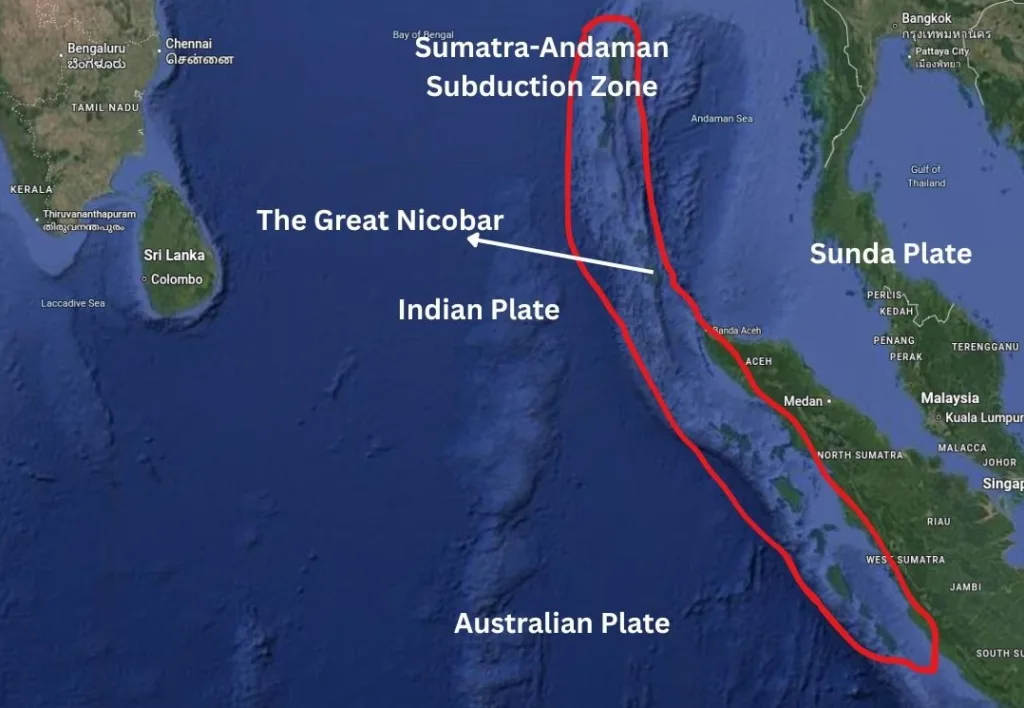
During the 2004 Indian Ocean tsunami, large parts of Great Nicobar witnessed severe coastal destruction and land subsidence. Indira Point, located near the proposed project zone, partially sank after the tsunami reshaped sections of the coastline.
Despite this, the Great Nicobar project places major coastal infrastructure directly along the island’s southern shoreline, including the proposed transhipment port at Galathea Bay.
Environmental researchers and experts have raised concerns over the long-term feasibility of large-scale infrastructure in a region vulnerable to earthquakes, tsunamis and coastal instability. Questions have also been raised over dredging activity, shoreline alteration and the cumulative impact of industrial maritime activity on a fragile coastal ecosystem.
The environmental clearance.
In February 2026, the National Green Tribunal (NGT) upheld the environmental clearance, observing that the project carried economic and strategic significance for the region. The tribunal stated that adequate safeguards and mitigation measures had been incorporated into the approval process. However, the legal and environmental debates surrounding the project continue.
The perceived strategic importance
The Andaman and Nicobar Islands already host the Andaman and Nicobar Command, India’s only integrated tri-service military command. The proposed airport and associated infrastructure are expected to strengthen logistical and surveillance capabilities in the eastern Indian Ocean region, according to the Government. The project is also being viewed in the context of growing Chinese maritime presence across the Indian Ocean and Southeast Asia. Its location places India closer to major sea lanes used for commercial and naval movement in the region.
The private players
The PIB press release on January 27, 2023, points towards private-sector interest and participation in the bidding/EOI stage, especially for the proposed transhipment port at Galathea Bay. The shipping minister stated in the Parliament that the project would involve investment from private players. 11 firms expressed interest, including Adani.However, there is no publicly confirmed final allocation of the project to any other private company so far.
As far as the Government is concerned, the Great Nicobar Project offers advantages in terms of both economic growth and strategic positioning; however, environmental researchers and conservationists are alarmed by the significant ecological disruptions that the project may cause in the lives of tribal communities and the rich flora and fauna of the Island. Additionally, the opposition is actively voicing criticism of the government for ignoring the critical issues raised by the project.

Sujith A
Open Source Intelligence Researcher and Mis/Disinformation tracker. Passionate about investigations and a big fan of Sherlock Holmes.
View all posts by Sujith A