How a Bangladesh Theft Case Was Given a Communal Spin
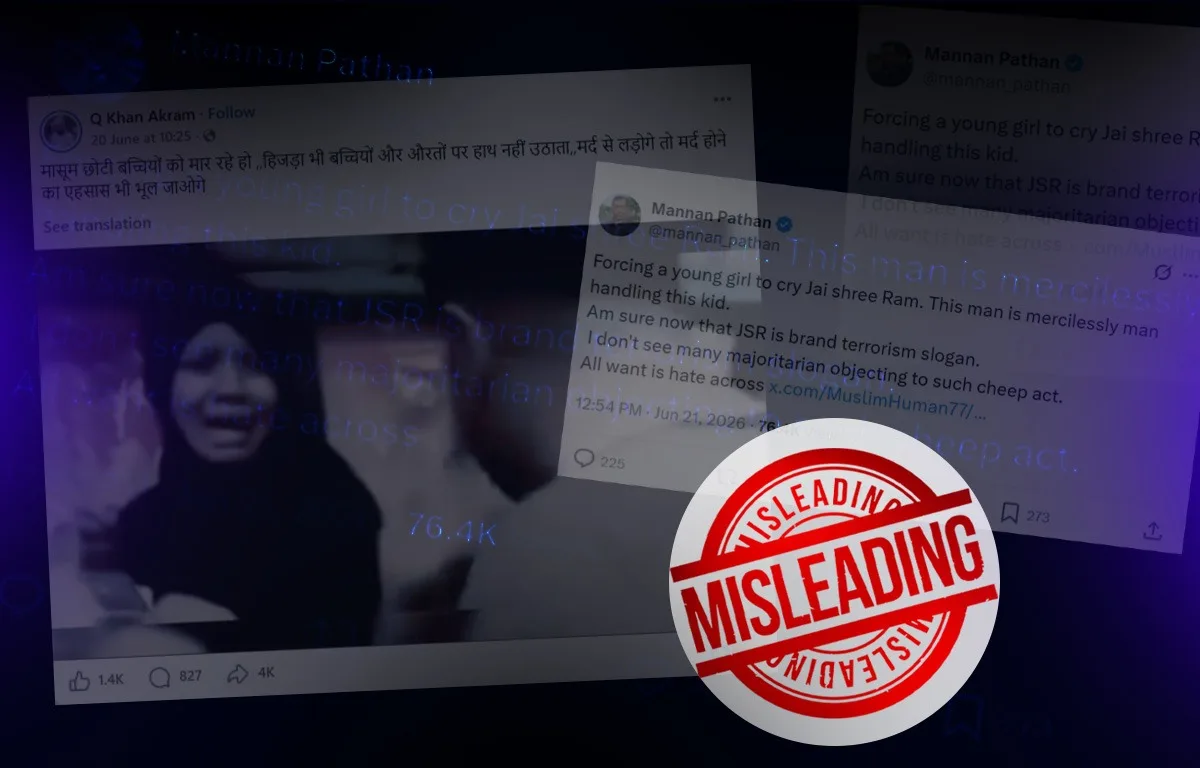
An old video from Dhaka has resurfaced with claims that Hindu men forced a Muslim girl to chant “Jai Shri Ram”. The original footage contains different audio, and evidence confirms the viral claim is misleading.
Communal claims on social media are perpetrated by several groups, irrespective of the religion, caste, or political affiliation they represent. Many times, genuine incidents are cast under a shadow of doubt as a flurry of claims falsely portraying a particular community as either the victim or the perpetrator is spread by people from both within and outside that community.
This time, such a claim is making the rounds on social media with a completely different narrative. As usual, it is spreading rapidly online, with people from different sides responding to it in different ways. Yet, no one seems to have asked the most fundamental question: is the incident actually true?
What does the viral video say?
A 24-second video is being widely shared on social media with claims that it shows Hindu men forcing a Muslim woman to chant “Jai Shri Ram”. The posts do not specify where the alleged incident took place. The video shows a woman wearing a hijab crying as a group of men intimidating and heckling her. In the background, male voices can be heard repeatedly saying, “Bolo Jai Shri Ram” in Bengali.
A Facebook account named Q Khan Akram shared the video on June 20 with a Hindi caption that translates to: “You are killing innocent little girls. Even transgender people do not raise their hands against girls and women. If you fight with a man, you will forget what it means to be a man.”
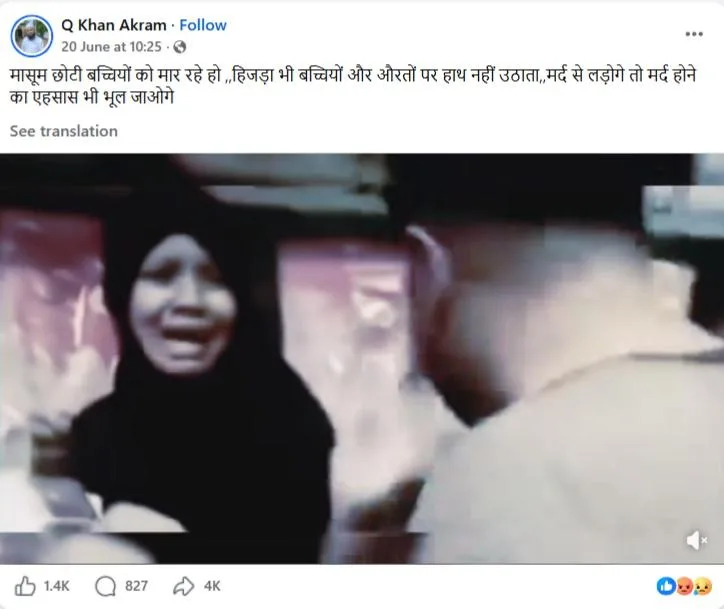
The Facebook profile has around 14,000 followers. As of the time of writing, the post remains active on the platform and has garnered around 1,400 likes and over 4,000 shares.
One user commented, “How much oppression you can do, we will be patient, we will do more than you oppression.” Others say this act is ‘wrong for all Hindus’.
On June 21, 2026, an X user, @mannan_pathan, also shared the video with the caption: “Forcing a young girl to cry Jai Shree Ram. This man is mercilessly manhandling this kid. Am sure now that JSR is brand terrorism slogan. I don’t see many majoritarian objecting to such a cheap act.”
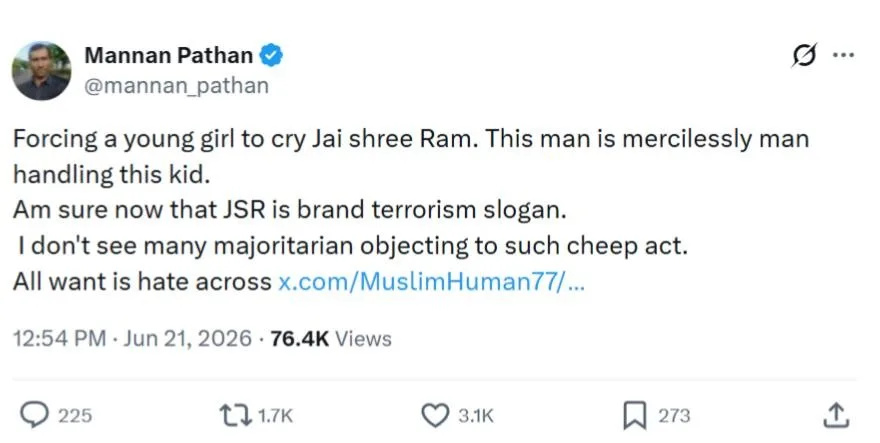
The video he shared was from a user named Nasreen Khan. It has since been taken down. As of June 30,2026 however, the post had garnered around 77,000 views, 3,100 likes, and 1,700 reposts.
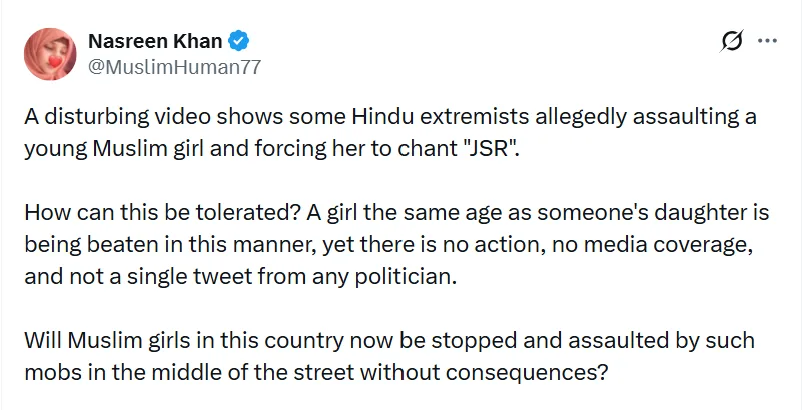
The post also attracted several comments demanding action against the man seen in the video. One user wrote, “Dear PM, if u hv any shame Ensure to Hang this terrorist.” Another commented, “Can someone identify this person and report him for terrorising a small girl?” Several users also tagged Prime Minister Narendra Modi and Union Home Minister Amit Shah, urging them to take strict and immediate action against the alleged perpetrators.
Several other accounts across X and Facebook have also shared the video.
How did we find out?
We performed a reverse image search using keyframes from the video. The search led us to several videos posted by Bangladeshi users on Facebook.
One of the earliest versions of the video we found was shared by Sylhetor News, a media outlet based in Sylhet, Bangladesh, on Facebook on September 16, 2025. According to the caption, a girl named Anika was caught stealing from a shop in Mirpur College Market, Dhaka. The caption states that some locals assaulted her after allegedly catching her red-handed. The girl reportedly admitted to committing the theft on the advice of a relative in an attempt to earn more money.
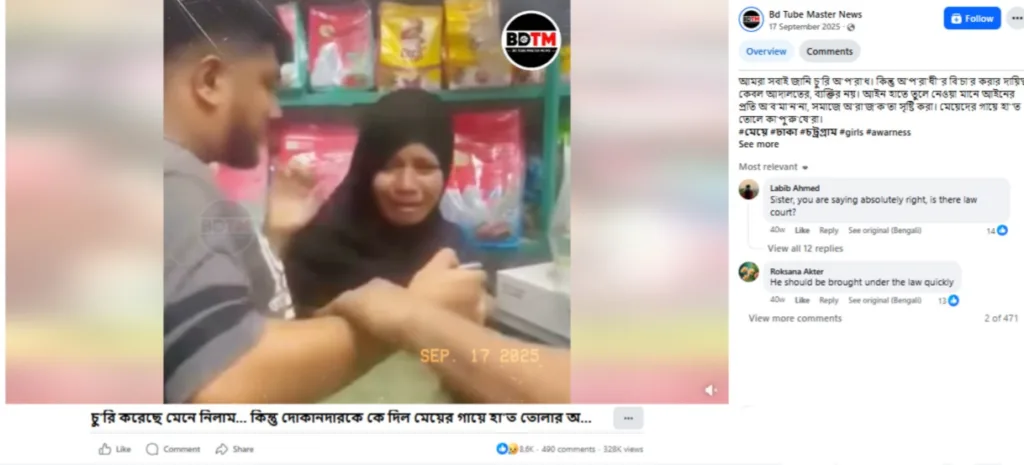
The original footage contains clear audio, which does not match the soundtrack in the viral video being shared with the communal claim. Notably, the phrase “Bolo Jai Shri Ram” is not audible at any point in the full-length video published by these media outlets. This indicates that the audio in the viral clip has been altered or replaced and does not belong to the original footage.
Additionally, the full-length versions of the video contain a shot of someone viewing the shop’s CCTV footage on a mobile phone. At the top of the screen, the name ‘Sohana’s Pet Shop’ is clearly visible. We geolocated the shop to Mirpur, Dhaka.
These pieces of evidence clarify that the incident is neither from India nor is the girl being forced to chant “Jai Shri Ram”. Instead, the viral clip uses altered audio to attach a false communal narrative to an unrelated incident.
False communal claims are spread by a range of actors across the political and ideological spectrum, often to reinforce existing narratives or inflame tensions. Such misinformation can have far-reaching consequences, deepening mistrust and polarisation while distracting from the actual issues shown in the video. In this case, the assault on a young girl—and the circumstances that led to it—has been overshadowed by a fabricated communal claim.
This is another example of how videos involving members of a particular community, regardless of where they originate, are frequently stripped of their original context and repurposed to support misleading narratives in India. What is needed is careful verification of facts and context before sharing such content on social media.