
‘Kill Her, Rape Her’: The Online Hate Campaign Against Judge Tabassum Khan After a Rare Cow Vigilante Verdict
The life imprisonment of 14 men convicted in a 2022 cow vigilante lynching case triggered an unprecedented online backlash, with communal abuse, rape threats and calls for violence directed at the Muslim judge who delivered the verdict.
Rape threats, calls to violence, abuse, and communal slurs. For the past few days, these have become the reality for a sitting judge in India, all because she did what was expected of her: deliver a verdict. But what made this verdict unusual was that it triggered outrage among the right-wing, both online and offline, because it sentenced the cow vigilantes to life imprisonment—a verdict that is exceedingly rare in India.
“Imagine, not one or two, but she, the Muslim judge, used her power to destroy the entire Hindu civilisational ground force of that area, fighting for survival!!! A Muslim remains a Muslim first irrespective of education”, one user wrote on X. Scores of such posts and comments are flooding social media, calling to kill her, rape her, and ‘give justice to the innocents who have been convicted’.
The judge in question is Tabassum Khan, an Additional District and Sessions Judge in Madhya Pradesh, who convicted 14 men for the 2022 lynching of Nazir Ahamed, a Muslim truck driver in the state. Being a Muslim woman, her identity is being viciously targeted by Hindutva right-wing influencers.

Since 2014, cow vigilante killings have become a ‘normal’ occurrence in India. Although hundreds of such incidents have been reported, very few cases have resulted in convictions. OBC had earlier calculated, based on available media reports, that out of the 113 cow vigilante deaths reported in India between 2015 and 2025, only five cases resulted in convictions. That is less than five percent, meaning that the vast majority of the remaining cases are still pending before the courts or the accused have been acquitted of all charges.
Against this backdrop, the fury of the right-wing over this ‘unusual’ verdict has taken violent forms.
“Cow smugglers roam free, while the protectors are being punished”.
One of the most viewed and widely shared videos was posted by Thakur Vishal Singh, who uses the Instagram username @vishalthakur_sanatani. Using expletives throughout the video, he said: “Listen, if our 14 brothers are not released within 14 days, there will be bloodshed across the country. Hindus, look—the ones who slaughter cows, those m**s, are roaming freely, and today one mulli m*d has become a judge and sentenced our 14 brothers to life imprisonment. Imagine what will happen when a mulla becomes the Prime Minister.”
The videos on his account have been taken down.
Another video by the same person, still available on a different Facebook account, openly issues rape threats against the judge. As on July 4, the video has garnered more than 37,000 views on Facebook.
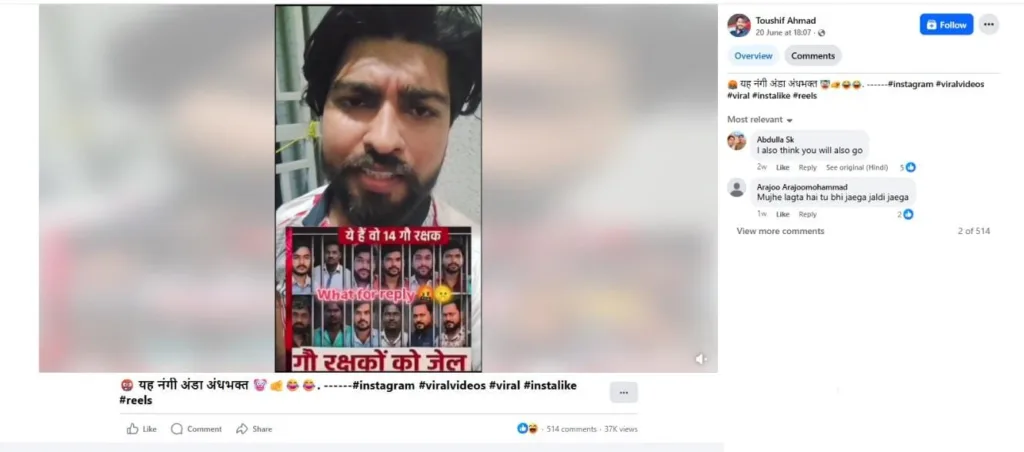
In another video, a woman accuses the judge of showing her “true colours” after sentencing the 14 “Hindu brothers” to life imprisonment. She warns that the judge would have to “face the consequences”.
Many users appeared shocked that the cow vigilantes had been punished, but not the alleged cow smugglers. One user, @Starboy2079, wrote on X on June 20: “The judgement delivered by Judge Tabassum Khan appears to be heavily influenced by religious bias. I urge Hindu organisations to immediately challenge this verdict in the High Court. I also request the Madhya Pradesh government to take suo motu cognisance and remove Judge Tabassum Khan from her position.” He also tagged Madhya Pradesh Chief Minister Mohan Yadav. The image used in the post is not of Judge Tabassum Khan.
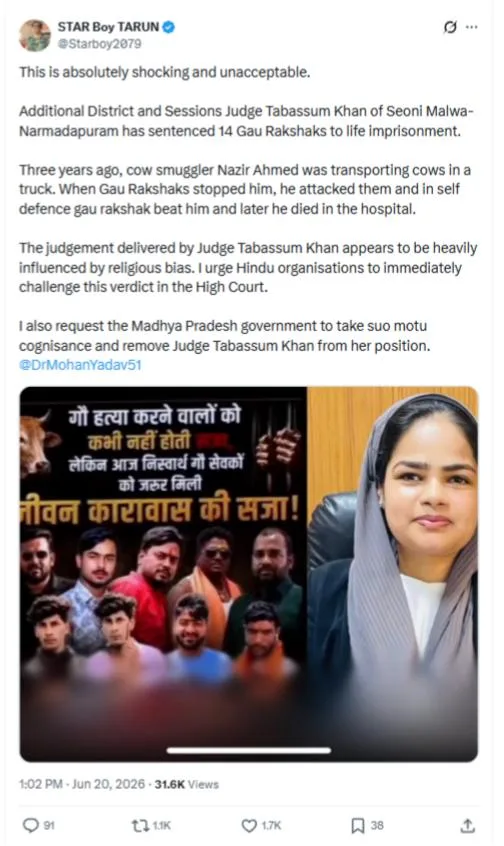
The account has more than 180,000 followers, and as of July 4, the post had amassed over 31,600 views.
One of the comments on the post read, “This judge should be punished. It should serve as a lesson for other judges.” Another user wrote, “If you give Muslims higher posts, they will choose religion over the nation.”
Another user referred to the judge as ‘jihadan’, an offensive communal slur used to target Muslims. “You make a jihadan a judge, then you expect her to give justice to Gau Rakshaks? Are you stupid? She will always stand with her religion. You are paying her to give judgment against the Gau Rakshaks. You are at fault; she is right. You should have known who you were selecting to be a judge. Tomorrow she can let terrorists go free also. Then what will you do?”, the user said.
Weaponising emotion to stoke hate
Another set of posts employs emotional narratives to fuel hatred against the judge’s religious identity. On June 22, a user, @chixxsays, posted a video showing a man hugging and consoling a crying child, with several others standing around them. The caption claims that they are the family members of one of the Gau Rakshaks sentenced to life imprisonment by Judge Tabassum Khan.
“His daughter is saying that we can survive without food, but please don’t keep my father in jail”, he caption reads, before urging the government to remove the judge from office and ‘release all 14 Gau Rakshaks’. The video has garnered more than 54,000 views and 3,700 likes.
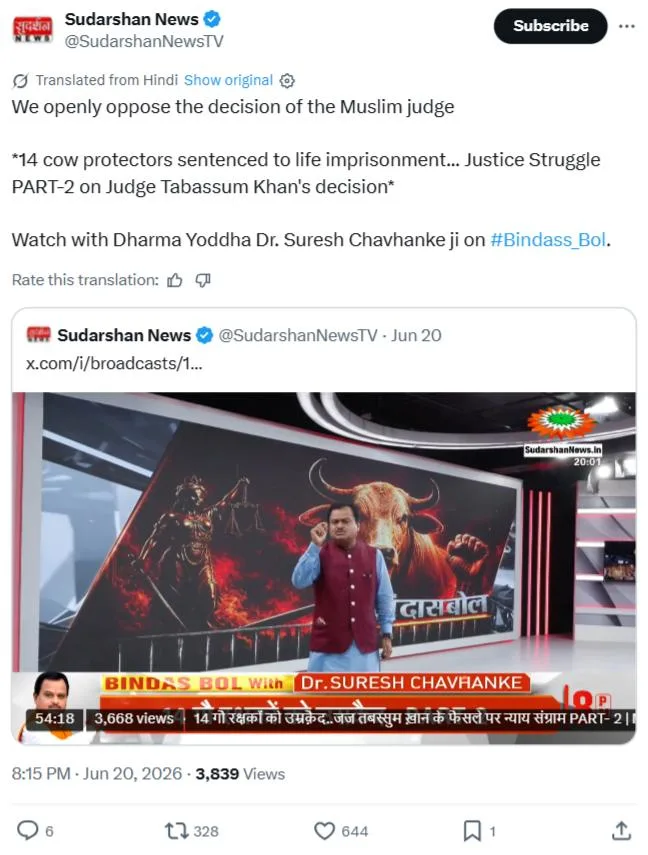
Right-wing channel Sudarshan News TV and its editor-in-chief, Suresh Chavhanke, also expressed solidarity with the convicted men. In a broadcast, Chavhanke urged viewers to ‘speak up’, warning that “your family members who risk their lives to save Gau Mata could also be imprisoned for life”.
The channel’s official X handle also posted, “We openly oppose the decision of the Muslim judge”.
Scholars of emotion in criminal justice such as Susan Bandes highlight how empathy is frequently selectively directed and can be politically manipulated within the legal system and broader public discourse. By focusing exclusively on the emotional stories of the families of the convicted cow vigilantes, the narrative selectively directs empathy away from the actual victims of the vigilante violence and towards the perpetrators’ families. When these stories are used to spew hatred towards the judge, they are being politically manipulated to undermine the legitimacy of the legal process.
The ‘double burden’ of being a Muslim woman
Scholars and media researchers frame this as a ‘double burden’, where the online attacks do not merely claim that “the judge is wrong”; they invoke her religion to communally delegitimise her and her womanhood to subject her to misogynistic contempt, questioning her authority on both grounds.
Studies describe this as the operation of ‘multi-layered systems of discrimination’, where patriarchy and Islamophobia intersect to shape the lived realities of Muslim women. Although courts have faced increasing harassment on social media over the past few years, this double burden makes Tabassum Khan an ‘easy target’ for the perpetrators.
Supreme Court Bar Association Condemns
The Supreme Court Bar Association (SCBA) strongly condemned the threats, intimidation and social media campaign targeting Judge Tabassum Khan. In a statement issued on July 3, the SCBA expressed solidarity with the judicial officer and called upon the Madhya Pradesh High Court and the State Government to ensure prompt action against those responsible for threatening the judge and inciting hatred against her.
The Seoni Malwa police have since registered an FIR against unidentified persons over the communal campaign targeting the judge, invoking Sections 196 and 302 of the Bharatiya Nyaya Sanhita.The FIR relates to social media posts that allegedly promoted communal hatred and threatened public order in the aftermath of the judgment. The Cyber Cell under the Ministry of Home Affairs has also issued notices under the Information Technology Act.
A Division Bench of the Madhya Pradesh High Court described the threats as “a direct attack on the justice delivery system”. The Bench observed that a judicial officer cannot be threatened merely because a section of society disagrees with a court verdict. The court has also sought a detailed report on the action taken against those responsible for issuing the threats. The matter is scheduled to be heard on July 9.