

Who Will Power India’s AI Boom?
Behind every chatbot response and AI-generated image lies an enormous demand for electricity. This report examines how India’s data centre expansion could reshape the country’s power system.
India’s ambition to become a global AI and cloud computing hub is driving unprecedented investment in hyperscale data centres. Companies including AirTrunk, AdaniConneX and Reliance have announced plans worth billions of dollars as the country positions itself as a major destination for artificial intelligence infrastructure.
However, behind every AI query, cloud service and large language model rests an enormous demand for electricity. As India expands its digital infrastructure, questions are increasingly being raised about whether the country’s power system can keep pace with this rapid growth.
This report analyses the proposed investments, the electricity demand associated with hyperscale data centres, and the effects of similar developments on electric grids in other parts of the world.
While AirTrunk has proposed developing 5 GW of data centre capacity in India, the figure does not refer to electricity generation. Instead, it represents the electrical power the facilities are designed to draw at full capacity.
Unlike power plants, which generate electricity, data centres are large consumers of electricity. The power drawn from the grid is used to operate servers, graphics processing units (GPUs), networking equipment, storage infrastructure, cooling systems, lighting, security systems, and other supporting facilities that keep the data centre operational around the clock.
Data centre capacity is therefore measured in megawatts (MW) or gigawatts (GW), indicating the maximum electrical load that the facility can support. AirTrunk’s proposed 5 GW project is equivalent to an installed electrical load of 5,000 MW.
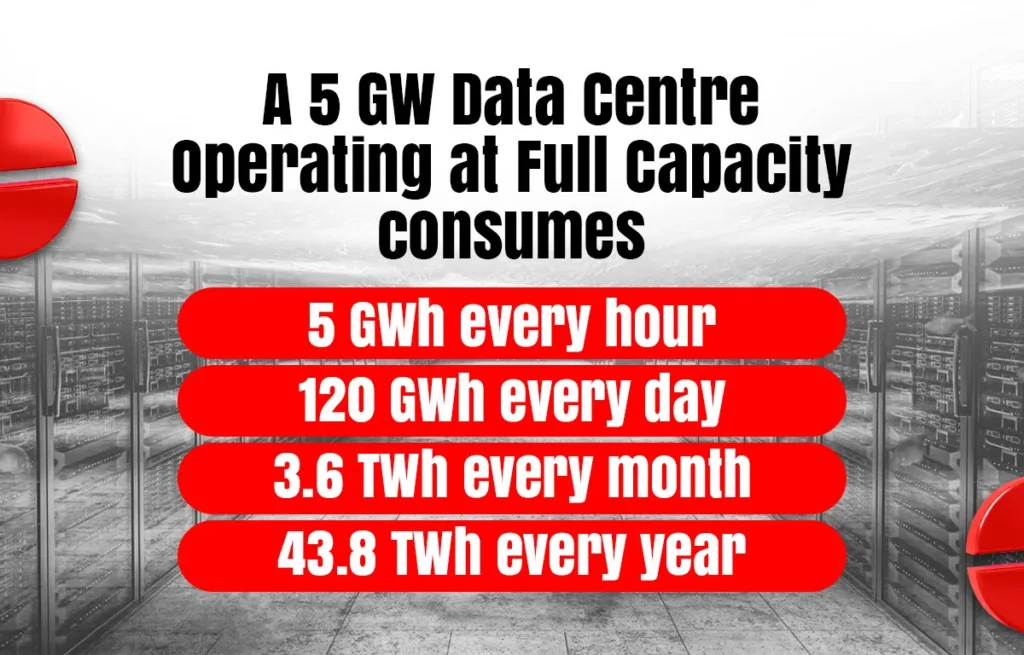
At full capacity, such a facility would consume 5 gigawatt-hours (GWh) of electricity per hour.
How much electricity would a 5 GW data centre actually consume?
To guarantee uninterrupted digital services, the data centre operates around the clock, and power consumption is typically measured in gigawatt-hours (GWh) or terawatt-hours (TWh).
Considering AirTrunk’s proposed 5 GW of data centre capacity, a facility operating continuously at full capacity would consume approximately 5 GWh per hour, 120 GWh per day, 3.6 TWh per month, and 43.8 TWh per year.
According to the International Energy Agency’s (IEA) 2025 report, Energy and AI, global data centre electricity consumption is projected to more than double from around 415 TWh in 2024 to approximately 945 TWh by 2030. The report attributes much of this expansion to the increasing deployment of AI workloads, noting that electricity consumption from AI-accelerated servers is expected to grow at around 30 per cent annually, significantly faster than that of conventional servers. Cooling systems and other supporting infrastructure are also projected to account for a large share of the increase in electricity demand.
The IEA further notes that although data centres are expected to account for less than three per cent of global electricity consumption by 2030, their impact is often concentrated within specific regions.
Lessons from global data centre expansion
Ireland offers one of the clearest examples of how fast data centre expansion can reshape a country’s electricity system.
According to a Le Monde report dated April 17, Ireland’s electricity transmission operator, EirGrid, reported repeated ‘orange alerts’ warning of differences between electricity supply and demand in 2021, prompting authorities to temporarily bring gas- and oil-fired power plants back into operation to maintain grid stability. EirGrid and ESB Networks have since announced infrastructure investments of nearly €19 billion over five years to strengthen the national electricity network. In Dublin, where data centres account for roughly half of the city’s electricity consumption, a moratorium on new grid connections for data centres was introduced in 2021 before being partially lifted under revised conditions in late 2025.
Similar concerns have emerged in the United States. Northern Virginia, widely regarded as the world’s largest data centre market, has experienced sustained growth in electricity demand as hyperscale facilities continue to expand. On June 30, PJM Interconnection, the operator of the largest electricity grid in the United States, voted to implement new measures to manage rising electricity demand from data centres, after warning that the rapid expansion of AI-related data centres could affect the balance between supply and demand across the network serving around 65 million people.
According to an Al Jazeera report published on July 3, PJM Interconnection requested that data centres switch to backup generators during emergency conditions to free up electricity for residential and commercial consumers. The report notes that data centres currently account for around 4 per cent of electricity demand in the United States, a figure projected to increase to 9 per cent by 2030.
Rising electricity costs in the United States
A February 2026 report published by the Environmental and Energy Study Institute (EESI) highlights that utilities across the country received interconnection requests from data centre developers amounting to more than 700 GW in 2025, exceeding the country’s average electricity demand in 2023. Although not all proposed projects are expected to be constructed, the report indicates that utilities are already investing in new generation capacity, transmission lines and substations to accommodate anticipated demand.
According to the report, these infrastructure investments are increasingly being reflected in electricity tariffs. It also notes that average residential electricity prices in the United States increased from around 13 cents per kilowatt-hour before 2019 to 19 cents by the end of 2025. However, Industry representatives suggest that data centres play a major role in investment, employment and tax revenues and should not be viewed as the sole driver of rising electricity prices.
Can India’s electricity system keep pace?
According to the Ministry of Power, India had an installed electricity generation capacity of 520.51 GW as of January 2026 and has largely eliminated the gap between electricity demand and supply. However, recognising that electricity demand is expected to continue rising, the National Electricity Plan projects that installed generation capacity will increase to 874 GW by 2031–32. Alongside large-scale renewable energy expansion, the government has also planned additional thermal generation, energy storage systems and transmission infrastructure to meet future demand, indicating that substantial investment in the power sector will be required over the coming decade.
In May 2026, peak electricity demand reached an all-time high of 270.73 GW, surpassing previous records, as prolonged heatwaves increased cooling requirements across large parts of the country. Despite rapid growth in renewable energy capacity, coal continued to account for more than 70 per cent of electricity generation, underscoring ongoing dependence on conventional power sources throughout peak demand.
Therefore, the rapid expansion of artificial intelligence and hyperscale data centres is expected to add another source of continuous electricity demand to India’s power system.
Many global data centre operators, including AirTrunk, have committed to increasing the use of renewable electricity to power their facilities. However, renewable sources such as solar and wind are intermittent and cannot generate electricity continuously throughout the day.
Experiences from countries such as Ireland and the United States suggest that the rapid growth of data centres can place significant pressure on electricity systems, entailing substantial investment in generation capacity, transmission networks and grid robustness. While India has considerably expanded its power sector over the past decade and continues to plan for future demand, artificial intelligence is creating a new category of continuous, high-density electricity consumption that differs from that of many traditional industries. Therefore, a steady, reliable and sustainable supply of electricity to power India’s digital ambitions will remain one of the key challenges confronting policymakers.

Sujith A
Open Source Intelligence Researcher and Mis/Disinformation tracker. Passionate about investigations and a big fan of Sherlock Holmes.
View all posts by Sujith A