13 Years in Court: A Journalist’s Fight for Justice
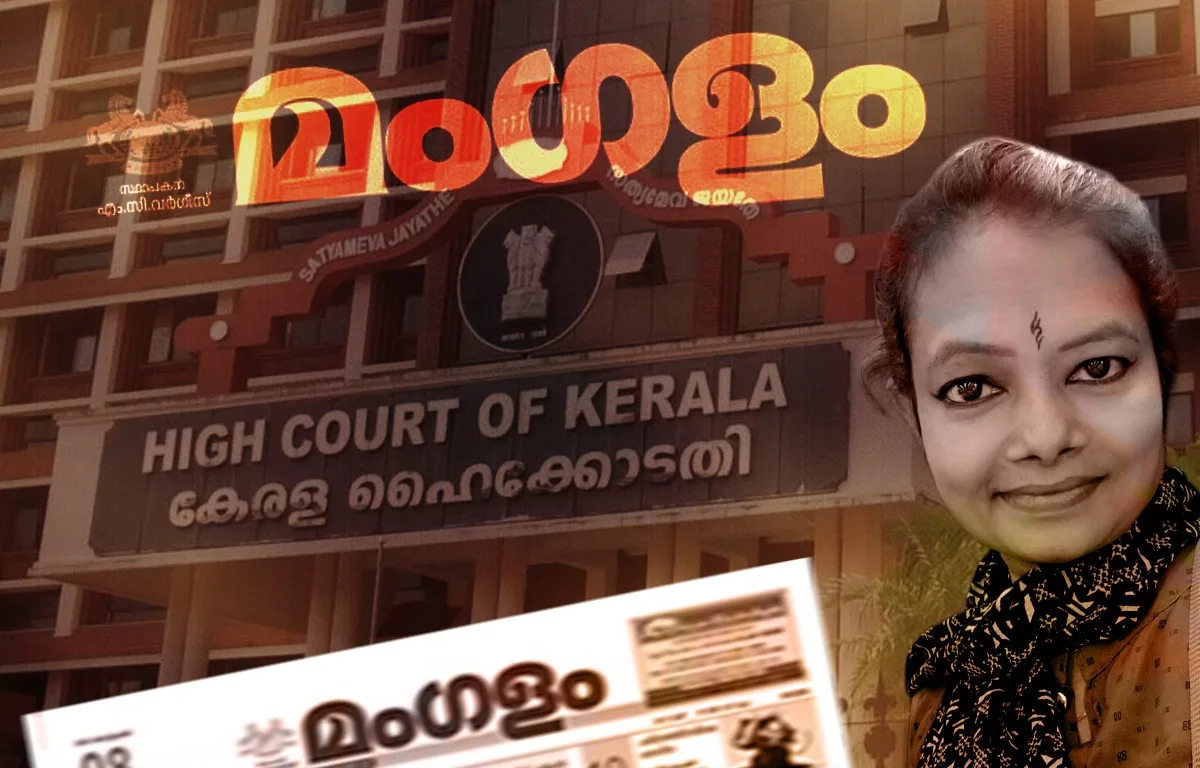
After being sacked by a newspaper, Swapna P.G. has spent 13 years fighting for her rights. The Kerala High Court has ruled her dismissal unlawful, but her battle for justice and unpaid wages continues. Her story exposes the price journalists pay for challenging their own management.
In January 2007, 28-year-old Swapna P.G. took leave from her workplace to visit the Employees’ State Insurance (ESI) office. She was eight months pregnant, with swollen feet and exhausted. She needed to apply for maternity leave.
When she handed over her documents, the officer behind the desk looked at her in disbelief: “You work at Mangalam? They don’t pay anything here. They haven’t deposited ESI in years.” This comment shocked Swapna. She left the office not just empty-handed but with an inescapable truth: at the media house where she worked, the people in charge simply did not care.
For 13 years, Swapna has been fighting a legal battle against Mangalam, one of Kerala’s prominent Malayalam-language dailies. She has spent over a decade working on the editorial desk. It has been a legal battle across three cases: chasing unpaid wage revisions, challenging her transfer at the Industrial Tribunal, and taking her fight against unlawful termination to the Kerala High Court.
A transfer out of nowhere
Swapna had worked as a sub-editor with newspaper publisher Mangalam Publications since October 2000. For over a decade, she worked at a bureau in Kottayam.
In 2013, Mangalam abruptly transferred her to Kannur as part of a general transfer order. Swapna alleges the move was an ‘act of victimisation’ instead of a routine transfer. When Swapna tried to connect with her new colleagues in Kannur, they asked, “Why did you come here? The place is inhospitable; we only sleep in the office.” She was also the only woman included in the transfer order. A few months later, the bureau closed, which Swapna alleges made the reasons for her transfer even more questionable.
At that time, Swapna was managing her busy job while also caring for her 6-year-old daughter. Her husband worked in Thrissur, so she was raising their child on her own, handling both her newsroom work and home responsibilities. The sudden transfer made things even harder, as she had to think about her job and her daughter’s well-being in a new town with very few facilities. She refused to go to Kannur. Instead, she took her grievance to the District Labour Officer in Kottayam and sought formal conciliation.
The management responded with internal disciplinary action, citing her refusal to join the Kannur bureau as the primary reason. On 19 February 2015, Mangalam dismissed her from service. This marked the abrupt end of her career in a newsroom and also the beginning of her long fight in court.
The legal road
Following the dismissal, Mangalam Publications turned to the Labour Court in Ernakulam to seek post-facto approval under Section 33(2)(b) of the 1947 Industrial Disputes Act. The company chose this method because three separate, unrelated claim petitions (CP Nos. 29 of 2013, 10 of 2014, and 30 of 2014) were already pending before that court. The Labour Court subsequently approved.
Under Section 33(2)(b) of the Industrial Disputes Act, 1947, “post-facto approval” refers to an approval that an employer applies for after they have already passed and executed an order of dismissal against an employee.
The unrelated claim petitions mentioned in the case were separate monetary disputes between management and workers, pending before the Labour Court at Ernakulam. Though unrelated to Swapna’s transfer from Kottayam to Kannur or her alleged failure to report for duty, these petitions were still active at the time of her dismissal, which required the management to file an application under Section 33(2)(b) seeking the Labour Court’s approval specifically because of the existence of those unrelated cases. However, the judicial officer of the Labour Court said this skipped an essential legal safeguard for workers and gave an award in favour of the management approving her dismissal.
Under Section 33(1)(b) of the Act, if an employer intends to dismiss a worker for misconduct connected with an active dispute, it must first secure express prior written permission from the specific authority dealing with that dispute.
She challenged the decision in the High Court in 2024, arguing that management had unlawfully bypassed the mandatory prior clearance for her dispute.
On September 2, 2026, the single bench of the Kerala High Court ruled in favour of Swapna P.G., declaring her dismissal by Mangalam Publications India (P) Ltd. unlawful under the Industrial Disputes Act, 1947. This was because the employer failed to obtain the required prior written permission from the Conciliation Officer. At the same time, the conciliation process was ongoing under Section 33(1)(b) of the Industrial Disputes Act, 1947. Kerala High Court Judge Justice Gopinath P. found that conciliation was still active at the time of her termination and rejected the publisher’s claim that it had ended earlier. The court observed that if any proceedings concerning Swapna’s transfer dispute were pending before the Conciliation Officer, Labour Court or Tribunal, prior permission under Section 33(1)(b) of the Industrial Disputes Act, 1947, was mandatory.
Victory did not come easily for Swapna. She lived in a village 17 km away from Kottayam town, and every month, attending a hearing meant travelling 82km to the High Court in Ernakulam. Each hearing was a fight for her dignity and justice. The long, strenuous journeys and the uncertainty wore her down, but she did not give up. After two years of legal battle, the judgment finally came in her favour.
‘Conciliation talks collapsed’, says the management
To defend its decision to dismiss Swapna, the management argued that conciliation talks had collapsed on 3 February 2015, two weeks before the dismissal order was signed. The management contended that the officer was effectively functus officio (having discharged their official duty), meaning no conciliation proceedings remained legally pending when Swapna was dismissed on 19 February.
The Kerala High Court dismissed that position, citing the Supreme Court judgment in Lokmat Newspapers Pvt. Ltd. v. Shankarprasad (1999). Justice Gopinath cited the apex court’s ruling regarding the legal standard set by Section 20(2)(b) of the Act:
“…when during conciliation proceedings no settlement is arrived at between the parties, the conciliation proceedings shall be deemed to have concluded when the failure report of the Conciliation Officer is received by the appropriate Government.”
Justice Gopinath observed that an issue cannot be treated as closed simply because an officer’s inquiry has concluded.
The court also considered Punjab Beverages Pvt. Ltd. v. Suresh Chand (1978), with Justice Gopinath citing the Supreme Court’s guidance on the scope of an inquiry under Section 33-A:
“…mere contravention of Section 33 by the employer will not entitle the workman to an order of reinstatement, because inquiry under Section 33-A is not confined only to the determination of the question as to whether the employer has contravened Section 33, but even if such contravention is proved, the Tribunal has to go further and deal also with the merits of the order of discharge or dismissal.”
Kerala High Court ruled that the requirements of Section 33(1)(b) and Section 33(2)(b) were entirely different and could not be interchanged.
Closing the case, he ordered:
“…this writ petition can be disposed of clarifying that the order of the Labour Court shall not be treated in any manner as compliance with the provisions of Section 33(1)(b) of the 1947 Act and it will be open to the petitioner to initiate any proceedings that she may be advised to initiate on the basis that there has not been compliance with the provisions of Section 33(1)(b) of the 1947 Act.”
The tangled web of cases
Swapna clarified that she has three ongoing cases. Two of these are before the High Court, seeking recovery of wage arrears due under the Manisana and Majithia Wage Board recommendations. The third is a case regarding her transfer, which is ongoing before the Industrial Tribunal, whose sittings are held in Kottayam.
Alleging that the legal system is unfair to employees, Swapna said: ‘In India’s courts, the process itself becomes the punishment. Big corporate legal teams can easily afford to drag a case out for years, but for an ordinary worker, it just drains them financially.’
In many key hearings, management representatives often failed to show up. Even an appeal to the Women’s Commission led to further delays.
While the Kerala High Court ultimately cancelled the order of her unlawful dismissal, her fight for unpaid wages drags on amid endless appeals and unresolved claims.
The isolation of the newsroom
“In the newsroom, people want to survive,” Swapna says quietly. Some former colleagues offered hushed sympathy over late-night phone calls, checking in when no one was watching. But on the record, she found herself walking an isolated path.
Another female colleague, Manju Joseph, a sub-editor, faced a similar pattern of obstruction and delay. After Mangalam dismissed her, she challenged the dismissal before a labour tribunal. When Manju attempted to access her statutory Provident Fund, state authorities dispatched the mandatory Form 19 to her at Mangalam for attestation. Management returned it unsigned, claiming it could not verify her service history while her labour court case was still pending. This deliberate withholding of statutory entitlements highlights a management culture that routinely frustrates workers’ rights.
Swapna’s ordeal was not an isolated incident; it reflects a broader systemic flaw in how management handles statutory labour protections.
Union backing was scarce during the initial, crucial years, says Swapna. Early representations to the Kerala Union of Working Journalists (KUWJ) met with reluctance, with officials citing an unwillingness to intervene against company management. However, she added that the current KUWJ leadership is very supportive. Through most of it, her main support was her home: her husband and parents, who stood by her through years of precarious finances and emotional strain.
Because of the litigation, Swapna’s journalism career came to a standstill. She never took up another full-time media role, instead surviving on occasional freelance work, piece-rate writing, and sheer resolve.
The long arms of the law
Indian newspaper management has frequently used prolonged litigation to wear down employees pursuing wage and welfare claims. In 2014, the Supreme Court ordered publishers to pay higher wages under the Majithia Wage Board, but many did not comply. When employees filed contempt petitions, the court declined to intervene in 2017 and instead told workers to pursue a slower recovery process. In 2020, when journalists’ unions challenged layoffs and pay cuts during the pandemic, the Supreme Court encouraged settlements, leaving many complaints unresolved.
In Indrakumar Jain v. Dainik Bhaskar (Bombay High Court, February 2024), the court held that working journalists could not file unfair labour practice complaints before Maharashtra’s labour courts because they are not included in the definition of ‘employee’ under the concerned statute. In Lenin Kumar Ray v. Express Publications (Madurai) Ltd (Supreme Court, October 2024), the court ruled that a Junior Engineer at the New Indian Express, dismissed after six years of his appointment, was not a ‘workman’ under the definition of the statute and was not entitled to reinstatement or compensation.
The one recent win came in the Kerala High Court’s January 2025 ruling in the Deshabhimani case brought by sub-editor K.S. Hariharan.
K.S. Hariharan, who served as a Chief Sub-Editor at Deshabhimani Daily, was dismissed on October 29, 2008, after a disciplinary inquiry. Instead of receiving a formal termination letter, he learned of his dismissal the following day in a newspaper announcement. The Kollam Labour Court rejected Hariharan’s plea as time-barred. He challenged this decision before the High Court.
In K.S. Hariharan vs The Labour Court, the Kerala High Court addressed the question of whether a newspaper announcement of an employee’s dismissal constitutes a valid legal notice to commence the three-year limitation period under Section 2-A(3) of the Industrial Disputes Act, 1947. Justice K. Babu held that a short news report or an unverified certificate of posting does not constitute proper service of a disciplinary order. Because the employer did not officially send the dismissal letter until years later, the employee filed the industrial dispute during conciliation within the allowed time. The High Court set aside the Labour Court’s dismissal and sent the case back for a new hearing.
Refusing to look away
Thirteen years later, Swapna has yet to return to her full-time newsroom position. Her wage claims remain unresolved, and her cases are still pending in court. Despite these setbacks, she continues to pursue justice in an industry that has offered little support.
“Walking away would have meant conceding defeat to a system that believes it can mistreat workers, especially women, without consequence,” Swapna says. “There are laws in place to protect women’s rights and uphold labour dignity in this country; if we don’t demand that institutions honour them, who will?”
Swapna’s legal battle deserves attention because in the Indian context, it is unusual for a journalist to challenge their own management in court rather than quietly accept dismissal or resign and move on. In an industry where jobs are precarious and professional networks matter, journalists often choose silence, fearing that a public dispute with a former employer could jeopardise future employment. Many leave without challenging the circumstances of their exit, keeping the details confidential to protect their careers.
By taking the legal route, Swapna has brought an often-hidden aspect of newsroom culture into the open: the power imbalance between media management and journalists, and the professional risks involved in demanding accountability. Her case is not just about an individual employment dispute; it also raises questions about labour rights, workplace power and the price journalists may pay for standing up for themselves.
More than ten years later, she finds herself in the same place, holding on to the law, which has offered her some measure of victory. The Kerala High Court’s ruling in her favour was a significant milestone, but the fight is far from over.