Unlocking Your Phone: The Cellebrite Trail
Locked phones, powerful extraction tools and mounting privacy concerns. Government procurement records reveal how India’s law enforcement and investigative agencies are acquiring technology to extract data from mobile phones. With documented cases of misuse worldwide, a crucial question emerges: who holds these agencies accountable, and what safeguards protect citizens’ digital privacy?
On 2 November 2026, speaking on comedian Kunal Kamra’s podcast, YouTuber Dhruv Rathee said he suspected that the Delhi police had attempted to extract data from his iPhone using Cellebrite after detaining him in October 2026.
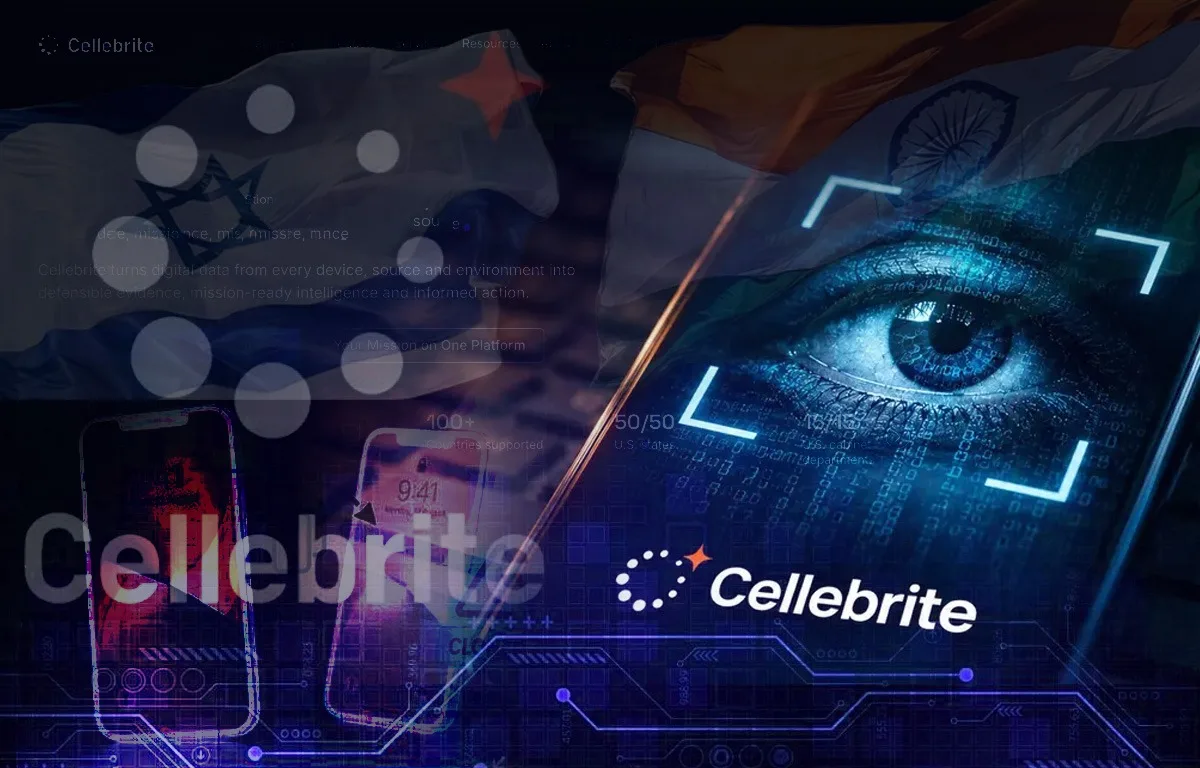
Cellebrite, a digital intelligence company founded in 1999 and headquartered in Petah Tikva, Israel, develops tools that law enforcement and investigative agencies use to access and examine data stored on mobile devices. Its products include forensic extraction systems that can retrieve information from supported devices, including certain locked phones.
The government procurement records reveal that several Indian agencies have sought or acquired Cellebrite products. These include the National Investigation Agency (NIA), the Serious Fraud Investigation Office (SFIO), Kerala’s Home Department and Karnataka State Police. The reported purchases raise questions about the growing use of commercial mobile forensic technology by Indian law enforcement agencies and the safeguards governing access to citizens’ personal data.
Cellebrite’s growing footprint in India
An investigation by the Internet Freedom Foundation (IFF), published by The Wire on 8 November 2026, identified 15 procurement listings involving Cellebrite products across 11 government tenders published in India during 2026.
The procurement records indicate that the use of Cellebrite technology is extending across multiple government agencies in India.
The agencies named in the records include the National Investigation Agency (NIA), the Serious Fraud Investigation Office (SFIO), the Department of Military Affairs, and the police and forensic departments of Kerala, Karnataka, and Himachal Pradesh. Of these listings, three had been awarded contracts as of 6 November 2026.
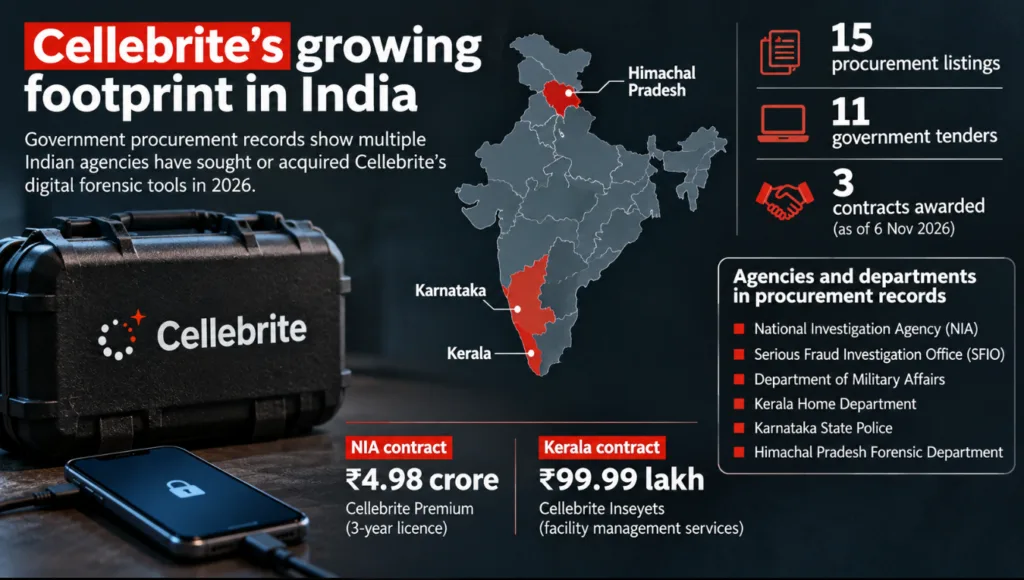
The image shows the Government of India’s procurement details for Cellebrite.
NIA was granted an exemption from the government’s Make in India procurement preference to purchase Cellebrite Premium with a three-year licence. The approval was recorded in a Ministry of Home Affairs letter dated 20 January 2026, following approval by Union Home Minister Amit Shah. The contract was subsequently awarded to Nextechno Gen Pvt Ltd for ₹4,97,99,515.
The SFIO, which functions under the Ministry of Corporate Affairs, also awarded a contract involving Cellebrite’s Digital Collector and Inspector products. The contract, awarded to TNS Networking Solutions Pvt Ltd in March 2026, was worth ₹21,98,350, of which ₹11,99,780 was allocated to Cellebrite products.
A tender issued on 16 July 2026 also listed Kerala’s Home Department and sought facility management services involving Cellebrite Inseyets mobile extraction capabilities. The contract, worth ₹99,99,910, was awarded to Alibi Global Pvt Ltd.
Karnataka State Police and Himachal Pradesh’s forensic departments have also issued tenders involving Cellebrite products, including mobile forensic acquisition tools, licence renewals and extraction services.
What can Cellebrite do?
A smartphone protected by a passcode or encryption can present challenges for investigators seeking access to its contents. Cellebrite’s Universal Forensic Extraction Device (UFED) is designed to help investigators extract data from supported mobile devices using different acquisition methods.
These include logical extraction, which retrieves accessible information such as contacts, messages, call logs and photographs; file-system extraction, which can access a wider range of files and system data; and physical extraction, which attempts to acquire a bit-by-bit image of a device’s memory where supported.
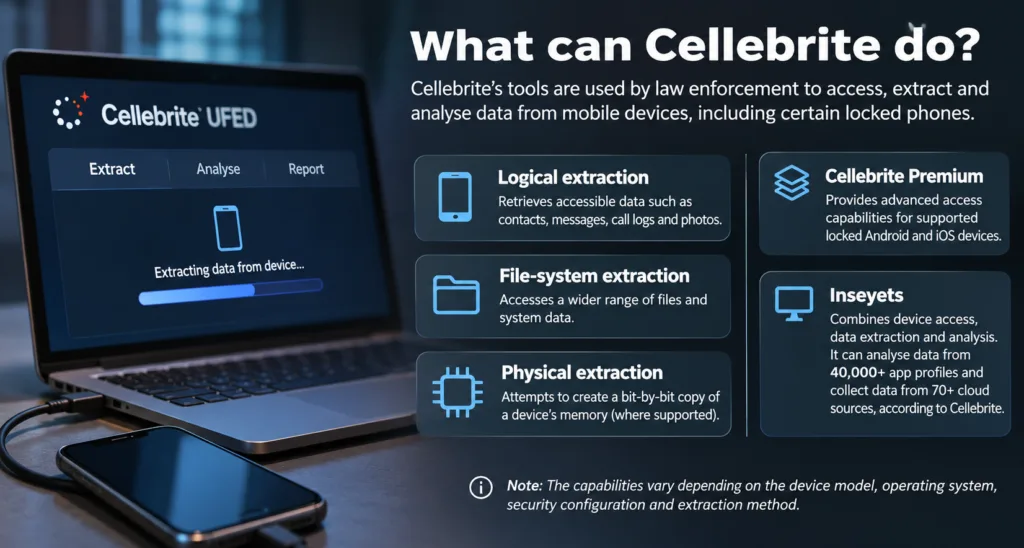
The image shows Cellebrite’s capabilities.
The premium access in Cellebrite provides advanced access capabilities for supported locked Android and iOS devices. Its Inseyets suite combines device access and extraction tools with software for decoding and analysing the collected information.
According to the company, Inseyets can analyse data from more than 40,000 application profiles and supports cloud data collection from over 70 sources.
The capabilities, however, vary depending on the device model, operating system, security configuration and extraction method.
Recorded instances of Cellebrite misuse around the world
Investigations by human rights organisations and digital security researchers have documented instances in which Cellebrite’s forensic extraction tools were used to access the phones of journalists, activists and political opponents. In several cases, the devices were examined while their owners were in police custody.
Serbia
According to Amnesty International’s report published on 16 December 2024, Serbian police and intelligence authorities had used Cellebrite tools to extract information from the phones of journalists and activists. One case involved independent journalist Slaviša Milanov, whose phone was examined after he was taken to a police station.
Amnesty’s forensic analysis identified traces of Cellebrite use and the installation of NoviSpy, a previously undocumented Android spyware. The investigation found evidence that Cellebrite’s tools had been used to facilitate spyware infections in at least two cases.
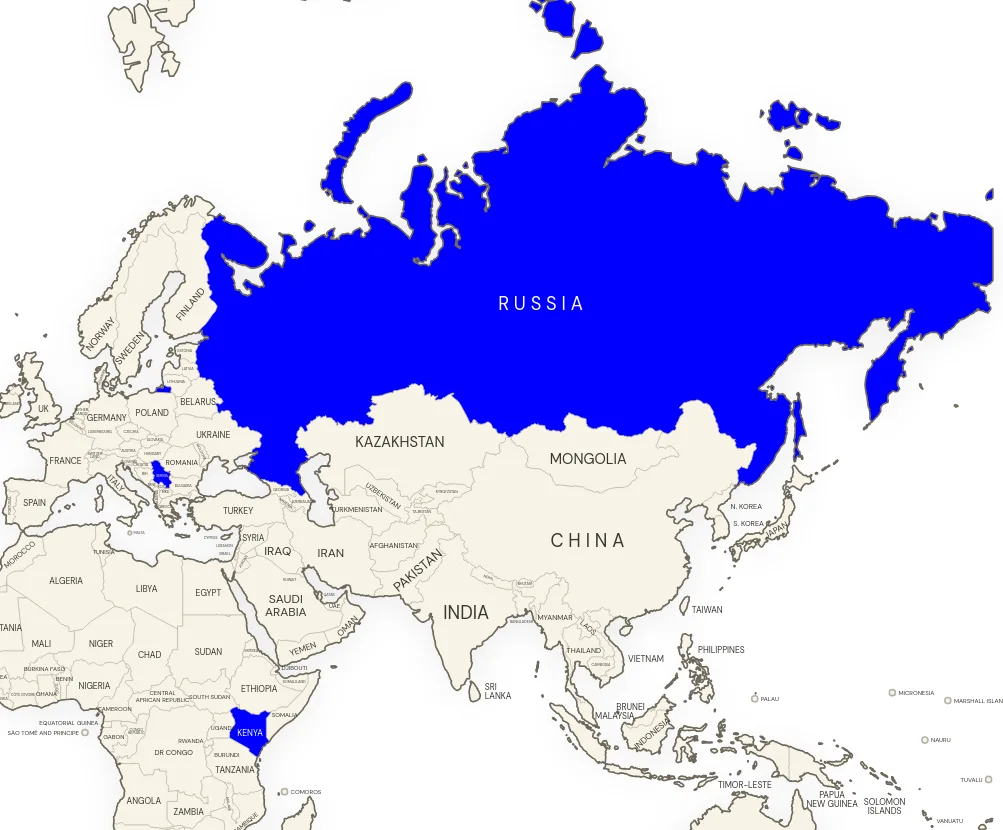
The image highlights countries with recorded incidents of Cellebrite misuse.
Kenya
In February 2026, Citizen Lab documented a similar case in Kenya. According to the report, Citizen Lab found evidence that Cellebrite’s forensic extraction tools had been used on the phone of activist and opposition politician Boniface Mwangi after his arrest in July 2025. The researchers identified traces of the extraction on his Samsung device while it was in police custody. Boniface Mwangi alleged that he had not provided the password to his phone to the authorities.
Russia
In June 2026, Citizen Lab published another report that sheds light on the misuse of Cellebrite in Russia. The report states that the Russian authorities had used Cellebrite’s UFED to access the phone of opposition activist Andrey Pivovarov, who was arrested in 2021. Researchers identified forensic traces of the tool on his iPhone, while documents prepared by Russian authorities confirmed that information extracted from his devices was used in his prosecution. The findings also indicated that Russian authorities continued using Cellebrite technology despite the company’s announcement that it had cancelled its contracts with Russian customers in 2021.
These cases raise concerns about the use of commercial digital forensic tools against individuals exercising their rights to freedom of expression and peaceful assembly.
Who safeguards the data?
The use of mobile forensic extraction tools raises questions about the legal safeguards governing access to personal information stored on seized devices. In India, the right to privacy is recognised as a fundamental right under Article 21 of the Constitution, following the Supreme Court’s landmark judgment in ‘Justice K.S. Puttaswamy (Retd.) v. Union of India’ in 2017. The judgment established that any infringement of privacy must satisfy the requirements of legality, legitimate state interest and proportionality.
Section 105 of the Bharatiya Nagarik Suraksha Sanhita (BNSS) requires audio-video recording of specified search-and-seizure procedures, including the preparation of the seizure list. However, the provision does not, by itself, establish comprehensive safeguards governing the subsequent extraction, storage and retention of data obtained from seized electronic devices.
The Supreme Court has also been considering the need for specific guidelines governing the search and seizure of digital devices in Foundation for Media Professionals v. Union of India, a case that began in 2023. The petition raises concerns about the privacy implications of accessing personal devices during investigations and the absence of clear safeguards governing such searches. The case remains pending.
It is important to note that India does not have a dedicated statutory framework governing the forensic extraction of data from seized phones. Provisions dealing with the admissibility of electronic evidence do not, by themselves, establish whether the extraction was lawful or define the limits of investigators’ access to a device.
The absence of specific safeguards raises questions about the scope of data investigators can access, how extracted information is stored and who is authorised to examine it.
Cellebrite and Pegasus- similar, but different
Although both Cellebrite and Pegasus have been associated with digital surveillance and privacy concerns, they serve different purposes. Cellebrite’s tools are primarily designed for digital forensic extraction and generally require physical access to a mobile device to retrieve and analyse its data. Pegasus, developed by the Israeli company NSO Group, is spyware that can remotely infiltrate a target’s phone, including through zero-click attacks that do not require the user to interact with a malicious link or message.
The final say
The growing presence of Cellebrite’s technology in India’s law enforcement and investigative agencies raises questions about the safeguards governing access to citizens’ personal data. Procurement records show that agencies at both the central and state levels are investing in these tools, while documented cases from Serbia, Jordan, Kenya and Russia demonstrate how forensic extraction technology can be weaponised against privacy and civil liberties.
As these tools become part of India’s digital forensic infrastructure, transparency around their procurement and use becomes increasingly important. Questions about who can access extracted data, how long it is retained and what prevents its misuse remain central to the debate.

Sujith A
Open Source Intelligence Researcher and Mis/Disinformation tracker. Passionate about investigations and a big fan of Sherlock Holmes.
View all posts by Sujith A