When Meta Meets the Courtroom Algorithm: Mapping the Legal Cases Against Facebook, Instagram, and WhatsApp
From unencrypted chats to addictive feeds, the systems powering Meta are now under legal scrutiny worldwide. This report traces the growing courtroom battle against one of the world’s most powerful tech companies.
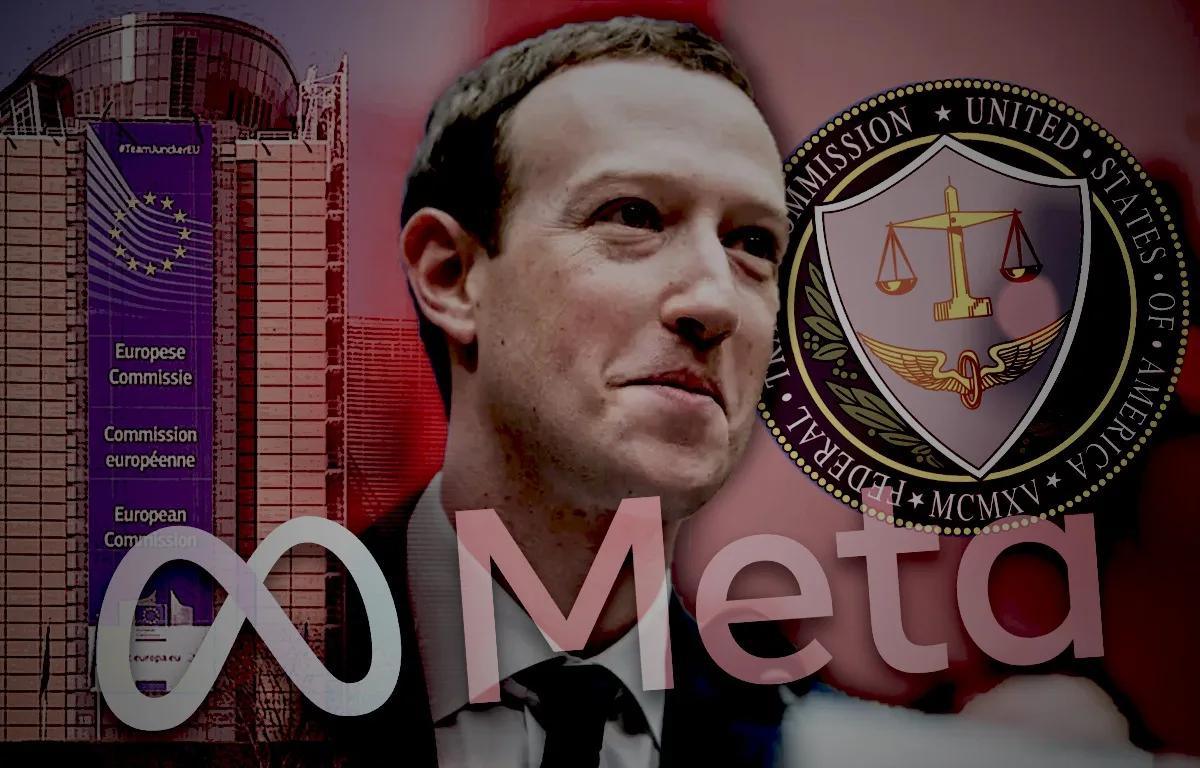
Meta is in for a bumpy ride in 2026, with multiple lawsuits in U.S. courts and regulatory bodies in Europe. A growing wave of legal challenges against the parent company of Facebook, Instagram and WhatsApp targets nearly every layer of its business. From allegations of monopolistic acquisitions and addictive platform design to child safety concerns, privacy claims, and algorithmic amplification, the cases against Meta now extend far beyond the content moderation debates that once dominated public attention.
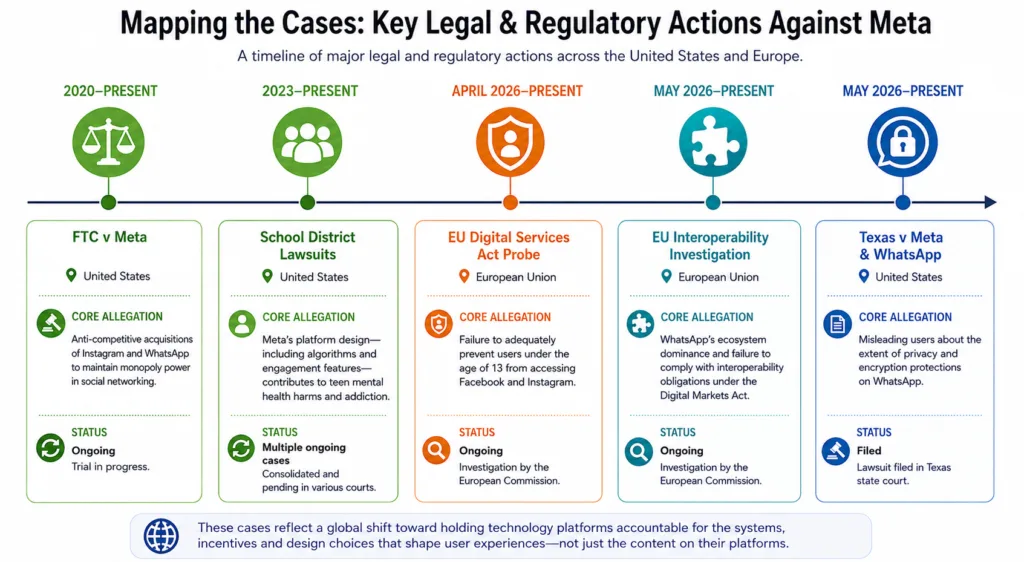
In April 2026, European regulators accused Meta of failing to adequately prevent underage users from accessing its platforms. In May, Texas sued Meta and WhatsApp over allegations that the company misled users about the extent of its privacy protections and encryption practices.
As the Federal Trade Commission’s long-running antitrust battle over Meta’s acquisitions of Instagram and WhatsApp continues, this report maps some of the major legal and regulatory cases currently confronting Meta.
WhatsApp and the recent privacy question
WhatsApp has long positioned itself as a privacy-focused messaging platform, with Meta repeatedly highlighting end-to-end encryption as one of its core protections for users. On May 21, Texas, the largest state in the United States, sued Meta and WhatsApp, alleging that the company misled users regarding the extent of its privacy and encryption protections. The complaint filed in Harrison County court claims that WhatsApp and Meta misleadingly guaranteed users that their messages on WhatsApp are encrypted, even though they can access ‘nearly all’ personal communications on the app. This recent legal scrutiny sheds light on the alleged structural gap between Meta’s privacy claims and its implementation.
On May 22, Andy Stone, Meta’s spokesperson, shared a post denying the alleged privacy gap in WhatsApp.
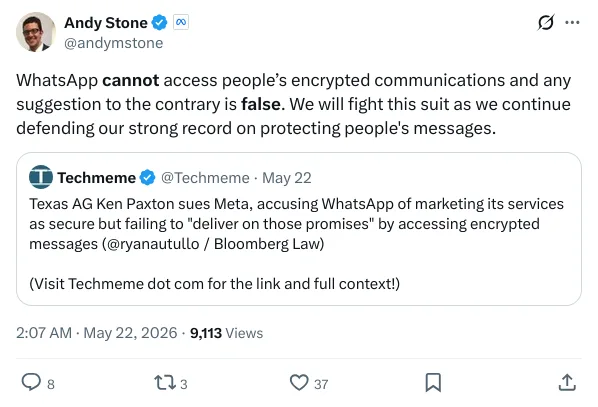
In his post, he states that WhatsApp does not have access to users’ encrypted messages and that Meta will fight the lawsuit, defending its record on safeguarding ‘people’s messages’.
On May 25, @mysk_co, an X account claiming to be associated with two iOS developers (according to the bio), demonstrated how WhatsApp stores chat databases unencrypted in an app group on iOS and macOS.
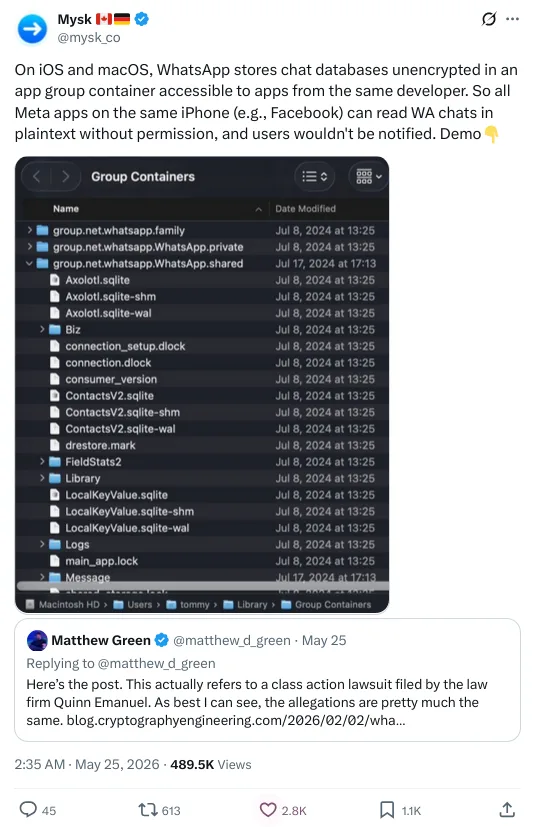
The post also suggests that other Meta apps, such as Facebook and Instagram, could read these WhatsApp messages in plaintext.
Meta and the legal pressure
Over the past several years, Meta has found itself at the centre of investigations involving privacy, competition, online safety, political advertising, and platform accountability. In the United States, Meta continues to face pressure from federal regulators, state governments, school districts, and individual lawsuits.
In December 2020, the Federal Trade Commission (FTC), an independent agency of the United States government whose primary mission is to protect consumers and promote fair competition, filed an antitrust lawsuit against Meta. The lawsuit focuses on whether Meta neutralised competition through its acquisitions of Instagram and WhatsApp.
Separate lawsuits concerning teen mental health accuse the company of designing platform features that encourage compulsive usage among younger users. More recently, Texas accused Meta and WhatsApp of misleading users regarding privacy and encryption protections, further damaging public trust in Meta.
European regulators have also expanded their focus on Meta under newer digital regulations. On April 29, officials highlighted the technology conglomerate’s failure to implement necessary safeguards to keep children under the age of 13 off Instagram and Facebook, which violates the European Union online safety law. Apart from other regulatory actions, these newer cases increasingly target the structural functioning of Meta’s platforms.
The Instagram and WhatsApp acquisitions
When Meta acquired Instagram in 2012 for approximately $1 billion and WhatsApp in 2014 for nearly $19 billion, the deals were largely framed as ambitious business expansions within a rapidly growing social media market.
The United States Federal Trade Commission (FTC) argues that Meta’s acquisitions were aimed at eliminating emerging competitors before they could threaten its dominance. Rejecting the FTC’s allegations, Meta argued that both Instagram and WhatsApp expanded significantly after the acquisitions due to investments in infrastructure, security, and scaling capabilities.
On November 18, 2025, Meta won the case when the United States District Judge James Boasberg ruled that the company does not hold a monopoly in social networking, sparing Meta from the potential sale of Instagram and WhatsApp as independent companies. In January 2026, the FTC appealed against this ruling,reviving the allegation that Meta is unlawfully maintaining a monopoly in the social networking sector.
Children, addiction, and platform design
One of the most significant legal challenges facing Meta revolves around allegations that its platforms are designed in ways that encourage compulsive usage among children and teenagers. School districts, families, and state authorities across the United States have accused the company of prioritising engagement-driven features such as infinite scrolling, autoplay videos, notifications, and algorithmic recommendations while allegedly overlooking their psychological impact on younger users.
The issue gained wider attention when a woman who worked at Facebook as a Product Manager publicly revealed details about the company’s internal dynamics.. A New York Times report published on October 3, 2021, stated that the whistleblower under the pseudonym ‘Sean’ revealed that Facebook was aware of the psychological harms the platform had on teenagers, yet chose profit over public interest.
On May 13, Meta challenged New Mexico’s $3.7 billion lawsuit accusing the company of designing its platforms to addict young users. During the trial, Alex Parkinson,Meta’s lawyer, argued that the lawsuit, if won, would force the conglomerate to pay for the mental health care for all teenagers in the state, rather than only those allegedly harmed.
Europe versus Meta
In April 2026, the European Commission stated that Meta may have violated the Digital Services Act by failing to adequately prevent users below the age of 13 from accessing Facebook and Instagram. The company has also faced scrutiny over its ‘Pay or Consent’ advertising model, under which European users were offered a choice between accepting personalised advertising or paying for an ad-free experience. The European Consumer Organisation (BEUC) and various national groups called for Meta to comply with European legislation. They also proposed the imposition of regular fines to discourage such practices by Meta. Together, these legal actions reflect a broader European effort to place stricter limits on the power and operational practices of large technology platforms.
The legal and regulatory actions against Meta now span multiple countries and various areas of concern, ranging from competition laws and child safety to privacy claims and algorithmic accountability. They largely focus on Meta’s acquisition patterns, engagement-driven design, advertising infrastructure, and data practices as interconnected parts of a much larger digital ecosystem.
From antitrust battles in the United States to child safety investigations in Europe, the cases against Meta collectively point to mounting concerns over how digital platforms shape behaviour, influence information flows, and operate at internet scale. As regulators continue to examine the relationship between platform design, user engagement, and public harm, the legal challenges facing Meta are increasingly part of a much larger debate over the accountability of global technology companies.

Sujith A
Open Source Intelligence Researcher and Mis/Disinformation tracker. Passionate about investigations and a big fan of Sherlock Holmes.
View all posts by Sujith A