Branded and Burned: Mapping Corporate Hate Campaigns in India (2000–2026)
A screenshot. A hashtag. A brand in crisis. In India, corporate backlash has found a new rhythm — fast, identity-driven, and impossible to ignore. This report maps two decades of outrage, tracing how corporate hate campaigns evolved from slow-burning product scandals into coordinated online firestorms fueled by religion, nationalism, and culture. This is not random or scattered. It is organised and coordinated. We have the evidence.
Lenskart framed by hate
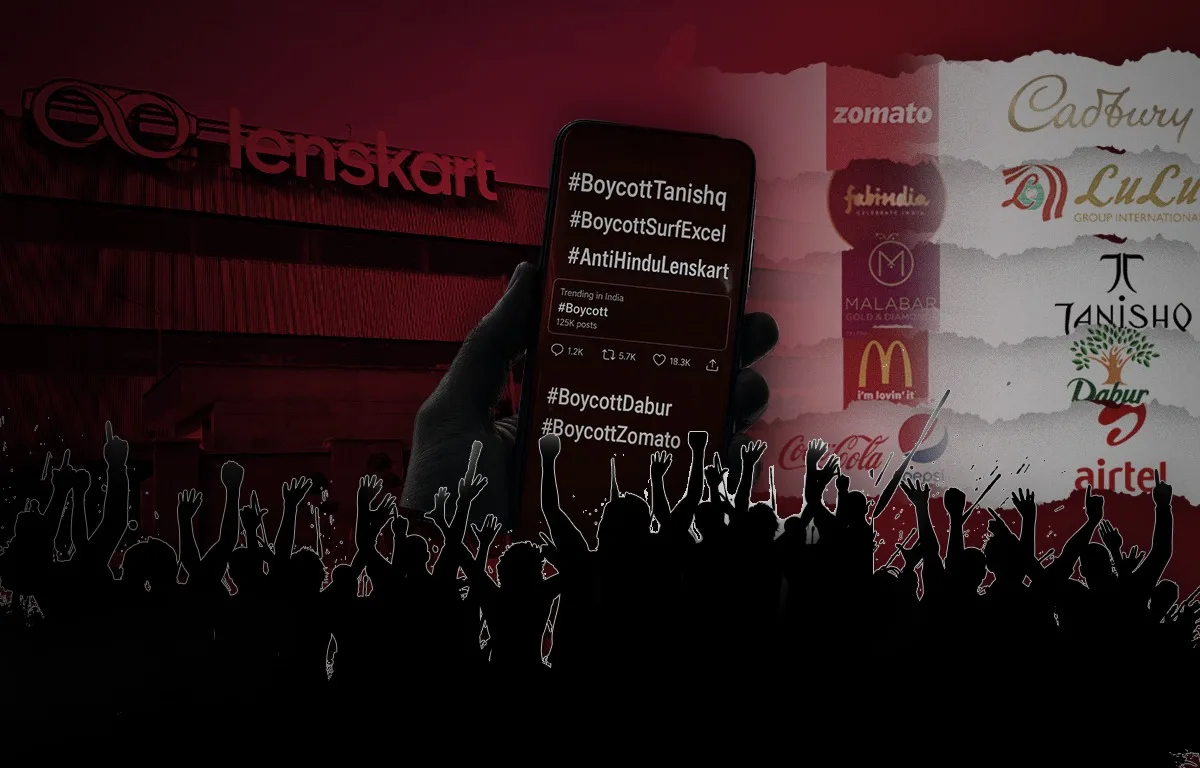
The investigation into TCS in Nashik is ongoing; however, it has emerged that the allegations of “Love Jihad” and forced conversion lack evidentiary support, based on the FIRs and other documents submitted in court. In the meantime, on April 15, a screenshot of Lenskart’s internal dress code went viral, sparking widespread online backlash. Lenskart Solutions Limited is an Indian multinational eyewear company based in Gurgaon. The image suggests Lenskart’s policy allegedly bans employees from displaying Hindu symbols like the tilak (sacred forehead mark), bindi (decorative dot), sindoor (red powder for married women), and kalawa (sacred thread).
This attracted massive backlash online in the form of organised hate campaigns, especially from right-wing accounts on social media, with trending hashtags such as #nobindinobusiness,#BoycottLensKart, and #AntiHinduLenskart.
The campaign also left a visible impact on the stock market, where Lenskart shares saw a brief decline.
Not an isolated incident, but there is a pattern.
The hate campaign against Lenskart is not an isolated incident, there have been similar situations in the past where hate campaigns were unleashed on organisations. Only the triggers vary.
A dataset of incidents where particular brands were targeted either online or via traditional media was prepared, covering cases from 2003 to 2026, including boycotts, coordinated campaigns, and significant public criticism. Incidents with only minor individual complaints or lacking media amplification were excluded. An independent analysis of this dataset was conducted. This OSINT report explores the visible characteristic shift between the outrages that occurred before and after 2014.
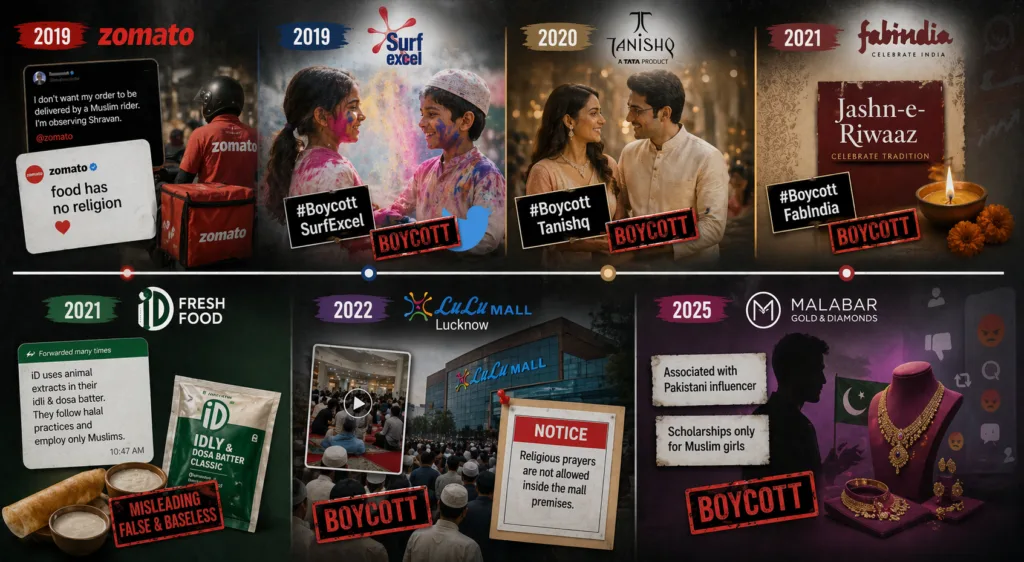
In 2019, a situation arose when a customer declined to accept a Zomato delivery from a Muslim delivery partner. The customer brought this issue to X (formerly Twitter), tagging the food delivery company and expressing that he refused to accept food from a Muslim individual as he was observing Shravan, a sacred Hindu month dedicated to t Lord Shiva. Zomato’s response, ‘food has no religion’, won them praises online.
Surf Excel: Holi Ad and Communal Backlash
In March 2019, a Holi advertisement released by Surf Excel faced backlash online after being shared on social media. The ad, titled “Rang Laaye Sang”, depicted a Hindu girl helping her Muslim friend reach a mosque safely during Holi, promoting a message of communal harmony. Soon after its release, the right-wing users criticised the campaign, alleging that it hurt Hindu sentiments and linked it to narratives such as “love jihad”. The hashtag #BoycottSurfExcel trended on X, while others came out in support of the advertisement.
Tanishq:‘Ekatvam’(Unity)and the Interfaith Ad Row
In October 2020, an ad was released by Tanishq, an Indian jewellery brand owned by Titan Company, which faced a boycott call online, reportedly accusing the brand of promoting “Love Jihad”. The ad depicted an interfaith couple- A Muslim family celebrating a baby shower for their Hindu daughter-in-law. The ad depicts the surprised daughter-in-law asking her mother-in-law the reason for the celebration as it is not part of their faith. She replies that the family wanted to celebrate her happiness in a way that is familiar and meaningful to her.Followed by the online hate campaign,Tanishq withdrew the advertisement.
Fab India:Festive Branding and Religious Outrage
Similarly, in October 2021, FabIndia, one of India’s largest private platforms for traditional, craft-based products, also faced online hate for naming its Diwali special festive collection with the Urdu phrase Jashn-e-Riwaaz (celebration of tradition).The promotional visuals showed models in traditional attire —sarees, kurtas, and ethnic wear—set in a celebratory, Diwali-like context.The brand described it as a collection that pays homage to Indian culture during the festive season.
A boycott campaign flooded social media, accusing the brand of linking Hindu festivals to Muslim ideology. The use of an Urdu name for the release of a collection around Diwali provoked the haters. As a result, FabIndia withdrew the promotional advertisement.
While these brands tried to uphold India’s secular framework, the efforts were shunned by boycott campaigns that displayed organised behaviour.
iD Fresh Food:Misinformation and Identity-Driven Hate
In September 2021, a viral communal WhatsApp forward targeted iD Fresh Food, claiming that the company used animal extracts in its idli and dosa-batter. The message also alleged that the company followed “halal practices” and hired only Muslims, drawing on the background of its founders. The claims spread widely online, causing the company to issue a statement calling the allegation “misleading, false and baseless” and clarifying that its products contain only vegetarian ingredients.
Lulu Mall and Malabar Gold : Disinformation and Boycott Calls
In 2022, a video purporting to show individuals offering namaz inside the Lulu Mall shopping area in Lucknow in UP sparked a boycott campaign against the brand. Following the outrage, the shopping complex issued a notice banning religious prayers on the mall premises.
In 2025, a Kerala-based jewellery group, Malabar Gold and Diamonds, was also subjected to a boycott trend for its alleged association with a Pakistani influencer. Even disinformation that the brand only provided scholarships to Muslims girls was widely shared on social media.
Early Corporate Protests in India
Corporate protests against companies in India has a longer history, shaped by industrial disasters and environmental conflicts. The Bhopal Gas Tragedy remains one of the earliest major cases, where a toxic gas leak at a Union Carbide plant in December 1984 led to thousands of deaths and long-term health impacts on hundreds of thousands. Sustained protests and legal actions followed, centered on accountability.
Another notable agitation occurred in the early 2000s, where resistance against Coca-Cola at Plachimada in Palakkad district of Kerala took a different form, with local communities raising concerns over groundwater depletion and contamination linked to a bottling plant. Protests began in 2002 and continued for years, leading to the plant’s closure in 2004 following prolonged legal disputes and community pressure. April 22, 2026, marked the 24th anniversary of the struggle.
The Corporate Backlashes Before and After 2014
In India, corporate backlash predates social media, which was often triggered by product quality concerns and isolated disputes. Rather than originating from public scrutiny, these backlashes moved through proper media channels such as television and print media.
In 2001, McDonald’s, an American international fast food restaurant chain, revealed that beef tallow was used in French fries. This led to protests from Hindu groups targeting McDonald’s in Mumbai.
In 2003, Cadbury faced a nationwide backlash following reports of contamination in its products. Along the same timeline, organisations such as Pepsi and Coca-Cola were also engulfed by the pesticide allegations. This resulted in protests, regulatory scrutiny, and bans in some regions.
In the years after 2014, the structure of corporate backlash began to shift. Triggers become smaller, often limited to a single post, video, or document. What follows is rapid amplification across platforms, where framing took shape early and spread before a company could respond. The pace compressed, and the response window narrowed.
Early signs of online outrage can be mapped back to the 2018 Bharti Airtel Controversy, where a customer refused to be served by a Muslim customer service representative.
The shift in pattern is evident in the boycott campaigns targeting Zomato in 2019, Surf Excel in 2019, Tanishq in 2020, Malabar Gold, Lulu Group, ID Fresh Food and FabIndia in 2021.
In these cases, the boycott trend often sprouted as a small opinion shared on social media, which was soon amplified by netizens into a full-blown communal hatred. Social media Platforms such as X (formerly Twitter) acted as breeding grounds for these trends.
The 2021 social media outrage against Dabur, an Indian multinational consumer goods company, reflects a trend fueled by homophobia. Netizens widely criticised the Dabur ad that featured a same-sex couple observing Karva Chauth (a one-day Hindu festival celebrated annually by married Hindu women, symbolising their deep love for their husbands).
Later cases, such as the 2025 controversy surrounding Malabar Gold & Diamonds, show how online narratives can extend beyond platforms. The recent episode involving Lenskart follows a similar trajectory.
Are There Common Players Behind This Hate Game?
Analysis of boycott trends on X reveals a coordinated behaviour and we found a set of accounts that recurrently appears in the trends such as #BoycottSurfExcel, #BoycottTanishq, #BoycottFabIndia, #Boycottmalabargold, and #BoycottLenskart.
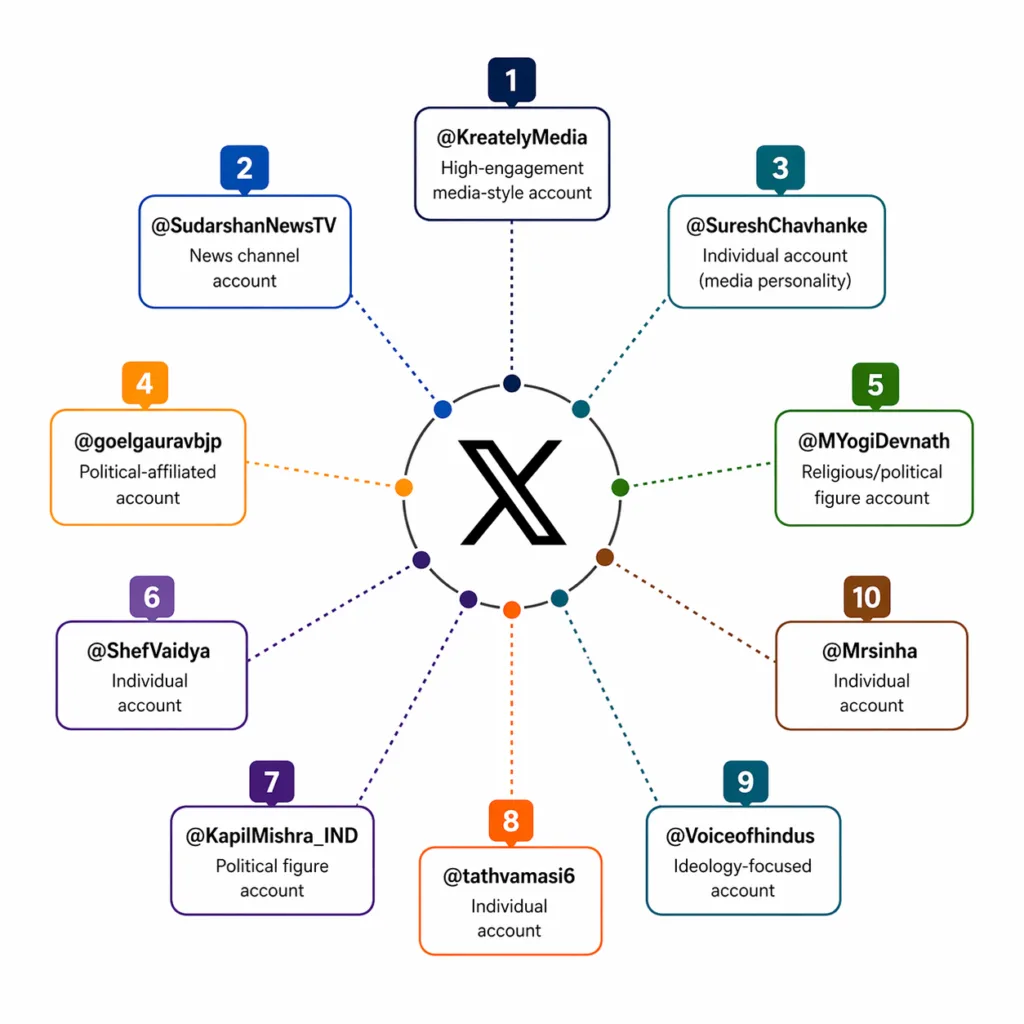
The posts supporting the boycott trend shared by these accounts attract higher engagement and play a key role in amplifying the overall trend.
Key Distinction: Pre vs Post 2014
The difference between earlier incidents and recent cases is not limited to scale. It reflects a shift in how backlash forms, spreads, and often forces a response. The change becomes clearer when the two periods are placed side by side.
| Aspect | Before 2014 | After 2014 |
| Trigger | Product issues, isolated complaints | Ads, viral videos, screenshots, internal documents |
| Amplification | TV news, print media, local protests | X, Instagram, WhatsApp, coordinated online activity |
| Speed | Slow build-up over days or weeks | Rapid escalation within hours or days |
| Narrative Type | Issue-specific and limited in scope | Identity-driven (religion, culture, nationalism), easily reused |
| Participation | Localised, smaller groups | Mass participation, anonymous accounts, networked amplification |
| Format of Outrage | News debates, protests, complaints | Hashtags, viral clips, coordinated trolling, boycott calls |
| Corporate Response | Delayed statements, internal review | Immediate reactions, ad withdrawals, policy changes |
| Spillover | Mostly contained within media cycle | Often crosses from online to offline (protests, FIRs) |
Earlier incidents depended on institutional amplification. Media coverage, regulatory action, or organised protests determined how far an issue traveled. In recent cases, amplification begins at the point of origin.
A post or video carries its own distribution, allowing narratives to form and spread before verification or response. This reduces the time available for companies to react and increases the likelihood of immediate action.
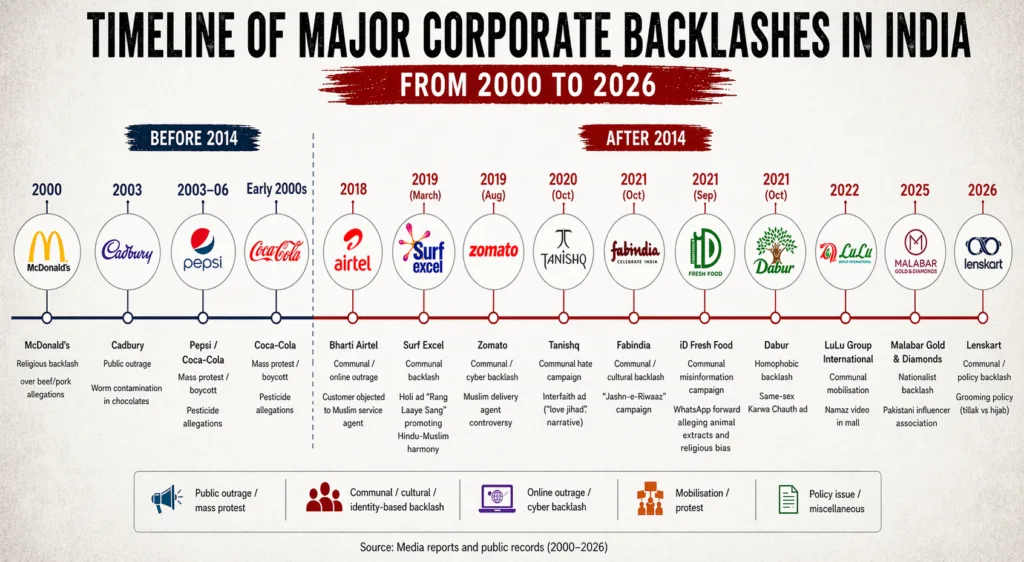
This transition becomes visible when incidents are mapped over time.
Lenskart’s Clarification
In response to the backlash, Lenskart updated its style guide, highlighting that employees can wear cultural or religious items such as sacred threads, bangles, kalawa, mangalsutra, kada, or similar items.
The clarification shared on Lenskart’s official X account reads, “Lenskart was built in Bharat, by Indians, for Indians. Our 2400+ stores are run by people who bring their beliefs, their traditions, their identity to work every day. That is not something we will ever ask anyone to leave at the door.”
From Grievance to Bigotry – Where is India Heading?
Corporate backlash in India did not begin with social media, but the way it moves has changed. Early corporate campaigns were largely rooted in legitimate grievances-environmental destruction, public health crises and accountability for industrial negligence. The struggles at Bhopal and Plachimada for example were driven by communities demanding justice for tangible, verifiable harm.What has emerged over the past decade,however,is markedly different in character. The campaigns against corporates mapped in this report reflect a shift away from material concerns towards identity-driven outrage, where religion,culture and jingoism serve as the primary fuel.The triggers are often thin-an advertisement, a dress code, a product name- and the concerns frequently irrational, amplified by coordinate online networks well before facts could be established. What was once protest or resistance has,in many cases, become a hate campaign driven by religious sentiment-most often an aggressive manifestation of Hindutva ideology.

Sujith A
Open Source Intelligence Researcher and Mis/Disinformation tracker. Passionate about investigations and a big fan of Sherlock Holmes.
View all posts by Sujith A