How Clickbait Bites: Uncovering the ₹5,000 Trap
A promise of ₹5,000. A newly elected Chief Minister. A network of repurposed Facebook pages. This investigation traces Meta advertisements that used the images of V.D. Satheesan and D.K. Shivakumar to promote dubious financial assistance schemes, uncovering suspicious advertiser details, recycled pages, and websites that redirect users to payment links rather than any verified government benefit.
A Facebook advertisement claiming that social media users can receive up to ₹5,000 in financial assistance from the Congress party has been circulating on Meta platforms in recent days. These advertisements feature Kerala Chief Minister V.D. Satheesan and Karnataka Chief Minister D.K. Shivakumar.
This is not the first time such advertisements have surfaced. In December 2025, Offbeat Concerns reported a network of Meta advertisements that falsely used the names of schemes such as the Pradhan Mantri Rojgar Yojana and the Pradhan Mantri Mudra Yojana while promising users payments of ₹5,000. Although the political figures and schemes referenced in the advertisements have changed, the core modus operandi remains the same.
In this report, we analyse the Meta ad scams that use the photos of the newly elected Chief Ministers of Kerala and Karnataka.
Examining the advertisements
We identified that from June 6 to June 8, Facebook pages ‘UDF Scheme’ and ‘Innam 4996’ ran ads featuring the Chief Minister of Kerala, V.D Satheesan. The Malayalam text in both the ads indicates that the Congress party is offering financial assistance of ₹5,000. The voice-over requests users to click on the website linked to the advertisement to claim the amount.
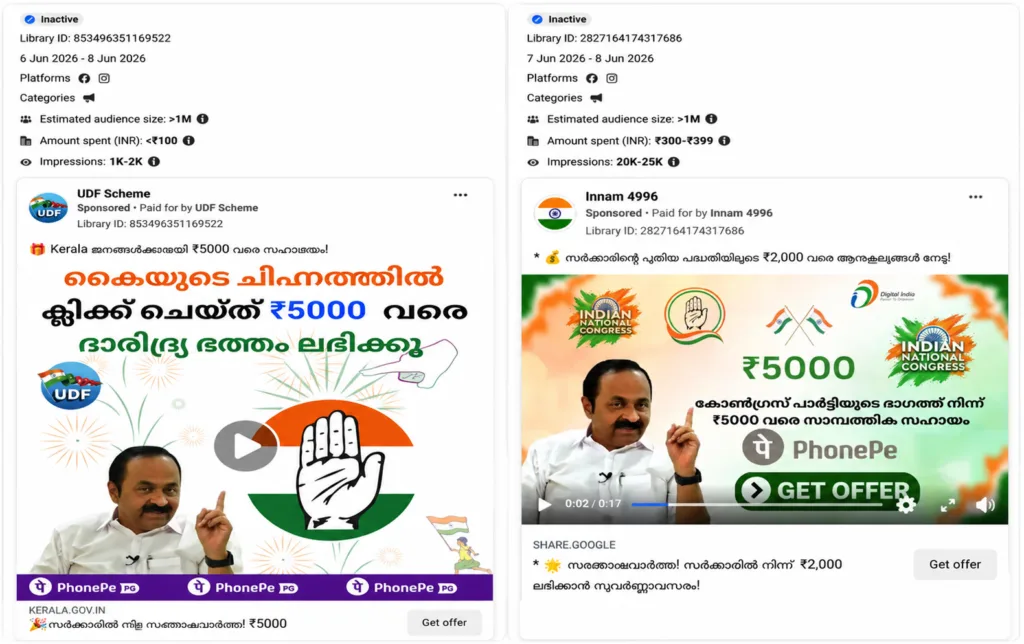
Both ads were run on Facebook and Instagram between June 6 and June 8, with an estimated audience larger than 10 Lakh people. Despite being promoted through different advertisers, the creatives use similar visual elements, including the image of V.D Satheesan, the Indian National Congress (INC) logo, and claims of direct financial assistance.
We found no credible sources indicating that any such financial assistance scheme exists.
What do we know about advertisers?
The Page Transparency section shows that the page was created on December 13, 2024, under the name ‘UDF Scheme’. The page was later renamed ‘Kerala ₹649’ and ‘PM Mudra Yojna’ before reverting to ‘UDF Scheme’ on April 5, 2026.
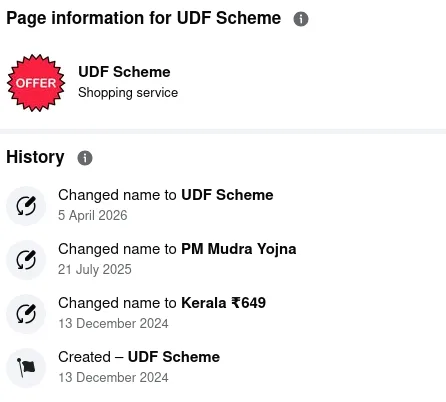
It also reveals that the page was managed from two different locations within India.
Similarly, the Page Transparency information of the Facebook page ‘Innam 4996’ shows that the page was created on March 15, 2025, under the name ‘HOLLY OFFER 1’. The page was later renamed ‘Innam 4996’ on July 12, 2025.
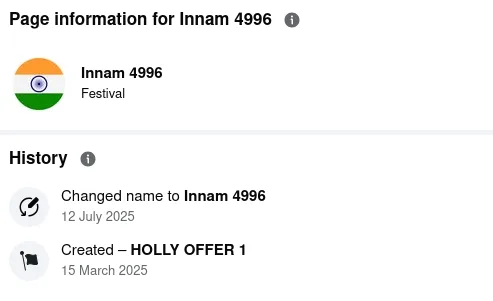
The repeated name changes suggest that the pages may have been repurposed over time and are now being used to promote financial assistance advertisements.
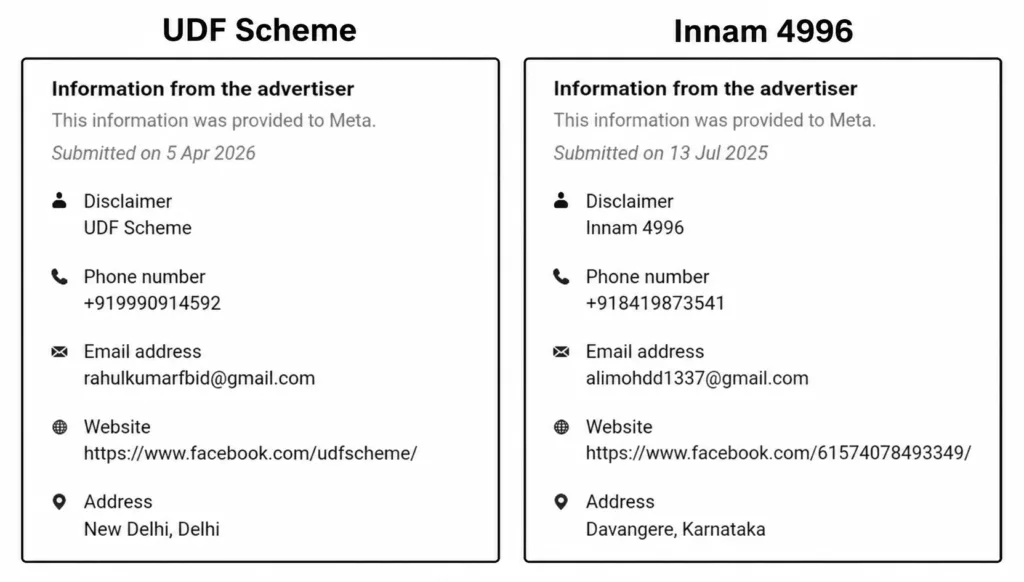
The ad disclaimer of the advertiser ‘UDF Scheme’ provides key information such as phone number ‘+919990914592,’ email address ‘rahulkumarfbid@gmail.com,’ and address “New Delhi, Delhi.”
Similarly, the advertiser information for ‘Innam 4996’ lists the phone number ‘+918419873541,’ email address ‘alimohdd1337@gmail.com,’ and address ‘Davangere, Karnataka’.
Though the advertisement featuring V.D. Satheesan is inactive and the website linked to it is not accessible as of June 10, we identified that the page ‘UDF Scheme’ also had ads featuring the new Chief Minister of Karnataka, D.K Shivakumar.
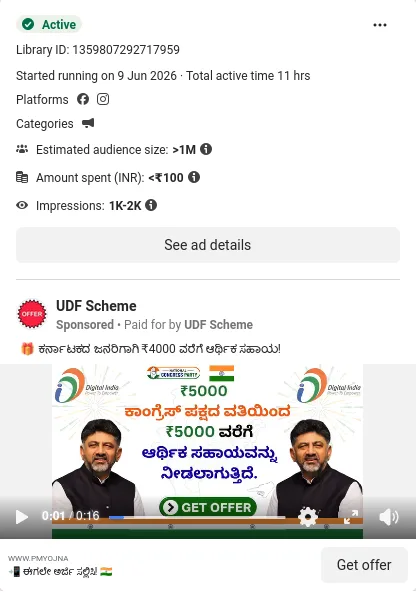
Similar to the Malayalam ad, the Kannada ad also offers financial assistance on behalf of the Congress party.
What does the website associated with the ad reveal?
Clicking the “Get offer” button redirects users to the webpage ‘https://pm.mudra-yojna.us/lol/Kannada/’. The website features a photo of DK Shivakumar along with the INC logo, and the Kannada text on the website translates to, “₹5,000 will be credited to everyone’s account through the Jan Dhan Yojana.”
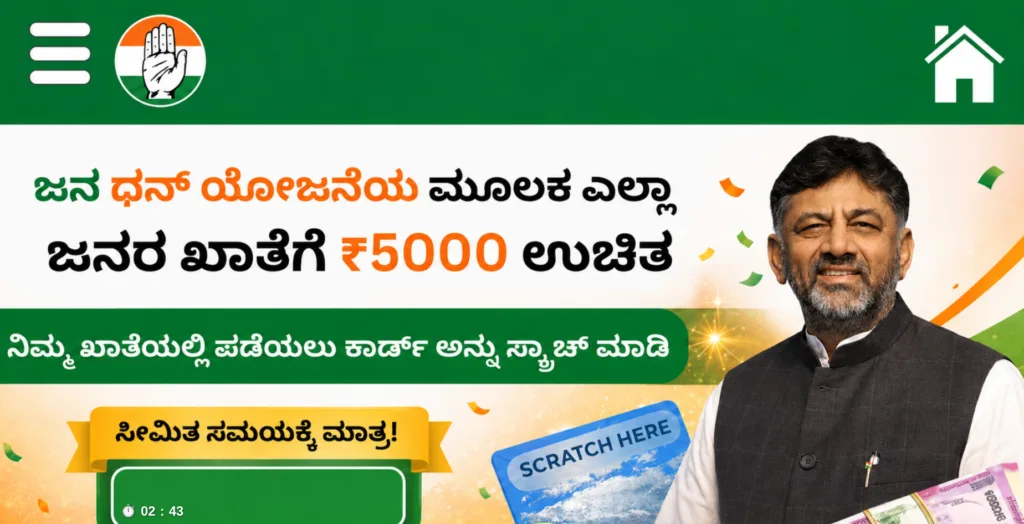
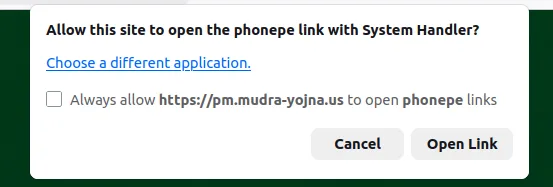
Clicking anywhere on the website initiates a PhonePe payment link that redirects users to the PhonePe application.
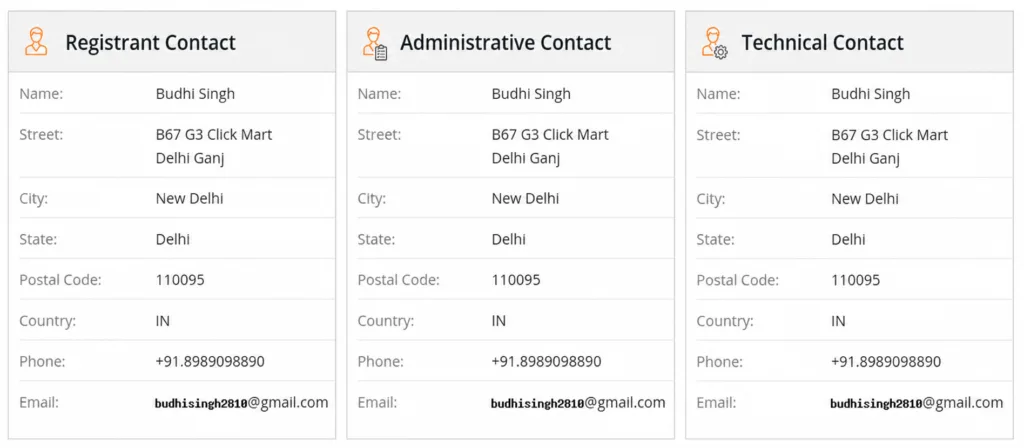
The analysis of the website’s registrar information revealed that it was registered under ‘Budhi Singh,’ with the address ‘B67 G3 Click Mart Delhi Ganj,’ phone number ‘+918989098890,’ and email address ‘budhisingh2810@gmail.com’. We observed that the same contact details were provided for the registrant, administrative contact, and technical contact.
The advertisements examined in this investigation show how scam operators continue to adapt their tactics by exploiting political figures, party symbols, and promises of financial assistance. While earlier campaigns relied on the names of central government schemes, the latest advertisements have shifted to using the images of newly elected Chief Ministers and references to the Congress party.
Our analysis found a network of repurposed Facebook pages, questionable advertiser details, and websites that ultimately redirect users to payment links rather than any verified government benefit.
Sujith A
Open Source Intelligence Researcher and Mis/Disinformation tracker. Passionate about investigations and a big fan of Sherlock Holmes.
View all posts by Sujith A