Dissent Under Watch: How Meta Controls What We See
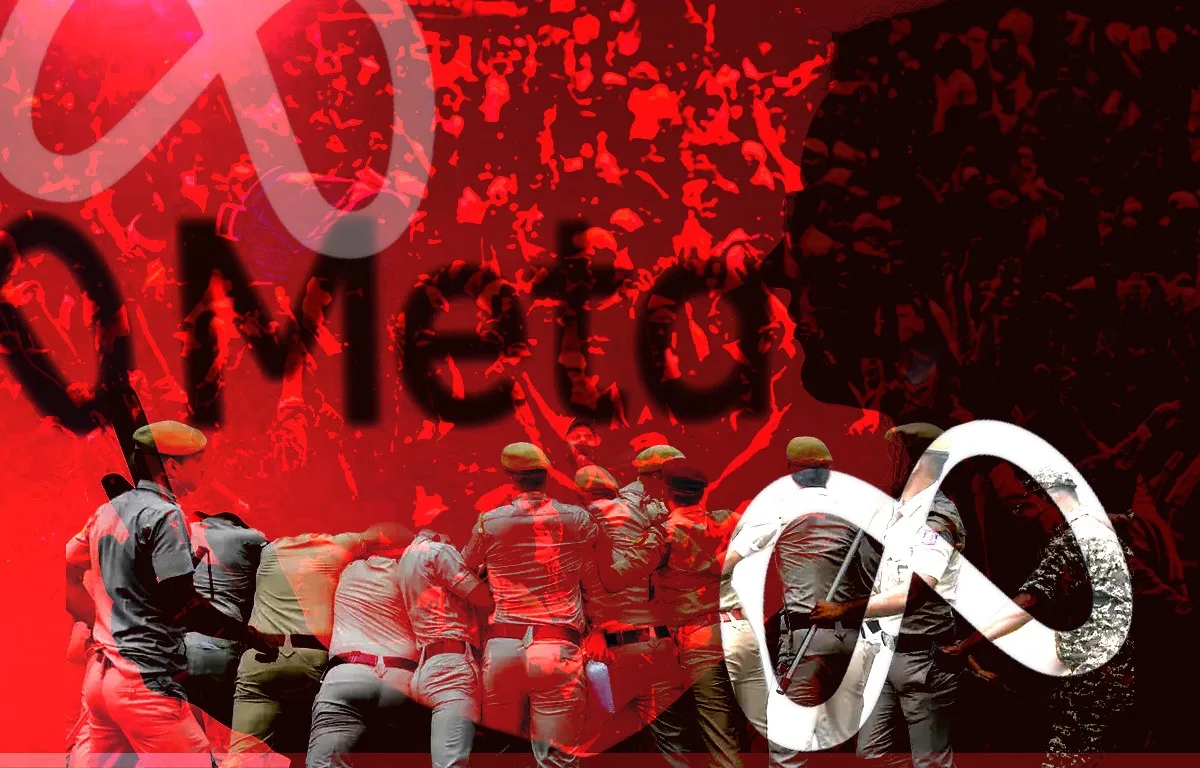
From the CJP protests at Jantar Mantar to reporting on Kashmir and political developments in Kerala, content on Meta’s platforms has been removed, restricted, labelled sensitive or stripped of reach. Government requests, legal requirements and automated systems have all been cited. But when protest and critical journalism become harder to see, a larger question emerges: who decides what the public gets to see?
On July 20, India witnessed one of the most closely watched student protests, led by the Cockroach Janata Party (CJP), at Delhi’s Jantar Mantar. Every smartphone became an eye for those monitoring the situation online. Social media platforms such as Instagram, Facebook and X were filled with visuals that revealed the grim reality of how the state dealt with dissent. These visuals were prevalent online and continued to catalyse racial opposition to the government even after the protest subsided.
The Internet Freedom Foundation also raised questions over whether protest-related content was being subjected to reduced distribution or feature restrictions. What appeared on the streets was therefore not necessarily what remained visible online.
And this was not the first time content linked to a protest or political developments became difficult to access on Meta’s platforms. This report examines other instances in which Meta acted as an online dictator.
CJP protest and the disappearing posts
According to the Internet Freedom Foundation’s (IFF) official statement released on July 22, multiple Instagram users began reporting that posts and Reels documenting the demonstrations that occurred at Jantar Mantar, Delhi, were becoming harder to access. The IFF further stated that reels shared by the CJP’s official account and politician Anish Gawande were being marked as ‘sensitive content’, with some users unable to open them through the ‘See reel’ option. Content creators also reported sudden and unexplained drops in reach.
On July 22, The Economic Times similarly reported complaints that Instagram was no longer prioritising protest-related posts in users’ feeds.
On 27 July, Delhi Police said it had asked social media platforms to remove posts and videos containing what it described as offensive or abusive remarks against Prime Minister Narendra Modi that were uploaded during the CJP protests.
Police said several posts had already been removed following notices issued to platforms. However, the available evidence does not establish that every CJP-related restriction on Instagram resulted from these police notices.
Therefore, the specific connection between individual Meta takedowns and government requests remains unclear.
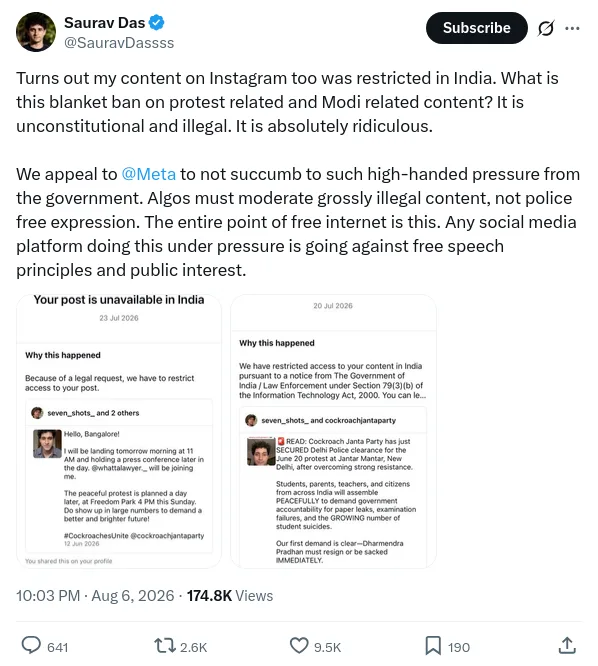
On August 6, Saurav Das, CJP’s co-convenor, also shared an X post revealing how Meta restricted his Instagram account in India.
What do the Gaza war and farmers’ protest in India have in common?
Several past instances show a similar pattern. In December 2020, during the farmers’ protests in India, Facebook temporarily took down the Kisan Ekta Morcha page, which had been used to communicate about the farmers’ agitation, and it became an example of protest-related content disappearing from Meta’s platforms. Facebook said, in its defence, that its automated systems had detected increased activity on the page and mistakenly flagged it as spam. The company said it restored the page within 3 hours of becoming aware of the issue.
A similar issue emerged on a much larger scale after the Gaza war began in October 2023. Human Rights Watch documented more than 1,050 cases involving the removal or suppression of Palestine-related content on Facebook and Instagram between October and November 2023. The documented cases included post and comment removals, account suspensions, restrictions on users’ ability to interact with content, restrictions on features and reduced visibility or reach. Meta disputed the characterisation of the problem as deliberate systemic suppression, saying its platforms were dealing with a surge of harmful content and that its systems could make errors.
A blanket over press freedom
On August 6, Instagram restricted a post by Scroll.In about Kashmir’s pellet-gun victims, including a report on how most victims were still awaiting compensation years after being injured. A second post published later that day was also restricted.
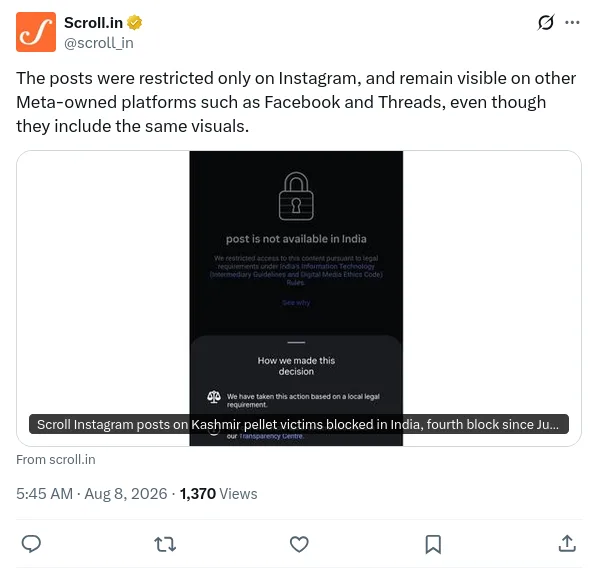
Scroll reported that Instagram cited ‘legal requirements’ under India’s Information Technology Rules and said the content had been restricted in India via an automated system implemented in accordance with those requirements. The posts remained accessible on other Meta-owned platforms, including Facebook and Threads.
A similar restriction affected an Instagram post by The Hindu linking to its report on Kashmir pellet victim Insha Mushtaq, who was blinded by pellet injuries during the 2016 unrest.
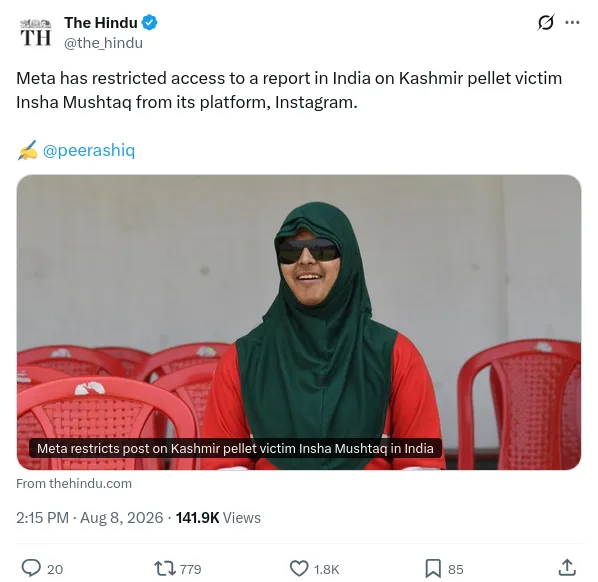
Meta told The Hindu that access to the content had been restricted in India in accordance with the IT Rules. The specific government direction or legal provision behind the restriction, however, has not been disclosed. The timing is significant as the use of pellet guns came under fresh scrutiny following the CJP protests at Jantar Mantar, where protesters were also reported to have suffered pellet injuries.
Attack on Press Freedom in Kerala too
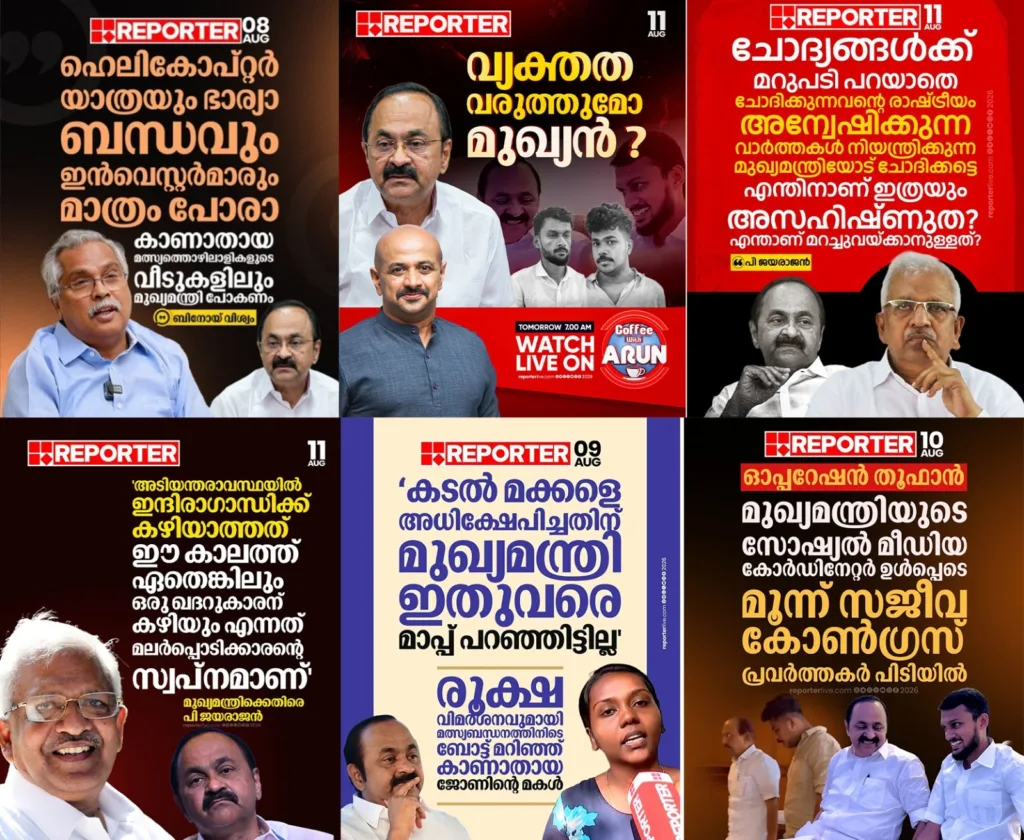
Kerala provides a fresh example of Meta’s hardening grip over political news. Reporter TV, one of the prominent Malayalam news channels, alleged that eight posts from its Facebook page were subjected to 24-hour access restrictions in India, following what Meta told the channel were official legal requests from the government.
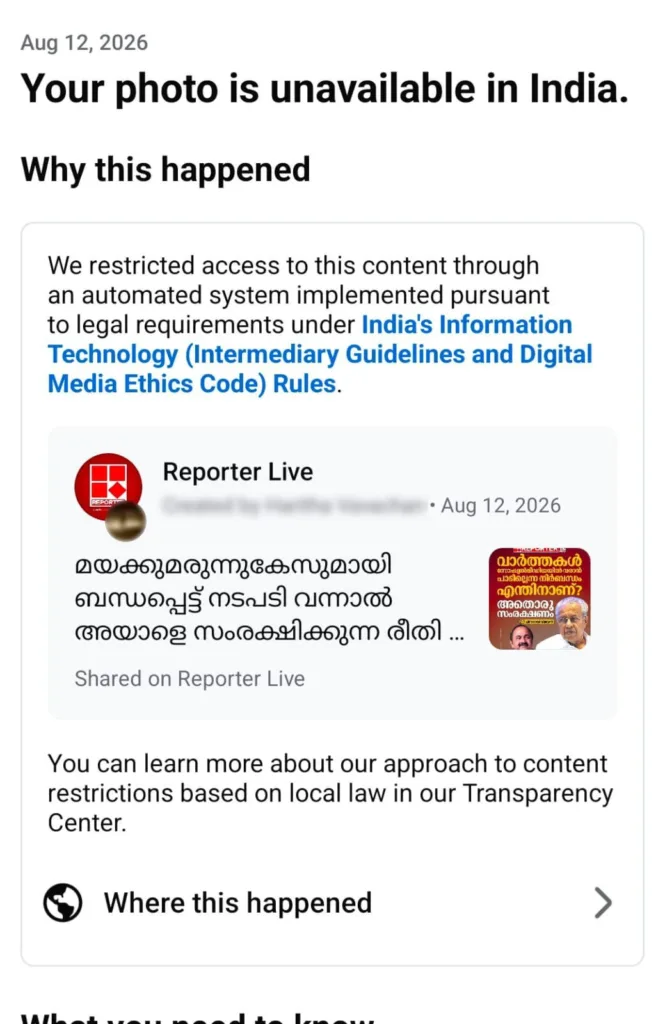
According to Reporter TV, the posts included reports on the arrest of three Congress workers, including a person said to be the social media coordinator for Chief Minister V D Satheeshan. The news cards of Reporter TV, highlighting the criticism raised by CPIM and CPI leaders, including P Jayarajan and Binoy Viswam, against the Chief Minister, were also taken down by Meta following a legal request by the Government. Jiji, the daughter of a fisherman, John Mathyas, who went missing, raised stringent criticism against the Government for the alleged lapse in conducting search operations. Reporter TV’s news card on her remarks against the Chief Minister was also taken down. Reporter TV alleged that the Government and the ruling party have misused provisions of India’s IT Rules to restrict news critical of the government.
In November 2025, the Facebook account of veteran journalist and former editor of The New Indian Express, N. Madhavan Kutty, was blocked after the Kerala Police sought action over a post he made about the Delhi blasts. This happened during the tenure of the Left Government in Kerala. He challenged the restriction before the Kerala High Court, which has recently directed Meta to restore his account provisionally.
Across these cases, the disappearance of political and protest-related content from Meta’s platforms has taken different forms, ranging from temporary takedowns and sensitive-content labels to restrictions issued in response to legal requests. In some instances, Meta has acknowledged that its systems made mistakes, while in others, the exact basis for the restriction remains unclear. Censoring at this level will ensure the propagation of narratives that decisively suppress dissent.
Sujith A
Open Source Intelligence Researcher and Mis/Disinformation tracker. Passionate about investigations and a big fan of Sherlock Holmes.
View all posts by Sujith A