When War Zones Rank Higher: India’s Press Freedom Crisis
With new IT rules, data protection laws, and growing corporate-media ties, India’s press freedom is under strain. RSF describes the environment as increasingly hostile, with journalists facing both state pressure and online intimidation.
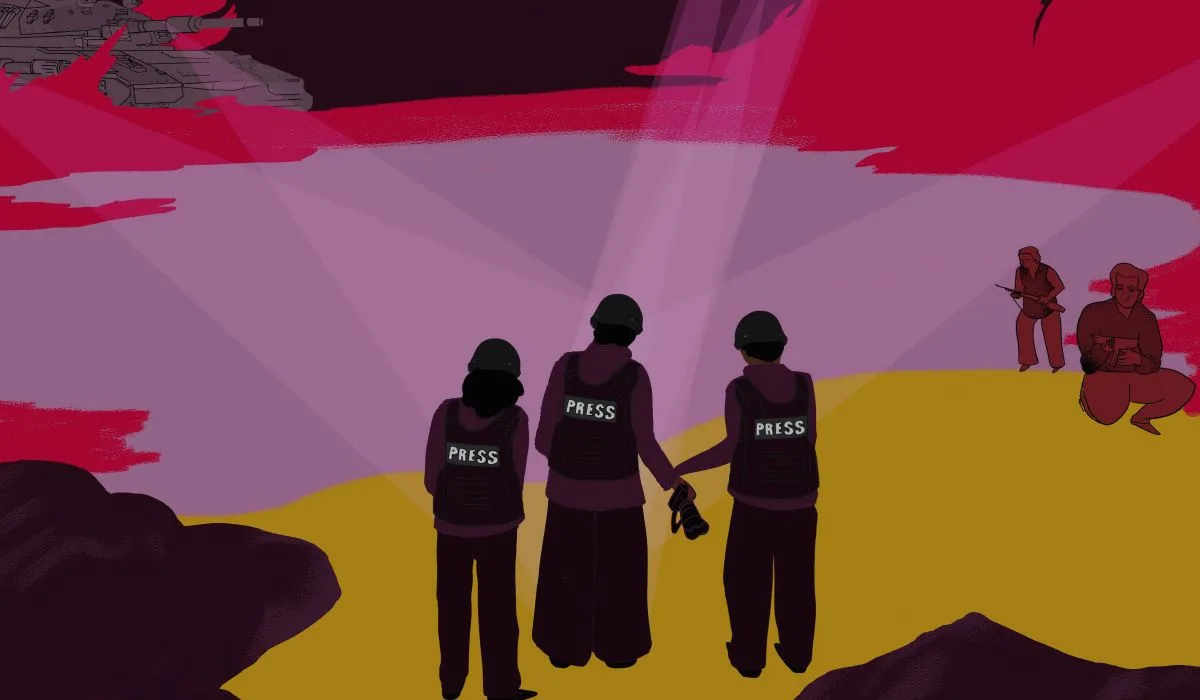
More than 220 reporters have been killed in Gaza by the Israeli army since October 7, 2023. They have been bombed, starved, and shot dead. Surviving and freed Palestinian journalists describe the place as a ‘living graveyard.’
Yet, according to the World Press Freedom Index by Reporters Without Borders (RSF), Palestine is still a slightly better place for journalists to do their work than India.
RSF releases the annual index based on five key indicators of journalistic freedom in each country, ranking 180 countries accordingly: political context, legal framework, economic context, sociocultural context, and safety. India has been placed in the ‘very serious’, the most critical category of the index in recent years. This year, it has fallen from its previous rank of 151st to 157th, performing worse than several countries with strong religious or authoritarian governance models, such as Pakistan.
‘With a rise in violence against journalists, highly concentrated media ownership, and outlets with increasingly overt political alignment, press freedom is in crisis in ‘the world’s largest democracy,’ ruled since 2014 by Prime Minister Narendra Modi, leader of the Bharatiya Janata Party (BJP) and embodiment of the Hindu nationalist right,’ RSF notes in its report.
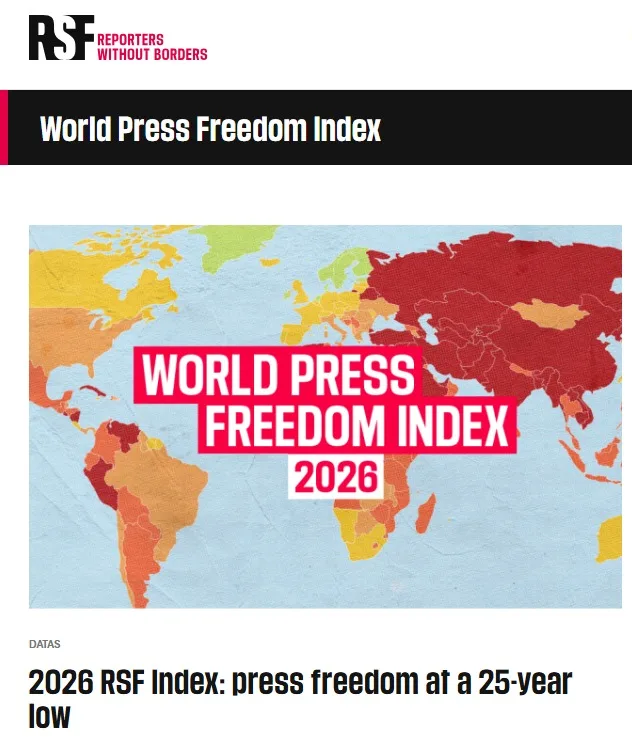
With a score of 31.96, India has performed worse than the previous year across all five criteria. With the recent introduction of IT rules, the data protection law, and the increasingly frightening social and political environment faced by journalists, the country is increasingly becoming a ‘nightmare’ for its journalists and independent media organisations.
The ‘worst’ in 25 years
RSF notes that in 25 years, the average score of all 180 countries and territories surveyed in the index has ‘never been so low’. More than half of the world’s countries have now fallen into the ‘difficult’ or ‘very serious’ categories for press freedom.
The index is led by Norway, the Netherlands, Estonia, Denmark and Sweden. The countries at the end are Saudi Arabia, Iran, China, North Korea and Eritrea.
Mario Guevara, a Spanish-language reporter from El Salvador, was deported from the United States after being arrested while reporting and held in custody since June 14, 2025. RSF had earlier condemned the act.
In the 2026 index, the United States has fallen to 64th place, seven positions lower than the previous year. RSF states that President Donald Trump has turned his repeated attacks on the press and journalists into a ‘systematic policy,’ describing the country as already having a ‘tense security environment marked by police violence.’
The index’s legal indicator has seen the most severe decline this year, according to RSF. This score deteriorated in more than 60% of states between 2025 and 2026. India is among the countries that, according to RSF, has performed worst on this indicator. Other countries where the legal indicator has declined include Egypt (169th), Israel (116th), and Georgia (135th).
According to the index, this has become a ‘global phenomenon,’ where circumventing press laws and misusing emergency legislation and common law has become the norm.
Post-Assad Syria, after years in the bottom 10, has jumped 36 places to 141st following the fall of Bashar al-Assad’s dictatorship in December 2025. The steepest fall has been in Niger.
The report also notes that ‘Eastern Europe and the Middle East are the two most dangerous regions for journalists in the world, as they have been for 25 years’, notably putting Russia (172nd) and Iran (177th) in the bottom 10.
India’s worsening climate
The Committee to Protect Journalists (CPJ) has documented 91 journalists and media workers killed in India since it began keeping records. India’s consistent fall in the press freedom index starkly reflects this ground reality.
Though India’s media landscape is vast, it has fallen into an ‘unofficial state of emergency’ since Narendra Modi came to power in 2014, according to RSF. It also states that Modi has engineered a ‘spectacular rapprochement’ between his party, the Bharatiya Janata Party (BJP), and the big families dominating the media.
The report names Mukesh Ambani and Gautam Adani, two of India’s biggest industrialists, and describes Ambani as the prime minister’s ‘close friend,’ noting that he owns around 70 media outlets followed by at least 800 million Indians. It also described the ‘hostile takeover’ of NDTV at the end of 2022 by Gautam Adani as ‘the end of pluralism in the mainstream media.’
Following the acquisition, NDTV co-founder Prannoy Roy launched a digital news venture called DeKoder in 2024, focusing on data-driven election analysis and ground reporting.
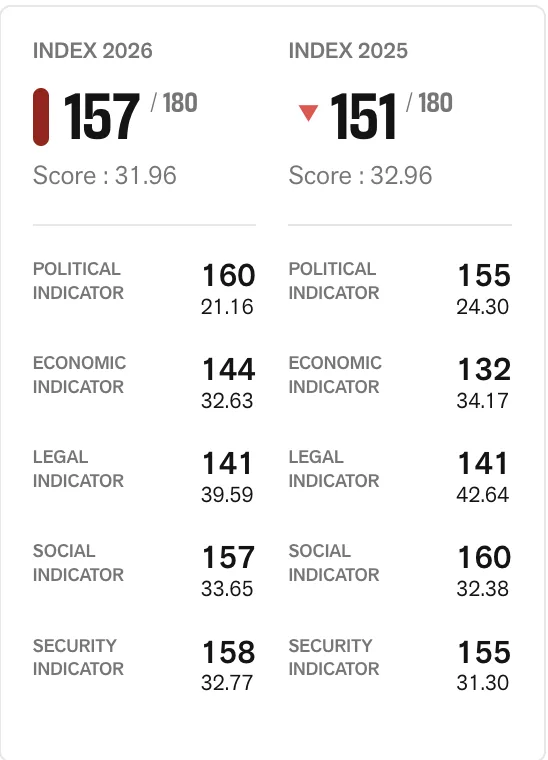
The report also highlights how governments have continued to use colonial-era laws—such as those related to sedition, defamation, and anti-state activities—to suppress the media. It specifically mentions the Telecommunications Act (2023), the Information Technology Amendment Rules (2023), and the Digital Personal Data Protection Act (2023) as laws used to curb and censor dissent.
A Prime Minister with zero press conferences
The report says that ‘The prime minister does not hold press conferences, grants interviews only to journalists and YouTubers who cover him in a favourable light, and is highly critical of those who do not show allegiance.’ It also adds that Indian journalists are often subjected to harassment campaigns by BJP-backed trolls.
With an average of two to three journalists killed each year due to their work, RSF describes India as one of the ‘world’s most dangerous countries for media professionals.’ The report also highlights coordinated campaigns of hatred and calls for violence on social media, noting that such campaigns are especially severe when they target women journalists.
For journalists in Kashmir, the situation is described as ‘worrisome’. Reporters are often harassed by police and paramilitary forces, and some are subjected to ‘provisional detention,’ meaning they are held for extended periods without any crime being proven against them.
As of April 30, two journalists are detained in India according to the RSF.
The numbers on the ground could be worse
According to the Committee to Protect Journalists (CPJ), at least 262 journalists and media workers have been killed across Gaza Strip, Yemen, Lebanon, Israel, and Iran since the Israel–Gaza war began on October 7, 2023, and the Iran war began on February 28, 2026 (as of April 28, 2026).
CPJ states that Israel has killed more journalists than any other government since it began collecting data in 1992, calling this war the ‘deadliest on record’ for journalists.
Yet it stands at 156th place in the index.
This is because RSF’s methodology assesses the indicators in particular ways, where the reality on the ground may be different. The index shows a significant improvement in the ranking in terms of the economic and political indicators. The scores on political indicators seem to reflect the Palestinian Authority’s relationship with its own press rather than Israeli military conduct.
Also, there is another rule that may result in undercounting. A journalist is recorded as killed only when RSF can confirm a direct causal link between the death and the person’s journalistic activity. The Palestinian Journalists’ Syndicate had earlier accused RSF of ‘whitewashing the image of the occupation’. RSF denies the charge.
The declining social and political climate for journalists across the world presents a threatening reality that points to the erosion of democracies globally. From a prime minister refusing to engage with the country’s media to journalists being killed, attacked, and targeted both online and offline, this is a deeply troubling moment for India as well. Close ties between governments and corporate interests have only reinforced this reality. Across the world, the pattern is undeniable and clearly calls for urgent action.